
“Computing and fabricating multilayer models”
Conference:
Type(s):
Title:
- Computing and fabricating multilayer models
Session/Category Title:
- Stereo and Light Fields
Presenter(s)/Author(s):
Abstract:
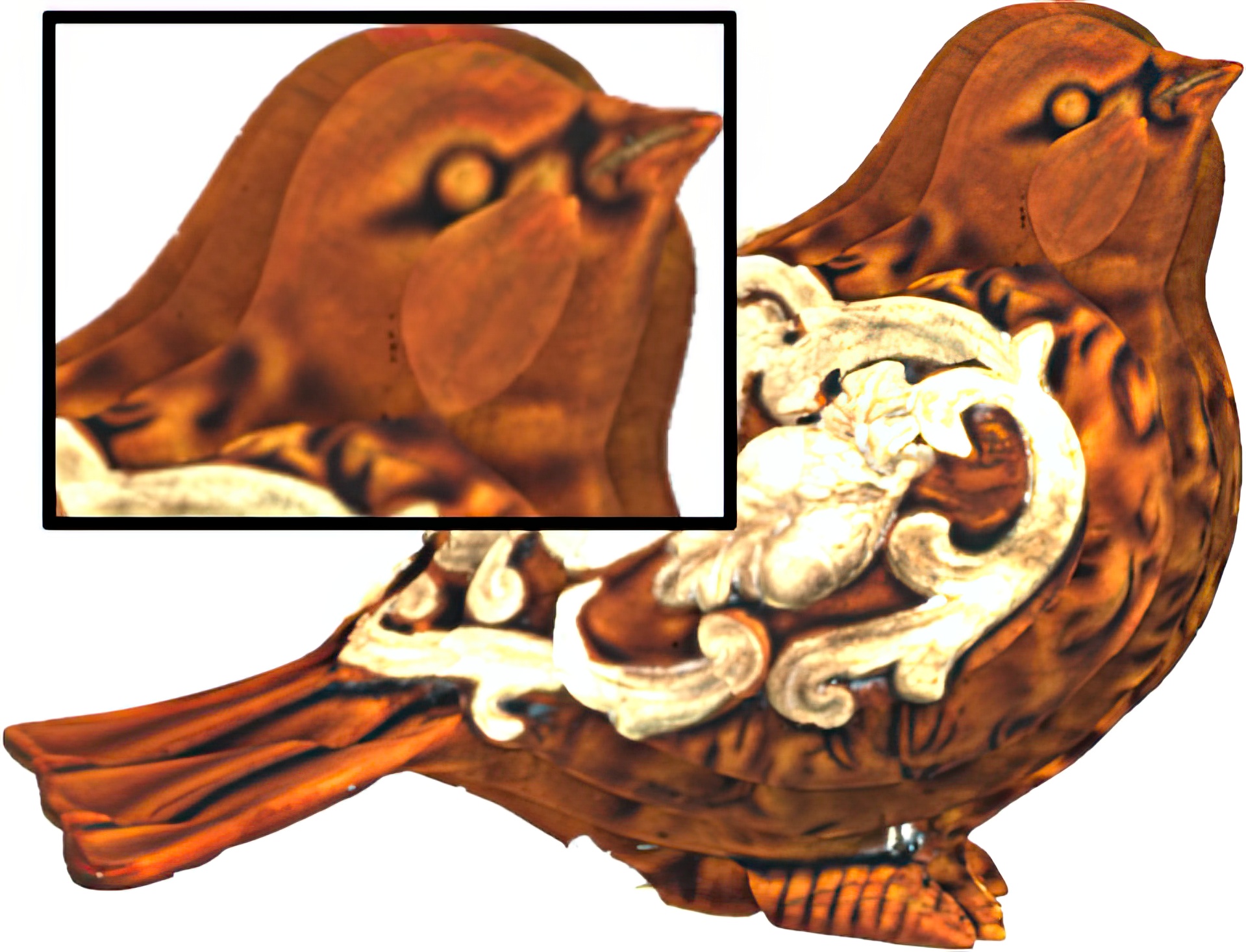
We present a method for automatically converting a digital 3D model into a multilayer model: a parallel stack of high-resolution 2D images embedded within a semi-transparent medium. Multilayer models can be produced quickly and cheaply and provide a strong sense of an object’s 3D shape and texture over a wide range of viewing directions. Our method is designed to minimize visible cracks and other artifacts that can arise when projecting an input model onto a small number of parallel planes, and avoid layer transitions that cut the model along important surface features. We demonstrate multilayer models fabricated with glass and acrylic tiles using commercially available printers.
References:
1. Akeley, K., Watt, S. J., Girshick, A. R., and Banks, M. S. 2004. A stereo display prototype with multiple focal distances. ACM Transactions on Graphics 23, 3 (Aug.), 804–813. Google ScholarDigital Library
2. Barnum, P. C., Narasimhan, S. G., and Kanade, T. 2010. A multi-layered display with water drops. ACM Transactions on Graphics 29, 4 (July), 1. Google ScholarDigital Library
3. Boykov, Y. Y., and Kolmogorov, V. 2001. An experimental comparison of min-cut/max-flow algorithms for energy minimization in vision. In EMMCVPR, 359–374. Google ScholarDigital Library
4. Decoret, X., Sillion, F., Schaufler, G., and Dorsey, J. 1999. Multi-layered impostors for accelerated rendering. Computer Graphics Forum 18, 3 (Sept.), 61–73.Google ScholarCross Ref
5. Dimitrov, D., Schreve, K., and de Beer, N. 2006. Advances in three dimensional printing state of the art and future perspectives. Rapid Prototyping Journal 12, 136–147.Google ScholarCross Ref
6. Favalora, G. 2005. Volumetric 3D displays and application infrastructure. Computer 38, 8 (Aug.), 37–44. Google ScholarDigital Library
7. Gotoda, H. 2010. A multilayer liquid crystal display for au-tostereoscopic 3D viewing. In Proc. SPIE, vol. 7524.Google Scholar
8. Holroyd, M., Lawrence, J., and Zickler, T. 2010. A coaxial optical scanner for synchronous acquisition of 3D geometry and surface reflectance. ACM Transactions on Graphics (Proceedings of SIGGRAPH 2010). Google ScholarDigital Library
9. Jones, A., McDowall, I., Yamada, H., Bolas, M., and Debevec, P. 2007. Rendering for an interactive 360 degree light field display. ACM Trans. Graph. 26 (July). Google ScholarDigital Library
10. Landis, H., 2002. Production-ready global illumination. Course 16 notes, SIGGRAPH 2002. http://www.spherevfx.co.uk/downloads/ProductionReadyGI.pdf.Google Scholar
11. Lee, C., DiVerdi, S., and Höllerer, T. 2008. Depth-fused 3D imagery on an immaterial display. IEEE transactions on visualization and 15, 1, 20–33. Google ScholarDigital Library
12. Marschner, S., and Lobb, R. 1994. An evaluation of reconstruction filters for volume rendering. Proceedings Visualization ’94, 100–107,. Google ScholarDigital Library
13. Nayar, S. K., and Narasimhan, S. G. 1999. Vision in bad weather. In Proceedings of the IEEE International Conference on Computer Vision (ICCV), 820–827. Google ScholarDigital Library
14. Reche, A., Martin, I., and Drettakis, G. 2004. Volumetric reconstruction and interactive rendering of trees from photographs. In ACM Transactions on Graphics (SIGGRAPH Conference Proceedings, 720–727. Google ScholarDigital Library
15. Schaufler, G. 1998. Image-based object representation by layered impostors. Proceedings of the ACM symposium on Virtual reality software and technology 1998 – VRST ’98, 99–104. Google ScholarDigital Library
16. Schaufler, G. 1998. Per-object image warping with layered impostors. Rendering Techniques 1, 145–156.Google ScholarCross Ref
17. Seitz, S. M., and Dyer, C. R. 1999. Photorealistic scene reconstruction by voxel coloring. Int. J. Computer Vision 35, 2, 151–173. Google ScholarDigital Library
18. Soltan, P., Trias, J., Robinson, W., and Dahlke, W. 1992. Laser Based 3-D Volumetric Display System (First Generation). SPIE-The International Society for Optical, May, 9–14.Google Scholar
19. Sullivan, A. 2004. DepthCube solid-state 3D volumetric display. In Stereoscopic Displays and Virtual Reality Systems XI, SPIE, San Jose, CA, USA, A. J. Woods, J. O. Merritt, S. A. Benton, and M. T. Bolas, Eds., vol. 5291, 279–284.Google Scholar
20. Tamura, S., and Tanaka, K. 1982. Multilayer 3-d display by multidirectional beam splitter. Applied Optics 21, 3659–3663.Google ScholarCross Ref
21. Tan, P., Zeng, G., Wang, J., Kang, S. B., and Quan, L. 2007. Image-based tree modeling. ACM Transactions on Graphics (Proceedings of SIGGRAPH 2007) 27. Google ScholarDigital Library
22. Troitski, I. 2005. Laser-induced image technology (yesterday, today, and tomorrow). In Society of Photo-Optical Instrumentation Engineers (SPIE) Conference Series, vol. 5664, 293–301.Google ScholarCross Ref
23. Wetzstein, G., Lanman, D., Heidrich, W., and Raskar, R. 2011. Layered 3D: Tomographic image synthesis for attenuation-based light field and high dynamic range displays. ACM Trans. Graph. 30, 4. Google ScholarDigital Library
24. Wood, R. 2003. Laser-induced damage of optical materials. Taylor & Francis.Google Scholar



