“Computer-generated residential building layouts”
Conference:
Type(s):
Title:
- Computer-generated residential building layouts
Session/Category Title:
- 3D modeling
Presenter(s)/Author(s):
Moderator(s):
Abstract:
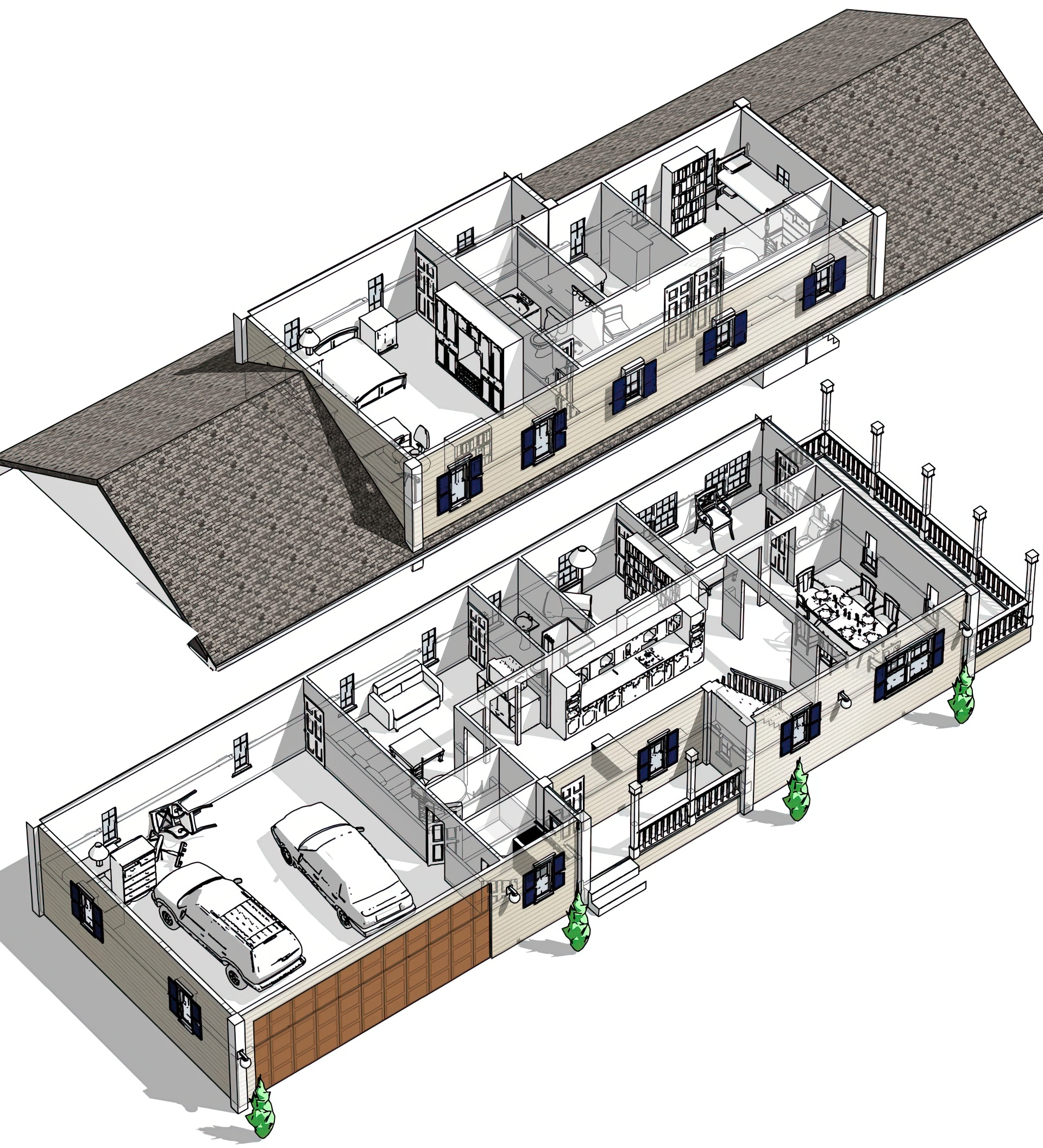
We present a method for automated generation of building layouts for computer graphics applications. Our approach is motivated by the layout design process developed in architecture. Given a set of high-level requirements, an architectural program is synthesized using a Bayesian network trained on real-world data. The architectural program is realized in a set of floor plans, obtained through stochastic optimization. The floor plans are used to construct a complete three-dimensional building with internal structure. We demonstrate a variety of computer-generated buildings produced by the presented approach.
References:
1. Aichholzer, O., Aurenhammer, F., Alberts, D., and Gärtner, B. 1995. A novel type of skeleton for polygons. Journal of Universal Computer Science 1, 12, 752–761.Google Scholar
2. Alexander, C., Ishikawa, S., and Silverstein, M. 1977. A Pattern Language: Towns, Buildings, Construction. Oxford University Press.Google Scholar
3. Arvin, S. A., and House, D. H. 2002. Modeling architectural design objectives in physically based space planning. Automation in Construction 11, 2, 213–225.Google ScholarCross Ref
4. Boyd, S., and Vandenberghe, L. 2004. Convex Optimization. Cambridge University Press. Google ScholarDigital Library
5. Chen, X., Kang, S. B., Xu, Y.-Q., Dorsey, J., and Shum, H.-Y. 2008. Sketching reality: realistic interpretation of architectural designs. ACM Transactions on Graphics 27, 2. Google ScholarDigital Library
6. Eruhimov, V., Murphy, K., and Bradski, G., 2003. Intel’s open-source probabilistic networks library.Google Scholar
7. Galle, P. 1981. An algorithm for exhaustive generation of building floor plans. Commununications of the ACM 24, 12, 813–825. Google ScholarDigital Library
8. Geman, S., and Geman, D. 1984. Stochastic relaxation, Gibbs distribution, and the Bayesian restoration of images. IEEE Transactions on Pattern Analysis and Machine Intelligence 6, 721–741.Google ScholarDigital Library
9. Germer, T., and Schwarz, M. 2009. Procedural arrangement of furniture for real-time walkthroughs. Computer Graphics Forum 28, 8, 2068–2078.Google ScholarCross Ref
10. Green, P. J. 1995. Reversible jump Markov chain Monte Carlo computation and Bayesian model determination. Biometrika 82, 711–732.Google ScholarCross Ref
11. Hahn, E., Bose, P., and Whitehead, A. 2006. Persistent real-time building interior generation. In Sandbox ’06: Proceedings of the 2006 ACM SIGGRAPH symposium on Videogames, ACM. Google ScholarDigital Library
12. Harada, M., Witkin, A., and Baraff, D. 1995. Interactive physically-based manipulation of discrete/continuous models. In Proc. SIGGRAPH, ACM. Google ScholarDigital Library
13. Heckerman, D. 1999. A tutorial on learning with Bayesian networks. In Learning in Graphical Models, M. I. Jordan, Ed. MIT Press. Google ScholarDigital Library
14. Hillier, B., and Hanson, J. 1989. The Social Logic of Space. Cambridge University Press.Google Scholar
15. Jacobson, M., Silverstein, M., and Winslow, B. 2005. Patterns of Home. The Taunton Press.Google Scholar
16. Kalay, Y. E. 2004. Architecture’s New Media: Principles, Theories, and Methods of Computer-Aided Design. MIT Press. Google ScholarDigital Library
17. Koller, D., and Friedman, N. 2009. Probabilistic Graphical Models: Principles and Techniques. MIT Press. Google ScholarDigital Library
18. Lai, T.-T., and Leinwand, S. M. 1988. Algorithms for floor-plan design via rectangular dualization. IEEE Transactions on Computer-Aided Design 7, 12, 1278–1289.Google ScholarDigital Library
19. Lauritzen, S. L., and Spiegelhalter, D. J. 1988. Local computations with probabilities on graphical structures and their application to expert systems. Journal of the Royal Statistical Society, Series B 50, 2, 157–224.Google Scholar
20. Lefebvre, S., Hornus, S., and Lasram, A. 2010. By-example synthesis of architectural textures. ACM Transactions on Graphics 29, 4. Google ScholarDigital Library
21. Legakis, J., Dorsey, J., and Gortler, S. 2001. Feature-based cellular texturing for architectural models. In Proc. SIGGRAPH, ACM. Google ScholarDigital Library
22. Liggett, R. S. 2000. Automated facilities layout: past, present and future. Automation in Construction 9, 197–215.Google ScholarCross Ref
23. March, L., and Steadman, P. 1971. Spatial allocation procedures. In The Geometry of Environment. MIT Press, ch. 13, 303–317.Google Scholar
24. Martin, J., 2005. Algorithmic beauty of buildings methods for procedural building generation. Computer Science Honors Thesis, Trinity University.Google Scholar
25. Martin, J. 2006. Procedural house generation: a method for dynamically generating floor plans. In Poster session, Symposium on Interactive 3D Graphics and Games.Google Scholar
26. Michalek, J. J., Choudhary, R., and Papalambros, P. Y. 2002. Architectural layout design optimization. Engineering Optimization 34, 5, 461–484.Google ScholarCross Ref
27. Mitchell, W. J. 1990. The Logic of Architecture: Design, Computation, and Cognition. MIT Press. Google ScholarDigital Library
28. Müller, P., Wonka, P., Haegler, S., Ulmer, A., and Van Gool, L. 2006. Procedural modeling of buildings. In Proc. SIGGRAPH, ACM. Google ScholarDigital Library
29. Müller, P., Zeng, G., Wonka, P., and Van Gool, L. 2007. Image-based procedural modeling of facades. In Proc. SIGGRAPH, ACM. Google ScholarDigital Library
30. Niederauer, C., Houston, M., Agrawala, M., and Humphreys, G. 2003. Non-invasive interactive visualization of dynamic architectural environments. In Proc. Symposium on Interactive 3D graphics, ACM, 55–58. Google ScholarDigital Library
31. Pottmann, H., Liu, Y., Wallner, J., Bobenko, A., and Wang, W. 2007. Geometry of multi-layer freeform structures for architecture. In Proc. SIGGRAPH, ACM. Google ScholarDigital Library
32. Pottmann, H., Schiftner, A., Bo, P., Schmiedhofer, H., Wang, W., Baldassini, N., and Wallner, J. 2008. Freeform surfaces from single curved panels. In Proc. SIGGRAPH, ACM. Google ScholarDigital Library
33. Press, W. H., Flannery, B. P., Teukolsky, S. A., and Vetterling, W. T. 2007. Numerical recipes: the art of scientific computing, 3rd ed. Cambridge University Press.Google Scholar
34. Sarrafzadeh, M., and Lee, D. T. 1993. Algorithmic Aspects of VLSI Layout. World Scientific. Google ScholarDigital Library
35. Schwarz, A., Berry, D. M., and Shaviv, E. 1994. Representing and solving the automated building design problem. Computer-Aided Design 26, 9, 689–698.Google ScholarCross Ref
36. Séquin, C. H., and Kalay, Y. E. 1998. A suite of prototype CAD tools to support early phases of architectural design. Automation in Construction 7, 449–464.Google ScholarCross Ref
37. Shaviv, E., and Gali, D. 1974. A model for space allocation in complex buildings. Build International 7, 6, 493–518.Google Scholar
38. Shaviv, E. 1987. Generative and evaluative CAAD tools for spatial allocation problems. In Computability of Design, Y. E. Kalay, Ed. John Wiley & Sons, ch. 10, 191–212. Google ScholarDigital Library
39. Stiny, G. 2006. Shape: Talking about Seeing and Doing. MIT Press. Google ScholarDigital Library
40. Susanka, S. 2001. The Not So Big House: A Blueprint for the Way We Really Live. The Taunton Press.Google Scholar
41. The American Institute of Architects. 2007. Architectural Graphic Standards, 11th ed. John Wiley & Sons, Inc.Google Scholar
42. Wampler, K., and Popović, Z. 2009. Optimal gait and form for animal locomotion. In Proc. SIGGRAPH, ACM. Google ScholarDigital Library
43. Wertheimer, L. 2009. Schematic Design. Kaplan Architecture Education.Google Scholar
44. White, S. R. 1984. Concepts of scale in simulated annealing. AIP Conference Proceedings 122, 1, 261–270.Google ScholarCross Ref
45. Whiting, E., Ochsendorf, J., and Durand, F. 2009. Procedural modeling of structurally-sound masonry buildings. In Proc. SIGGRAPH Asia, ACM. Google ScholarDigital Library
46. Wood, H. 2007. Essential House Plan Collection: 1500 Best Selling Home Plans. Home Planners.Google Scholar
47. Yin, X., Wonka, P., and Razdan, A. 2009. Generating 3d building models from architectural drawings: a survey. IEEE Computer Graphics and Applications 29, 1, 20–30. Google ScholarDigital Library