
“Computational highlight holography”
Conference:
Type(s):
Title:
- Computational highlight holography
Session/Category Title:
- Computational imagery
Presenter(s)/Author(s):
Moderator(s):
Abstract:
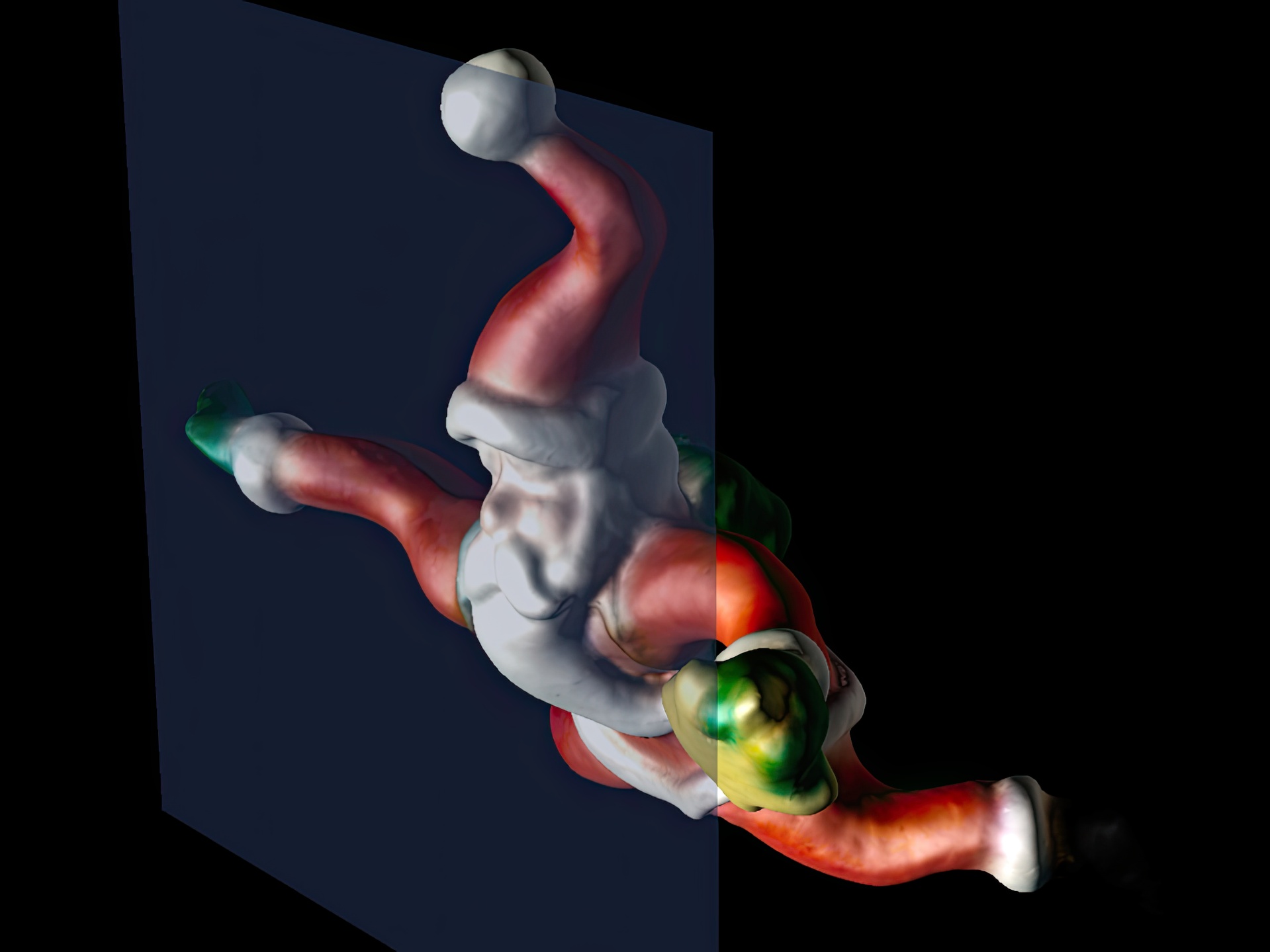
Computational highlight holography converts three-dimensional computer models into mechanical “holograms” fabricated on (specular) reflective or refractive materials. The surface consists of small grooves with patches of paraboloids or hyperboloids, each of which produces a highlight when illuminated by a directional light. Each highlight appears in different places for different view directions, with the correct binocular and motion parallax corresponding to a virtual 3D point position. Our computational pipeline begins with a 3D model and desired view position, samples the model to generate points that depict its features accurately, and computes a maximal set of non-overlapping patches to be embedded in the surface. We provide a preview of the hologram for the user, then fabricate the surface using a computer-controlled engraving machine. We show a variety of different fabricated holograms: reflective, transmissive, and holograms with color and proper shading. We also present extensions to stationary and animated 2D stippled images.
References:
1. Abramson, N. H. 2000. Incoherent Holography. Proc. SPIE (Holography 2000), Vol. 4149, No. 1 (Oct.), 153–164.Google Scholar
2. Beaty, W. J., 1995. Hand-Drawn Holograms. http://amasci.com/amateur/holo1.html.Google Scholar
3. Beaty, W. J. 2003. Drawing Holograms by Hand. Proc. SPIE (Practical Holography XVII and Holographic Materials IX), Vol. 5005, No. 1, 156–167.Google ScholarCross Ref
4. Benton, S. A. 1969. Hologram Reconstruction with Extended Light Sources. Journal of Optical Society of America, Vol. 59 (Oct.), 1545–1546.Google Scholar
5. Cole, F., Golovinskiy, A., Limpaecher, A., Barros, H. S., Finkelstein, A., Funkhouser, T., and Rusinkiewicz, S. 2008. Where Do People Draw Lines? ACM Trans. Graph. (Proc. SIGGRAPH), Vol. 27, No. 3 (Aug.), 88:1–88:11. Google ScholarDigital Library
6. Cole, F., Sanik, K., DeCarlo, D., Finkelstein, A., Funkhouser, T., Rusinkiewicz, S., and Singh, M. 2009. How Well Do Line Drawings Depict Shape? ACM Trans. Graph. (Proc. SIGGRAPH), Vol. 28, No. 3 (Aug.), 28:1–28:9. Google ScholarDigital Library
7. DeCarlo, D., and Rusinkiewicz, S. 2007. Highlight Lines for Conveying Shape. In Proc. NPAR, 63–70. Google ScholarDigital Library
8. DeCarlo, D., Finkelstein, A., Rusinkiewicz, S., and Santella, A. 2003. Suggestive Contours for Conveying Shape. ACM Trans. Graph. (Proc. SIGGRAPH), Vol. 22, No. 3, 848–855. Google ScholarDigital Library
9. Denisyuk, Y. 1962. Photographic Reconstruction of the Optical Properties of an Object in Its Own Scattered Radiation Field. Sov. Phys. Docl, Vol. 7, 543–545.Google Scholar
10. Eichler, J., Dünkel, L., and Gonçalves, O. 2003. Three-Dimensional Image Construction by Curved Surface Scratches. Applied Optics, Vol. 42, 5627–5633.Google ScholarCross Ref
11. Fuchs, M., Raskar, R., Seidel, H.-P., and Lensch, H. P. A. 2008. Towards Passive 6D Reflectance Field Displays. ACM Trans. Graph. (Proc. SIGGRAPH), Vol. 27, No. 3 (Aug.), 58:1–58:8. Google ScholarDigital Library
12. Gabor, D. 1948. A New Microscopic Principle. Nature, Vol. 161 (May), 777–779.Google ScholarCross Ref
13. Garfield, E. 1981. ISI’s ‘World Brain’ by Gabriel Liebermann: The World’s First Holographic Engraving. Essays of an Information Scientist, Vol. 5, 348–354.Google Scholar
14. Hertzmann, A., and Zorin, D. 2000. Illustrating Smooth Surfaces. In Proc. SIGGRAPH, 517–526. Google ScholarDigital Library
15. Ives, F., 1903. Parallax Stereogram and Process for Making Same. U.S. Patent No. 725,567.Google Scholar
16. Ives, F. 1928. A Camera for Making Parallax Panoramagrams. Journal of the Optical Society of America, Vol. 17 (Dec.), 435–439.Google ScholarCross Ref
17. Jones, A., McDowall, I., Yamada, H., Bolas, M., and Debevec, P. 2007. Rendering for an Interactive 360° Light Field Display. ACM Trans. Graph. (Proc. SIGGRAPH), Vol. 26, No. 3 (July), 40:1–40:10. Google ScholarDigital Library
18. Judd, T., Durand, F., and Adelson, E. 2007. Apparent Ridges for Line Drawing. ACM Trans. Graph. (Proc. SIGGRAPH), Vol. 26, No. 3, 19:1–19:8. Google ScholarDigital Library
19. Lee, Y., Markosian, L., Lee, S., and Hughes, J. F. 2007. Line Drawings via Abstracted Shading. ACM Trans. Graph. (Proc. SIGGRAPH), Vol. 26, No. 3, 18:1–18:8. Google ScholarDigital Library
20. Leith, E., and Upatnieks, J. 1962. Reconstructed Wavefronts and Communication Theory. Journal of the Optical Society of America, Vol. 52, No. 10 (Oct.), 1123–1130.Google ScholarCross Ref
21. Lippmann, G. 1908. Epreuves Reversibles Donnant la Sensation du Relief. Journal of Physics, Vol. 7, No. 4 (Nov.), 821–825.Google Scholar
22. Matusik, W., and Pfister, H. 2004. 3D TV: A Scalable System for Real-Time Acquisition, Transmission, and Autostereoscopic Display of Dynamic Scenes. ACM Trans. Graph. (Proc. SIGGRAPH), Vol. 23, No. 3 (Aug.), 814–824. Google ScholarDigital Library
23. Ohtake, Y., Belyaev, A., and Seidel, H.-P. 2004. Ridge-Valley Lines on Meshes via Implicit Surface Fitting. ACM Trans. Graph. (Proc. SIGGRAPH), Vol. 23, No. 3 (Aug.), 609–612. Google ScholarDigital Library
24. Okoshi, T. 1976. Three-Dimensional Imaging Techniques. Academic Press, New York.Google Scholar
25. Patow, G., and Pueyo, X. 2005. A Survey of Inverse Surface Design from Light Transport Behavior Specification. Computer Graphics Forum, Vol. 24, No. 4 (Dec.), 773–790.Google ScholarCross Ref
26. Patow, G., Pueyo, X., and Vinacua, A. 2007. User-Guided Inverse Reflector Design. Computers & Graphics, Vol. 31, No. 3 (June), 501–515. Google ScholarDigital Library
27. Perlin, K., Paxia, S., and Kollin, J. S. 2000. An Autostereoscopic Display. In Proc. SIGGRAPH, 319–326. Google ScholarDigital Library
28. Plummer, W. T., and Gardner, L. R. 1992. A Mechanically Generated Hologram. Applied Optics, Vol. 31, 6585–6588.Google ScholarCross Ref
29. Saito, T., and Takahashi, T. 1990. Comprehensible Rendering of 3-D Shapes. In Proc. SIGGRAPH, 197–206. Google ScholarDigital Library
30. Secord, A. 2002. Weighted Voronoi Stippling. In Proc. NPAR, 37–43. Google ScholarDigital Library
31. Vlasic, D., Baran, I., Matusik, W., and Popović, J. 2008. Articulated Mesh Animation from Multi-view Silhouettes. ACM Trans. Graph. (Proc. SIGGRAPH), Vol. 27, No. 3 (Aug.), 97:1–97:10. Google ScholarDigital Library
32. Weyrich, T., Peers, P., Matusik, W., and Rusinkiewicz, S. 2009. Fabricating Microgeometry for Custom Surface Reflectance. ACM Trans. Graph. (Proc. SIGGRAPH), Vol. 28, No. 3 (July), 32:1–32:6. Google ScholarDigital Library



