“Weatherscapes: nowcasting heat transfer and water continuity” by Herrera, Hädrich, Pałubicki, Banuti, Pirk, et al. …
Conference:
Type(s):
Title:
- Weatherscapes: nowcasting heat transfer and water continuity
Session/Category Title:
- Physically-based Simulation and Motion Control
Presenter(s)/Author(s):
Abstract:
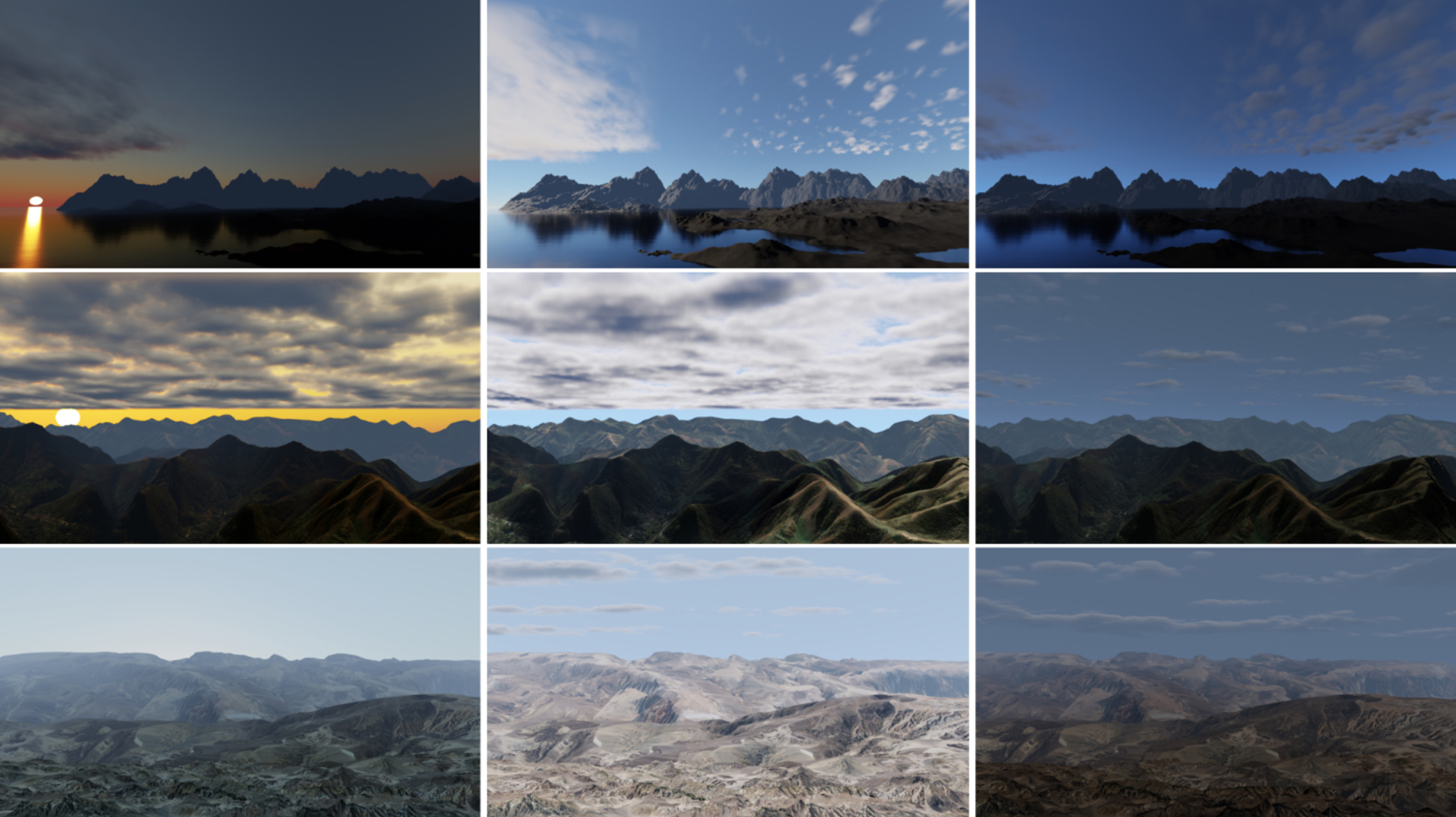
Due to the complex interplay of various meteorological phenomena, simulating weather is a challenging and open research problem. In this contribution, we propose a novel physics-based model that enables simulating weather at interactive rates. By considering atmosphere and pedosphere we can define the hydrologic cycle – and consequently weather – in unprecedented detail. Specifically, our model captures different warm and cold clouds, such as mammatus, hole-punch, multi-layer, and cumulonimbus clouds as well as their dynamic transitions. We also model different precipitation types, such as rain, snow, and graupel by introducing a comprehensive microphysics scheme. The Wegener-Bergeron-Findeisen process is incorporated into our Kessler-type microphysics formulation covering ice crystal growth occurring in mixed-phase clouds. Moreover, we model the water run-off from the ground surface, the infiltration into the soil, and its subsequent evaporation back to the atmosphere. We account for daily temperature changes, as well as heat transfer between pedosphere and atmosphere leading to a complex feedback loop. Our framework enables us to interactively explore various complex weather phenomena. Our results are assessed visually and validated by simulating weatherscapes for various setups covering different precipitation events and environments, by showcasing the hydrologic cycle, and by reproducing common effects such as Foehn winds. We also provide quantitative evaluations creating high-precipitation cumulonimbus clouds by prescribing atmospheric conditions based on infrared satellite observations. With our model we can generate dynamic 3D scenes of weatherscapes with high visual fidelity and even nowcast real weather conditions as simulations by streaming weather data into our framework.
References:
1. C. D. Ahrens. 2014. Essentials of meteorology: an invitation to the atmosphere. Cengage Learning.
2. C. D. Ahrens and R. Henson. 2021. Meteorology today: an introduction to weather, climate, and the environment. Cengage learning.
3. O. A. Alduchov and R. E. Eskridge. 1996. Improved Magnus form approximation of saturation vapor pressure. Journal of Applied Meteorology and Climatology 35, 4 (1996), 601–609.
4. J. D. Anderson. 2003. Modern compressible flow. Tata McGraw-Hill Education. Standard Atmosphere. 1975. International organization for standardization. ISO 2533 (1975), 1975.
5. A. H. Auer. 1972. Distribution of graupel and hail with size. Monthly Weather Review 100, 5 (1972), 325–328.
6. R. G. Barry. 1977. International Cloud Atlas, Volume I: Manual on the Observation of Clouds and Other Meteors.
7. A. M. Blyth, L. J. Bennett, and C. G. Collier. 2015. High-resolution observations of precipitation from cumulonimbus clouds. Meteorological applications 22, 1 (2015), 75–89.
8. A. Bouthors and F. Neyret. 2004. Modeling clouds shape. In Eurographics 2004 – Short Presentations, M. Alexa and E. Galin (Eds.). Eurographics Association.
9. R. Bridson. 2015. Fluid Simulation for Computer Graphics. CRC Press.
10. R. Bridson and M. Müller-Fischer. 2007. Fluid simulation: SIGGRAPH 2007 Course Notes. (08 2007), 1–81.
11. W. Brutsaert. 2014. Daily evaporation from drying soil: Universal parameterization with similarity. Water Resources Research 50, 4 (2014), 3206–3215.
12. A. Chern, F. Knöppel, U. Pinkall, P. Schröder, and S. Weißmann. 2016. SchröDinger’s Smoke. ACM Trans. Graph. 35, 4, Article 77 (July 2016), 13 pages.
13. W. R. Cotton. 1972. Numerical simulation of precipitation development in supercooled cumuli—Part II. Monthly Weather Review 100, 11 (1972), 764–784.
14. F. Da, D. Hahn, C. Batty, C. Wojtan, and E. Grinspun. 2016. Surface-Only Liquids. ACM Trans. on Graphics (SIGGRAPH 2016) (2016).
15. Y. Dobashi, K. Kusumoto, T. Nishita, and T. Yamamoto. 2008. Feedback Control of Cumuliform Cloud Formation Based on Computational Fluid Dynamics. In ACM SIGGRAPH 2008 Papers (Los Angeles, California) (SIGGRAPH ’08). Association for Computing Machinery, Article 94, 8 pages.
16. J. Dudhia. 1989. Numerical study of convection observed during the winter monsoon experiment using a mesoscale two-dimensional model. Journal of Atmospheric Sciences 46, 20 (1989), 3077–3107.
17. A. Voldoire et al. 2013a. The CNRM-CM5. 1 global climate model: description and basic evaluation. Climate dynamics 40, 9 (2013), 2091–2121.
18. B. Stevens et al. 2013b. Atmospheric component of the MPI-M Earth system model: ECHAM6. Journal of Advances in Modeling Earth Systems 5, 2 (2013), 146–172.
19. F. Hourdin et al. 2013c. LMDZ5B: the atmospheric component of the IPSL climate model with revisited parameterizations for clouds and convection. Climate Dynamics 40, 9-10 (2013), 2193–2222.
20. J. H. Van Boxel et al. 1997. Numerical model for the fall speed of rain drops in a rain fall simulator. In Workshop on wind and water erosion. 77–85.
21. R. L. Miller et al. 2006. Mineral dust aerosols in the NASA Goddard Institute for Space Sciences ModelE atmospheric general circulation model. Journal of Geophysical Research: Atmospheres 111, D6 (2006).
22. S. Watanabe et al. 2011. MIROC-ESM 2010: Model description and basic results of CMIP5-20c3m experiments. Geoscientific Model Development 4, 4 (2011), 845–872.
23. C. W. Ferreira Barbosa, Y. Dobashi, and T. Yamamoto. 2015. Adaptive Cloud Simulation Using Position Based Fluids. Comput. Animat. Virtual Worlds 26, 3–4 (2015), 367–375.
24. N. H. Fletcher. 2011. The physics of rainclouds. Cambridge University Press.
25. I. Garcia-Dorado, D. G. Aliaga, S. Bhalachandran, P. Schmid, and D. Niyogi. 2017. Fast Weather Simulation for Inverse Procedural Design of 3D Urban Models. ACM Trans. Graph. 36, 2, Article 21 (2017), 19 pages.
26. G. Y. Gardner. 1985. Visual Simulation of Clouds. In Proceedings of the 12th Annual Conference on Computer Graphics and Interactive Techniques (SIGGRAPH ’85). Association for Computing Machinery, 297–304.
27. C. Gissler, A. Henne, S. Band, A. Peer, and M. Teschner. 2020. An Implicit Compressible SPH Solver for Snow Simulation. ACM Trans. Graph. 39, 4, Article 36 (July 2020), 16 pages.
28. P. Goswami and F. Neyret. 2017. Real-Time Landscape-Size Convective Clouds Simulation and Rendering. In Proceedings of the 13th Workshop on Virtual Reality Interactions and Physical Simulations (Lyon, France) (VRIPHYS ’17). Eurographics Association, 1–8.
29. E. J. Griffith, F. H. Post, T. Heus, and H. J. J. Jonker. 2009. Interactive simulation and visualisation of atmospheric large-eddy simulations. Technical Report. Technical Report 2 TuDelft Data Visualization Group.
30. D. G. Groenendyk, T. P. A. Ferré, K. R. Thorp, and A. K. Rice. 2015. Hydrologic-process-based soil texture classifications for improved visualization of landscape function. PloS one 10, 6 (2015), e0131299.
31. K. L. S. Gunn and J. S. Marshall. 1958. The distribution with size of aggregate snowflakes. Journal of Atmospheric Sciences 15, 5 (1958), 452–461.
32. T. Hädrich, D. T. Banuti, W. Pałubicki, S. Pirk, and D. L. Michels. 2021. Fire in Paradise: Mesoscale Simulation of Wildfires. ACM Transaction on Graphics 40, 4, Article 163 (08 2021).
33. T. Hädrich, M. Makowski, W. Pałubicki, D. T. Banuti, S. Pirk, and D. L. Michels. 2020. Stormscapes: Simulating Cloud Dynamics in the Now. ACM Transaction on Graphics 39, 6, Article 175 (12 2020).
34. M. J. Harris, W. V. Baxter, T. Scheuermann, and A. Lastra. 2003. Simulation of Cloud Dynamics on Graphics Hardware. In ACM SIGGRAPH/EUROGRAPHICS Conference on Graphics Hardware (San Diego, California) (HWWS ’03). Eurographics Association, 92–101.
35. S.-Y. Hong, J. Dudhia, and S.-H. Chen. 2004. A revised approach to ice microphysical processes for the bulk parameterization of clouds and precipitation. Monthly weather review 132, 1 (2004), 103–120.
36. R. E. Horton. 1941. An approach toward a physical interpretation of infiltration-capacity. Soil science society of America journal 5, C (1941), 399–417.
37. R. A. Houze. 2014. Cloud Dynamics. Elsevier.
38. E.-Y. Hsie, R. D. Farley, and H. D. Orville. 1980. Numerical simulation of ice-phase convective cloud seeding. Journal of Applied Meteorology and Climatology 19, 8 (1980), 950–977.
39. L. Huang, T. Hädrich, and D. L. Michels. 2019. On the Accurate Large-Scale Simulation of Ferrofluids. ACM Trans. Graph. 38, 4, Article 93 (July 2019), 15 pages.
40. L. Huang and D. L. Michels. 2020. Surface-Only Ferrofluids. ACM Trans. Graph. 39, 6, Article 174 (Nov. 2020), 17 pages.
41. G. Itseez. 2015. Open source computer vision library.
42. W. A. Jury and R. Horton. 2004. Soil physics. John Wiley & Sons.
43. J. T. Kajiya and B. P. Von Herzen. 1984. Ray Tracing Volume Densities. SIGGRAPH Comput. Graph. 18, 3 (1984), 165–174.
44. K. M. Kanak and J. M. Straka. 2006. An idealized numerical simulation of mammatus-like clouds. Atmospheric Science Letters 7, 1 (2006), 2–8.
45. B. Kärcher and U. Burkhardt. 2008. A cirrus cloud scheme for general circulation models. Quarterly Journal of the Royal Meteorological Society 134, 635 (2008), 1439–1461.
46. E. Kessler. 1995. On the continuity and distribution of water substance in atmospheric circulations. Atmospheric Research 38, 1 (1995), 109–145.
47. B. Kim, V. C. Azevedo, M. Gross, and B. Solenthaler. 2020. Lagrangian Neural Style Transfer for Fluids. ACM Transaction on Graphics (SIGGRAPH) (2020).
48. T. Kim and M. C. Lin. 2003. Visual simulation of ice crystal growth. In Proceedings of the 2003 ACM SIGGRAPH/Eurographics symposium on Computer animation. Citeseer, 86–97.
49. D. Koschier, J. Bender, B. Solenthaler, and M. Teschner. 2019. Smoothed Particle Hydrodynamics Techniques for the Physics Based Simulation of Fluids and Solids. In Eurographics 2019 – Tutorials, W. Jakob and E. Puppo (Eds.). The Eurographics Association.
50. P. K. Kundu, I. M. Cohen, and D. R. Dowling. 2012. Fluid mechanics, 5th version. Academic, Berlin (2012).
51. R. Lal and M. K. Shukla. 2004. Principles of soil physics. CRC Press.
52. W. C. Ley. 1894. Cloudland: A study on the structure and characters of clouds. E. Stanford.
53. Z. Li, H. W. Barker, and L. Moreau. 1995. The variable effect of clouds on atmospheric absorption of solar radiation. Nature 376, 6540 (1995), 486–490.
54. Y.-L. Lin, R. D. Farley, and H. D. Orville. 1983. Bulk parameterization of the snow field in a cloud model. Journal of Applied Meteorology and climatology 22, 6 (1983), 1065–1092.
55. J. D. Locatelli and P. V. Hobbs. 1974. Fall speeds and masses of solid precipitation particles. Journal of Geophysical Research 79, 15 (1974), 2185–2197.
56. D. Lubin, J.-P. Chen, P. Pilewskie, V. Ramanathan, and F. Valero. 1996. Microphysical examination of excess cloud absorption in the tropical atmosphere. Journal of Geophysical Research: Atmospheres 101, D12 (1996), 16961–16972.
57. M. P. Meyers, P. J. DeMott, and W. R. Cotton. 1992. New primary ice-nucleation parameterizations in an explicit cloud model. Journal of Applied Meteorology and Climatology 31, 7 (1992), 708–721.
58. R. Miyazaki, Y. Dobashi, and T. Nishita. 2002. Simulation of Cumuliform Clouds Based on Computational Fluid Dynamics. In Eurographics.
59. H. Morrison, J. A. Milbrandt, G. H. Bryan, K. Ikeda, S. A. Tessendorf, and G. Thompson. 2015. Parameterization of cloud microphysics based on the prediction of bulk ice particle properties. Part II: Case study comparisons with observations and other schemes. Journal of Atmospheric Sciences 72, 1 (2015), 312–339.
60. A. Nemes and W. J. Rawls. 2004. Soil texture and particle-size distribution as input to estimate soil hydraulic properties. Developments in soil science 30 (2004), 47–70.
61. F. Neyret. 1997. Qualitative Simulation of Convective Cloud Formation and Evolution. In Computer Animation and Simulation ’97, D. Thalmann and M. van de Panne (Eds.). Springer Vienna, Vienna, 113–124.
62. D. Overby, Z. Melek, and J. Keyser. 2002. Interactive physically-based cloud simulation. In 10th Pacific Conference on Computer Graphics and Applications, 2002. Proceedings. 469–470.
63. M. Padilla, A. Chern, F. Knöppel, U. Pinkall, and P. Schröder. 2019. On Bubble Rings and Ink Chandeliers. ACM Trans. Graph. 38, 4, Article 129 (July 2019), 14 pages.
64. K. Perlin. 1985. An image synthesizer. ACM Siggraph Computer Graphics 19, 3 (1985), 287–296.
65. M. Pharr, W. Jakob, and G. Humphreys. 2016. Physically based rendering: From theory to implementation. Morgan Kaufmann.
66. S. Pirk, T. Jarząbek, M.and Hädrich, D. L. Michels, and W. Palubicki. 2017. Interactive Wood Combustion for Botanical Tree Models. ACM Trans. Graph. 36, 6, Article 197 (Nov. 2017), 12 pages.
67. S. Pirk, T. Niese, T. Hädrich, B. Benes, and O. Deussen. 2014. Windy Trees: Computing Stress Response for Developmental Tree Models. ACM Trans. Graph. 33, 6, Article 204 (Nov. 2014), 11 pages.
68. F. Pithan, B. Medeiros, and T. Mauritsen. 2014. Mixed-phase clouds cause climate model biases in Arctic wintertime temperature inversions. Climate dynamics 43, 1-2 (2014), 289–303.
69. H. R. Pruppacher and J. D. Klett. 2012. Microphysics of Clouds and Precipitation: Reprinted 1980. Springer Science & Business Media.
70. R. M. Rasmussen and A. J. Heymsfield. 1987. Melting and shedding of graupel and hail. Part I: Model physics. Journal of Atmospheric Sciences 44, 19 (1987), 2754–2763.
71. S. Ravichandran, E. Meiburg, and R. Govindarajan. 2020. Mammatus cloud formation by settling and evaporation. Journal of Fluid Mechanics 899 (2020), A27.
72. T. Reed and B. Wyvill. 1994. Visual Simulation of Lightning. In Proceedings of the 21st Annual Conference on Computer Graphics and Interactive Techniques (SIGGRAPH ’94). Association for Computing Machinery, New York, NY, USA, 359–364.
73. B. Ren, J. Huang, M. C. Lin, and S.-M. Hu. 2018. Controllable dendritic crystal simulation using orientation field. In Computer Graphics Forum, Vol. 37. Wiley Online Library, 485–495.
74. H. Richner and P. Hächler. 2013. Understanding and forecasting Alpine foehn. In Mountain Weather Research and Forecasting. Springer, 219–260.
75. P. J. Ross and J.-Y. Parlange. 1994. Comparing exact and numerical solutions of Richard’s equation for one-dimensional infiltration and drainage. Soil science 157, 6 (1994), 341–344.
76. L. D. Rotstayn. 1997. A physically based scheme for the treatment of stratiform clouds and precipitation in large-scale models. I: Description and evaluation of the micro-physical processes. Quarterly Journal of the Royal Meteorological Society 123, 541 (1997), 1227–1282.
77. L. D. Rotstayn, B. F. Ryan, and J. J. Katzfey. 2000. A scheme for calculation of the liquid fraction in mixed-phase stratiform clouds in large-scale models. Monthly weather review 128, 4 (2000), 1070–1088.
78. S. A. Rutledge and P. Hobbs. 1983. The mesoscale and microscale structure and organization of clouds and precipitation in midlatitude cyclones. VIII: A model for the “seeder-feeder” process in warm-frontal rainbands. Journal of Atmospheric Sciences 40, 5 (1983), 1185–1206.
79. S. A. Rutledge and P. V. Hobbs. 1984. The mesoscale and microscale structure and organization of clouds and precipitation in midlatitude cyclones. XII: A diagnostic modeling study of precipitation development in narrow cold-frontal rainbands. Journal of Atmospheric Sciences 41, 20 (1984), 2949–2972.
80. J. Schalkwijk, H. J. J. Jonker, A. P. Siebesma, and E. Van Meijgaard. 2015. Weather forecasting using GPU-based large-eddy simulations. Bulletin of the American Meteorological Society 96, 5 (2015), 715–723.
81. P. Schultz. 1995. An explicit cloud physics parameterization for operational numerical weather prediction. Monthly weather review 123, 11 (1995), 3331–3343.
82. M. A. Shirazi, L. Boersma, and J. W. Hart. 1988. A unifying quantitative analysis of soil texture: improvement of precision and extension of scale. Soil Science Society of America Journal 52, 1 (1988), 181–190.
83. H.-J. Song and B.-J. Sohn. 2018. An evaluation of WRF microphysics schemes for simulating the warm-type heavy rain over the Korean peninsula. Asia-Pacific Journal of Atmospheric Sciences 54, 2 (2018), 225–236.
84. R. C. Srivastava. 1967. A study of the effect of precipitation on cumulus dynamics. Journal of Atmospheric Sciences 24, 1 (1967), 36–45.
85. R. C. Srivastava. 1971. Size distribution of raindrops generated by their breakup and coalescence. Journal of Atmospheric Sciences 28, 3 (1971), 410–415.
86. J. Stam. 1999. Stable Fluids. Proc. of ACM SIGGRAPH (1999), 121–128.
87. J. Steinhoff and D. Underhill. 1994. Modification of the Euler equations for “vorticity confinement”: Application to the computation of interacting vortex rings. Physics of Fluids 6, 8 (1994), 2738–2744.
88. T. Stocker. 2011. Introduction to Climate Modeling. Springer-Verlag Berlin Heidelberg.
89. A. Stomakhin, C. Schroeder, C. Jiang, L. Chai, J. Teran, and A. Selle. 2014. Augmented MPM for phase-change and varied materials. ACM Transactions on Graphics (TOG) 33, 4 (2014), 1–11.
90. J. M. Straka. 2009. Cloud and precipitation microphysics: principles and parameterizations. Cambridge University Press.
91. S. Trömel, A. V. Ryzhkov, M. Diederich, K. Mühlbauer, S. Kneifel, J. Snyder, and C. Simmer. 2017. Multisensor characterization of mammatus. Monthly Weather Review 145, 1 (2017), 235–251.
92. K. Um, X. Hu, and N. Thürey. 2018. Liquid Splash Modeling with Neural Networks. CGF 37, 8 (2018), 171–182.
93. B. Ummenhofer, L. Prantl, N. Thürey, and V. Koltun. 2020. Lagrangian Fluid Simulation with Continuous Convolutions. In ICLR.
94. U. Vimont, J. Gain, M. Lastic, G. Cordonnier, B. Abiodun, and M.-C. Cani. 2020. Interactive Meso-scale Simulation of Skyscapes. Eurographics (2020).
95. E. M. Volodin, N. A. Dianskii, and A. V. Gusev. 2010. Simulating present-day climate with the INMCM4. 0 coupled model of the atmospheric and oceanic general circulations. Izvestiya, Atmospheric and Oceanic Physics 46, 4 (2010), 414–431.
96. A. Webanck, Y. Cortial, E. Guérin, and E. Galin. 2018. Procedural cloudscapes. In Computer Graphics Forum, Vol. 37. Wiley Online Library, 431–442.
97. T. Wu, R. Yu, F. Zhang, Z. Wang, M. Dong, L. Wang, X. Jin, D. Chen, and L. Li. 2010. The Beijing Climate Center atmospheric general circulation model: description and its performance for the present-day climate. Climate dynamics 34, 1 (2010), 123.
98. Y. Xie, E. Franz, M. Chu, and N. Thürey. 2018. TempoGAN: A Temporally Coherent, Volumetric GAN for Super-Resolution Fluid Flow. ACM Trans. Graph. 37, 4, Article 95 (2018), 15 pages.
99. T. Xue, H. Su, C. Han, C. Jiang, and M. Aanjaneya. 2020. A novel discretization and numerical solver for non-fourier diffusion. ACM Transactions on Graphics (TOG) 39, 6 (2020), 1–14.
100. M. K. Yau and R. R. Rogers. 1996. A short course in cloud physics. Elsevier.
101. L. Yu. 2007. Global variations in oceanic evaporation (1958–2005): The role of the changing wind speed. Journal of climate 20, 21 (2007), 5376–5390.