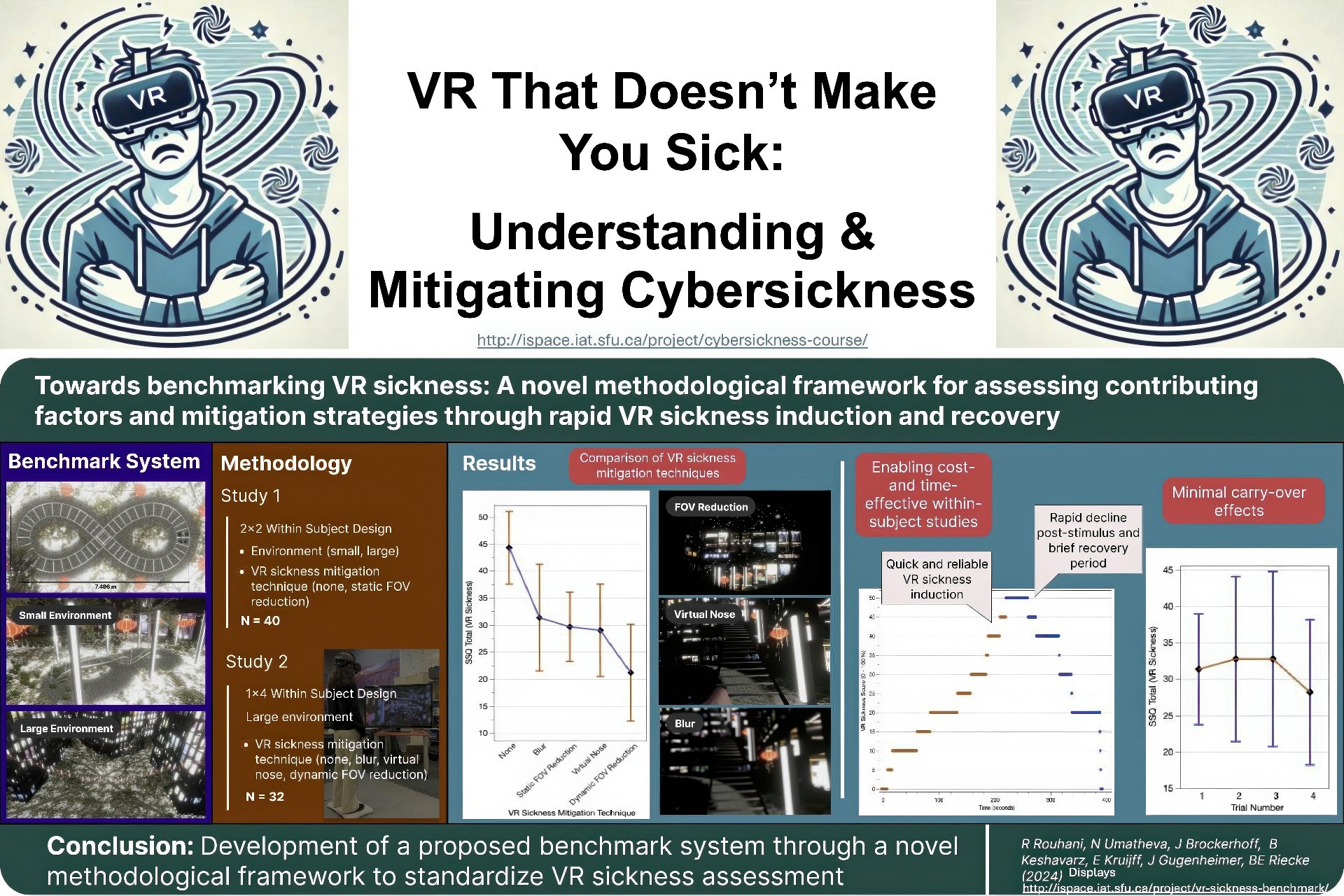
“VR That Doesn’t Make You Sick: Understanding & Mitigating Cybersickness” by Riecke and Keshavarz
Conference:
Type(s):
Title:
- VR That Doesn’t Make You Sick: Understanding & Mitigating Cybersickness
Organizer(s):
Presenter(s)/Author(s):
Abstract:
Cybersickness remains a major barrier to VR/XR adoption, limiting user experience, accessibility, and long-term engagement. While advancements in hardware and software—such as higher refresh rates, improved tracking, and predictive motion smoothing—have mitigated some aspects of cybersickness, designing for it remains a challenge due to the lack of a universal solution and an incomplete understanding of its causes. Sensory conflicts, postural instability, and individual variability contribute to its complexity, making prevention difficult. Additionally, the absence of a standardized design framework leaves developers relying on fragmented solutions that fail to fully address the issue. This course bridges research and industry, equipping developers, designers, and researchers with practical, evidence-based strategies to create immersive, low-cybersickness VR/XR experiences. Attendees will: – Understand the root causes of cybersickness, exploring key theories, such as sensory conflict or postural instability, and discussing contributing factors. – Learn practical design techniques for reducing cybersickness through locomotion, interaction, and UI/scene optimizations—including insights from HyperJump, leaning-based locomotion, FOV management, and comfort-enhancing UI design. – Explore cutting-edge industry applications and new research, including insights from the VR Sickness Benchmark—a step toward standardizing cybersickness evaluation and mitigation. – Engage in interactive discussions, including a Worst Cybersickness Story Swap, live audience polls, Miro board collaboration, and video showcases of effective mitigation techniques. – Receive structured, research-backed “Do’s & Don’ts” guidelines, offering a developer-friendly reference for implementing cybersickness mitigation strategies in real-world projects. This course bridges research and industry practice, ensuring attendees leave with immediately applicable strategies to enhance XR usability. Ideal for VR/XR developers, UX designers, and researchers, this session translates scientific insights into real-world solutions, helping attendees design more immersive, comfortable, and inclusive VR/XR experiences. Participants will be equipped with the knowledge and tools to better identify, assess, and mitigate cybersickness, improving user comfort, engagement, and adoption in XR applications across gaming, training, and simulation.
Additional Information:
-
- Familiarity with VR/XR development or UX design principles.
- Basic understanding of VR locomotion, interaction, or UI/UX concepts.
- Interest in cybersickness mitigation, human perception, or immersive experience design.
-
- 0:00 – 0:05 Introduction & Course Goals
- 0:05 – 0:10 Icebreaker: Worst Cybersickness Story Swap
- 0:10 – 0:30 Understanding Cybersickness: Terminology, Theories & Factors
- 0:30 – 0:40 Evaluating & Measuring Cybersickness
- 0:40 – 0:50 Designing for Low-Cybersickness: Environment & Interaction
- 0:50 – 1:00 Locomotion & Navigation Strategies
- 1:00 – 1:10 Practical Design Guidelines: Do’s & Don’ts
- 1:10 – 1:20 VR Sickness Benchmark: Toward Standardization
- 1:20 – 1:30 Q&A & Closing
Beginner
Prerequisite: This course is designed to be accessible to a broad audience while offering deep insights for experienced professionals.
Recommended (but not required) background:
No advanced technical knowledge is required. The session will cover both scientific foundations and practical, hands-on strategies, making it suitable for developers, designers, and researchers at various levels of expertise.
Topics: Interaction Design, VR, XR
List of topics and approximate times:
Draft Proposed Course Schedule (1.5 Hours):
Additional Info: Cybersickness remains a persistent challenge in VR/XR, hindering user experience and adoption. This course bridges research and industry, equipping developers, designers, and researchers with science-backed strategies to mitigate cybersickness through optimized locomotion, interaction, and environment design. Engage with case studies and activities to create more comfortable, accessible VR/XR experiences.