“Tomographic projector: large scale volumetric display with uniform viewing experiences” by Jo, Lee, Yoo, Choi, Kim, et al. …
Conference:
Type(s):
Title:
- Tomographic projector: large scale volumetric display with uniform viewing experiences
Session/Category Title:
- Light Hardware
Presenter(s)/Author(s):
Moderator(s):
Abstract:
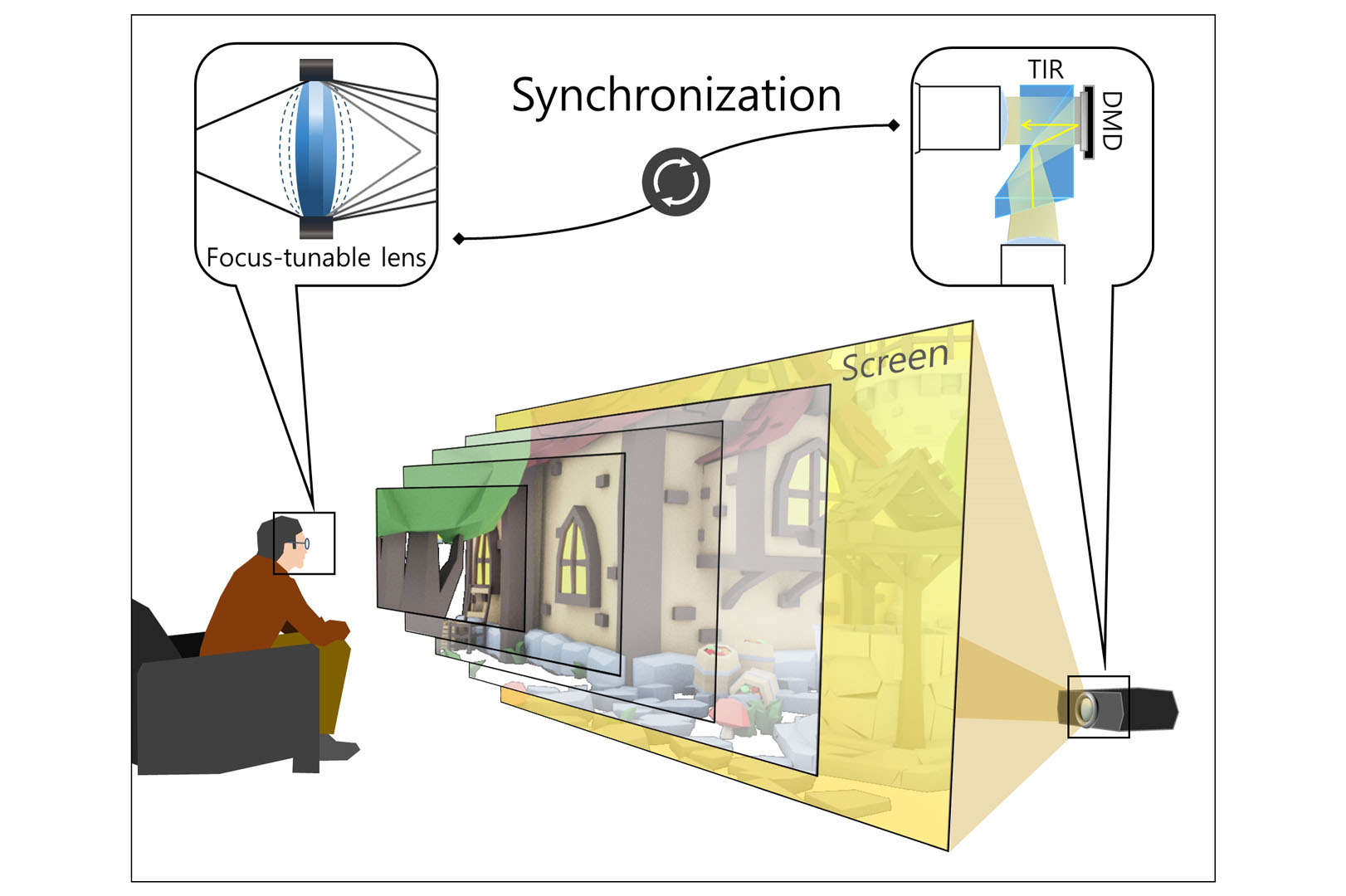
Over the past century, as display evolved, people have demanded more realistic and immersive experiences in theaters. Here, we present a tomographic projector for a volumetric display system that accommodates large audiences while providing a uniform experience. The tomographic projector combines high-speed digital micromirror and three spatial light modulators to refresh projection images at 7200 Hz. With synchronization of the tomographic projector and wearable focus-tunable eyepieces, the presented system can reconstruct 60 focal planes for volumetric representation right in front of audiences. We demonstrate proof of concept of the proposed system by implementing a miniaturized theater environment. Experimentally, we show that this system has wide expressible depth range with focus cues from 25 cm to optical infinity with sufficient tolerance while preserving high resolution and contrast. We also confirm that the proposed system provides uniform experience in a wide range of viewing zone through simulation and experiment. Additionally, the tomographic projector has capability to equalize vergence state that varies in conventional stereoscopic 3D theater according to viewing position as well as interpupillary distance. This study is concluded with thorough discussion about tomographic projectors in terms of challenges and research issues.
References:
1. Kurt Akeley, Simon J Watt, Ahna Reza Girshick, and Martin S Banks. 2004. A stereo display prototype with multiple focal distances. ACM Trans. Graph. 23, 3 (2004), 804–813.Google ScholarDigital Library
2. Anders H Andersen and Avinash C Kak. 1984. Simultaneous algebraic reconstruction technique (SART): a superior implementation of the ART algorithm. Ultrasonic imaging 6, 1 (1984), 81–94.Google Scholar
3. D. J. Butler, J. Wulff, G. B. Stanley, and M. J. Black. 2012. A naturalistic open source movie for optical flow evaluation. In European Conf. on Computer Vision (ECCV) (Part IV, LNCS 7577), A. Fitzgibbon et al. (Eds.) (Ed.). Springer-Verlag, 611–625.Google Scholar
4. Jen-Hao Rick Chang, BVK Kumar, and Aswin C Sankaranarayanan. 2018. Towards multifocal displays with dense focal stacks. In SIGGRAPH Asia 2018 Technical Papers. ACM, 198.Google Scholar
5. Heejin Choi, Joohwan Kim, Seong-Woo Cho, Yunhee Kim, Jae Byung Park, and Byoungho Lee. 2008. Three-dimensional-two-dimensional mixed display system using integral imaging with an active pinhole array on a liquid crystal panel. Applied optics 47, 13 (2008), 2207–2214.Google Scholar
6. Suyeon Choi, Seungjae Lee, Youngjin Jo, Dongheon Yoo, Dongyeon Kim, and Byoungho Lee. 2019. Optimal binary representation via non-convex optimization on tomographic displays. Optics Express 27, 17 (2019), 24362–24381.Google ScholarCross Ref
7. Neil A Dodgson. 2005. Autostereoscopic 3D displays. Computer 38, 8 (2005), 31–36.Google ScholarDigital Library
8. David Dunn, Cary Tippets, Kent Torell, Petr Kellnhofer, Kaan Akşit, Piotr Didyk, Karol Myszkowski, David Luebke, and Henry Fuchs. 2017. Wide field of view varifocal near-eye display using see-through deformable membrane mirrors. IEEE Transactions on Visualization and Computer Graphics 23, 4 (2017), 1322–1331.Google ScholarDigital Library
9. Netalee Efrat, Piotr Didyk, Mike Foshey, Wojciech Matusik, and Anat Levin. 2016. Cinema 3D: large scale automultiscopic display. ACM Transactions on Graphics (TOG) 35, 4 (2016), 59.Google ScholarDigital Library
10. Zhongpai Gao, Alex Hwang, Guangtao Zhai, and Eli Peli. 2018. Correcting geometric distortions in stereoscopic 3D imaging. PloS one 13, 10 (2018), e0205032.Google ScholarCross Ref
11. Gabor T Herman and Attila Kuba. 2012. Discrete tomography: Foundations, algorithms, and applications. Springer Science & Business Media.Google Scholar
12. Matthew Hirsch, Gordon Wetzstein, and Ramesh Raskar. 2014. A compressive light field projection system. ACM Transactions on Graphics (TOG) 33, 4 (2014), 58.Google ScholarDigital Library
13. David M Hoffman, Ahna R Girshick, Kurt Akeley, and Martin S Banks. 2008. Vergence-accommodation conflicts hinder visual performance and cause visual fatigue. Journal of vision 8, 3 (2008), 33–33.Google ScholarCross Ref
14. Fu-Chung Huang, Kevin Chen, and Gordon Wetzstein. 2015. The light field stereoscope: immersive computer graphics via factored near-eye light field displays with focus cues. ACM Trans. Graph. 34, 4 (2015), 60.Google ScholarDigital Library
15. Haruo Isono, Minoru Yasuda, and Hideaki Sasazawa. 1993. Autostereoscopic 3-D display using LCD-generated parallax barrier. Electronics and Communications in Japan (Part II: Electronics) 76, 7 (1993), 77–84.Google ScholarCross Ref
16. Changwon Jang, Kiseung Bang, Gang Li, and Byoungho Lee. 2018. Holographic near-eye display with expanded eye-box. In SIGGRAPH Asia 2018 Technical Papers. ACM, 195.Google Scholar
17. Michael Kalloniatis and Charles Luu. 2007. Temporal resolution. (2007).Google Scholar
18. Yunhee Kim, Joohwan Kim, Jin-Mo Kang, Jae-Hyun Jung, Heejin Choi, and Byoungho Lee. 2007. Point light source integral imaging with improved resolution and viewing angle by the use of electrically movable pinhole array. Optics Express 15, 26 (2007), 18253–18267.Google ScholarCross Ref
19. R. Konrad, E.A Cooper, and G. Wetzstein. 2016. Novel Optical Configurations for Virtual Reality: Evaluating User Preference and Performance with Focus-tunable and Monovision Near-eye Displays. In Proc. CHI. 1211–1220.Google Scholar
20. Robert Konrad, Nitish Padmanaban, Keenan Molner, Emily A. Cooper, and Gordon Wetzstein. 2017. Accommodation-invariant Computational Near-eye Displays. ACM Trans. Graph. 36, 4 (2017), 88.Google ScholarDigital Library
21. Frank L Kooi and Alexander Toet. 2004. Visual comfort of binocular and 3D displays. Displays 25, 2–3 (2004), 99–108.Google ScholarCross Ref
22. Marc TM Lambooij, Wijnand A IJsselsteijn, and Ingrid Heynderickx. 2007. Visual discomfort in stereoscopic displays: a review. In Stereoscopic Displays and Virtual Reality Systems XIV, Vol. 6490. International Society for Optics and Photonics, 64900I.Google Scholar
23. Douglas Lanman, Matthew Hirsch, Yunhee Kim, and Ramesh Raskar. 2010. Content-adaptive parallax barriers: optimizing dual-layer 3D displays using low-rank light field factorization. ACM Trans. Graph. 29, 6 (2010), 163.Google ScholarDigital Library
24. Douglas Lanman and David Luebke. 2013. Near-eye light field displays. ACM Transactions on Graphics (TOG) 32, 6 (2013), 220.Google ScholarDigital Library
25. Lewis. Larmore. 1965. Introduction to photographic principles / Lewis Larmore (2d ed. ed.). Dover Publications New York. ix, 229 p. pages.Google Scholar
26. Jungjin Lee, Sangwoo Lee, Younghui Kim, and Junyong Noh. 2016. ScreenX: Public immersive theatres with uniform movie viewing experiences. IEEE transactions on visualization and computer graphics 23, 2 (2016), 1124–1138.Google Scholar
27. Seungjae Lee, Jaebum Cho, Byounghyo Lee, Youngjin Jo, Changwon Jang, Dongyeon Kim, and Byoungho Lee. 2018. Foveated retinal optimization for see-through near-eye multi-layer displays. IEEE Access 6 (2018), 2170–2180.Google ScholarCross Ref
28. Seungjae Lee, Youngjin Jo, Dongheon Yoo, Jaebum Cho, Dukho Lee, and Byoungho Lee. 2019. Tomographic near-eye displays. Nature communications 10, 1 (2019), 2497.Google Scholar
29. Gang Li, Dukho Lee, Youngmo Jeong, Jaebum Cho, and Byoungho Lee. 2016. Holographic display for see-through augmented reality using mirror-lens holographic optical element. Opt. Lett. 41, 11 (2016), 2486–2489.Google ScholarCross Ref
30. Gabriel Lippmann. 1908. Epreuves reversibles Photographies integrals. Comptes-Rendus Academie des Sciences 146 (1908), 446–451.Google Scholar
31. Kevin J MacKenzie, David M Hoffman, and Simon J Watt. 2010. Accommodation to multiple-focal-plane displays: Implications for improving stereoscopic displays and for accommodation control. Journal of Vision 10, 8 (2010), 22–22.Google ScholarCross Ref
32. Andrew Maimone and Henry Fuchs. 2013. Computational augmented reality eyeglasses. In Proc. ISMAR. 29–38.Google ScholarCross Ref
33. Andrew Maimone, Andreas Georgiou, and Joel S. Kollin. 2017. Holographic Near-Eye Displays for Virtual and Augmented Reality. ACM Trans. Graph. 36, 4 (2017), 85.Google ScholarDigital Library
34. Michael Mauderer, Simone Conte, Miguel A Nacenta, and Dhanraj Vishwanath. 2014. Depth perception with gaze-contingent depth of field. In Proceedings of the SIGCHI Conference on Human Factors in Computing Systems. ACM, 217–226.Google ScholarDigital Library
35. Bernard Mendiburu. 2012. 3D movie making: stereoscopic digital cinema from script to screen. Focal press.Google Scholar
36. Olivier Mercier, Yusufu Sulai, Kevin Mackenzie, Marina Zannoli, James Hillis, Derek Nowrouzezahrai, and Douglas Lanman. 2017. Fast gaze-contingent optimal decompositions for multifocal displays. ACM Trans. Graph. 36, 6 (2017), 237.Google ScholarDigital Library
37. Rahul Narain, Rachel A Albert, Abdullah Bulbul, Gregory J Ward, Martin S Banks, and James F O’Brien. 2015. Optimal presentation of imagery with focus cues on multi-plane displays. ACM Trans. Graph. 34, 4 (2015), 59.Google ScholarDigital Library
38. Yuji Nojiri, Hirokazu Yamanoue, Atsuo Hanazato, Masaki Emoto, and Fumio Okano. 2004. Visual comfort/discomfort and visual fatigue caused by stereoscopic HDTV viewing. In Stereoscopic Displays and Virtual Reality Systems XI, Vol. 5291. International Society for Optics and Photonics, 303–314.Google ScholarCross Ref
39. Nitish Padmanaban, Robert Konrad, Tal Stramer, Emily A Cooper, and Gordon Wetzstein. 2017. Optimizing virtual reality for all users through gaze-contingent and adaptive focus displays. Proceedings of the National Academy of Sciences 114, 9 (2017), 2183–2188.Google ScholarCross Ref
40. Jae-Hyeung Park, Keehoon Hong, and Byoungho Lee. 2009. Recent progress in three-dimensional information processing based on integral imaging. Applied Optics 48, 34 (2009), H77–H94.Google ScholarCross Ref
41. Soon-gi Park, Jiwoon Yeom, Youngmo Jeong, Ni Chen, Jong-Young Hong, and Byoungho Lee. 2014. Recent issues on integral imaging and its applications. Journal of Information Display 15, 1 (2014), 37–46.Google ScholarCross Ref
42. Archibald Stanley Percival. 1892. The relation of convergence to accommodation and its practical bearing. Ophthal. Rev. 11 (1892), 313–328.Google Scholar
43. Tom Peterka, Robert L Kooima, Daniel J Sandin, Andrew Johnson, Jason Leigh, and Thomas A DeFanti. 2008. Advances in the dynallax solid-state dynamic parallax barrier autostereoscopic visualization display system. IEEE transactions on visualization and computer graphics 14, 3 (2008), 487–499.Google ScholarDigital Library
44. Kishore Rathinavel, Hanpeng Wang, Alex Blate, and Henry Fuchs. 2018. An extended depth-at-field volumetric near-eye augmented reality display. IEEE transactions on visualization and computer graphics 24, 11 (2018), 2857–2866.Google ScholarCross Ref
45. Takashi Shibata, Joohwan Kim, David M Hoffman, and Martin S Banks. 2011. The zone of comfort: Predicting visual discomfort with stereo displays. Journal of vision 11, 8 (2011), 11–11.Google ScholarCross Ref
46. RE Stevens, DP Rhodes, A Hasnain, and P-Y Laffont. 2018. Varifocal technologies providing prescription and VAC mitigation in HMDs using Alvarez lenses. In Digital Optics for Immersive Displays, Vol. 10676. International Society for Optics and Photonics, 106760J.Google ScholarCross Ref
47. Yasuhiro Takaki and Nichiyo Nago. 2010. Multi-projection of lenticular displays to construct a 256-view super multi-view display. Optics express 18, 9 (2010), 8824–8835.Google Scholar
48. Kazuhiko Ukai and Peter A Howarth. 2008. Visual fatigue caused by viewing stereoscopic motion images: Background, theories, and observations. Displays 29, 2 (2008), 106–116.Google ScholarCross Ref
49. Marc von Waldkirch, Paul Lukowicz, and Gerhard Tröster. 2003. Defocusing simulations on a retinal scanning display for quasi accommodation-free viewing. Optics express 11, 24 (2003), 3220–3233.Google Scholar
50. Koki Wakunami, Po-Yuan Hsieh, Ryutaro Oi, Takanori Senoh, Hisayuki Sasaki, Yasuyuki Ichihashi, Makoto Okui, Yi-Pai Huang, and Kenji Yamamoto. 2016. Projection-type see-through holographic three-dimensional display. Nature communications 7 (2016), 12954.Google Scholar
51. Gordon Wetzstein, Douglas Lanman, Wolfgang Heidrich, and Ramesh Raskar. 2011. Layered 3D: tomographic image synthesis for attenuation-based light field and high dynamic range displays. ACM Trans. Graph. 30, 4 (2011), 95.Google ScholarDigital Library
52. Lei Xiao, Anton Kaplanyan, Alexander Fix, Matthew Chapman, and Douglas Lanman. 2018. DeepFocus: learned image synthesis for computational displays. In SIGGRAPH Asia 2018 Technical Papers. ACM, 200.Google Scholar