“Stackabilization”
Conference:
Type(s):
Title:
- Stackabilization
Session/Category Title:
- Sculpting, Stacking, Structure and Boxes
Presenter(s)/Author(s):
Abstract:
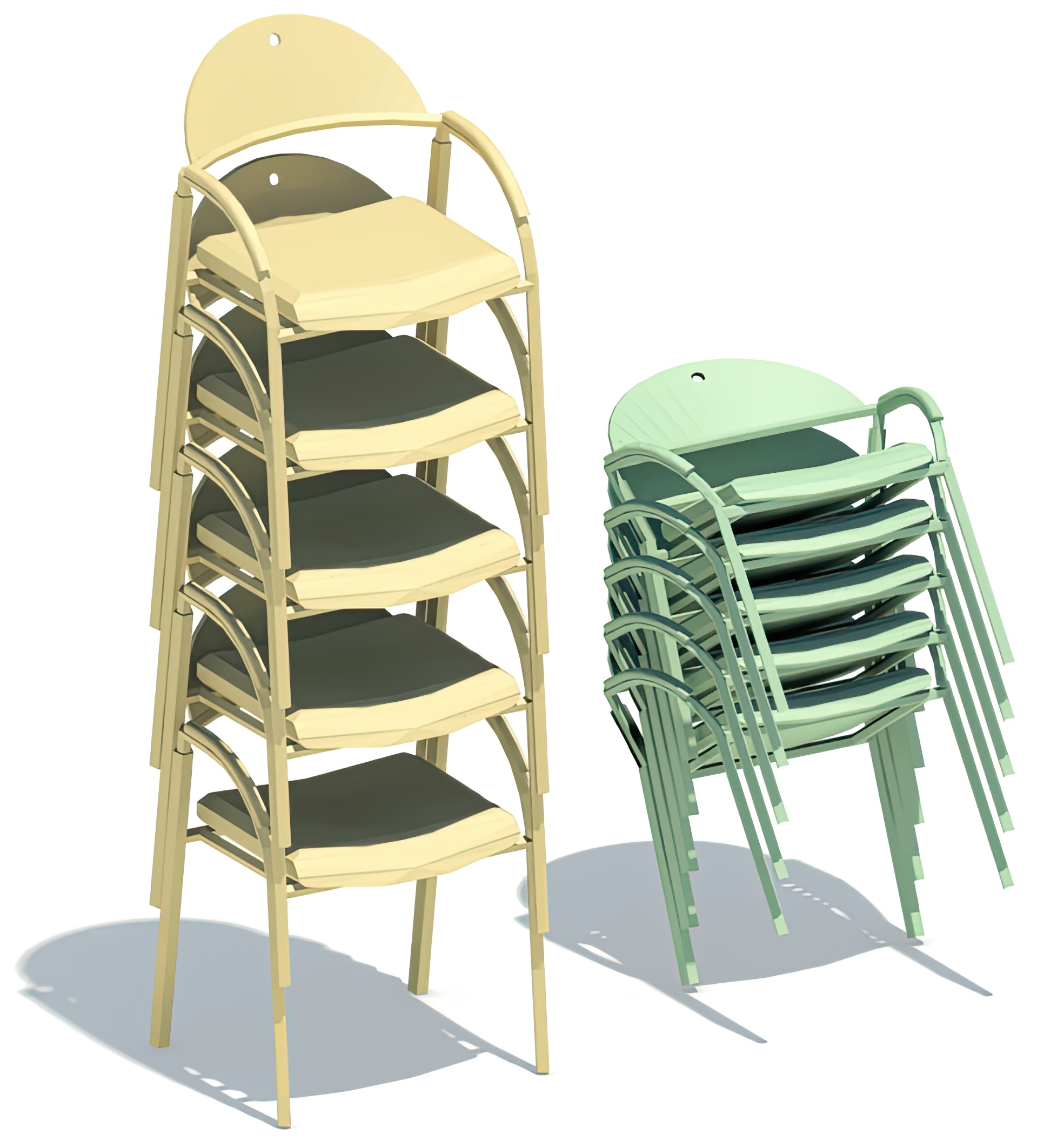
We introduce the geometric problem of stackabilization: how to geometrically modify a 3D object so that it is more amenable to stacking. Given a 3D object and a stacking direction, we define a measure of stackability, which is derived from the gap between the lower and upper envelopes of the object in a stacking configuration along the stacking direction. The main challenge in stackabilization lies in the desire to modify the object’s geometry only subtly so that the intended functionality and aesthetic appearance of the original object are not significantly affected. We present an automatic algorithm to deform a 3D object to meet a target stackability score using energy minimization. The optimized energy accounts for both the scales of the deformation parameters as well as the preservation of pre-existing geometric and structural properties in the object, e. g., symmetry, as a means of maintaining its functionality. We also present an intelligent editing tool that assists a modeler when modifying a given 3D object to improve its stackability. Finally, we explore a few fun variations of the stackabilization problem.
References:
1. Attene, M., Falcidieno, B., and Spagnuolo, M. 2006. Hierarchical mesh segmentation based on fitting primitives. THE VISUAL COMPUTER 22, 181–193.
2. Au, O. K.-C., Tai, C.-L., Chu, H.-K., Cohen-Or, D., and Lee, T.-Y. 2008. Skeleton extraction by mesh contraction. ACM Trans. Graph. 27, 3.
3. Dong, H., Guarneri, P., and Fadel, G. 2011. Bi-level approach to vehicle component layout with shape morphing. Journal of Mechanical Design 133, 4, 041008.
4. Fiell, C., and Fiell, P. 2000. 1000 Chairs. Taschen.
5. Gal, R., Sorkine, O., Mitra, N., and Cohen-Or, D. 2009. iwires: An analyze-and-edit approach to shape manipulation. ACM Trans. on Graph 28, 3.
6. Hoppe, H., DeRose, T., Duchamp, T., McDonald, J., and Stuetzle, W. 1993. Mesh optimization. In Proceedings of the 20th annual conference on Computer graphics and interactive techniques, ACM, New York, NY, USA, SIGGRAPH ’93, 19–26.
7. Ju, T., Schaefer, S., and Warren, J. 2005. Mean value coordinates for closed triangular meshes. ACM Trans. Graph. 24, 3 (July), 561–566.
8. Kaplan, C. S., and Salesin, D. H. 2000. Escherization. In Proceedings of the 27th annual conference on Computer graphics and interactive techniques, ACM Press/Addison-Wesley Publishing Co., New York, NY, USA, SIGGRAPH ’00, 499–510.
9. Kavan, L., Collins, S., Žára, J., and O’Sullivan, C. 2007. Skinning with dual quaternions. In Proceedings of the 2007 symposium on Interactive 3D graphics and games, ACM, New York, NY, USA, I3D ’07, 39–46.
10. Kelly, T., and Wonka, P. 2011. Interactive architectural modeling with procedural extrusions. ACM Trans. on Graph 30, 14:1–14:15.
11. Lau, M., Ohgawara, A., Mitani, J., and Igarashi, T. 2011. Converting 3d furniture models to fabricatable parts and connectors. ACM Trans. on Graph 30, 85:1–85:6.
12. Meng, M., Fan, L., and Liu, L. 2011. A comparative evaluation of foreground/background sketch-based mesh segmentation algorithms. Comput. Graph. 35 (June), 650–660.
13. Merrell, P., Schkufza, E., and Koltun, V. 2010. Computer-generated residential building layouts. ACM Trans. on Graph 29, 181:1–181:12.
14. Merrell, P., Schkufza, E., Li, Z., Agrawala, M., and Koltun, V. 2011. Interactive furniture layout using interior design guidelines. ACM Trans. on Graph 30, 87:1–87:10.
15. Mitra, N. J., Guibas, L. J., and Pauly, M. 2006. Partial and approximate symmetry detection for 3D geometry. ACM Trans. on Graph 25, 3, 560–568.
16. Mitra, N. J., Guibas, L. J., and Pauly, M. 2007. Symmetrization. ACM Trans. on Graph 26, 3, 63:1–8.
17. Mitra, N. J., Yang, Y.-L., Yan, D.-M., Li, W., and Agrawala, M. 2010. Illustrating how mechanical assemblies work. ACM Trans. on Graph 29, 58:1–58:12.
18. Umetani, N., Igarashi, T., and Mitra, N. J. 2012. Guided exploration of physically valid shapes for furniture design. ACM Transactions on Graphics 31, 4.
19. Yu, L.-F., Yeung, S.-K., Tang, C.-K., Terzopoulos, D., Chan, T. F., and Osher, S. J. 2011. Make it home: automatic optimization of furniture arrangement. ACM Trans. on Graph 30, 86:1–86:12.
20. Zheng, Y., Fu, H., Cohen-Or, D., Au, O. K.-C., and Tai, C.-L. 2011. Component-wise controllers for structure-preserving shape manipulation. Computer Graphics Forum (Special Issue of Eurographics) 30, 2, 563–572.