
“Speculative AI Re-enactment of the Figurist’s Encounters With the I Ching” by Clarke, Masu and Papatheodorou
Conference:
Type(s):
Title:
- Speculative AI Re-enactment of the Figurist’s Encounters With the I Ching
Session/Category Title:
- Culture and Computation
Presenter(s)/Author(s):
Moderator(s):
Abstract:
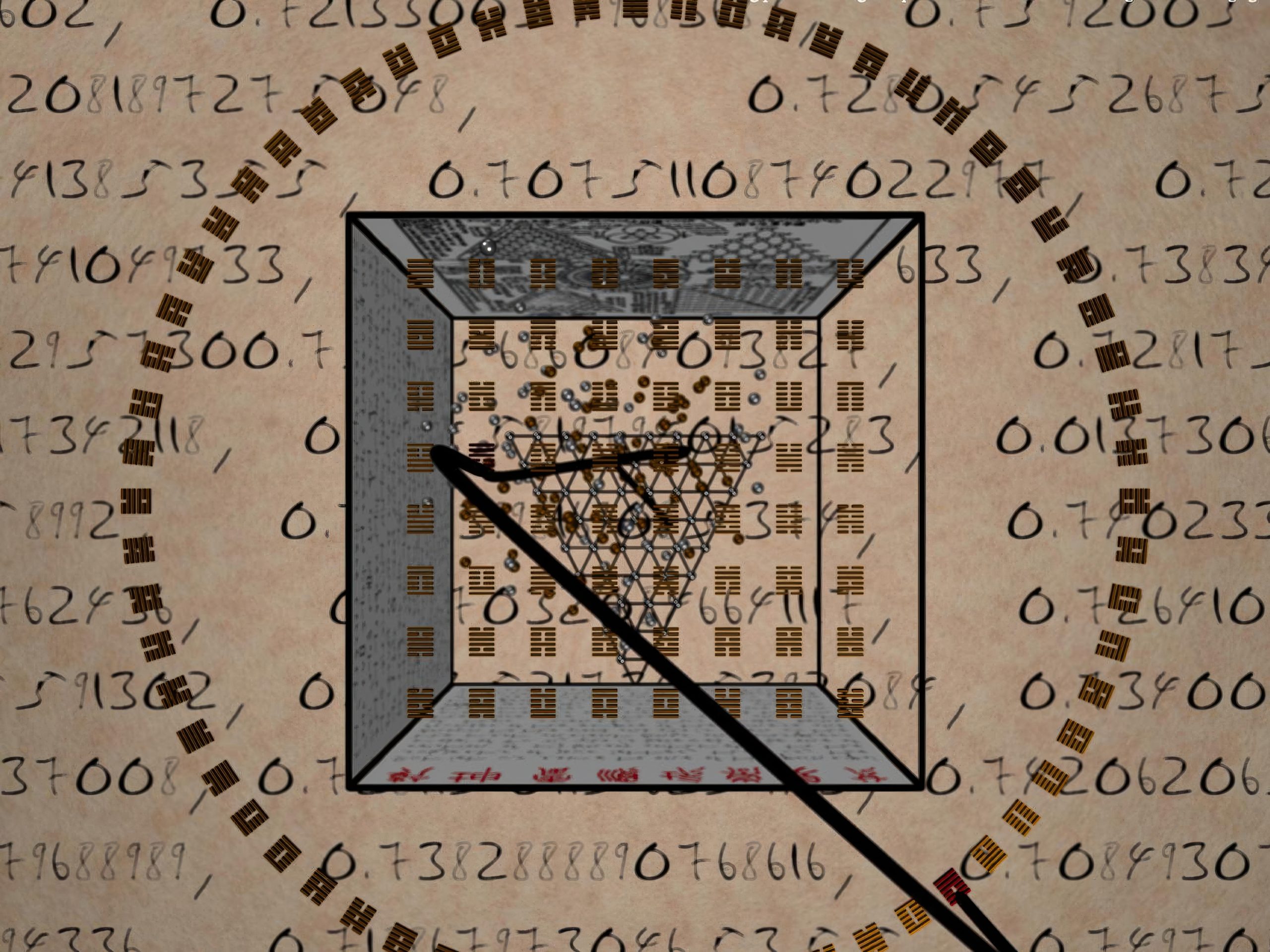
This paper presents a speculative AI reenactment of the Figurists’ 17th-century encounter with the I Ching. By drawing parallels between traditional divination practices and contemporary AI systems, the work explores interpretive processes, cultural bias, and the historical lineage of predictive devices. The presented artwork uses AI text embeddings to map intersections between I Ching hexagrams and Biblical characters, visualised through a generative diagram that incorporates hand-drawn elements and evolving connections. This project highlights the potential of AI as both a cultural artefact and a creative system, inviting reflection on the interpretive frameworks, and speculative possibilities inherent in AI technologies.
References:
[1] Alan Berkowitz and Daniel J. Cook. 2015. Leibniz-Bouvet Correspondence: Translation and Annotations. https://leibniz-bouvet.swarthmore.edu/ Accessed: 2025-04-23.
[2] Adam Blazejczak. 2023. I Ching Wilhelm Dataset. https://github.com/adamblvck/iching-wilhelm-dataset Accessed: 2025-04-23.
[3] Kieran Browne and Ben Swift. 2018. The Other Side: Algorithm as Ritual in Artificial Intelligence. In 2018 CHI Conference on Human Factors in Computing Systems. ACM, New York, NY, USA, 1–9.
[4] Mercedes Bunz, Daniel Chávez Heras, Eva Jäger, Alasdair Milne, and Joanna Zylinska. 2023. Creative-Critical-Constructive-Collaborative-Computational: Towards a C5 model in Creative AI.
[5] John Cage. 1961. Silence: Lectures and Writings. Wesleyan University Press, Middletown, Connecticut.
[6] Chris Chesher and César Albarrán-Torres. 2023. The emergence of autolography: the ‘magical’ invocation of images from text through AI. Media International Australia 189, 1 (2023), 57 – 73.
[7] Steve Collins. 2004. Technology and Magick. Scan: Journal of Media Arts Culture 1, 2 (June 2004).
[8] P. K Dick. 1962. The man in the high castle. New York, Putnam.
[9] Ramsey Dukes. 1988. Words Made Flesh: Artificial Intelligence, Humanity, and the Cosmos. The Mouse That Spins, Winchester, UK.
[10] Jake Elwes. 2019. Zizi – Queering the Dataset.
[11] Kawin Ethayarajh. 2019. Word Embedding Analogies: Understanding King – Man + Woman = Queen. https://kawine.github.io/blog/nlp/2019/06/21/word-analogies.html Accessed: 2024-11-27.
[12] Hal Foster. 2004. An Archival Impulse. October 110 (2004), 3–22.
[13] Isabel O. Gallegos, Ryan A. Rossi, Joe Barrow, Md Mehrab Tanjim, Sungchul Kim, Franck Dernoncourt, Tong Yu, Ruiyi Zhang, and Nesreen K. Ahmed. 2024. Bias and Fairness in Large Language Models: A Survey. arxiv:https://arXiv.org/abs/2309.00770
[14] Alexander Gerner. [n. d.]. Diagrammatic Thinking. http://monumenttotransformation.org/atlas-of-transformation/html/d/diagrammatic-thinking/diagrammatic-thinking-alexander-gerner.html Accessed: 2024-11-27.
[15] Saidiya Hartman. 2008. Venus in Two Acts. Small Axe 12, 2 (2008), 1–14.
[16] Drew Hemment, Ruth Aylett, Vaishak Belle, Dave Murray-Rust, Ewa Luger, Jane Hillston, Michael Rovatsos, and Frank Broz. 2019. Experiential AI. AI Matters 5, 1 (apr 2019), 25–31.
[17] Drew Hemment, Matjaz Vidmar, Daga Panas, Dave Murray-Rust, Vaishak Belle, and Aylett Ruth. 2023. Agency and legibility for artists through Experiential AI. arxiv:https://arXiv.org/abs/2306.02327
[18] Geoffrey Hinton and Sam Roweis. 2002. Stochastic neighbor embedding. In Proceedings of the 15th International Conference on Neural Information Processing Systems. MIT Press, Cambridge, MA, USA, 857–864.
[19] Arthur Koestler. 1959. The Sleepwalkers: A History of Man’s Changing Vision of the Universe. Arkana, London, England; New York, N.Y., USA.
[20] Andreas Kratky. 2022. Poetic Automatisms: A Comparison of Surrealist Automatisms and Artificial Intelligence for Creative Expression. LNICST 422 LNICST (2022), 359 – 378.
[21] Wenjie Liu, Sai Chen, Guoyao Huang, Lingfeng Lu, Huakang Li, and Guozi Sun. 2023. Incorporating I Ching Knowledge Into Prediction Task via Data Mining. Journal of Database Management 34 (01 2023), 1–16.
[22] Caitlin Lustig and Daniela Rosner. 2022. From Explainability to Ineffability? ML Tarot and the Possibility of Inspiriting Design. In Proceedings of the 2022 ACM DIS Conference. ACM, New York, NY, USA, 123–136.
[23] Maggie MacLure. 2021. Inquiry as Divination. Qualitative Inquiry 27, 5 (2021), 502–511.
[24] John X. Morris, Volodymyr Kuleshov, Vitaly Shmatikov, and Alexander M. Rush. 2023. Text Embeddings Reveal (Almost) As Much As Text. arxiv:https://arXiv.org/abs/2310.06816
[25] OpenAI. 2022. New and improved embedding model. https://openai.com/index/new-and-improved-embedding-model/ Accessed: 2025-04-23.
[26] Hamed Rashtian and Gabriela Aceves-Sepúlveda. 2023. Same Old Story: Agential Realism in the Study of Colonial Histories. In Proceedings of the 28th International Symposium on Electronic Art (ISEA). Paris, France.
[27] Benjamin Seide, Ross Williams, and Elke Reinhuber. 2019. The Gone Garden VR Experience – An Impressionistic Representation as Virtual Heritage Reconstruction. In Proceedings of the 25th International Symposium on Electronic Art (ISEA). ISEA International, Gwangju, Korea.
[28] Serpentine Arts Technologies. 2024. Future Art Ecosystems 4: Art X Public AI. Serpentine Gallery.
[29] Richard J. Smith. 2012. The I Ching: A Biography. Princeton University Press, Princeton.
[30] Kostas Terzidis, Filippo Fabrocini, and Hyejin Lee. 2023. Unintentional intentionality: art and design in the age of artificial intelligence. AI and Society 38, 4 (2023), 1715 – 1724.
[31] Vincent Thornhill, Guillemette Legrand, and Isaac Clarke. 2023. Spectral Plain: A Case Study for Exploring the World-Building Potential of Co-Creative Systems that Combine Text Generation Models with Game Mechanics. In Proceedings of the 28th International Symposium on Electronic Art (ISEA). ISEA International, Paris, France.
[32] Unknown Author. 1701. Diagram of hexagrams sent by Bouvet to Leibniz. Leibniz Archive, Niedersächsische Landesbibliothek. https://commons.wikimedia.org/wiki/File:Diagram_of_I_Ching_hexagrams_owned_by_Gottfried_Wilhelm_Leibniz,_1701.jpg
[33] Laurens van der Maaten and Geoffrey Hinton. 2008. Visualizing Data Using t-SNE. Journal of Machine Learning Research 9 (2008), 2579–2605.
[34] Richard [trans.] Wilhelm and Cary F. [trans.] Baynes. 1968. The I Ching or Book of Changes (third printing ed.). Routledge & K. Paul, London. 740 pages.
[35] Youngeun Yu, Hyunjung Yu, Jeihee Cho, Jueun Park, Eunjungv Lim, and Jueun Ha. 2022. Human-AI Co-creation Practice to Reconfigure the Cultural Emotion : Han. ACM International Conference Proceeding Series (2022), 414 – 417.
[36] Yijia Zhang, Qingyu Chen, Zhiyong Yang, Hongfei Lin, and Zhiyong Lu. 2019. BioWordVec, improving biomedical word embeddings with subword information and MeSH. Scientific Data 6, 1 (2019), 52.



