“Sparse Stress Structures from Optimal Geometric Measures” by Chern and Rowe
Conference:
Type(s):
Title:
- Sparse Stress Structures from Optimal Geometric Measures
Session/Category Title:
- Computational Design
Presenter(s)/Author(s):
Abstract:
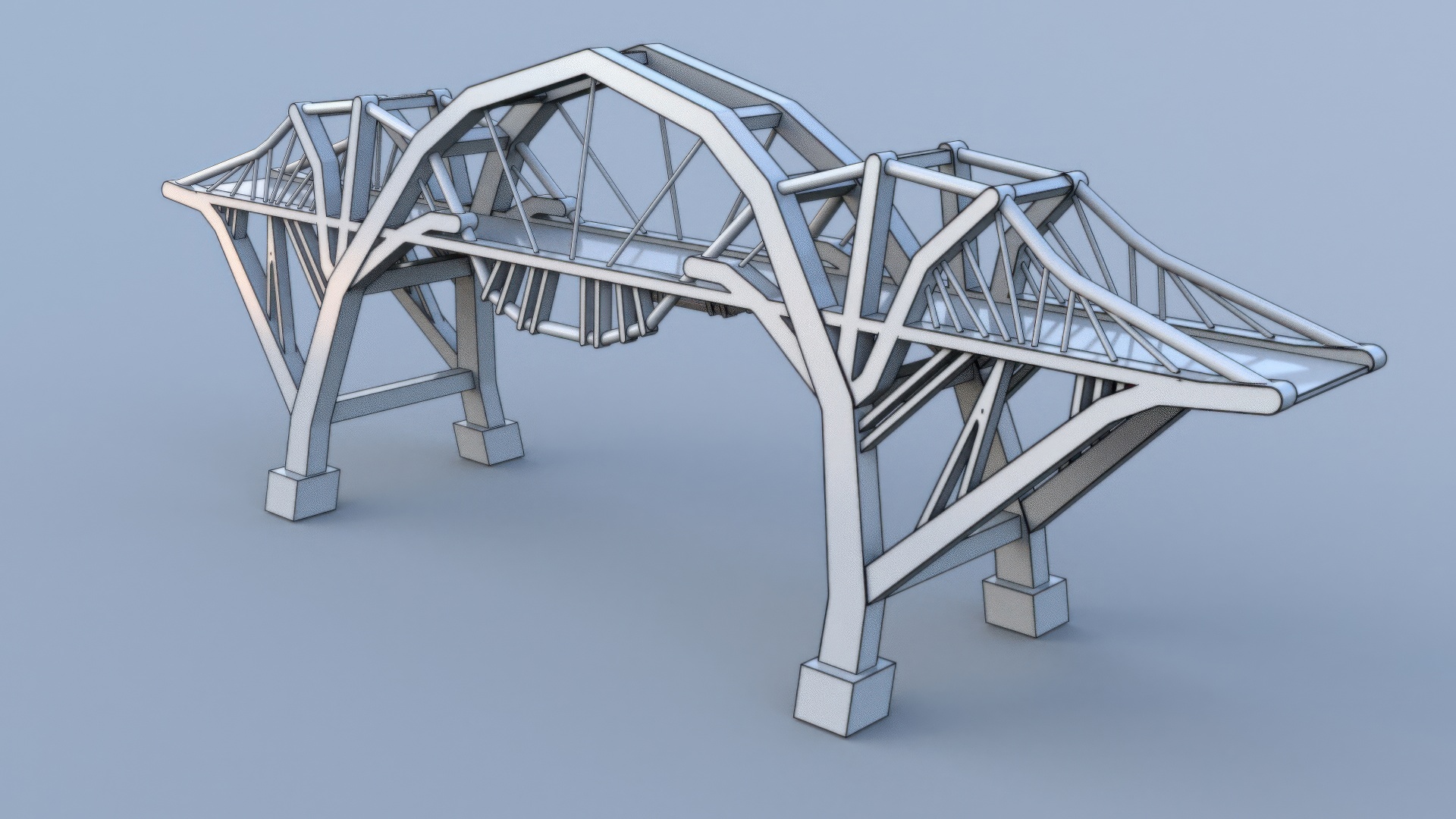
Identifying optimal structural designs given loads and constraints is a primary challenge in topology optimization and shape optimization. We propose a novel approach to this problem by finding a minimal tensegrity structure—a network of cables and struts in equilibrium with a given loading force. Through the application of geometric measure theory and compressive sensing techniques, we show that this seemingly difficult graph-theoretic problem can be reduced to a numerically tractable continuous optimization problem. With a light-weight iterative algorithm involving only Fast Fourier Transforms and local algebraic computations, we can generate sparse supporting structures featuring detailed branches, arches, and reinforcement structures that respect the prescribed loading forces and obstacles.
References:
[1]
William K Allard. 1972. On the first variation of a varifold. Annals of mathematics 95, 3 (1972), 417–491.
[2]
Martin Philip Bendsoe and Ole Sigmund. 2003. Topology optimization: theory, methods, and applications. Springer Science & Business Media.
[3]
Marcel Berger and D Ebin. 1969. Some decompositions of the space of symmetric tensors on a Riemannian manifold. Journal of Differential Geometry 3, 3-4 (1969), 379–392.
[4]
Mauro Bonafini, Giandomenico Orlandi, and Édouard Oudet. 2018. Variational approximation of functionals defined on 1-dimensional connected sets: the planar case. SIAM Journal on Mathematical Analysis 50, 6 (2018), 6307–6332.
[5]
Sofien Bouaziz, Sebastian Martin, Tiantian Liu, Ladislav Kavan, and Mark Pauly. 2014. Projective dynamics: Fusing constraint projections for fast simulation. ACM transactions on graphics (TOG) 33, 4 (2014), 1–11.
[6]
Blanche Buet, Gian Paolo Leonardi, and Simon Masnou. 2017. A Varifold Approach to Surface Approximation. Archive for Rational Mechanics and Analysis 226, 2 (jun 2017), 639–694. https://doi.org/10.1007/s00205-017-1141-0
[7]
Nicolas Charon and Alain Trouvé. 2013. The varifold representation of non-oriented shapes for diffeomorphic registration. CoRR abs/1304.6108 (2013). arXiv:1304.6108http://arxiv.org/abs/1304.6108
[8]
Scott Shaobing Chen, David L Donoho, and Michael A Saunders. 2001. Atomic decomposition by basis pursuit. SIAM review 43, 1 (2001), 129–159.
[9]
Fernando de Goes, Beibei Liu, Max Budninskiy, Yiying Tong, and Mathieu Desbrun. 2014. Discrete 2-tensor fields on triangulations. In Computer Graphics Forum, Vol. 33. Wiley Online Library, 13–24.
[10]
Joshua D. Deaton and Ramana V. Grandhi. 2014. A Survey of Structural and Multidisciplinary Continuum Topology Optimization: Post 2000. Struct. Multidiscip. Optim. 49, 1 (jan 2014), 1–38. https://doi.org/10.1007/s00158-013-0956-z
[11]
David L Donoho and Michael Elad. 2003. Optimally sparse representation in general (nonorthogonal) dictionaries via ℓ1 minimization. Proceedings of the National Academy of Sciences 100, 5 (2003), 2197–2202.
[12]
Shintaro Ehara and Yoshihiro Kanno. 2010. Topology design of tensegrity structures via mixed integer programming. International Journal of Solids and Structures 47, 5 (2010), 571–579. https://doi.org/10.1016/j.ijsolstr.2009.10.020
[13]
Richard Buckminster Fuller. US3063521A, Nov. 1962. Tensile-integrity structures.
[14]
Francisca Gil-Ureta, Nico Pietroni, and Denis Zorin. 2019. Structurally optimized shells. arXiv preprint arXiv:1904.12240 (2019).
[15]
Valentin Gomez-Jauregui. 2004. Tensegrity structures and their application to architecture. Ph. D. Dissertation.
[16]
Albert Graells Rovira and Josep M. Mirats Tur. 2009. Control and simulation of a tensegrity-based mobile robot. Robotics and Autonomous Systems 57, 5 (2009), 526–535. https://doi.org/10.1016/j.robot.2008.10.010
[17]
Donald E Ingber. 2003. Tensegrity I. Cell structure and hierarchical systems biology. J. Cell Sci. 116, Pt 7 (April 2003), 1157–1173.
[18]
Martin Kilian, Davide Pellis, Johannes Wallner, and Helmut Pottmann. 2017. Material-minimizing forms and structures. ACM Transactions on Graphics (TOG) 36, 6 (2017), 1–12.
[19]
Sarah Kushner, Risa Ulinski, Karan Singh, David IW Levin, and Alec Jacobson. 2021. Levitating Rigid Objects with Hidden Rods and Wires. In Computer Graphics Forum, Vol. 40. Wiley Online Library, 221–230.
[20]
Minchen Li, Zachary Ferguson, Teseo Schneider, Timothy R Langlois, Denis Zorin, Daniele Panozzo, Chenfanfu Jiang, and Danny M Kaufman. 2020. Incremental potential contact: intersection-and inversion-free, large-deformation dynamics.ACM Trans. Graph. 39, 4 (2020), 49.
[21]
Haixiang Liu, Yuanming Hu, Bo Zhu, Wojciech Matusik, and Eftychios Sifakis. 2018. Narrow-Band Topology Optimization on a Sparsely Populated Grid. ACM Transactions on Graphics (TOG) 37, 6 (2018).
[22]
Sebastian Martin, Bernhard Thomaszewski, Eitan Grinspun, and Markus Gross. 2011. Example-based elastic materials. In ACM SIGGRAPH 2011 papers. 1–8.
[23]
David Palmer, Dmitriy Smirnov, Stephanie Wang, Albert Chern, and Justin Solomon. 2022. DeepCurrents: Learning Implicit Representations of Shapes with Boundaries. In Proceedings of the IEEE/CVF Conference on Computer Vision and Pattern Recognition (CVPR).
[24]
C. Paul, F.J. Valero-Cuevas, and H. Lipson. 2006. Design and control of tensegrity robots for locomotion. IEEE Transactions on Robotics 22, 5 (2006), 944–957. https://doi.org/10.1109/TRO.2006.878980
[25]
Paul Pegon, Filippo Santambrogio, and Qinglan Xia. 2019. A fractal shape optimization problem in branched transport. Journal de Mathématiques Pures et Appliquées 123 (2019), 244–269.
[26]
S. Rajeev and C. S. Krishnamoorthy. 1997. Genetic algorithms-based methodology for design optimization of trusses.
[27]
G. I. N. Rozvany. 2009. A critical review of established methods of structural topology optimization. Structural and Multidisciplinary Optimization 37, 3 (2009), 217–237. https://doi.org/10.1007/s00158-007-0217-0
[28]
Ole Sigmund and Kurt Maute. 2013. Topology optimization approaches. Structural and Multidisciplinary Optimization 48, 6 (2013), 1031–1055. https://doi.org/10.1007/s00158-013-0978-6
[29]
Anthony So and Yinyu Ye. 2006. A Semidefinite Programming Approach to Tensegrity Theory and Realizability of Graphs. Proceedings of the Annual ACM-SIAM Symposium on Discrete Algorithms, 766–775. https://doi.org/10.1145/1109557.1109641
[30]
Anthony Man-Cho So and Yinyu Ye. 2007. Theory of semidefinite programming for Sensor Network Localization. Mathematical Programming 109, 2 (01 Mar 2007), 367–384. https://doi.org/10.1007/s10107-006-0040-1
[31]
D Stamenović, J J Fredberg, N Wang, J P Butler, and D E Ingber. 1996. A microstructural approach to cytoskeletal mechanics based on tensegrity. J. Theor. Biol. 181, 2 (July 1996), 125–136.
[32]
Gilbert Strang and Robert V Kohn. 1983. Hencky-Prandtl nets and constrained Michell trusses. Computer Methods in Applied Mechanics and Engineering 36, 2 (1983), 207–222.
[33]
Gunnar Tibert and Sergio Pellegrino. 2003. Deployable Tensegrity Masts. https://doi.org/10.2514/6.2003-1978 arXiv:https://arc.aiaa.org/doi/pdf/10.2514/6.2003-1978
[34]
Stephanie Wang and Albert Chern. 2021. Computing Minimal Surfaces with Differential Forms. ACM Trans. Graph. 40, 4 (August 2021), 113:1–113:14. https://doi.org/10.1145/3450626.3459781
[35]
Yafeng Wang and Xian Xu. 2019. Prestress Design of Tensegrity Structures Using Semidefinite Programming. Advances in Civil Engineering 2019 (16 Jan 2019), 5081463. https://doi.org/10.1155/2019/5081463
[36]
Qinglan Xia. 2010. Numerical simulation of optimal transport paths. In 2010 Second International Conference on Computer Modeling and Simulation, Vol. 1. IEEE, 521–525.
[37]
Junfeng Yang and Xiaoming Yuan. 2013. Linearized augmented Lagrangian and alternating direction methods for nuclear norm minimization. Mathematics of computation 82, 281 (2013), 301–329.