
“SLANG.D: Fast, Modular and Differentiable Shader Programming” by Bangaru, Wu, Li, Munkberg, Bernstein, et al. …
Conference:
Type(s):
Title:
- SLANG.D: Fast, Modular and Differentiable Shader Programming
Session/Category Title:
- \nabla f = ?
Presenter(s)/Author(s):
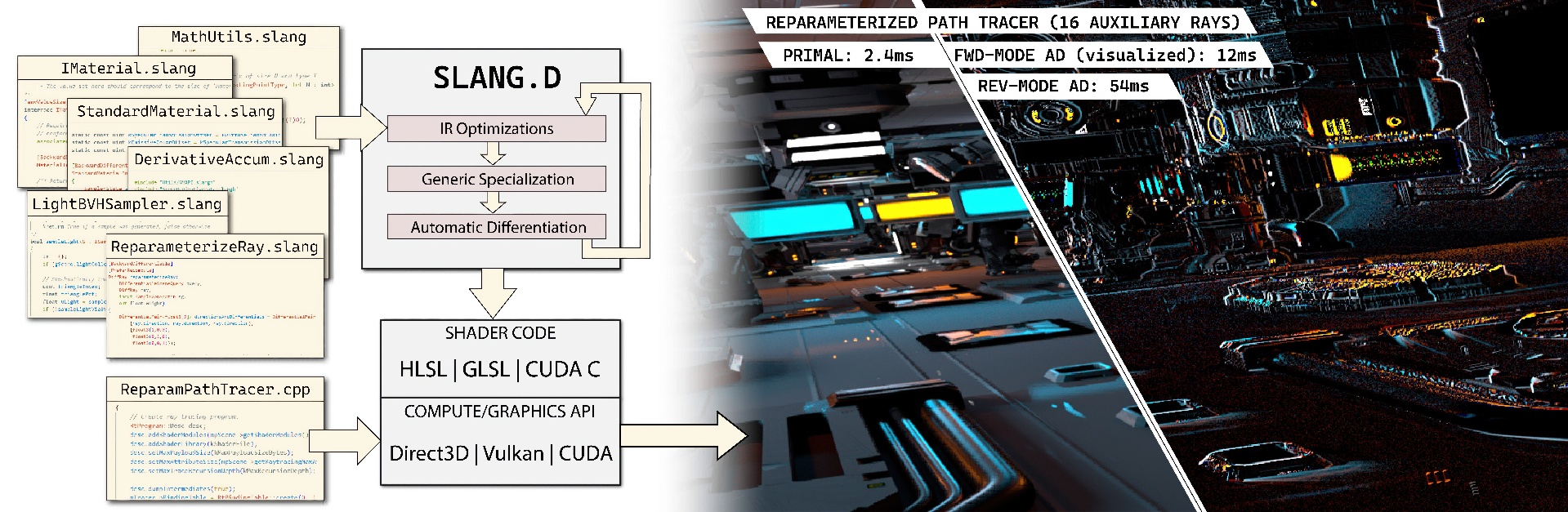
Abstract:
We introduce SLANG.D, a shading language that incorporates first-class automatic differentiation support derived from the Slang language. The new shading language allows us to transform a Direct3D-based path tracer to be fully differentiable with minor modifications to existing code. SLANG.D enables a shared ecosystem between machine learning frameworks and pre-existing graphics hardware API-based rendering systems, promoting the interchange of components and ideas across these two domains. Our contributions include a differentiable type system designed to ensure type safety and semantic clarity in codebases that blend differentiable and non-differentiable code, language primitives that automatically generate both forward and reverse gradient propagation methods, and a compiler architecture that generates efficient derivative propagation shader code for graphics pipelines. Our compiler supports differentiating code that involves arbitrary control-flow, dynamic dispatch, generics and higher-order differentiation, while providing developers flexible control of checkpointing and gradient aggregation strategies for best performance. Our system allows us to differentiate an existing real-time path tracer, Falcor, with minimal change to its shader code. We show that the compiler-generated derivative kernels perform as efficiently as handwritten ones. In several benchmarks, the SLANG.D code achieves significant speedup when compared to prior automatic differentiation systems.



