
“Simulation, modeling and authoring of glaciers” by Argudo, Galin, Peytavie, Paris and Guérin
Conference:
Type(s):
Title:
- Simulation, modeling and authoring of glaciers
Session/Category Title:
- Animation: Fluids - Phenomenon
Presenter(s)/Author(s):
Abstract:
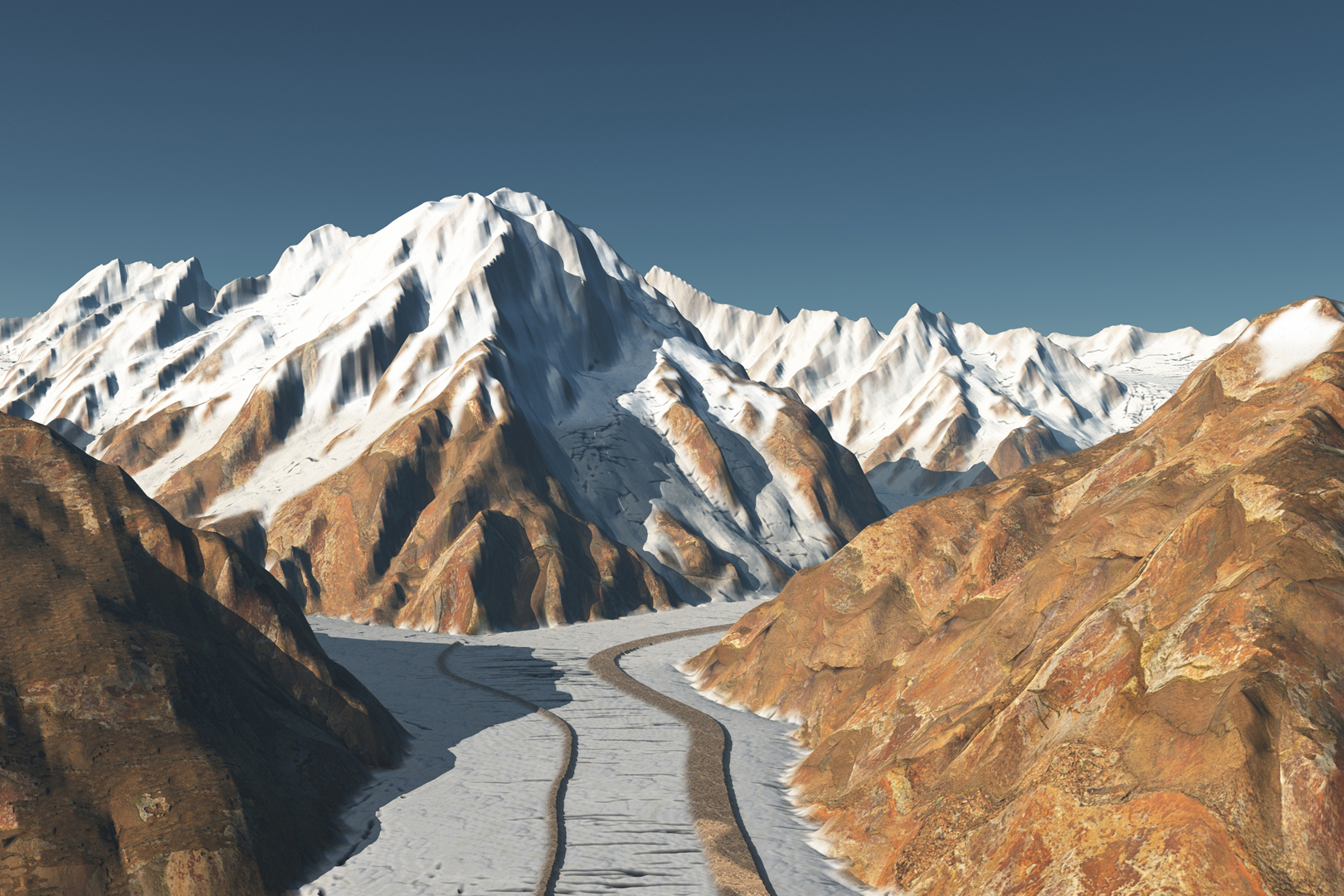
Glaciers are some of the most visually arresting and scenic elements of cold regions and high mountain landscapes. Although snow-covered terrains have previously received attention in computer graphics, simulating the temporal evolution of glaciers as well as modeling their wide range of features has never been addressed. In this paper, we combine a Shallow Ice Approximation simulation with a procedural amplification process to author high-resolution realistic glaciers. Our multiresolution method allows the interactive simulation of the formation and the evolution of glaciers over hundreds of years. The user can easily modify the environment variables, such as the average temperature or precipitation rate, to control the glacier growth, or directly use brushes to sculpt the ice or bedrock with interactive feedback. Mesoscale and smallscale landforms that are not captured by the glacier simulation, such as crevasses, moraines, seracs, ogives, or icefalls are synthesized using procedural rules inspired by observations in glaciology and according to the physical parameters derived from the simulation. Our method lends itself to seamless integration into production pipelines to decorate reliefs with glaciers and realistic ice features.
References:
1. Richard Barnes, Clarence Lehman, and David Mulla. 2014. Priority-flood: An optimal depression-filling and watershed-labeling algorithm for digital elevation models. Computers and Geosciences 62 (2014), 117–127.Google ScholarDigital Library
2. Matthew M Bennett and Neil F Glasser. 2011. Glacial geology: ice sheets and landforms. John Wiley & Sons.Google Scholar
3. Robert Bindschadler. 1983. The Importance of Pressurized Subglacial Water in Separation and Sliding at the Glacier Bed. Journal of Glaciology 29, 101 (1983), 3–19.Google ScholarCross Ref
4. J. Braun, D. Zwartz, and J.H. Tomkin. 1999. A new surface-processes model combining glacial and fluvial erosion. Annals of Glaciology 28 (1999), 282–290.Google ScholarCross Ref
5. Ed Bueler. 2016. Numerical modelling of glaciers, ice sheets, and ice shelves (course notes).Google Scholar
6. Yanyun Chen, Hanqiu Sun, Hui Lin, and Enhua Wu. 2003. Modelling and rendering of snowy natural scenery using multi-mapping techniques. Journal of Visualization and Computer Animation 14, 1 (2003), 21–30.Google ScholarCross Ref
7. Aland Clowes and Peter Comfort. 1987. Process and landform: an outline of contemporary geomorphology. Oliver & Boyd.Google Scholar
8. William Colgan, Harihar Rajaram, Waleed Abdalati, Cheryl McCutchan, Ruth Mottram, Mahsa S. Moussavi, and Shane Grigsby. 2016. Glacier crevasses: Observations, models, and mass balance implications. Reviews of Geophysics 54, 1 (2016), 119–161.Google ScholarCross Ref
9. Guillaume Cordonnier, P. Ecormier, Eric Galin, James Gain, Bedrich Benes, and MariePaule Cani. 2018. Interactive Generation of Time-evolving, Snow-Covered Landscapes with Avalanches. Computer Graphics Forum 37, 2 (2018), 497–509.Google ScholarCross Ref
10. Kurt M Cuffey and William Stanley Bryce Paterson. 2010. The physics of glaciers. Academic Press.Google Scholar
11. François Dagenais, Jonathan Gagnon, and Eric Paquette. 2016. An Efficient Layered Simulation Workflow for Snow Imprints. The Visual Computer 32, 6–8 (2016), 881–890.Google ScholarDigital Library
12. David L Egholm, Mads F Knudsen, Chris D Clark, and Jerome E Lesemann. 2011. Modeling the flow of glaciers in steep terrains: The integrated second-order shallow ice approximation (iSOSIA). Journal of Geophysical Research: Earth Surface 116, F2 (2011).Google Scholar
13. Ian S. Evans and Nicholas J. Cox. 2005. Global variations of local asymmetry in glacier altitude: separation of north-south and east-west components. Journal of Glaciology 51, 174 (2005), 469–482.Google ScholarCross Ref
14. Paul Fearing. 2000. Computer Modelling of Fallen Snow. In Proceedings of Siggraph. ACM Press/Addison-Wesley Publishing Co., 37–46.Google ScholarDigital Library
15. Niels Festenberg and Stefan Gumhold. 2011. Diffusion-Based Snow Cover Generation. Computer Graphics Forum 30, 6 (2011), 1837–1849.Google ScholarCross Ref
16. N. V. Festenberg and S. Gumhold. 2009. A Geometric Algorithm for Snow Distribution in Virtual Scenes. In Proceedings of EG Conference on Natural Phenomena. 17–25.Google Scholar
17. David Foldes and Bedrich Benes. 2007. Occlusion-Based Snow Accumulation Simulation. In Workshop in Virtual Reality Interactions and Physical Simulation “VRIPHYS” (2007). The Eurographics Association, 35–41.Google Scholar
18. Eric Galin, Eric Guérin, Adrien Peytavie, Guillaume Cordonnier, Marie-Paule Cani, Bedrich Benes, and James Gain. 2019. A Review of Digital Terrain Modeling. Computer Graphics Forum (proceedings of Eurographics 2019 STAR) 38, 2 (2019), 553–577.Google Scholar
19. J. W. Glen and Max Ferdinand Perutz. 1955. The creep of polycrystalline ice. Proceedings of the Royal Society of London. Series A. Mathematical and Physical Sciences 228, 1175 (1955), 519–538.Google Scholar
20. Francois Grosbellet, Adrien Peytavie, Éric Guérin, Eric Galin, Stéphane Mérillou, and Bedrich Benes. 2016. Environmental Objects for Authoring Procedural Scenes. Computer Graphics Forum 35, 1 (2016), 296–308.Google ScholarDigital Library
21. Rachel M. Headley, Gerard Roe, and Bernard Hallet. 2012. Glacier longitudinal profiles in regions of active uplift. Earth and Planetary Science Letters 317–318 (2012), 354–362.Google Scholar
22. Tommy Hinks and Ken Museth. 2009. Wind-driven snow buildup using a level set approach. In EG Ireland Workshop Series. 19–26.Google Scholar
23. Richard Huggett. 2016. Fundamentals of geomorphology. Routledge Fundamentals of Physical Geography.Google Scholar
24. Kolumban Hutter. 1983. Theoretical glaciology; material science of ice and the mechanics of glaciers and ice sheets. D. Reidel Publishing Company, Dordrecht, The Netherlands.Google Scholar
25. A. H. Jarosch, C. G. Schoof, and F. S. Anslow. 2013. Restoring mass conservation to shallow ice flow models over complex terrain. The Cryosphere 7, 1 (2013), 229–240.Google ScholarCross Ref
26. Mark A. Kessler, Robert S. Anderson, and Greg M. Stock. 2006. Modeling topographic and climatic control of east-west asymmetry in Sierra Nevada glacier length during the Last Glacial Maximum. Journal of Geophysical Research: Earth Surface 111, F2 (2006).Google Scholar
27. Wouter Knap, Johannes Oerlemans, and Martin Cabée. 1996. Climate sensitivity of the ice cap of King George Island, South Shetland Islands, Antarctica. Annals of Glaciology 23 (1996), 154–159.Google ScholarCross Ref
28. MW Mahaffy. 1976. A three-dimensional numerical model of ice sheets: Tests on the Barnes Ice Cap, Northwest Territories. Journal of Geophysical Research 81, 6 (1976), 1059–1066.Google ScholarCross Ref
29. N. Maréchal, E. Guérin, E. Galin, S. Mérillou, and N. Mérillou. 2010. Heat Transfer Simulation for Modeling Realistic Winter Sceneries. Computer Graphics Forum 29, 2 (2010), 449–458.Google ScholarCross Ref
30. Claus Moeslund, Thomas anvisud Madsen, Michael Aagaard, and Dennis Lerche. 2005. Modeling falling and accumulating snow. In Vision, Video and Graphics. The Eurographics Association.Google Scholar
31. Tomoaki Moriya and Tokiichiro Takahashi. 2010. A Real Time Computer Model for Wind-Driven Fallen Snow. In ACM SIGGRAPH ASIA 2010 Sketches. 26:1–26:2.Google ScholarDigital Library
32. Kazunobu Muraoka and Norishige Chiba. 2000. Visual Simulation of Snowfall, Snow Cover and Snowmelt. In Proceedings of the Parallel and Distributed Systems: Workshops (ICPADS ’00).Google ScholarCross Ref
33. Tomoyuki Nishita, Hiroshi Iwasaki, Yoshinori Dobashi, and Eihachiro Nakamae. 1997. A Modeling and Rendering Method for Snow by Using Metaballs. Computer Graphics Forum 16, 3 (1997), C357–C364.Google ScholarCross Ref
34. John Frederick Nye. 1957. The distribution of stress and velocity in glaciers and icesheets. Proceedings of the Royal Society of London. Series A. Mathematical and Physical Sciences 239, 1216 (1957), 113–133.Google Scholar
35. J Oerlemans. 1986. An attempt to simulate historic front variations of Nigardsbreen, Norway. Theoretical and applied climatology 37, 3 (1986), 126–135.Google ScholarCross Ref
36. Simon Premože, William B. Thompson, and Peter Shirley. 1999. Geospecific Rendering of Alpine Terrain. In Eurographics Workshop on Rendering (EGWR’99) (Granada, Spain). 107–118.Google Scholar
37. D. T. Reynolds, S. D. Laycock, and A. M. Day. 2015. Real-time Accumulation of Occlusion-based Snow. The Visual Computer 31, 5 (2015), 689–700.Google ScholarDigital Library
38. P L Roe. 1986. Characteristic-Based Schemes for the Euler Equations. Annual Review of Fluid Mechanics 18, 1 (1986), 337–365.Google ScholarCross Ref
39. Wong Sai-Keung and Fu I-Ting. 2015. Hybrid-based Snow Simulation and Snow Rendering with Shell Textures. Computer Animation and Virtual Worlds 26, 3–4 (2015), 413–421.Google Scholar
40. Alexey Stomakhin, Craig Schroeder, Lawrence Chai, Joseph Teran, and Andrew Selle. 2013. A Material Point Method for Snow Simulation. ACM Transactions on Graphics 32, 4 (2013), 102:1–102:10.Google ScholarDigital Library
41. Robert W. Sumner, James F. O’Brien, and Jessica K. Hodgins. 1999. Animating Sand, Mud, and Snow. Computer Graphics Forum 18, 1 (1999), 17–26.Google ScholarCross Ref
42. Kohe Tokoi. 2006. A shadow buffer technique for simulating snow-covered shapes. In International Conference on Computer Graphics, Imaging and Visualisation. IEEE Computer Society, 310–316.Google Scholar
43. Bram van Leer. 1979. Towards the ultimate conservative difference scheme. V. A second-order sequel to Godunov’s method. J. Comput. Phys. 32, 1 (1979), 101 — 136.Google ScholarCross Ref
44. ChangboWang, Zhangye Wang, Tian Xia, and Qunsheng Peng. 2006. Real-time Snowing Simulation. The Visual Computer 22, 5 (2006), 315–323.Google ScholarDigital Library



