“Shape from Release: Inverse Design and Fabrication of Controlled Release Structures” by Panetta, Mohammadian, Luci and Babaei
Conference:
Type(s):
Title:
- Shape from Release: Inverse Design and Fabrication of Controlled Release Structures
Session/Category Title:
- Simulation of Everything
Presenter(s)/Author(s):
Abstract:
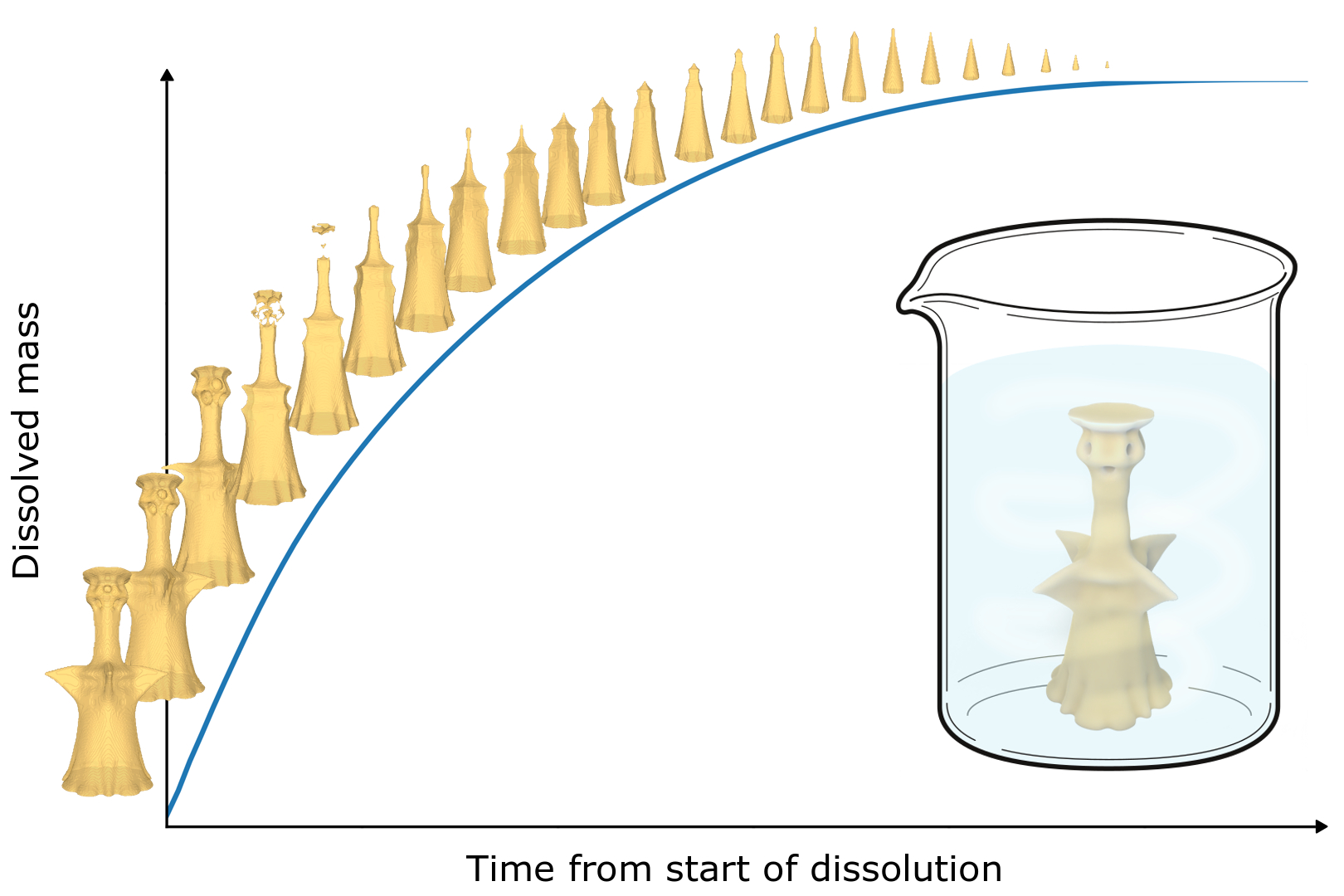
Objects with different shapes can dissolve in significantly different ways inside a solution. Predicting different shapes’ dissolution dynamics is an important problem especially in pharmaceutics. More important and challenging, however, is controlling the dissolution via shape, i.e., designing shapes that lead to a desired release behavior of materials in a solvent over a specific time. Here, we tackle this challenge by introducing a computational inverse design pipeline. We begin by introducing a simple, physically-inspired differentiable forward model of dissolution. We then formulate our inverse design as a PDE-constrained topology optimization that has access to analytical derivatives obtained via sensitivity analysis. Furthermore, we incorporate fabricability terms in the optimization objective that enable physically realizing our designs. We thoroughly analyze our approach on a diverse set of examples via both simulation and fabrication.
References:
1. Grégoire Allaire, Charles Dapogny, Alexis Faure, and Georgios Michailidis. 2017. Shape optimization of a layer by layer mechanical constraint for additive manufacturing. Comptes Rendus Mathematique 355, 6 (2017), 699–717.
2. Thomas Auzinger, Wolfgang Heidrich, and Bernd Bickel. 2018. Computational design of nanostructural color for additive manufacturing. ACM Transactions on Graphics (TOG) 37, 4 (2018), 1–16.
3. Vahid Babaei, Kiril Vidimče, Michael Foshey, Alexandre Kaspar, Piotr Didyk, and Wojciech Matusik. 2017. Color contoning for 3D printing. ACM Transactions on Graphics (TOG) 36, 4 (2017), 1–15.
4. Moritz Bächer, Emily Whiting, Bernd Bickel, and Olga Sorkine-Hornung. 2014. Spin-it: optimizing moment of inertia for spinnable objects. ACM Transactions on Graphics (TOG) 33, 4 (2014), 1–10.
5. Martin Philip Bendsoe and Ole Sigmund. 2013. Topology optimization: theory, methods, and applications. Springer Science & Business Media.
6. Amit H. Bermano, Thomas Funkhouser, and Szymon Rusinkiewicz. 2017. State of the Art in Methods and Representations for Fabrication-Aware Design. Computer Graphics Forum 36, 2 (2017), 509–535. arXiv:https://onlinelibrary.wiley.com/doi/pdf/10.1111/cgf.13146
7. Bernd Bickel, Moritz Bächer, Miguel A Otaduy, Hyunho Richard Lee, Hanspeter Pfister, Markus Gross, and Wojciech Matusik. 2010. Design and fabrication of materials with desired deformation behavior. ACM Transactions on Graphics (TOG) 29, 4 (2010), 1–10.
8. Laura Briese, Rolf S Arvidson, and Andreas Luttge. 2017. The effect of crystal size variation on the rate of dissolution-A kinetic Monte Carlo study. Geochimica et Cosmochimica Acta 212 (2017), 167–175.
9. Tyler E Bruns and Daniel A Tortorelli. 2001. Topology optimization of non-linear elastic structures and compliant mechanisms. Computer methods in applied mechanics and engineering 190, 26–27 (2001), 3443–3459.
10. David O. Cooney. 1972. Effect of geometry on the dissolution of pharmaceutical tablets and other solids: Surface detachment kinetics controlling. AIChE Journal 18, 2 (1972), 446–449. arXiv:https://aiche.onlinelibrary.wiley.com/doi/pdf/10.1002/aic.690180234
11. Stelian Coros, Bernhard Thomaszewski, Gioacchino Noris, Shinjiro Sueda, Moira Forberg, Robert W Sumner, Wojciech Matusik, and Bernd Bickel. 2013. Computational design of mechanical characters. ACM Transactions on Graphics (TOG) 32, 4 (2013), 1–12.
12. Keenan Crane, Clarisse Weischedel, and Max Wardetzky. 2017. The Heat Method for Distance Computation. Commun. ACM 60, 11 (Oct. 2017), 90–99.
13. Klaus Deckelnick, Charles M Elliott, and Vanessa Styles. 2011. Numerical analysis of an inverse problem for the eikonal equation. Numer. Math. 119, 2 (2011), 245–269.
14. Reiner M Dreizler and Eberhard KU Gross. 2012. Density functional theory: an approach to the quantum many-body problem. Springer Science & Business Media.
15. Adolf Fick. 1855. Ueber diffusion. Annalen der Physik 170, 1 (1855), 59–86.
16. Jason Furtney. 2021. scikit-fmm: the fast marching method for Python. https://github.com/scikit-fmm/scikit-fmm.
17. Michael C Georgiadis and Margaritis Kostoglou. 2001. On the optimization of drug release from multi-laminated polymer matrix devices. Journal of controlled release 77, 3 (2001), 273–285.
18. Jonathan Goole and Karim Amighi. 2016. 3D printing in pharmaceutics: A new tool for designing customized drug delivery systems. International journal of pharmaceutics 499, 1–2 (2016), 376–394.
19. Alvaro Goyanes, Pamela Robles Martinez, Asma Buanz, Abdul W Basit, and Simon Gaisford. 2015. Effect of geometry on drug release from 3D printed tablets. International journal of pharmaceutics 494, 2 (2015), 657–663.
20. HB Hopfenberg. 1976. Controlled release from erodible slabs, cylinders, and spheres. ACS Publications.
21. WE Katstra, RD Palazzolo, CW Rowe, B Giritlioglu, P Teung, and MJ Cima. 2000. Oral dosage forms fabricated by Three Dimensional Printing™. Journal of controlled release 66, 1 (2000), 1–9.
22. Christopher Xu Fu Lam, XM Mo, Swee-Hin Teoh, and DW Hutmacher. 2002. Scaffold development using 3D printing with a starch-based polymer. Materials Science and Engineering: C 20, 1–2 (2002), 49–56.
23. Shingyu Leung and Jianliang Qian. 2006. An adjoint state method for three-dimensional transmission traveltime tomography using first-arrivals. Communications in Mathematical Sciences 4, 1 (2006), 249–266.
24. Dingzeyu Li, David IW Levin, Wojciech Matusik, and Changxi Zheng. 2016. Acoustic voxels: computational optimization of modular acoustic filters. ACM Transactions on Graphics (TOG) 35, 4 (2016), 1–12.
25. Sanxiu Lu and Kristi S Anseth. 1999. Photopolymerization of multilaminated poly (HEMA) hydrogels for controlled release. Journal of controlled release 57, 3 (1999), 291–300.
26. Sanxiu Lu, W Fred Ramirez, and Kristi S Anseth. 1998. Modeling and optimization of drug release from laminated polymer matrix devices. AIChE journal 44, 7 (1998), 1689–1696.
27. Jonàs Martinez, Samuel Hornus, Haichuan Song, and Sylvain Lefebvre. 2018. Polyhedral Voronoi diagrams for additive manufacturing. ACM Transactions on Graphics (TOG) 37, 4 (2018), 1–15.
28. Wojciech Matusik, Boris Ajdin, Jinwei Gu, Jason Lawrence, Hendrik P. A. Lensch, Fabio Pellacini, and Szymon Rusinkiewicz. 2009. Printing Spatially-varying Reflectance. ACM Trans. Graph. 28, 5 (Dec. 2009), 128:1–128:9.
29. Momchil Minkov, Ian AD Williamson, Lucio C Andreani, Dario Gerace, Beicheng Lou, Alex Y Song, Tyler W Hughes, and Shanhui Fan. 2020. Inverse design of photonic crystals through automatic differentiation. ACS Photonics (2020).
30. Niloy J Mitra and Mark Pauly. 2009. Shadow art. ACM Transactions on Graphics 28, CONF (2009), 156–1.
31. E Bruce Nauman, Kandarp Patel, and Pankaj Karande. 2010. On the design and optimization of diffusion-controlled, planar delivery devices. Chemical engineering science 65, 2 (2010), 923–930.
32. Shree K Nayar, Katsushi Ikeuchi, and Takeo Kanade. 1991. Shape from interreflections. International Journal of Computer Vision 6, 3 (1991), 173–195.
33. Martin Nisser, Junyi Zhu, Tianye Chen, Katarina Bulovic, Parinya Punpongsanon, and Stefanie Mueller. 2019. Sequential support: 3D printing dissolvable support material for time-dependent mechanisms. In Proceedings of the Thirteenth International Conference on Tangible, Embedded, and Embodied Interaction. 669–676.
34. Mikhail Osanov and James K Guest. 2016. Topology optimization for architected materials design. Annual Review of Materials Research 46 (2016), 211–233.
35. Felix Ospald and Roland Herzog. 2017. SIMP based topology optimization for injection molding of SFRPs. In World Congress of Structural and Multidisciplinary Optimisation. Springer, 850–861.
36. L. Pauling. 2014. General Chemistry. Dover Publications. https://books.google.com/books?id=EpxSzteNvMYC
37. Katarzyna Pietrzak, Abdullah Isreb, and Mohamed A Alhnan. 2015. A flexible-dose dispenser for immediate and extended release 3D printed tablets. European journal of pharmaceutics and biopharmaceutics 96 (2015), 380–387.
38. Michal Piovarči, Michael Foshey, Vahid Babaei, Szymon Rusinkiewicz, Wojciech Matusik, and Piotr Didyk. 2020. Towards spatially varying gloss reproduction for 3D printing. ACM Transactions on Graphics (TOG) 39, 6 (2020), 1–13.
39. Romain Prévost, Emily Whiting, Sylvain Lefebvre, and Olga Sorkine-Hornung. 2013. Make it stand: balancing shapes for 3D fabrication. ACM Transactions on Graphics (TOG) 32, 4 (2013), 1–10.
40. Celeste Sagui and Thomas A Darden. 1999. Molecular dynamics simulations of biomolecules: long-range electrostatic effects. Annual review of biophysics and biomolecular structure 28, 1 (1999), 155–179.
41. Abraham. Savitzky and M. J. E. Golay. 1964. Smoothing and Differentiation of Data by Simplified Least Squares Procedures. Analytical Chemistry 36, 8 (1964), 1627–1639. arXiv:https://doi.org/10.1021/ac60214a047
42. Christian Schüller, Daniele Panozzo, and Olga Sorkine-Hornung. 2014. Appearance-mimicking surfaces. ACM Transactions on Graphics (TOG) 33, 6 (2014), 1–10.
43. Christian Schumacher, Bernd Bickel, Jan Rys, Steve Marschner, Chiara Daraio, and Markus Gross. 2015. Microstructures to control elasticity in 3D printing. ACM Transactions on Graphics (TOG) 34, 4 (2015), 136.
44. Yuliy Schwartzburg, Romain Testuz, Andrea Tagliasacchi, and Mark Pauly. 2014. High-contrast computational caustic design. ACM Transactions on Graphics (TOG) 33, 4 (2014), 1–11.
45. James A Sethian. 1985. Curvature and the evolution of fronts. Communications in Mathematical Physics 101, 4 (1985), 487–499.
46. J. A. Sethian. 1999. Fast Marching Methods. SIAM Rev. 41, 2 (1999), 199–235. arXiv:https://doi.org/10.1137/S0036144598347059
47. Seyyedeh Faezeh Seyyedrezaei and Gholamreza Dadashzadeh. 2016. Optimal Control of Light Propagation Governed by Eikonal Equation within Inhomogeneous Media Using Computational Adjoint Approach. Journal of Communication Engineering 5, 1 (2016), 24–37.
48. L. Shargel, A. Yu, and S. Wu-Pong. 2016. Applied Biopharmaceutics & Pharmacokinetics, Seventh Edition. McGraw-Hill Education.
49. Juergen Siepmann and F Siepmann. 2008. Mathematical modeling of drug delivery. International journal of pharmaceutics 364, 2 (2008), 328–343.
50. Justyna Skowyra, Katarzyna Pietrzak, and Mohamed A Alhnan. 2015. Fabrication of extended-release patient-tailored prednisolone tablets via fused deposition modelling (FDM) 3D printing. European Journal of Pharmaceutical Sciences 68 (2015), 11–17.
51. Ondrej Stava, Juraj Vanek, Bedrich Benes, Nathan Carr, and Radomír Měch. 2012. Stress relief: improving structural strength of 3D printable objects. ACM Transactions on Graphics (TOG) 31, 4 (2012), 1–11.
52. Denis Sumin, Tobias Rittig, Vahid Babaei, Thomas Nindel, Alexander Wilkie, Piotr Didyk, Bernd Bickel, Jaroslav Kurivánek, Karol Myszkowski, and Tim Weyrich. 2019. Geometry-aware scattering compensation for 3D printing. ACM Trans. Graph. 38, 4 (2019).
53. Pengbin Tang, Jonas Zehnder, Stelian Coros, and Bernhard Thomaszewski. 2020. A harmonic balance approach for designing compliant mechanical systems with nonlinear periodic motions. ACM Transactions on Graphics (TOG) 39, 6 (2020), 1–14.
54. Seema Thakral, Naveen K Thakral, and Dipak K Majumdar. 2013. Eudragit®: a technology evaluation. Expert opinion on drug delivery 10, 1 (2013), 131–149.
55. Robert E Treybal. 1980. Mass transfer operations. New York 466 (1980).
56. Fengwen Wang, Boyan Stefanov Lazarov, and Ole Sigmund. 2011. On projection methods, convergence and robust formulations in topology optimization. Structural and Multidisciplinary Optimization 43, 6 (2011), 767–784.
57. Lingfeng Wang and Emily Whiting. 2016. Buoyancy optimization for computational fabrication. In Computer Graphics Forum, Vol. 35. Wiley Online Library, 49–58.
58. Robert J Woodham. 1980. Photometric method for determining surface orientation from multiple images. Optical engineering 19, 1 (1980), 191139.
59. Xinming Zhang. 2020. An Inverse Problem Solution Scheme for Solving the Optimization Problem of Drug-Controlled Release from Multilaminated Devices. Computational and Mathematical Methods in Medicine 2020 (2020).
60. P. Zunino, C. D’Angelo, L. Petrini, C. Vergara, C. Capelli, and F. Migliavacca. 2009. Numerical simulation of drug eluting coronary stents: Mechanics, fluid dynamics and drug release. Computer Methods in Applied Mechanics and Engineering 198, 45 (2009), 3633–3644. Models and Methods in Computational Vascular and Cardiovascular Mechanics.