
“Second-Order Finite Elements for Deformable Surfaces” by Le, Deng, Bu, Zhu and Du
Conference:
Type(s):
Title:
- Second-Order Finite Elements for Deformable Surfaces
Session/Category Title:
- Deformable Solids
Presenter(s)/Author(s):
Abstract:
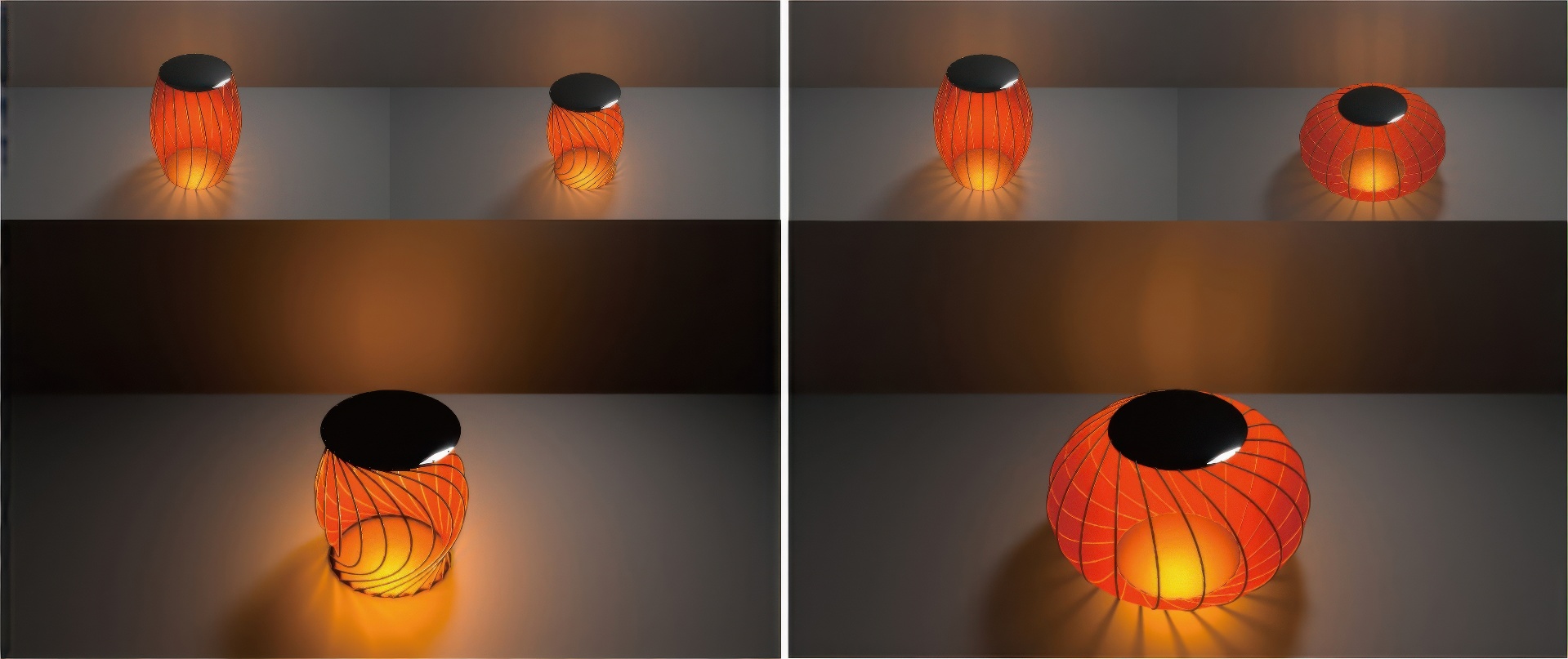
We present a computational framework for simulating deformable surfaces with second-order triangular finite elements. Our method develops numerical schemes for discretizing stretching, shearing, and bending energies of deformable surfaces in a second-order finite-element setting. In particular, we introduce a novel discretization scheme for approximating mean curvatures on a curved triangle mesh. Our framework also integrates a virtual-node finite-element scheme that supports two-way coupling between cut-cell rods without expensive remeshing. We compare our approach with traditional simulation methods using linear and higher-order finite elements and demonstrate its advantages in several challenging settings, such as low-resolution meshes, anisotropic triangulation, and stiff materials. Finally, we showcase several applications of our framework in cloth simulation, mixed Origami and Kirigami, and biologically-inspired soft wing simulation.
References:
[1]
G Abaqus. 2011. Abaqus 6.11. Dassault Systemes Simulia Corporation, Providence, RI, USA (2011).
[2]
Chandrajit L. Bajaj, Guoliang Xu, and Qin Zhang. 2007. Smooth surface constructions via a higher-order level-set method. In CAD/Graphics. 27.
[3]
David Baraff and Andrew Witkin. 1998. Large Steps in Cloth Simulation. In Proceedings of the 25th Annual Conference on Computer Graphics and Interactive Techniques. 43–54.
[4]
Timothy Barth and Paul Frederickson. 1990. Higher order solution of the Euler equations on unstructured grids using quadratic reconstruction. In 28th aerospace sciences meeting. 13.
[5]
Klaus-Jürgen Bathe and Lee-Wing Ho. 1981. A simple and effective element for analysis of general shell structures. Computers & Structures 13, 5-6 (1981), 673–681.
[6]
Jean-Louis Batoz, Klaus-JÜRgen Bathe, and Lee-Wing Ho. 1980. A study of three-node triangular plate bending elements. International journal for numerical methods in engineering 15, 12 (1980), 1771–1812.
[7]
Jacob Bedrossian, James H. Von Brecht, Siwei Zhu, Eftychios Sifakis, and Joseph M Teran. 2010. A second order virtual node method for elliptic problems with interfaces and irregular domains. J. Comput. Phys. 229, 18 (2010), 6405–6426.
[8]
T. Belytschko, H. Stolarski, and N. Carpenter. 1984. A C0 triangular plate element with one-point quadrature. Internat. J. Numer. Methods Engrg. 20, 5 (1984), 787–802.
[9]
Miklós Bergou, Max Wardetzky, Stephen Robinson, Basile Audoly, and Eitan Grinspun. 2008. Discrete Elastic Rods. ACM Transactions on Graphics (TOG) 27, 3 (aug 2008), 63:1–63:12.
[10]
Sofien Bouaziz, Sebastian Martin, Tiantian Liu, Ladislav Kavan, and Mark Pauly. 2014. Projective dynamics: Fusing constraint projections for fast simulation. ACM transactions on graphics (TOG) 33, 4 (2014), 1–11.
[11]
Eddy Boxerman. 2003. Speeding up cloth simulation. Ph. D. Dissertation. University of British Columbia.
[12]
Stephen Boyd, Stephen P Boyd, and Lieven Vandenberghe. 2004. Convex optimization. Cambridge university press.
[13]
David E. Breen, Donald H. House, and Michael J. Wozny. 1994. Predicting the drape of woven cloth using interacting particles. In Proceedings of the 21st annual conference on Computer graphics and interactive techniques. 365–372.
[14]
R. Bridson, S. Marino, and R. Fedkiw. 2003. Simulation of Clothing with Folds and Wrinkles. In Proceedings of the 2003 ACM SIGGRAPH/Eurographics Symposium on Computer Animation (San Diego, California) (SCA ’03). Eurographics Association, Goslar, DEU, 28–36.
[15]
Oleksiy Busaryev, Tamal K. Dey, and Huamin Wang. 2013. Adaptive fracture simulation of multi-layered thin plates. ACM Transactions on Graphics (TOG) 32, 4 (2013), 1–6.
[16]
EMB Campello, PM Pimenta, and P Wriggers. 2003. A triangular finite shell element based on a fully nonlinear shell formulation. Computational mechanics 31, 6 (2003), 505–518.
[17]
Hsiao-Yu Chen, Arnav Sastry, Wim M. van Rees, and Etienne Vouga. 2018. Physical simulation of environmentally induced thin shell deformation. ACM Transactions on Graphics (TOG) 37, 4 (2018), 1–13.
[18]
Zhili Chen, Renguo Feng, and Huamin Wang. 2013. Modeling friction and air effects between cloth and deformable bodies. ACM Transactions on Graphics (TOG) 32, 4 (2013), 1–8.
[19]
Fehmi Cirak, Michael Ortiz, and Peter Schröder. 2000. Subdivision surfaces: a new paradigm for thin-shell finite-element analysis. Internat. J. Numer. Methods Engrg. 47, 12 (2000), 2039–2072.
[20]
David Cohen-Steiner and Jean-Marie Morvan. 2003. Restricted Delaunay Triangulations and Normal Cycle. In Proceedings of the nineteenth annual symposium on Computational geometry. 312–321.
[21]
Tim Davis. 2023. SuiteSparse: A Suite of Sparse matrix packages. https://github.com/DrTimothyAldenDavis/SuiteSparse.
[22]
Sailkat Dey, Robert M. O’bara, and Mark S. Shephard. 1999. Curvilinear Mesh Generation in 3D. In IMR. Citeseer, 407–417.
[23]
Bernhard Eberhardt, Olaf Etzmuß, and Michael Hauth. 2000. Implicit-explicit schemes for fast animation with particle systems. In Computer Animation and Simulation 2000. Springer, 137–151.
[24]
Bernhard Eberhardt, Andreas Weber, and Wolfgang Strasser. 1996. A fast, flexible, particle-system model for cloth draping. IEEE Computer Graphics and Applications 16, 5 (1996), 52–59.
[25]
Yotam Gingold, Adrian Secord, Jefferson Y Han, Eitan Grinspun, and Denis Zorin. 2004. A discrete model for inelastic deformation of thin shells. In ACM SIGGRAPH/Eurographics symposium on computer animation. Citeseer.
[26]
Eitan Grinspun, Anil N Hirani, Mathieu Desbrun, and Peter Schröder. 2003. Discrete Shells. In Proceedings of the 2003 ACM SIGGRAPH/Eurographics symposium on Computer animation. Citeseer, 62–67.
[27]
Ami Harten, Bjorn Engquist, Stanley Osher, and Sukumar R. Chakravarthy. 1997. Uniformly high order accurate essentially non-oscillatory schemes, III. Springer.
[28]
Yuanming Hu, Yu Fang, Ziheng Ge, Ziyin Qu, Yixin Zhu, Andre Pradhana, and Chenfanfu Jiang. 2018. A moving least squares material point method with displacement discontinuity and two-way rigid body coupling. ACM Transactions on Graphics (TOG) 37, 4 (2018), 1–14.
[29]
Y. C. Hu, Y. X. Zhou, K. W. Kwok, and K. Y. Sze. 2021. Simulating flexible origami structures by finite element method. International Journal of Mechanics and Materials in Design (2021), 1–29.
[30]
H. T. Huynh, Zhi J. Wang, and Peter E. Vincent. 2014. High-order methods for computational fluid dynamics: A brief review of compact differential formulations on unstructured grids. Computers & fluids 98 (2014), 209–220.
[31]
Jeremy Ims, Zhaowen Duan, and Zhi J. Wang. 2015. meshCurve: an automated low-order to high-order mesh generator. In 22nd AIAA computational fluid dynamics conference. 2293.
[32]
Antony Jameson. 2011. Advances in bringing high-order methods to practical applications in computational fluid dynamics. In 20th AIAA Computational Fluid Dynamics Conference. 3226.
[33]
Chenfanfu Jiang, Craig Schroeder, Andrew Selle, Joseph Teran, and Alexey Stomakhin. 2015. The affine particle-in-cell method. ACM Transactions on Graphics (TOG) 34, 4 (2015), 1–10.
[34]
Claes Johnson. 2012. Numerical Solution of Partial Differential Equations by the Finite Element Method. Courier Corporation.
[35]
Couro Kane, Jerrold E Marsden, Michael Ortiz, and Matthew West. 2000. Variational Integrators and the Newmark Algorithm for Conservative and Dissipative Mechanical Systems. Internat. J. Numer. Methods Engrg. 49, 10 (2000), 1295–1325.
[36]
Theodore Kim and David Eberle. 2020. Dynamic deformables: implementation and production practicalities. In ACM SIGGRAPH 2020 Courses. 1–182.
[37]
H. Laurent and G. Rio. 2001. Formulation of a thin shell finite element with continuity C 0 and convected material frame notion. Computational Mechanics 27, 3 (2001), 218–232.
[38]
Minchen Li, Zachary Ferguson, Teseo Schneider, Timothy Langlois, Denis Zorin, Daniele Panozzo, Chenfanfu Jiang, and Danny M. Kaufman. 2020. Incremental Potential Contact: Intersection- and Inversion-free Large Deformation Dynamics. ACM Transactions on Graphics (TOG) 39, 4, Article 49 (2020).
[39]
Mickaël Ly, Romain Casati, Florence Bertails-Descoubes, Mélina Skouras, and Laurence Boissieux. 2018. Inverse elastic shell design with contact and friction. ACM Transactions on Graphics (TOG) 37, 6 (2018), 1–16.
[40]
Mickaël Ly, Jean Jouve, Laurence Boissieux, and Florence Bertails-Descoubes. 2020. Projective dynamics with dry frictional contact. ACM Transactions on Graphics (TOG) 39, 4 (2020), 57–1.
[41]
Richard H. Macneal. 1982. Derivation of element stiffness matrices by assumed strain distributions. Nuclear Engineering and Design 70, 1 (1982), 3–12.
[42]
Luigi Malomo, Jesús Pérez, Emmanuel Iarussi, Nico Pietroni, Eder Miguel, Paolo Cignoni, and Bernd Bickel. 2018. FlexMaps: computational design of flat flexible shells for shaping 3D objects. ACM Transactions on Graphics (TOG) 37, 6 (2018), 1–14.
[43]
Amin Mahmoudi Moghadam, Mehdi Shafieefar, and Roozbeh Panahi. 2016. Development of a high-order level set method: Compact conservative level set (CCLS). Computers & Fluids 129 (2016), 79–90.
[44]
Rahul Narain, Tobias Pfaff, and James F O’Brien. 2013. Folding and crumpling adaptive sheets. ACM Transactions on Graphics (TOG) 32, 4 (2013), 1–8.
[45]
Rahul Narain, Armin Samii, and James F. O’brien. 2012. Adaptive anisotropic remeshing for cloth simulation. ACM transactions on graphics (TOG) 31, 6 (2012), 1–10.
[46]
Jean-Christophe Nave, Rodolfo Ruben Rosales, and Benjamin Seibold. 2010. A gradient-augmented level set method with an optimally local, coherent advection scheme. J. Comput. Phys. 229, 10 (2010), 3802–3827.
[47]
Jorge Nocedal and Stephen Wright. 2006. Numerical Optimization. Springer Science & Business Media.
[48]
Julian Panetta, Florin Isvoranu, Tian Chen, Emmanuel Siéfert, Benoît Roman, and Mark Pauly. 2021. Computational inverse design of surface-based inflatables. ACM Transactions on Graphics (TOG) 40, 4 (2021), 1–14.
[49]
Julian Panetta, Mina Konaković-Luković, Florin Isvoranu, Etienne Bouleau, and Mark Pauly. 2019. X-shells: A new class of deployable beam structures. ACM Transactions on Graphics (TOG) 38, 4 (2019), 1–15.
[50]
Bořek Patzák. 2012. OOFEM—an object-oriented simulation tool for advanced modeling of materials and structures. Acta Polytechnica 52, 6 (2012).
[51]
Tobias Pfaff, Rahul Narain, Juan Miguel De Joya, and James F. O’Brien. 2014. Adaptive tearing and cracking of thin sheets. ACM Transactions on Graphics (TOG) 33, 4 (2014), 1–9.
[52]
R. Phaal and CR. Calladine. 1992. A simple class of finite elements for plate and shell problems. II: An element for thin shells, with only translational degrees of freedom. Internat. J. Numer. Methods Engrg. 35, 5 (1992), 979–996.
[53]
Teseo Schneider, Yixin Hu, Jérémie Dumas, Xifeng Gao, Daniele Panozzo, and Denis Zorin. 2018. Decoupling simulation accuracy from mesh quality. ACM transactions on graphics (2018).
[54]
Teseo Schneider, Yixin Hu, Xifeng Gao, Jérémie Dumas, Denis Zorin, and Daniele Panozzo. 2022. A large-scale comparison of tetrahedral and hexahedral elements for solving elliptic PDEs with the finite element method. ACM Transactions on Graphics (TOG) 41, 3 (2022), 1–14.
[55]
Nicholas Sharp, Keenan Crane, 2019. geometry-central. www.geometry-central.net.
[56]
Jonathan Shewchuk. 2002. What is a good linear finite element? interpolation, conditioning, anisotropy, and quality measures (preprint). University of California at Berkeley 73 (2002), 137.
[57]
Chi-Wang Shu. 2003. High-order finite difference and finite volume WENO schemes and discontinuous Galerkin methods for CFD. International Journal of Computational Fluid Dynamics 17, 2 (2003), 107–118.
[58]
Eftychios Sifakis and Jernej Barbic. 2012. FEM Simulation of 3D Deformable Solids: A Practitioner’s Guide to Theory, Discretization and Model Reduction. In ACM SIGGRAPH 2012 Courses (Los Angeles, California) (SIGGRAPH ’12). Association for Computing Machinery, New York, NY, USA, Article 20, 50 pages.
[59]
Eftychios Sifakis, Sebastian Marino, and Joseph Teran. 2008. Globally coupled collision handling using volume preserving Impulses. In SCA. 147–153.
[60]
Ari Stern and Eitan Grinspun. 2009. Implicit-explicit variational integration of highly oscillatory problems. Multiscale Modeling & Simulation 7, 4 (2009), 1779–1794.
[61]
K. Y. Sze and Dan Zhu. 1999. A quadratic assumed natural strain curved triangular shell element. Computer methods in applied mechanics and engineering 174, 1-2 (1999), 57–71.
[62]
Demetri Terzopoulos, John Platt, Alan Barr, and Kurt Fleischer. 1987. Elastically deformable models. In Proceedings of the 14th annual conference on Computer graphics and interactive techniques. 205–214.
[63]
Alexander Tessler and Thomas JR Hughes. 1985. A three-node Mindlin plate element with improved transverse shear. Computer Methods in Applied Mechanics and Engineering 50, 1 (1985), 71–101.
[64]
Oleg V. Vasilyev. 2000. High order finite difference schemes on non-uniform meshes with good conservation properties. J. Comput. Phys. 157, 2 (2000), 746–761.
[65]
Peter E. Vincent and Antony Jameson. 2011. Facilitating the adoption of unstructured high-order methods amongst a wider community of fluid dynamicists. Mathematical Modelling of Natural Phenomena 6, 3 (2011), 97–140.
[66]
Peter E. J. Vos, Spencer J. Sherwin, and Robert M. Kirby. 2010. From h to p efficiently: Implementing finite and spectral/hp element methods to achieve optimal performance for low-and high-order discretisations. J. Comput. Phys. 229, 13 (2010), 5161–5181.
[67]
Zhijian J. Wang, Krzysztof Fidkowski, Rémi Abgrall, Francesco Bassi, Doru Caraeni, Andrew Cary, Herman Deconinck, Ralf Hartmann, Koen Hillewaert, Hung T. Huynh, 2013. High-order CFD methods: current status and perspective. International Journal for Numerical Methods in Fluids 72, 8 (2013), 811–845.
[68]
Anna Wawrzinek, Klaus Hildebrandt, and Konrad Polthier. 2011. Koiter’s thin shells on catmull-clark limit surfaces. In VMV. 113–120.
[69]
Xu Zhongnian. 1992. A thick–thin triangular plate element. Internat. J. Numer. Methods Engrg. 33, 5 (1992), 963–973.
[70]
Xianlian Zhou and Jia Lu. 2005. NURBS-based Galerkin method and application to skeletal muscle modeling. In Proceedings of the 2005 ACM symposium on Solid and physical modeling. 71–78.



