
“RT-Octree: Accelerate PlenOctree Rendering with Batched Regular Tracking and Neural Denoising for Real-time Neural Radiance Fields” by Shu, Yi, Meng, Wu and Ma
Conference:
Type(s):
Title:
- RT-Octree: Accelerate PlenOctree Rendering with Batched Regular Tracking and Neural Denoising for Real-time Neural Radiance Fields
Session/Category Title:
- Technical Papers Fast-Forward
Presenter(s)/Author(s):
Abstract:
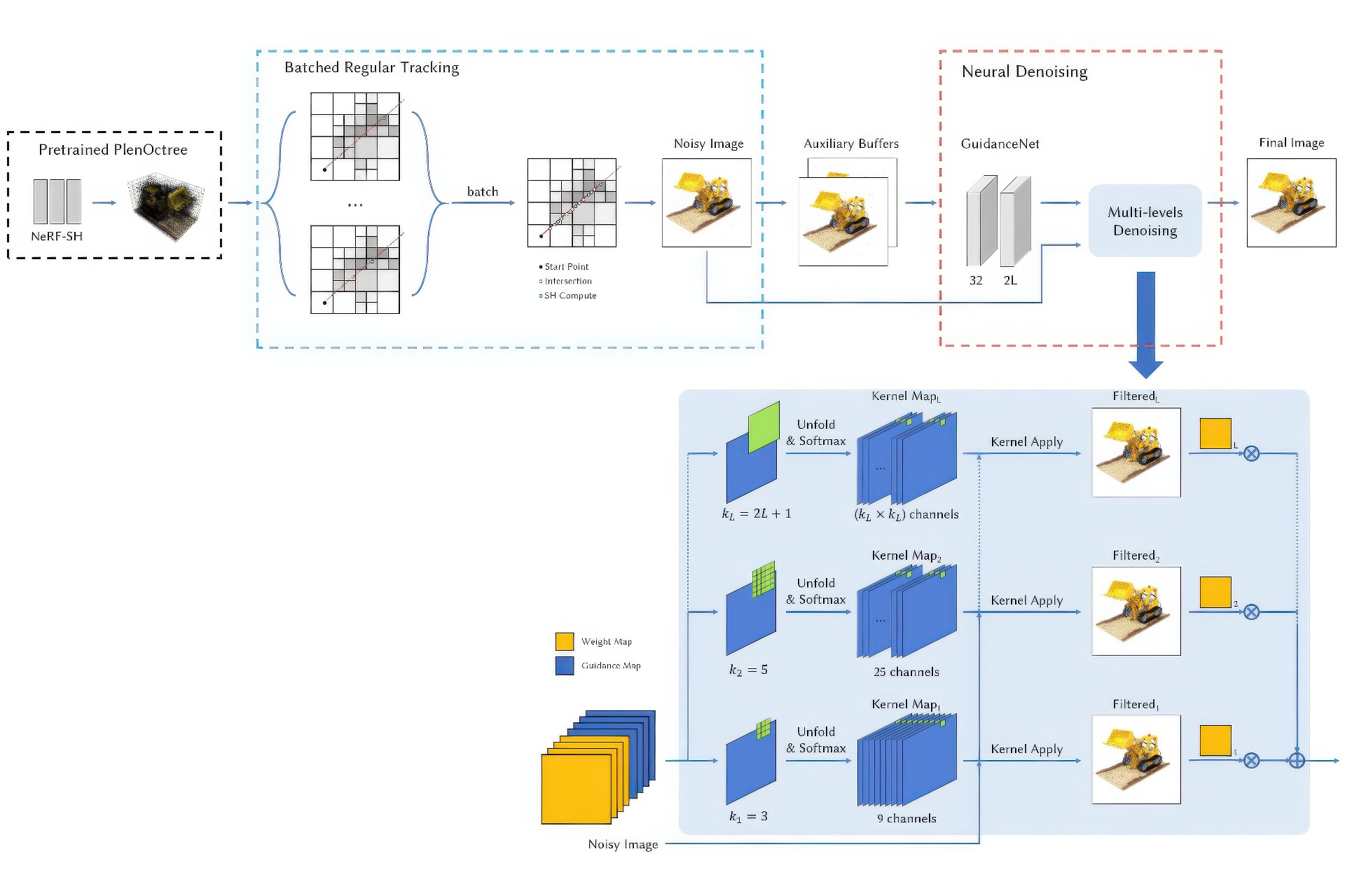
Neural Radiance Fields (NeRF) has demonstrated its ability to generate high-quality synthesized views. Nonetheless, due to its slow inference speed, there is a need to explore faster inference methods. In this paper, we propose RT-Octree, which uses batched regular tracking based on PlenOctree with neural denoising to achieve better real-time performance. We achieve this by modifying the volume rendering algorithm to regular tracking. We batch all samples for each pixel in one single ray-voxel intersection process to further improve the real-time performance. To reduce the variance caused by insufficient samples while ensuring real-time speed, we propose a lightweight neural network named GuidanceNet, which predicts the guidance map and weight maps utilized for the subsequent multi-layer denoising module. We evaluate our method on both synthetic and real-world datasets, obtaining a speed of 100+ frames per second (FPS) with a resolution of 1920 x 1080. Compared to PlenOctree, our method is 1.5 to 2 times faster in inference time and significantly outperforms NeRF by several orders of magnitude. The experimental results demonstrate the effectiveness of our approach in achieving real-time performance while maintaining similar rendering quality.
References:
[1]
Anne Aaron, Zhi Li, Megha Manohara, Joe Yuchieh Lin, Eddy Chi-Hao Wu, and C-C Jay Kuo. 2015. Challenges in cloud based ingest and encoding for high quality streaming media. In 2015 IEEE international conference on image processing (ICIP). IEEE, 1732–1736.
[2]
John C Butcher and Harry Messel. 1958. Electron number distribution in electron-photon showers. Physical Review 112, 6 (1958), 2096.
[3]
John Charles Butcher and Harry Messel. 1960. Electron number distribution in electron-photon showers in air and aluminium absorbers. Nuclear Physics 20 (1960), 15–128.
[4]
Chakravarty R Alla Chaitanya, Anton S Kaplanyan, Christoph Schied, Marco Salvi, Aaron Lefohn, Derek Nowrouzezahrai, and Timo Aila. 2017. Interactive reconstruction of Monte Carlo image sequences using a recurrent denoising autoencoder. ACM Transactions on Graphics (TOG) 36, 4 (2017), 1–12.
[5]
Eric R Chan, Connor Z Lin, Matthew A Chan, Koki Nagano, Boxiao Pan, Shalini De Mello, Orazio Gallo, Leonidas J Guibas, Jonathan Tremblay, Sameh Khamis, 2022. Efficient geometry-aware 3D generative adversarial networks. In Proceedings of the IEEE/CVF Conference on Computer Vision and Pattern Recognition. 16123–16133.
[6]
Kuian Chen. 2023. ngp_pl: Instant-ngp in pytorch+cuda trained with pytorch-lightning. https://github.com/kwea123/ngp_pl
[7]
Zhiqin Chen, Thomas Funkhouser, Peter Hedman, and Andrea Tagliasacchi. 2022. Mobilenerf: Exploiting the polygon rasterization pipeline for efficient neural field rendering on mobile architectures. arXiv preprint arXiv:2208.00277 (2022).
[8]
Holger Dammertz, Daniel Sewtz, Johannes Hanika, and Hendrik PA Lensch. 2010. Edge-avoiding a-trous wavelet transform for fast global illumination filtering. In Proceedings of the Conference on High Performance Graphics. 67–75.
[9]
Mauricio Delbracio, Pablo Musé, Antoni Buades, Julien Chauvier, Nicholas Phelps, and Jean-Michel Morel. 2014. Boosting Monte Carlo rendering by ray histogram fusion. ACM Transactions on Graphics (TOG) 33, 1 (2014), 1–15.
[10]
Boyang Deng, Jonathan T. Barron, and Pratul P. Srinivasan. 2020. JaxNeRF: an efficient JAX implementation of NeRF. https://github.com/google-research/google-research/tree/master/jaxnerf
[11]
Xiaohan Ding, Xiangyu Zhang, Ningning Ma, Jungong Han, Guiguang Ding, and Jian Sun. 2021. Repvgg: Making vgg-style convnets great again. In Proceedings of the IEEE/CVF conference on computer vision and pattern recognition. 13733–13742.
[12]
Hangming Fan, Rui Wang, Yuchi Huo, and Hujun Bao. 2021. Real-time Monte Carlo Denoising with Weight Sharing Kernel Prediction Network. In Computer Graphics Forum, Vol. 40. Wiley Online Library, 15–27.
[13]
Stephan J Garbin, Marek Kowalski, Matthew Johnson, Jamie Shotton, and Julien Valentin. 2021. Fastnerf: High-fidelity neural rendering at 200fps. In Proceedings of the IEEE/CVF International Conference on Computer Vision. 14346–14355.
[14]
Jon Hasselgren, Jacob Munkberg, Marco Salvi, Anjul Patney, and Aaron Lefohn. 2020. Neural temporal adaptive sampling and denoising. In Computer Graphics Forum, Vol. 39. Wiley Online Library, 147–155.
[15]
Peter Hedman, Pratul P Srinivasan, Ben Mildenhall, Jonathan T Barron, and Paul Debevec. 2021. Baking neural radiance fields for real-time view synthesis. In Proceedings of the IEEE/CVF International Conference on Computer Vision. 5875–5884.
[16]
Tao Hu, Shu Liu, Yilun Chen, Tiancheng Shen, and Jiaya Jia. 2022. EfficientNeRF Efficient Neural Radiance Fields. In Proceedings of the IEEE/CVF Conference on Computer Vision and Pattern Recognition (CVPR). 12902–12911.
[17]
Yifan Jiang, Peter Hedman, Ben Mildenhall, Dejia Xu, Jonathan T Barron, Zhangyang Wang, and Tianfan Xue. 2023. AligNeRF: High-Fidelity Neural Radiance Fields via Alignment-Aware Training. In Proceedings of the IEEE/CVF Conference on Computer Vision and Pattern Recognition. 46–55.
[18]
James T Kajiya. 1986. The rendering equation. In Proceedings of the 13th annual conference on Computer graphics and interactive techniques. 143–150.
[19]
Markus Kettunen, Eugene d’Eon, Jacopo Pantaleoni, and Jan Novák. 2021. An unbiased ray-marching transmittance estimator. arXiv preprint arXiv:2102.10294 (2021).
[20]
Diederik P Kingma and Jimmy Ba. 2014. Adam: A method for stochastic optimization. arXiv preprint arXiv:1412.6980 (2014).
[21]
Arno Knapitsch, Jaesik Park, Qian-Yi Zhou, and Vladlen Koltun. 2017. Tanks and temples: Benchmarking large-scale scene reconstruction. ACM Transactions on Graphics (ToG) 36, 4 (2017), 1–13.
[22]
Peter Kutz, Ralf Habel, Yining Karl Li, and Jan Novák. 2017. Spectral and decomposition tracking for rendering heterogeneous volumes. ACM Transactions on Graphics (TOG) 36, 4 (2017), 1–16.
[23]
Ruilong Li, Hang Gao, Matthew Tancik, and Angjoo Kanazawa. 2023. Nerfacc: Efficient sampling accelerates nerfs. arXiv preprint arXiv:2305.04966 (2023).
[24]
Lingjie Liu, Jiatao Gu, Kyaw Zaw Lin, Tat-Seng Chua, and Christian Theobalt. 2020. Neural Sparse Voxel Fields. NeurIPS (2020).
[25]
Haimin Luo, Anpei Chen, Qixuan Zhang, Bai Pang, Minye Wu, Lan Xu, and Jingyi Yu. 2021. Convolutional neural opacity radiance fields. In 2021 IEEE International Conference on Computational Photography (ICCP). IEEE, 1–12.
[26]
Nelson Max. 1995. Optical models for direct volume rendering. IEEE Transactions on Visualization and Computer Graphics 1, 2 (1995), 99–108.
[27]
Xiaoxu Meng, Quan Zheng, Amitabh Varshney, Gurprit Singh, and Matthias Zwicker. 2020. Real-time Monte Carlo Denoising with the Neural Bilateral Grid. In EGSR (DL). 13–24.
[28]
Ben Mildenhall, Pratul P. Srinivasan, Matthew Tancik, Jonathan T. Barron, Ravi Ramamoorthi, and Ren Ng. 2020. NeRF: Representing Scenes as Neural Radiance Fields for View Synthesis. In ECCV.
[29]
Thomas Müller, Alex Evans, Christoph Schied, and Alexander Keller. 2022. Instant Neural Graphics Primitives with a Multiresolution Hash Encoding. ACM Trans. Graph. 41, 4, Article 102 (July 2022), 15 pages. https://doi.org/10.1145/3528223.3530127
[30]
Thomas Neff, Pascal Stadlbauer, Mathias Parger, Andreas Kurz, Joerg H Mueller, Chakravarty R Alla Chaitanya, Anton Kaplanyan, and Markus Steinberger. 2021. DONeRF: Towards Real-Time Rendering of Compact Neural Radiance Fields using Depth Oracle Networks. In Computer Graphics Forum, Vol. 40. Wiley Online Library, 45–59.
[31]
Merlin Nimier-David, Thomas Müller, Alexander Keller, and Wenzel Jakob. 2022. Unbiased inverse volume rendering with differential trackers. ACM Transactions on Graphics (TOG) 41, 4 (2022), 1–20.
[32]
Jan Novák, Iliyan Georgiev, Johannes Hanika, and Wojciech Jarosz. 2018. Monte Carlo methods for volumetric light transport simulation. In Computer Graphics Forum, Vol. 37. Wiley Online Library, 551–576.
[33]
Ken Perlin and Eric M Hoffert. 1989. Hypertexture. In Proceedings of the 16th annual conference on Computer graphics and interactive techniques. 253–262.
[34]
Marie-Julie Rakotosaona, Fabian Manhardt, Diego Martin Arroyo, Michael Niemeyer, Abhijit Kundu, and Federico Tombari. 2023. NeRFMeshing: Distilling Neural Radiance Fields into Geometrically-Accurate 3D Meshes. arXiv preprint arXiv:2303.09431 (2023).
[35]
Daniel Rebain, Wei Jiang, Soroosh Yazdani, Ke Li, Kwang Moo Yi, and Andrea Tagliasacchi. 2021. Derf: Decomposed radiance fields. In Proceedings of the IEEE/CVF Conference on Computer Vision and Pattern Recognition. 14153–14161.
[36]
Christian Reiser, Songyou Peng, Yiyi Liao, and Andreas Geiger. 2021. Kilonerf: Speeding up neural radiance fields with thousands of tiny mlps. In Proceedings of the IEEE/CVF International Conference on Computer Vision. 14335–14345.
[37]
Christian Reiser, Rick Szeliski, Dor Verbin, Pratul Srinivasan, Ben Mildenhall, Andreas Geiger, Jon Barron, and Peter Hedman. 2023. Merf: Memory-efficient radiance fields for real-time view synthesis in unbounded scenes. ACM Transactions on Graphics (TOG) 42, 4 (2023), 1–12.
[38]
Sara Fridovich-Keil and Alex Yu, Matthew Tancik, Qinhong Chen, Benjamin Recht, and Angjoo Kanazawa. 2022. Plenoxels: Radiance Fields without Neural Networks. In CVPR.
[39]
Christoph Schied, Anton Kaplanyan, Chris Wyman, Anjul Patney, Chakravarty R Alla Chaitanya, John Burgess, Shiqiu Liu, Carsten Dachsbacher, Aaron Lefohn, and Marco Salvi. 2017. Spatiotemporal variance-guided filtering: real-time reconstruction for path-traced global illumination. In Proceedings of High Performance Graphics. 1–12.
[40]
TM Sutton, FB Brown, FG Bischoff, DB MacMillan, CL Ellis, JT Ward, CT Ballinger, DJ Kelly, and L Schindler. 1999. The physical models and statistical procedures used in the RACER Monte Carlo code. Technical Report. Knolls Atomic Power Lab.
[41]
Towaki Takikawa, Joey Litalien, Kangxue Yin, Karsten Kreis, Charles Loop, Derek Nowrouzezahrai, Alec Jacobson, Morgan McGuire, and Sanja Fidler. 2021. Neural geometric level of detail: Real-time rendering with implicit 3D shapes. In Proceedings of the IEEE/CVF Conference on Computer Vision and Pattern Recognition. 11358–11367.
[42]
Jiaxiang Tang, Hang Zhou, Xiaokang Chen, Tianshu Hu, Errui Ding, Jingdong Wang, and Gang Zeng. 2023. Delicate textured mesh recovery from nerf via adaptive surface refinement. arXiv preprint arXiv:2303.02091 (2023).
[43]
Thijs Vogels, Fabrice Rousselle, Brian McWilliams, Gerhard Röthlin, Alex Harvill, David Adler, Mark Meyer, and Jan Novák. 2018. Denoising with kernel prediction and asymmetric loss functions. ACM Transactions on Graphics (TOG) 37, 4 (2018), 1–15.
[44]
Zhou Wang, Alan C Bovik, Hamid R Sheikh, and Eero P Simoncelli. 2004. Image quality assessment: from error visibility to structural similarity. IEEE transactions on image processing 13, 4 (2004), 600–612.
[45]
Xinyue Wei, Fanbo Xiang, Sai Bi, Anpei Chen, Kalyan Sunkavalli, Zexiang Xu, and Hao Su. 2023. NeuManifold: Neural Watertight Manifold Reconstruction with Efficient and High-Quality Rendering Support. arXiv preprint arXiv:2305.17134 (2023).
[46]
Lior Yariv, Peter Hedman, Christian Reiser, Dor Verbin, Pratul P Srinivasan, Richard Szeliski, Jonathan T Barron, and Ben Mildenhall. 2023. BakedSDF: Meshing Neural SDFs for Real-Time View Synthesis. arXiv preprint arXiv:2302.14859 (2023).
[47]
Alex Yu, Ruilong Li, Matthew Tancik, Hao Li, Ren Ng, and Angjoo Kanazawa. 2021. PlenOctrees for Real-time Rendering of Neural Radiance Fields. In ICCV.
[48]
CD Zerby, RB Curtis, and Hugo W Bertini. 1961. The relativistic doppler problem. Technical Report. Oak Ridge National Lab.(ORNL), Oak Ridge, TN (United States).
[49]
Jian Zhang, Jinchi Huang, Bowen Cai, Huan Fu, Mingming Gong, Chaohui Wang, Jiaming Wang, Hongchen Luo, Rongfei Jia, Binqiang Zhao, 2022b. Digging into Radiance Grid for Real-Time View Synthesis with Detail Preservation. In Computer Vision–ECCV 2022: 17th European Conference, Tel Aviv, Israel, October 23–27, 2022, Proceedings, Part XV. Springer, 724–740.
[50]
Qiang Zhang, Seung-Hwan Baek, Szymon Rusinkiewicz, and Felix Heide. 2022a. Differentiable point-based radiance fields for efficient view synthesis. In SIGGRAPH Asia 2022 Conference Papers. 1–12.
[51]
Richard Zhang, Phillip Isola, Alexei A Efros, Eli Shechtman, and Oliver Wang. 2018. The unreasonable effectiveness of deep features as a perceptual metric. In Proceedings of the IEEE conference on computer vision and pattern recognition. 586–595.



