“Reinforced FDM: multi-axis filament alignment with controlled anisotropic strength” by Fang, Zhang, Zhong, Chen, Zhong, et al. …
Conference:
Type(s):
Title:
- Reinforced FDM: multi-axis filament alignment with controlled anisotropic strength
Session/Category Title:
- Fabrication: Carving, Dicing, and Printing
Presenter(s)/Author(s):
Abstract:
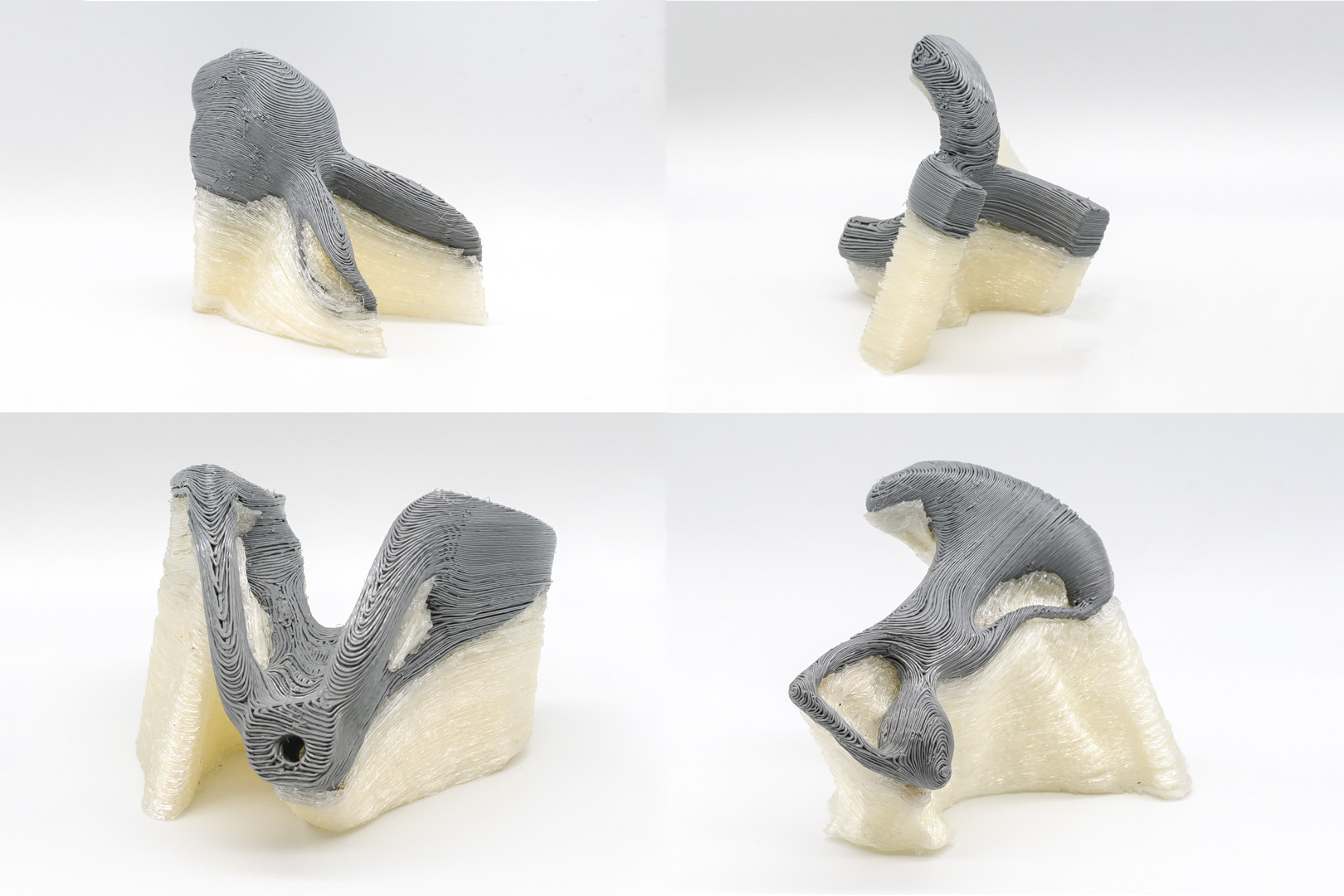
The anisotropy of mechanical strength on a 3D printed model can be controlled in a multi-axis 3D printing system as materials can be accumulated along dynamically varied directions. In this paper, we present a new computational framework to generate specially designed layers and toolpaths of multi-axis 3D printing for strengthening a model by aligning filaments along the directions with large stresses. The major challenge comes from how to effectively decompose a solid into a sequence of strength-aware and collision-free working surfaces. We formulate it as a problem to compute an optimized governing field together with a selected orientation of fabrication setup. Iso-surfaces of the governing field are extracted as working surface layers for filament alignment. Supporting structures in curved layers are constructed by extrapolating the governing field to enable the fabrication of overhangs. Compared with planar-layer based Fused Deposition Modeling (FDM) technology, models fabricated by our method can withstand up to 6.35× loads in experimental tests.
References:
1. Sung-Hoon Ahn, Shad And, Paul Wright, Michael Montero, Dan Odell, and Shad Roundy. 2002. Anisotropic material properties of fused deposition modeling ABS. Rapid Prototyping Journal 8 (10 2002). Google ScholarCross Ref
2. R. Allen and R. Trask. 2015. An experimental demonstration of effective Curved Layer Fused Filament Fabrication utilising a parallel deposition robot. Additive Manufacturing 8 (2015), 78–87.Google ScholarCross Ref
3. Rahul Arora, Alec Jacobson, Timothy R. Langlois, Yijiang Huang, Caitlin Mueller, Wojciech Matusik, Ariel Shamir, Karan Singh, and David I.W. Levin. 2019. Volumetric Michell Trusses for Parametric Design & Fabrication. In Proceedings of the 3rd ACM Symposium on Computation Fabrication (SCF ’19). ACM, New York, NY, USA, 13.Google Scholar
4. Debapriya Chakraborty, B. Aneesh Reddy, and A. Roy Choudhury. 2008. Extruder Path Generation for Curved Layer Fused Deposition Modeling. Comput. Aided Des. 40, 2 (feb 2008), 235–243. Google ScholarDigital Library
5. Qiaodong Cui, Timothy Langlois, Pradeep Sen, and Theodore Kim. 2020. Fast and Robust Stochastic Structural Optimization. Computer Graphics Forum 39 (05 2020), 385–397. Google ScholarCross Ref
6. Chengkai Dai, Charlie C. L. Wang, Chenming Wu, Sylvain Lefebvre, Guoxin Fang, and Yong-Jin Liu. 2018. Support-Free Volume Printing by Multi-Axis Motion. ACM Trans. Graph. 37, 4, Article Article 134 (July 2018), 14 pages. Google ScholarDigital Library
7. Jérémie Dumas, Jean Hergel, and Sylvain Lefebvre. 2014. Bridging the Gap: Automated Steady Scaffoldings for 3D Printing. ACM Trans. Graph. 33, 4, Article Article 98 (July 2014), 10 pages. Google ScholarDigital Library
8. Herbert Edelsbrunner and Ernst P. Mücke. 1994. Three-Dimensional Alpha Shapes. ACM Trans. Graph. 13, 1 (Jan. 1994), 43–72. Google ScholarDigital Library
9. Gershon Elber. 2014. Accessibility in 5-axis milling environment. Computer-Aided Design 26, 11 (2014), 796–802.Google ScholarCross Ref
10. Jimmy Etienne, Nicolas Ray, Daniele Panozzo, Samuel Hornus, Charlie C. L. Wang, Jonàs Martínez, Sara McMains, Marc Alexa, Brian Wyvill, and Sylvain Lefebvre. 2019. CurviSlicer: Slightly Curved Slicing for 3-Axis Printers. ACM Trans. Graph. 38, 4, Article Article 81 (July 2019), 11 pages. Google ScholarDigital Library
11. Miguel Fernandez-Vicente, Wilson Calle, Santiago Ferrandiz, and Andres Conejero. 2016. Effect of Infill Parameters on Tensile Mechanical Behavior in Desktop 3D Printing. 3D Printing and Additive Manufacturing 3, 3 (2016), 183–192. Google ScholarCross Ref
12. Ian Gibson, David W. Rosen, and Brent Stucker. 2009. Additive Manufacturing Technologies: Rapid Prototyping to Direct Digital Manufacturing (1st ed.). Springer Publishing Company, Incorporated.Google Scholar
13. Francisca Gil-Ureta, Nico Pietroni, and Denis Zorin. 2020. Reinforcement of General Shell Structures. ACM Trans. Graph. 39, 5, Article 153 (June 2020), 19 pages. Google ScholarDigital Library
14. S. Gottschalk, M. C. Lin, and D. Manocha. 1996. OBBTree: A Hierarchical Structure for Rapid Interference Detection. In Proceedings of the 23rd Annual Conference on Computer Graphics and Interactive Techniques (SIGGRAPH ’96). ACM, New York, NY, USA, 171–180. Google ScholarDigital Library
15. Jeroen P. Groen and Ole Sigmund. 2018. Homogenization-based topology optimization for high-resolution manufacturable microstructures. Internat. J. Numer. Methods Engrg. 113, 8 (2018), 1148–1163. Google ScholarCross Ref
16. Jeroen P. Groen, Jun Wu, and Ole Sigmund. 2019. Homogenization-based stiffness optimization and projection of 2D coated structures with orthotropic infill. Computer Methods in Applied Mechanics and Engineering 349 (2019), 722 — 742. Google ScholarCross Ref
17. Gael Guennebaud, Benoit Jacob, and et al. 2019. Eigen v3.3. http://eigen.tuxfamily.org.Google Scholar
18. Samuel Hornus, Tim Kuipers, Olivier Devillers, Monique Teillaud, Jonàs Martínez, Marc Glisse, Sylvain Lazard, and Sylvain Lefebvre. 2020. Variable-Width Contouring for Additive Manufacturing. ACM Trans. Graph. 39, 4, Article 131 (July 2020), 17 pages. Google ScholarDigital Library
19. Pengcheng Hu, Kai Tang, and Chen-Han Lee. 2013. Global obstacle avoidance and minimum workpiece setups in five-axis machining. Computer-Aided Design 45, 10 (2013), 1222 — 1237. Google ScholarDigital Library
20. Yijiang Huang, Juyong Zhang, Xin Hu, Guoxian Song, Zhongyuan Liu, Lei Yu, and Ligang Liu. 2016. FrameFab: Robotic Fabrication of Frame Shapes. ACM Trans. Graph. 35, 6, Article Article 224 (Nov. 2016), 11 pages. Google ScholarDigital Library
21. G.Q. Jin, W.D. Li, and L. Gao. 2013. An Adaptive Process Planning Approach of Rapid Prototyping and Manufacturing. Robot. Comput.-Integr. Manuf. 29, 1 (Feb. 2013), 23–38. Google ScholarDigital Library
22. Steven Keating and Neri Oxman. 2013. Compound Fabrication: A Multi-Functional Robotic Platform for Digital Design and Fabrication. Robot. Comput.-Integr. Manuf. 29, 6 (Dec. 2013), 439–448. Google ScholarDigital Library
23. Yong-Joon Kim, Gershon Elber, Michael Bartoň, and Helmut Pottmann. 2015. Precise Gouging-Free Tool Orientations for 5-Axis CNC Machining. Comput. Aided Des. 58, C (Jan. 2015), 220–229. Google ScholarDigital Library
24. Timothy Langlois, Ariel Shamir, Daniel Dror, Wojciech Matusik, and David I. W. Levin. 2016. Stochastic Structural Analysis for Context-Aware Design and Fabrication. ACM Trans. Graph. 35, 6, Article 226 (Nov. 2016), 13 pages. Google ScholarDigital Library
25. T. Llewellyn-Jones, R. Allen, and R. Trask. 2016. Curved layer fused filament fabrication using automated tool-path generation. 3D Printing and Additive Manufacturing 3, 4 (2016), 236–243.Google Scholar
26. Lin Lu, Andrei Sharf, Haisen Zhao, Yuan Wei, Qingnan Fan, Xuelin Chen, Yann Savoye, Changhe Tu, Daniel Cohen-Or, and Baoquan Chen. 2014. Build-to-Last: Strength to Weight 3D Printed Objects. ACM Trans. Graph. 33, 4, Article Article 97 (July 2014), 10 pages. Google ScholarDigital Library
27. Yayue Pan, Chi Zhou, Yong Chen, and Jouni Partanen. 2014. Multitool and Multi-Axis Computer Numerically Controlled Accumulation for Fabricating Conformal Features on Curved Surfaces. Journal of Manufacturing Science and Engineering 136, 3 (03 2014). Google ScholarCross Ref
28. Sushrut Pavanaskar, Sushrut Pande, Youngwook Kwon, Zhongyin Hu, Alla Sheffer, and Sara McMains. 2015. Energy-efficient vector field based toolpaths for CNC pocketmachining. Journal of Manufacturing Processes 20 (2015), 314 — 320. Google ScholarCross Ref
29. Huaishu Peng, Rundong Wu, Steve Marschner, and François Guimbretière. 2016. On-The-Fly Print: Incremental Printing While Modelling. In Proceedings of the 2016 CHI Conference on Human Factors in Computing Systems (CHI 16). 887–896. Google ScholarDigital Library
30. Stephen P. Radzevich and Erik D. Goodman. 2002. Computation of Optimal Workpiece Orientation for Multi-axis NC Machining of Sculptured Part Surfaces. Journal of Mechanical Design 124, 2 (05 2002), 201–212. Google ScholarCross Ref
31. Jaret C. Riddick, Mulugeta A. Haile, Ray Von Wahlde, Daniel P. Cole, Oluwakayode Bamiduro, and Terrence E. Johnson. 2016. Fractographic analysis of tensile failure of acrylonitrile-butadiene-styrene fabricated by fused deposition modeling. Additive Manufacturing 11 (2016), 49 — 59. Google ScholarCross Ref
32. Christian Schumacher, Jonas Zehnder, and Moritz Bächer. 2018. Set-in-Stone: Worst-Case Optimization of Structures Weak in Tension. ACM Trans. Graph. 37, 6, Article Article 252 (Dec. 2018), 13 pages. Google ScholarDigital Library
33. Ondrej Stava, Juraj Vanek, Bedrich Benes, Nathan Carr, and Radomír Měch. 2012. Stress Relief: Improving Structural Strength of 3D Printable Objects. ACM Trans. Graph. 31, 4, Article Article 48 (July 2012), 11 pages. Google ScholarDigital Library
34. John C. Steuben, Athanasios P. Iliopoulos, and John G. Michopoulos. 2016. Implicit Slicing for Functionally Tailored Additive Manufacturing. Comput. Aided Des. 77, C (Aug. 2016), 107–119. Google ScholarDigital Library
35. Kam-Ming Mark Tam and Caitlin T Mueller. 2017. Additive Manufacturing Along Principal Stress Lines. 3D Printing and Additive Manufacturing 4, 2 (2017), 63–81. Google ScholarCross Ref
36. G.M. Treece, R.W. Prager, and A.H. Gee. 1999. Regularised marching tetrahedra: improved iso-surface extraction. Computers Graphics 23, 4 (1999), 583 — 598. Google ScholarCross Ref
37. Erva Ulu, Emrullah Korkmaz, Kubilay Yay, O. Burak Ozdoganlar, and Levent Burak Kara. 2015. Enhancing the Structural Performance of Additively Manufactured Objects Through Build Orientation Optimization. Journal of Mechanical Design 137, 11 (10 2015). Google ScholarCross Ref
38. Nobuyuki Umetani and Ryan Schmidt. 2013. Cross-Sectional Structural Analysis for 3D Printing Optimization. In SIGGRAPH Asia 2013 Technical Briefs. Article 5, 4 pages. Google ScholarDigital Library
39. J. Vanek, J. A. G. Galicia, and B. Benes. 2014. Clever Support: Efficient Support Structure Generation for Digital Fabrication. In Proceedings of the Symposium on Geometry Processing. 117–125. Google ScholarDigital Library
40. Weiming Wang, Tuanfeng Y. Wang, Zhouwang Yang, Ligang Liu, Xin Tong, Weihua Tong, Jiansong Deng, Falai Chen, and Xiuping Liu. 2013. Cost-Effective Printing of 3D Objects with Skin-Frame Structures. ACM Trans. Graph. 32, 6, Article Article 177 (Nov. 2013), 10 pages. Google ScholarDigital Library
41. Jun Wu, Niels Aage, Rüdiger Westermann, and Ole Sigmund. 2018. Infill Optimization for Additive Manufacturing – Approaching Bone-like Porous Structures. IEEE Transactions on Visualization and Computer Graphics 24, 2 (February 2018), 1127–1140. Google ScholarCross Ref
42. Rundong Wu, Huaishu Peng, François Guimbretière, and Steve Marschner. 2016. Printing Arbitrary Meshes with a 5DOF Wireframe Printer. ACM Trans. Graph. 35, 4, Article Article 101 (July 2016), 9 pages. Google ScholarDigital Library
43. Fubao Xie, Lufeng Chen, Zhaoyu Li, and Kai Tang. 2020. Path smoothing and feed rate planning for robotic curved layer additive manufacturing. Robotics and Computer-Integrated Manufacturing 65 (2020), 101967. Google ScholarCross Ref
44. Ke Xu, Yingguang Li, Lufeng Chen, and Kai Tang. 2019. Curved layer based process planning for multi-axis volume printing of freeform parts. Computer-Aided Design 114 (2019), 51 — 63. Google ScholarCross Ref
45. William S. Yerazunis, John C. Barnwell III, and Daniel N. Nikovski. 2016. Strengthening ABS, Nylon, and Polyester 3D Printed Parts by Stress Tensor Aligned Deposition Paths and Five-Axis Printing. In International Solid Freeform Fabrication Symposium. https://www.merl.com/publications/TR2016-101Google Scholar
46. Xiaolong Zhang, Yang Xia, Jiaye Wang, Zhouwang Yang, Changhe Tu, and Wenping Wang. 2015. Medial Axis Tree-an Internal Supporting Structure for 3D Printing. Comput. Aided Geom. Des. 35, C (May 2015), 149–162. Google ScholarDigital Library
47. Haisen Zhao, Fanglin Gu, Qi-Xing Huang, Jorge Garcia, Yong Chen, Changhe Tu, Bedrich Benes, Hao Zhang, Daniel Cohen-Or, and Baoquan Chen. 2016. Connected Fermat Spirals for Layered Fabrication. ACM Trans. Graph. 35, 4, Article Article 100 (July 2016), 10 pages. Google ScholarDigital Library
48. Haisen Zhao, Hao Zhang, Shiqing Xin, Yuanmin Deng, Changhe Tu, Wenping Wang, Daniel Cohen-Or, and Baoquan Chen. 2018. DSCarver: Decompose-and-Spiral-Carve for Subtractive Manufacturing. ACM Trans. Graph. 37, 4, Article Article 137 (July 2018), 14 pages. Google ScholarDigital Library
49. Sikai Zhong, Zichun Zhong, and Jing Hua. 2019. Surface reconstruction by parallel and unified particle-based resampling from point clouds. Computer Aided Geometric Design 71 (2019), 43 — 62. Google ScholarCross Ref
50. Zichun Zhong, Wenping Wang, Bruno Lévy, Jing Hua, and Xiaohu Guo. 2018. Computing a High-Dimensional Euclidean Embedding from an Arbitrary Smooth Riemannian Metric. ACM Trans. Graph. 37, 4, Article 62 (July 2018), 16 pages. Google ScholarDigital Library
51. Qingnan Zhou, Julian Panetta, and Denis Zorin. 2013. Worst-Case Structural Analysis. ACM Trans. Graph. 32, 4, Article Article 137 (July 2013), 12 pages. Google ScholarDigital Library