
“Reach For the Spheres: Tangency-aware surface reconstruction of SDFs” by Sellán, Batty and Stein
Conference:
Type(s):
Title:
- Reach For the Spheres: Tangency-aware surface reconstruction of SDFs
Session/Category Title:
- Reconstruction
Presenter(s)/Author(s):
Abstract:
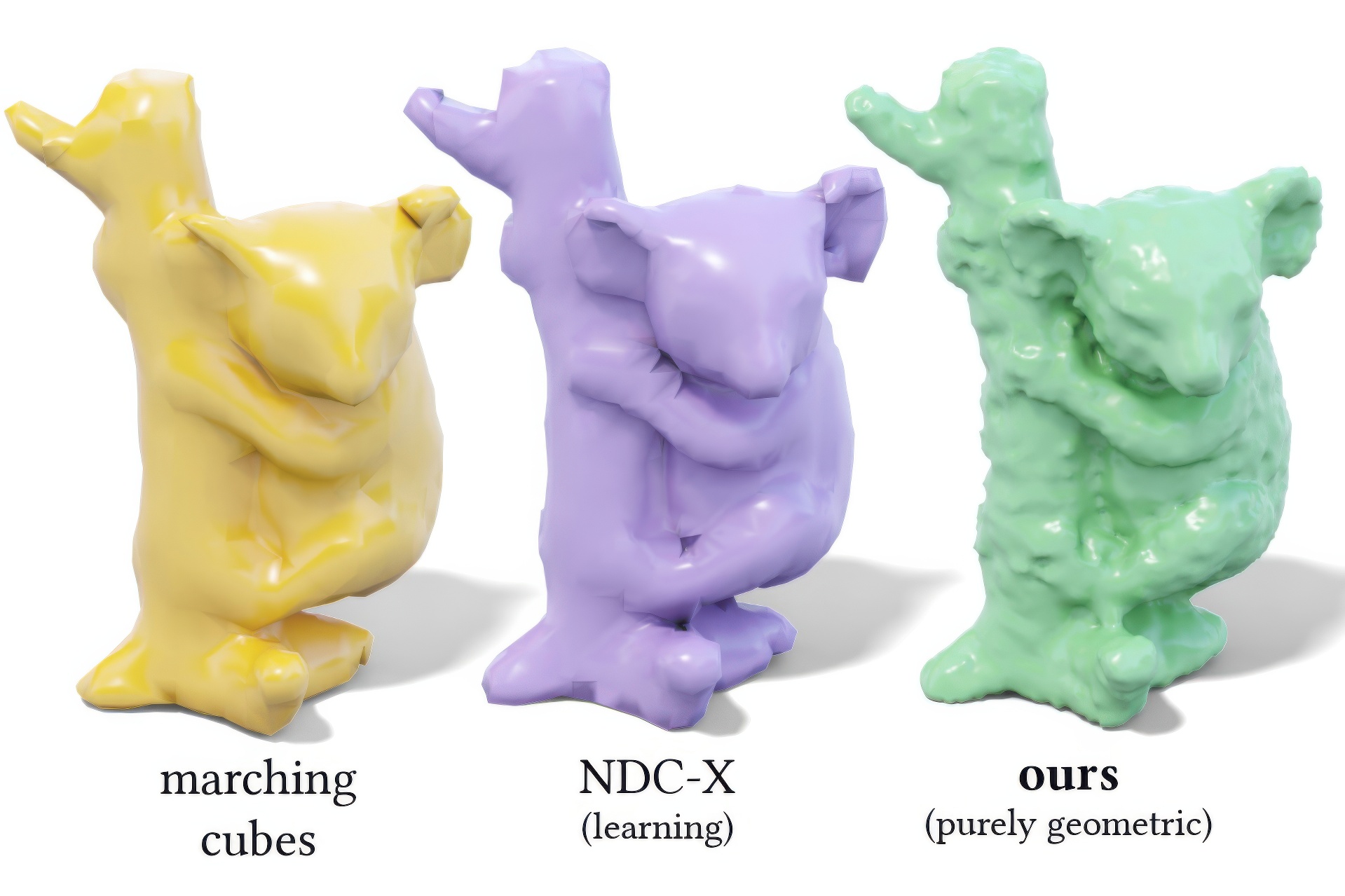
Signed distance fields (SDFs) are a widely utilized implicit surface representation that has applications in various fields such as computer graphics, computer vision, and applied mathematics. Despite their frequent use, traditional methods such as Marching Cubes and its variants often overlook fundamental properties of SDFs, resulting in mesh reconstructions that exhibit oversmoothing and feature loss. To address this, we propose a novel method based on a key insight: each SDF sample corresponds to a spherical region, and the surface represented by the discrete SDF has critical properties with respect to each sphere. Leveraging this understanding, our method formulates an energy that gauges the degree of violation of tangency constraints by a proposed surface. We then employ a gradient flow that minimizes our energy, starting from an initial triangle mesh that encapsulates the surface. The algorithm yields superior reconstructions, surpassing the quality of previous methods, even with sparsely sampled SDFs. Our approach provides a more nuanced understanding of SDFs and offers significant improvements in surface reconstruction.
References:
[1]
Aim Shape repository. 2011. Squirrel. https://www.thingiverse.com/thing:11705.
[2]
Nora Al-Badri and Jan Nikolai Nelles. 2016. Nefertiti. https://github.com/odedstein/meshes/tree/master/objects/nefertiti.
[3]
Pierre Alliez, David Cohen-Steiner, Mariette Yvinec, and Mathieu Desbrun. 2005. Variational Tetrahedral Meshing. In ACM SIGGRAPH 2005 Papers. 617–625. https://doi.org/10.1145/1186822.1073238
[4]
Sai Praveen Bangaru, Michaël Gharbi, Fujun Luan, Tzu-Mao Li, Kalyan Sunkavalli, Milos Hasan, Sai Bi, Zexiang Xu, Gilbert Bernstein, and Fredo Durand. 2022. Differentiable rendering of neural SDFs through reparameterization. In SIGGRAPH Asia 2022 Conference Papers. Article 5, 9 pages. https://doi.org/10.1145/3550469.3555397
[5]
Christopher Batty. 2011. Problem: Reconstructing meshes with sharp features from signed distance data. Personal website, https://web.archive.org/web/20111112202136http://www.cs.columbia.edu/ batty/misc/levelset_meshing/level_set_reconstruction.html.
[6]
billyd. 2016. Cat Stretch. https://www.thingiverse.com/thing:1565405.
[7]
Mario Botsch and Leif Kobbelt. 2004. A remeshing approach to multiresolution modeling. In Proceedings of the 2004 Eurographics/ACM SIGGRAPH symposium on Geometry processing. 185–192. https://doi.org/10.1145/1057432.1057457
[8]
Alan Brunton and Lubna Abu Rmaileh. 2021. Displaced Signed Distance Fields for Additive Manufacturing. ACM Trans. Graph. 40, 4, Article 179 (2021), 13 pages. https://doi.org/10.1145/3450626.3459827
[9]
Dennis R. Bukenberger and Hendrik P. A. Lensch. 2021. Be Water My Friend: Mesh Assimilation. Vis. Comput. 37, 9–11 (2021), 2725–2739. https://doi.org/10.1007/s00371-021-02183-6
[10]
Tony Chan and Luminita Vese. 1999. An active contour model without edges. In Scale-Space Theories in Computer Vision. Springer, 141–151. https://doi.org/10.1007/3-540-48236-9_13
[11]
Zhiqin Chen, Andrea Tagliasacchi, Thomas Funkhouser, and Hao Zhang. 2022a. Neural dual contouring. ACM Trans. Graph. 41, 4, Article 104 (2022), 13 pages. https://doi.org/10.1145/3528223.3530108
[12]
Zhiqin Chen, Andrea Tagliasacchi, Thomas Funkhouser, and Hao Zhang. 2022b. Neural dual contouring – GitHub repository. https://github.com/czq142857/NDC.
[13]
Zhiqin Chen and Hao Zhang. 2021. Neural marching cubes. ACM Trans. Graph. 40, 6, Article 251 (2021), 15 pages. https://doi.org/10.1145/3478513.3480518
[14]
Cornelis Brouwers. 2014. Teddy. https://www.thingiverse.com/techkey/designs.
[15]
cosmicblobs. 2021. cheburashka. accessed at libigl https://github.com/libigl/libigl-tutorial-data.
[16]
Keenan Crane. 2013a. bob. https://www.cs.cmu.edu/ kmcrane/Projects/ModelRepository/.
[17]
Keenan Crane. 2013b. Spot. https://www.cs.cmu.edu/ kmcrane/Projects/ModelRepository/.
[18]
Keenan Crane, Ulrich Pinkall, and Peter Schröder. 2013. Robust fairing via conformal curvature flow. ACM Trans. Graph. 32, 4, Article 61 (2013), 10 pages. https://doi.org/10.1145/2461912.2461986
[19]
Cyberware Inc.2023a. Horse. https://github.com/alecjacobson/common-3d-test-models/blob/master/data/horse.obj (year denotes online access).
[20]
Cyberware Inc.2023b. Igea. https://github.com/alecjacobson/common-3d-test-models/blob/master/data/igea.obj (year denotes online access).
[21]
Bruno Rodrigues De Araújo, Daniel S Lopes, Pauline Jepp, Joaquim A Jorge, and Brian Wyvill. 2015. A survey on implicit surface polygonization. ACM Computing Surveys (CSUR) 47, 4, Article 60 (2015), 39 pages. https://doi.org/10.1145/2732197
[22]
Mathieu Desbrun, Mark Meyer, Peter Schröder, and Alan H Barr. 1999. Implicit fairing of irregular meshes using diffusion and curvature flow. In Proceedings of the 26th annual conference on Computer graphics and interactive techniques. 317–324. https://doi.org/10.1145/311535.311576
[23]
O. Faugeras and R. Keriven. 1998. Variational principles, surface evolution, PDEs, level set methods, and the stereo problem. IEEE Transactions on Image Processing 7, 3 (1998), 336–344. https://doi.org/10.1109/83.661183
[24]
Nick Foster and Ronald Fedkiw. 2001. Practical animation of liquids. In Proceedings of the 28th annual conference on Computer graphics and interactive techniques. 23–30. https://doi.org/10.1145/383259.383261
[25]
Sarah F Frisken, Ronald N Perry, Alyn P Rockwood, and Thouis R Jones. 2000. Adaptively sampled distance fields: A general representation of shape for computer graphics. In Proceedings of the 27th annual conference on Computer graphics and interactive techniques. 249–254. https://doi.org/10.1145/344779.344899
[26]
Arnulph Fuhrmann, Gerrit Sobotka, and Clemens Groß. 2003. Distance fields for rapid collision detection in physically based modeling. In Proceedings of GraphiCon, Vol. 2003. 58–65.
[27]
GSC_Nakamura. 2013. Strawberry. https://www.thingiverse.com/thing:153548.
[28]
Rana Hanocka, Gal Metzer, Raja Giryes, and Daniel Cohen-Or. 2020. Point2Mesh: A Self-Prior for Deformable Meshes. ACM Trans. Graph. 39, 4, Article 126 (2020). https://doi.org/10.1145/3386569.3392415
[29]
John C Hart. 1996. Sphere tracing: A geometric method for the antialiased ray tracing of implicit surfaces. The Visual Computer 12, 10 (1996), 527–545. https://doi.org/10.1007/s003710050084
[30]
Adrian Hilton, Andrew J Stoddart, John Illingworth, and Terry Windeatt. 1996. Marching triangles: range image fusion for complex object modelling. In Proceedings of 3rd IEEE international conference on image processing, Vol. 2. IEEE, 381–384. https://doi.org/10.1109/ICIP.1996.560840
[31]
Josh Holinaty. 2020. Mushroom. https://github.com/odedstein/meshes/tree/master/objects/mushroom.
[32]
jansentee3d. 2018. Dragon Tower. https://www.thingiverse.com/thing:3155868.
[33]
Mark W Jones, J Andreas Baerentzen, and Milos Sramek. 2006. 3D distance fields: A survey of techniques and applications. IEEE Transactions on visualization and Computer Graphics 12, 4 (2006), 581–599. https://doi.org/10.1109/TVCG.2006.56
[34]
Tao Ju, Frank Losasso, Scott Schaefer, and Joe Warren. 2002. Dual contouring of hermite data. In Proceedings of the 29th annual conference on Computer graphics and interactive techniques. 339–346. https://doi.org/10.1145/566570.566586
[35]
Michael Kazhdan, Jake Solomon, and Mirela Ben-Chen. 2012. Can Mean-Curvature Flow be Modified to be Non-singular?Computer Graphics Forum 31, 5 (2012), 1745–1754. https://doi.org/10.1111/j.1467-8659.2012.03179.x
[36]
Leif P Kobbelt, Mario Botsch, Ulrich Schwanecke, and Hans-Peter Seidel. 2001. Feature sensitive surface extraction from volume data. In Proceedings of the 28th annual conference on Computer graphics and interactive techniques. 57–66. https://doi.org/10.1145/383259.383265
[37]
Pan Li, Bin Wang, Feng Sun, Xiaohu Guo, Caiming Zhang, and Wenping Wang. 2016. Q-mat: Computing medial axis transform by quadratic error minimization. ACM Trans. Graph. 35, 1, Article 8 (2016), 16 pages. https://doi.org/10.1145/2753755
[38]
Yiyi Liao, Simon Donne, and Andreas Geiger. 2018. Deep marching cubes: Learning explicit surface representations. In Proceedings of the IEEE Conference on Computer Vision and Pattern Recognition. 2916–2925. https://doi.org/10.1109/CVPR.2018.00308
[39]
Hsueh-Ti Derek Liu. 2023. BlenderToolbox. https://github.com/HTDerekLiu/BlenderToolbox.
[40]
Puze Liu, Kuo Zhang, Davide Tateo, Snehal Jauhri, Jan Peters, and Georgia Chalvatzaki. 2022. Regularized Deep Signed Distance Fields for Reactive Motion Generation. In 2022 IEEE/RSJ International Conference on Intelligent Robots and Systems (IROS). 6673–6680. https://doi.org/10.1109/IROS47612.2022.9981456
[41]
William E Lorensen and Harvey E Cline. 1987. Marching cubes: A high resolution 3D surface construction algorithm. Proceedings of the 14th Annual Conference on Computer Graphics and Interactive Techniques 21, 4 (1987), 163–169. https://doi.org/10.1145/37401.37422
[42]
Jaehwan Ma, Sang Won Bae, and Sunghee Choi. 2012. 3D medial axis point approximation using nearest neighbors and the normal field. The Visual Computer 28 (2012), 7–19. https://doi.org/10.1145/37401.37422
[43]
Max Planck Institute. 2023. Max Planck bust. https://github.com/alecjacobson/common-3d-test-models/blob/master/data/max-planck.obj (year denotes online access).
[44]
Ken Museth, David E Breen, Ross T Whitaker, and Alan H Barr. 2002. Level set surface editing operators. In Proceedings of the 29th annual conference on Computer graphics and interactive techniques. 330–338. https://doi.org/10.1145/566570.566585
[45]
Jorge Nocedal and Stephen J. Wright. 2006. Numerical Optimization (2 ed.). Springer New York. https://doi.org/10.1007/978-0-387-40065-5
[46]
Stanley Osher and Ronald Fedkiw. 2003. Level set methods and dynamic implicit surfaces. Springer New York. https://doi.org/10.1007/b98879
[47]
Jeong Joon Park, Peter Florence, Julian Straub, Richard Newcombe, and Steven Lovegrove. 2019. DeepSDF: Learning continuous signed distance functions for shape representation. In Proceedings of the IEEE/CVF conference on computer vision and pattern recognition. 165–174. https://doi.org/10.1109/CVPR.2019.00025
[48]
Patrick Bentley. 2017. Argonath. https://www.thingiverse.com/thing:2243300.
[49]
pmoews. 2016. Traditional Cow. https://www.thingiverse.com/thing:1602712/files.
[50]
Daniel Rebain, Baptiste Angles, Julien Valentin, Nicholas Vining, Jiju Peethambaran, Shahram Izadi, and Andrea Tagliasacchi. 2019. LSMAT least squares medial axis transform. In Computer Graphics Forum, Vol. 38. 5–18. https://doi.org/10.1111/cgf.13599
[51]
Edoardo Remelli, Artem Lukoianov, Stephan Richter, Benoit Guillard, Timur Bagautdinov, Pierre Baque, and Pascal Fua. 2020. Meshsdf: Differentiable iso-surface extraction. In Proceedings of the 34th International Conference on Neural Information Processing Systems. Article 1884, 11 pages.
[52]
Leonardo Sacht, Etienne Vouga, and Alec Jacobson. 2015. Nested Cages. ACM Trans. Graph. 34, 6, Article 170 (2015). https://doi.org/10.1145/2816795.2818093
[53]
Silvia Sellán, Noam Aigerman, and Alec Jacobson. 2021. Swept volumes via spacetime numerical continuation. ACM Trans. Graph. 40, 4, Article 55 (2021), 11 pages. https://doi.org/10.1145/3450626.3459780
[54]
Silvia Sellán, Yang Shen Ang, Jacob Kesten, and Alec Jacobson. 2022. Opening and Closing Surfaces. ACM Trans. Graph. 41, 6, Article 198 (2022), 12 pages. https://doi.org/10.1145/3414685.3417778
[55]
Silvia Sellán and Oded Stein. 2023. gpytoolbox: A Python Geometry Processing Toolbox. https://gpytoolbox.org/.
[56]
James Albert Sethian. 1999. Level set methods and fast marching methods: evolving interfaces in computational geometry, fluid mechanics, computer vision, and materials science. Cambridge university press.
[57]
Andrei Sharf, Thomas Lewiner, Ariel Shamir, Leif Kobbelt, and Daniel Cohen–Or. 2006. Competing Fronts for Coarse–to–Fine Surface Reconstruction. Computer Graphics Forum 25, 3 (2006), 389–398. https://doi.org/10.1111/j.1467-8659.2006.00958.x
[58]
Nicholas Sharp and Alec Jacobson. 2022. Spelunking the deep: guaranteed queries on general neural implicit surfaces via range analysis. ACM Trans. Graph. 41, 4, Article 107 (2022), 16 pages. https://doi.org/10.1145/3528223.3530155
[59]
Tianchang Shen, Jacob Munkberg, Jon Hasselgren, Kangxue Yin, Zian Wang, Wenzheng Chen, Zan Gojcic, Sanja Fidler, Nicholas Sharp, and Jun Gao. 2023. Flexible Isosurface Extraction for Gradient-Based Mesh Optimization. ACM Trans. Graph. 42, 4, Article 37 (jul 2023), 16 pages. https://doi.org/10.1145/3592430
[60]
Barton T. Stander and John C. Hart. 1997. Guaranteeing the Topology of an Implicit Surface Polygonization for Interactive Modeling. In Proceedings of the 24th Annual Conference on Computer Graphics and Interactive Techniques(SIGGRAPH ’97). 279–286. https://doi.org/10.1145/258734.258868
[61]
Oded Stein, Eitan Grinspun, and Keenan Crane. 2018. Developability of triangle meshes. ACM Trans. Graph. 37, 4, Article 77 (2018), 14 pages. https://doi.org/10.1145/3197517.3201303
[62]
Towaki Takikawa, Andrew Glassner, and Morgan McGuire. 2022. A dataset and explorer for 3D signed distance functions. Journal of Computer Graphics Techniques Vol 11, 2 (2022).
[63]
The Stanford 3D Scanning Repository. 1994. Stanford Bunny. http://graphics.stanford.edu/data/3Dscanrep/.
[64]
The Stanford 3D Scanning Repository. 1996. Armadillo. http://graphics.stanford.edu/data/3Dscanrep/.
[65]
The Stanford 3D Scanning Repository. 2023. Lucy. http://graphics.stanford.edu/data/3Dscanrep/ (year denotes online access).
[66]
Thunk3D scanner. 2019. koala bear. https://sketchfab.com/3d-models/koala-bear-221d8d6519944a65b473ea56fc032570.
[67]
TimEdwards. 2014. glChess chess set 2. https://www.thingiverse.com/thing:335658.
[68]
Kees Van Overveld and Brian Wyvill. 2004. Shrinkwrap: An efficient adaptive algorithm for triangulating an iso-surface. The visual computer 20 (2004), 362–379. https://doi.org/10.1007/s00371-002-0197-4
[69]
Delio Vicini, Sébastien Speierer, and Wenzel Jakob. 2022. Differentiable signed distance function rendering. ACM Trans. Graph. 41, 4, Article 125 (2022), 18 pages. https://doi.org/10.1145/3528223.3530139
[70]
Chris Wojtan, Matthias Müller-Fischer, and Tyson Brochu. 2011. Liquid simulation with mesh-based surface tracking. In ACM SIGGRAPH 2011 Courses. 1–84. https://doi.org/10.1145/2037636.2037644
[71]
Yiheng Xie, Towaki Takikawa, Shunsuke Saito, Or Litany, Shiqin Yan, Numair Khan, Federico Tombari, James Tompkin, Vincent Sitzmann, and Srinath Sridhar. 2022. Neural Fields in Visual Computing and Beyond. Computer Graphics Forum 41, 2 (2022), 641–676. https://doi.org/10.1111/cgf.14505
[72]
YahooJAPAN. 2013a. Scorpion. https://www.thingiverse.com/thing:182363.
[73]
YahooJAPAN. 2013b. Turtle. https://www.thingiverse.com/thing:182332.
[74]
Hong-Kai Zhao, Stanley Osher, and Ronald Fedkiw. 2001. Fast surface reconstruction using the level set method. In Proceedings IEEE Workshop on Variational and Level Set Methods in Computer Vision. 194–201. https://doi.org/10.1109/VLSM.2001.938900



