“Physically-accurate fur reflectance: modeling, measurement and rendering”
Conference:
Type(s):
Title:
- Physically-accurate fur reflectance: modeling, measurement and rendering
Session/Category Title:
- Illumination and Real-Time
Presenter(s)/Author(s):
Abstract:
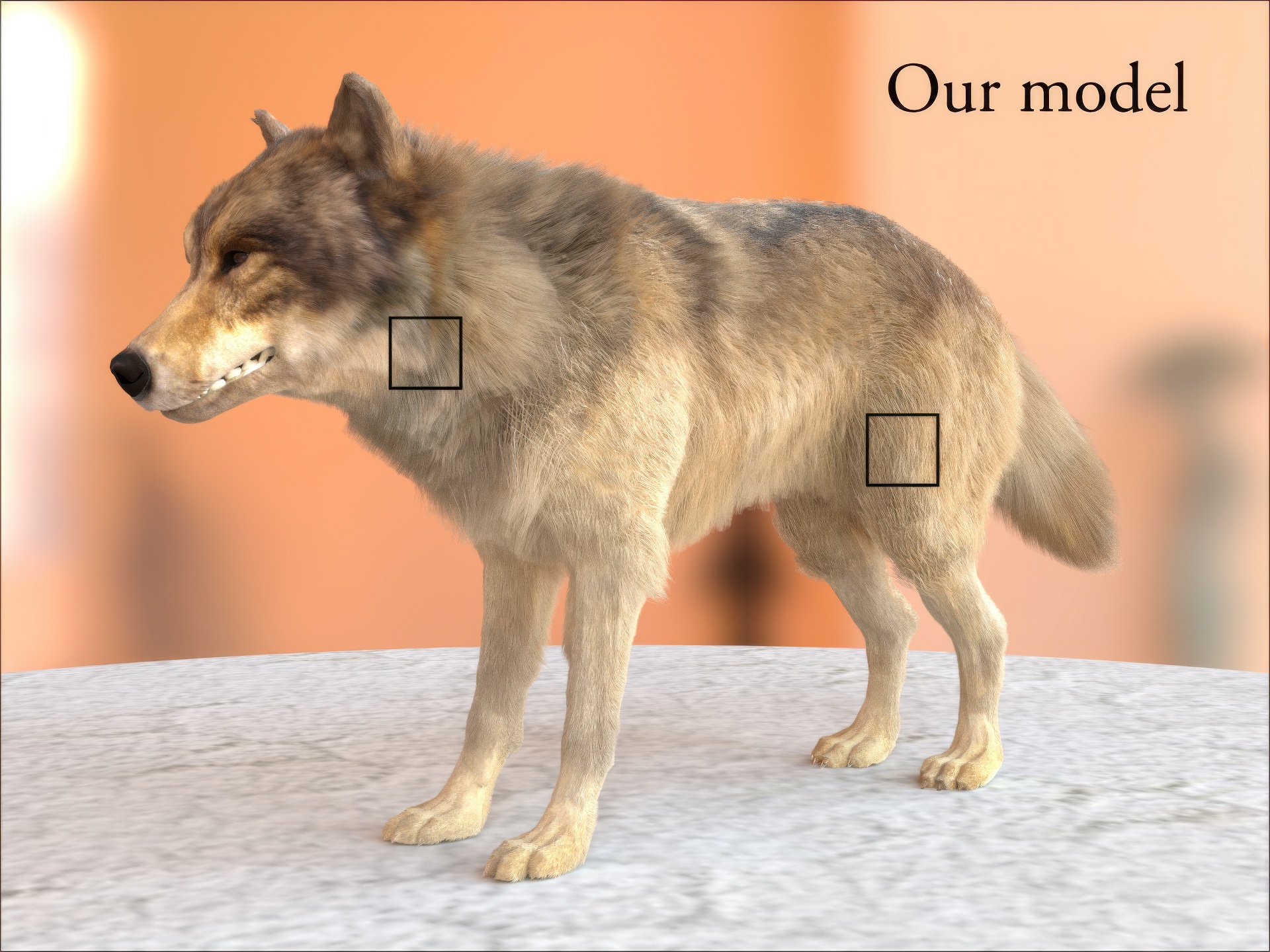
Rendering photo-realistic animal fur is a long-standing problem in computer graphics. Considerable effort has been made on modeling the geometric complexity of fur, but the reflectance of fur fibers is not well understood. Fur has a distinct diffusive and saturated appearance, that is not captured by either the Marschner hair model or the Kajiya-Kay model. In this paper, we develop a physically-accurate reflectance model for fur fibers. Based on anatomical literature and measurements, we develop a double cylinder model for the reflectance of a single fur fiber, where an outer cylinder represents the biological observation of a cortex covered by multiple cuticle layers, and an inner cylinder represents the scattering interior structure known as the medulla. Our key contribution is to model medulla scattering accurately—in contrast, for human hair, the medulla has minimal width and thus negligible contributions to the reflectance. Medulla scattering introduces additional reflection and transmission paths, as well as diffusive reflectance lobes. We validate our physical model with measurements on real fur fibers, and introduce the first database in computer graphics of reflectance profiles for nine fur samples. We show that our model achieves significantly better fits to the measured data than the Marschner hair reflectance model. For efficient rendering, we develop a method to precompute 2D medulla scattering profiles and analytically approximate our reflectance model with factored lobes. The accuracy of the approach is validated by comparing our rendering model to full 3D light transport simulations. Our model provides an enriched set of controls, where the parameters we fit can be directly used to render realistic fur, or serve as a starting point from which artists can manually tune parameters for desired appearances.
References:
1. Carrlee, E., and Horelick, L. 2011. The alaska fur id project: A virtual resource for material identification. In Objects Specialty Group Postprints, American Institute for Conservation of Historic and Artistic Works, vol. 18, 149–171.
2. Davis, A. 2006. Effective propagation kernels in structured media with broad spatial correlations, illustration with large-scale transport of solar photons through cloudy atmospheres. In Computational Methods in Transport, F. Graziani, Ed., vol. 48 of Lecture Notes in Computational Science and Engineering. Springer Berlin Heidelberg, 85–140.
3. Deedrick, D. W., and Koch, S. L. 2004. Microscopy of hair part 1: A practical guide and manual for human hairs. Forensics Science Communication.
4. Deedrick, D. W., and Koch, S. L. 2004. Microscopy of hair part ii: a practical guide and manual for animal hairs. Forensics Science Communication.
5. d’Eon, E., Francois, G., Hill, M., Letteri, J., and Aubry, J.-M. 2011. An energy-conserving hair reflectance model. In EGSR 11, 1181–1187.
6. d’Eon, E., Marschner, S., and Hanika, J. 2013. Importance sampling for physically-based hair fiber models. In SIGGRAPH Asia 2013 Technical Briefs, 25:1–25:4.
7. d’Eon, E., Marschner, S., and Hanika, J. 2014. A fiber scattering model with non-separable lobes. In ACM SIGGRAPH 2014 Talks, 46:1–46:1.
8. Donner, C., Lawrence, J., Ramamoorthi, R., Hachisuka, T., Jensen, H. W., and Nayar, S. 2009. An empirical BSSRDF model. ACM Trans. Graph. 28, 3, 30:1–30:10.
9. Galatk, A., Galatk, J., Krul, Z., and Galatk Jr, A., 2011. Furskin identification. http://www.furskin.cz.
10. Goldman, D. B. 1997. Fake fur rendering. In SIGGRAPH 97, 127–134.
11. Hashimoto, K. 1988. The structure of human hair. Clinics in Dermatology 6, 4, 7–21.
12. Hery, C., and Ramamoorthi, R. 2012. Importance sampling of reflection from hair fibers. Journal of Computer Graphics Techniques (JCGT) 1, 1, 1–17.
13. Jakob, W., 2010. Mitsuba renderer. http://www.mitsubarenderer.org.
14. Kajiya, J. T., and Kay, T. L. 1989. Rendering fur with three dimensional textures. In SIGGRAPH 89, 271–280.
15. Khungurn, P., and Marschner, S. 2015. Azimuthal scattering from elliptical hair fibers. Accepted to ACM Transactions on Graphics with minor revisions.
16. Lokovic, T., and Veach, E. 2000. Deep shadow maps. In SIGGRAPH 00, 385–392.
17. Marschner, S. R., Jensen, H. W., Cammarano, M., Worley, S., and Hanrahan, P. 2003. Light scattering from human hair fibers. ACM Trans. Graph. 22, 3, 780–791.
18. Moon, J. T., and Marschner, S. R. 2006. Simulating multiple scattering in hair using a photon mapping approach. ACM Trans. Graph. 25, 3, 1067–1074.
19. Nguyen, H., and Donnelly, W. 2005. Hair animation and rendering in the nalu demo. GPU Gems 2, 361–380.
20. Ogaki, S., Tokuyoshi, Y., and Schoellhammer, S. 2010. An empirical fur shader. In ACM SIGGRAPH ASIA 2010 Sketches, ACM, 16.
21. Ou, J., Xie, F., Krishnamachari, P., and Pellacini, F. 2012. Ishair: Importance sampling for hair scattering. In ACM SIGGRAPH 2012 Talks, 28:1–28:1.
22. Peers, P., vom Berge, K., Matusik, W., Ramamoorthi, R., Lawrence, J., Rusinkiewicz, S., and Dutré, P. 2006. A compact factored representation of heterogeneous subsurface scattering. ACM Trans. Graph. 25, 3, 746–753.
23. Qin, H., Chai, M., Hou, Q., Ren, Z., and Zhou, K. 2014. Cone tracing for furry object rendering. Visualization and Computer Graphics, IEEE Transactions on 20, 8, 1178–1188.
24. Ren, P., Wang, J., Gong, M., Lin, S., Tong, X., and Guo, B. 2013. Global illumination with radiance regression functions. ACM Trans. Graph. 32, 4, 130:1–130:12.
25. Sadeghi, I., Pritchett, H., Jensen, H. W., and Tamstorf, R. 2010. An artist friendly hair shading system. ACM Trans. Graph. 29, 4, 56:1–56:10.
26. Sadeghi, I., Bisker, O., De Deken, J., and Jensen, H. W. 2013. A practical microcylinder appearance model for cloth rendering. ACM Trans. Graph. 32, 2, 14:1–14:12.
27. Sintorn, E., and Assarsson, U. 2009. Hair self shadowing and transparency depth ordering using occupancy maps. In Symposium on Interactive 3D Graphics and Games, 67–74.
28. Sloan, P.-P., Kautz, J., and Snyder, J. 2002. Precomputed radiance transfer for real-time rendering in dynamic, low-frequency lighting environments. ACM Trans. Graph. 21, 3, 527–536.
29. Stam, J. 1995. Multiple scattering as a diffusion process. In Rendering Techniques 95. 41–50.
30. Stamm, R. F., Garcia, M. L., and Fuchs, J. J. 1977. The optical properties of human hair i. fundamental considerations and goniophotometer curves. Journal of the Society of Cosmetic Chemists 28, 9, 571–599.
31. Stokes, G. G. 1860. On the intensity of the light reflected from or transmitted through a pile of plates. Proceedings of the Royal Society of London 11, 545–556.
32. Tseng, C.-W. 2015. A Physically-Based Reflectance Model For Mammalian Fur Fibers Based On Anatomy And Gonioreflectometry Measurements. Master’s thesis, University of California San Diego.
33. Wang, R., Tran, J., and Luebke, D. 2005. All-frequency interactive relighting of translucent objects with single and multiple scattering. ACM Trans. Graph. 24, 3, 1202–1207.
34. Wei, X., 2006. What is human hair? a light and scanning electron microscopy study.
35. Xu, K., Ma, L.-Q., Ren, B., Wang, R., and Hu, S.-M. 2011. Interactive hair rendering and appearance editing under environment lighting. ACM Transactions on Graphics 30, 6, 173:1–173:10.
36. Yuksel, C., and Keyser, J. 2008. Deep opacity maps. Computer Graphics Forum 27, 2, 675–680.
37. Zinke, A., and Weber, A. 2007. Light scattering from filaments. IEEE Transactions on Visualization and Computer Graphics 13, 2, 342–356.
38. Zinke, A., Yuksel, C., Weber, A., and Keyser, J. 2008. Dual scattering approximation for fast multiple scattering in hair. ACM Trans. Graph. 27, 3, 32:1–32:10.
39. Zinke, A., Rump, M., Lay, T., Weber, A., Andriyenko, A., and Klein, R. 2009. A practical approach for photometric acquisition of hair color. ACM Trans. Graph. 28, 5, 165:1–165:9.