“Neural Collision Fields for Triangle Primitives” by Modi, Sueda, Zesch and Levin
Conference:
Type(s):
Title:
- Neural Collision Fields for Triangle Primitives
Session/Category Title:
- Neural Physics
Presenter(s)/Author(s):
Abstract:
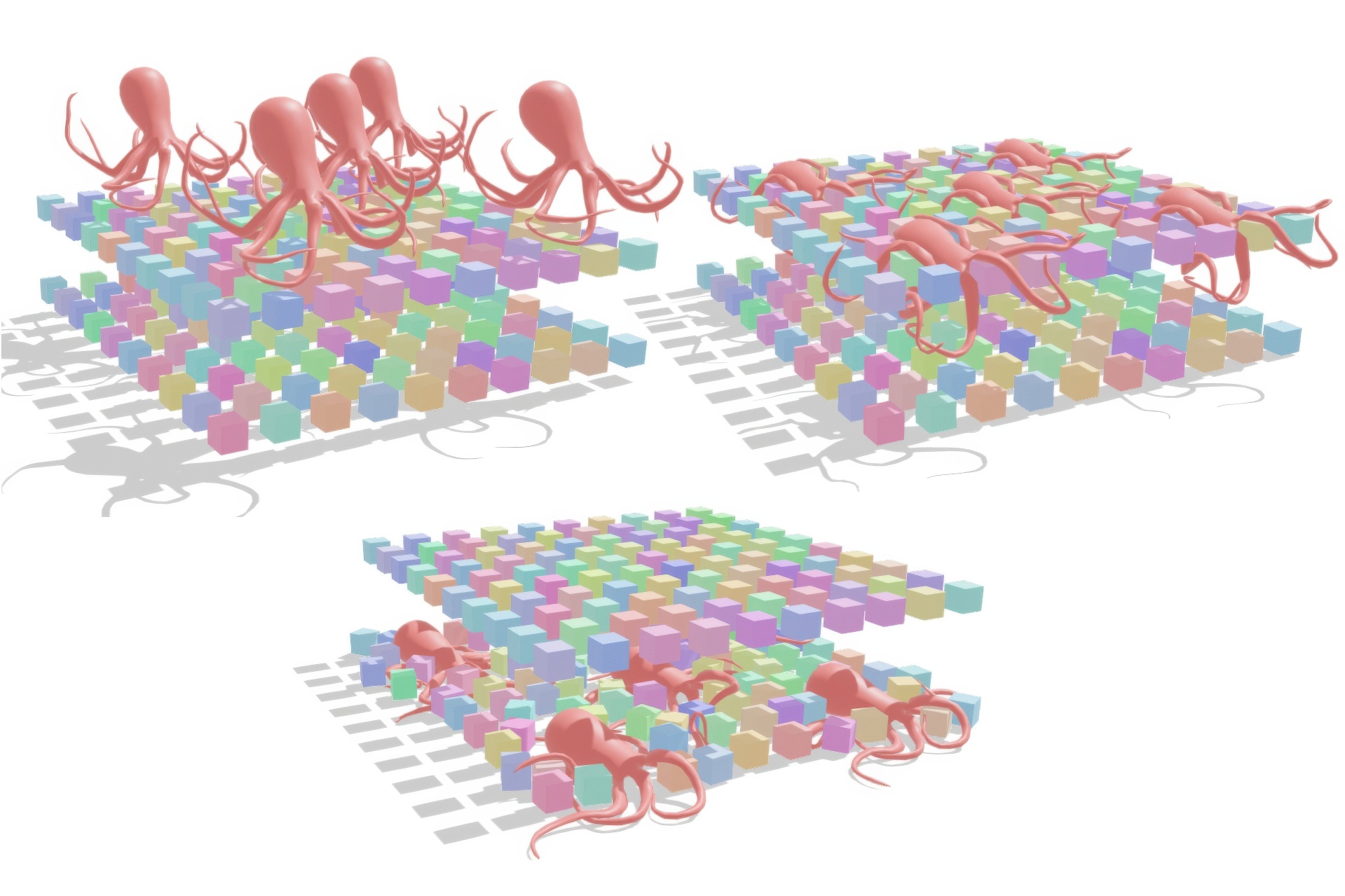
We present neural collision fields as an alternative to contact point sampling in physics simulations. Our approach is built on top of a novel smoothed integral formulation for the contact surface patches between two triangle meshes. By reformulating collisions as an integral, we avoid issues of sampling common to many collision-handling algorithms. Because the resulting integral is difficult to evaluate numerically, we store its solution in an integrated neural collision field — a 6D neural field in the space of triangle pair vertex coordinates. Our network generalizes well to new triangle meshes without retraining. We demonstrate the effectiveness of our method by implementing it as a constraint in a position-based dynamics framework and show that our neural formulation successfully handles collisions in practical simulations involving both volumetric and thin-shell geometries.
References:
[1]
Thiemo Alldieck, Hongyi Xu, and Cristian Sminchisescu. 2021. imGHUM: Implicit generative models of 3d human shape and articulated pose. In Proceedings of the IEEE/CVF International Conference on Computer Vision. 5461–5470.
[2]
Jan Bender. 2022. Position Based Dynamics. https://github.com/InteractiveComputerGraphics/PositionBasedDynamics
[3]
Tyson Brochu, Essex Edwards, and Robert Bridson. 2012. Efficient geometrically exact continuous collision detection. ACM Transactions on Graphics (TOG) 31, 4 (2012), 1–7.
[4]
Xinhao Cai, Eulalie Coevoet, Alec Jacobson, and Paul Kry. 2022. Active Learning Neural C-space Signed Distance Fields for Reduced Deformable Self-Collision. In Graphics Interface 2022.
[5]
Blender Online Community. 2018. Blender – a 3D modelling and rendering package. Blender Foundation, Stichting Blender Foundation, Amsterdam. http://www.blender.org
[6]
Erwin Coumans and Yunfei Bai. 2016–2021. PyBullet, a Python module for physics simulation for games, robotics and machine learning. http://pybullet.org.
[7]
Kenny Erleben. 2018. Methodology for assessing mesh-based contact point methods. ACM Transactions on Graphics (TOG) 37, 3 (2018), 1–30.
[8]
Zachary Ferguson, Minchen Li, Teseo Schneider, Francisca Gil-Ureta, Timothy Langlois, Chenfanfu Jiang, Denis Zorin, Danny M. Kaufman, and Daniele Panozzo. 2021. Intersection-free Rigid Body Dynamics. ACM Transactions on Graphics (SIGGRAPH) 40, 4, Article 183 (2021).
[9]
Sami Haddadin, Alessandro De Luca, and Alin Albu-Schäffer. 2017. Robot collisions: A survey on detection, isolation, and identification. IEEE Transactions on Robotics 33, 6 (2017), 1292–1312.
[10]
Diederik P Kingma and Jimmy Ba. 2014. Adam: A method for stochastic optimization. arXiv preprint arXiv:1412.6980 (2014).
[11]
Lei Lan, Danny M Kaufman, Minchen Li, Chenfanfu Jiang, and Yin Yang. 2022a. Affine body dynamics: Fast, stable & intersection-free simulation of stiff materials. arXiv preprint arXiv:2201.10022 (2022).
[12]
Lei Lan, Guanqun Ma, Yin Yang, Changxi Zheng, Minchen Li, and Chenfanfu Jiang. 2022b. Penetration-free projective dynamics on the GPU. ACM Transactions on Graphics (TOG) 41, 4 (2022), 1–16.
[13]
Lazaros Lazaridis, Maria Papatsimouli, Konstantinos-Filippos Kollias, Panagiotis Sarigiannidis, and George F Fragulis. 2021. Hitboxes: A Survey About Collision Detection in Video Games. In International Conference on Human-Computer Interaction. Springer, 314–326.
[14]
Minchen Li, Zachary Ferguson, Teseo Schneider, Timothy R Langlois, Denis Zorin, Daniele Panozzo, Chenfanfu Jiang, and Danny M Kaufman. 2020. Incremental potential contact: intersection-and inversion-free, large-deformation dynamics. ACM Trans. Graph. 39, 4 (2020), 49.
[15]
Minchen Li, Danny M. Kaufman, and Chenfanfu Jiang. 2021. Codimensional Incremental Potential Contact. ACM Trans. Graph. (SIGGRAPH) 40, 4, Article 170 (2021).
[16]
Ming Lin and Stefan Gottschalk. 1998. Collision detection between geometric models: A survey. In Proc. of IMA conference on mathematics of surfaces, Vol. 1. 602–608.
[17]
Miles Macklin, Kenny Erleben, Matthias Müller, Nuttapong Chentanez, Stefan Jeschke, and Zach Corse. 2020. Local optimization for robust signed distance field collision. Proceedings of the ACM on Computer Graphics and Interactive Techniques 3, 1 (2020), 1–17.
[18]
Brian Vincent Mirtich. 1996. Impulse-based dynamic simulation of rigid body systems. University of California, Berkeley.
[19]
Matthias Müller, Bruno Heidelberger, Marcus Hennix, and John Ratcliff. 2007. Position based dynamics. Journal of Visual Communication and Image Representation 18, 2 (2007), 109–118.
[20]
Jeong Joon Park, Peter Florence, Julian Straub, Richard Newcombe, and Steven Lovegrove. 2019. DeepSDF: Learning continuous signed distance functions for shape representation. In Proceedings of the IEEE/CVF Conference on Computer Vision and Pattern Recognition. 165–174.
[21]
Adam Paszke, Sam Gross, Francisco Massa, Adam Lerer, James Bradbury, Gregory Chanan, Trevor Killeen, Zeming Lin, Natalia Gimelshein, Luca Antiga, Alban Desmaison, Andreas Kopf, Edward Yang, Zachary DeVito, Martin Raison, Alykhan Tejani, Sasank Chilamkurthy, Benoit Steiner, Lu Fang, Junjie Bai, and Soumith Chintala. 2019. PyTorch: An Imperative Style, High-Performance Deep Learning Library. In Advances in Neural Information Processing Systems 32. Curran Associates, Inc., 8024–8035. http://papers.neurips.cc/paper/9015-pytorch-an-imperative-style-high-performance-deep-learning-library.pdf
[22]
Cristian Romero, Dan Casas, Maurizio M Chiaramonte, and Miguel A Otaduy. 2022. Contact-centric deformation learning. ACM Transactions on Graphics (TOG) 41, 4 (2022), 1–11.
[23]
Yulia Rubanova, Alvaro Sanchez-Gonzalez, Tobias Pfaff, and Peter Battaglia. 2021. Constraint-based graph network simulator. arXiv preprint arXiv:2112.09161 (2021).
[24]
Michael Strecke and Joerg Stueckler. 2021. DiffSDFSim: Differentiable rigid-body dynamics with implicit shapes. In 2021 International Conference on 3D Vision (3DV). IEEE, 96–105.
[25]
Matthias Teschner, Stefan Kimmerle, Bruno Heidelberger, Gabriel Zachmann, Laks Raghupathi, Arnulph Fuhrmann, M-P Cani, François Faure, Nadia Magnenat-Thalmann, Wolfgang Strasser, 2005. Collision detection for deformable objects. In Computer graphics forum, Vol. 24. Wiley Online Library, 61–81.
[26]
Bolun Wang, Zachary Ferguson, Xin Jiang, Marco Attene, Daniele Panozzo, and Teseo Schneider. 2022. Fast and Exact Root Parity for Continuous Collision Detection. In Computer Graphics Forum, Vol. 41. Wiley Online Library, 355–363.
[27]
Monan Wang and Jiaqi Cao. 2021. A review of collision detection for deformable objects. Computer Animation and Virtual Worlds 32, 5 (2021), e1987.
[28]
Shuqi Yang, Xingzhe He, and Bo Zhu. 2020. Learning physical constraints with neural projections. Advances in Neural Information Processing Systems 33 (2020), 5178–5189.
[29]
Ryan S. Zesch, Bethany R. Witemeyer, Ziyan Xiong, David I.W. Levin, and Shinjiro Sueda. 2022. Neural Collision Detection for Deformable Objects. arXiv preprint arXiv:2202.02309 (2022).
[30]
Ryan S. Zesch, Bethany R. Witemeyer, Ziyan Xiong, David I.W. Levin, and Shinjiro Sueda. 2023. NBD-Tree: Neural Bounded Deformation Tree for Collision Culling of Deformable Objects. In Southwest Data Science Conference.