“Modeling endpoint distribution of pointing selection tasks in virtual reality environments” by Yu, Liang, Lu, Fan and Ens
Conference:
Type(s):
Title:
- Modeling endpoint distribution of pointing selection tasks in virtual reality environments
Session/Category Title:
- Light Hardware
Presenter(s)/Author(s):
Moderator(s):
Abstract:
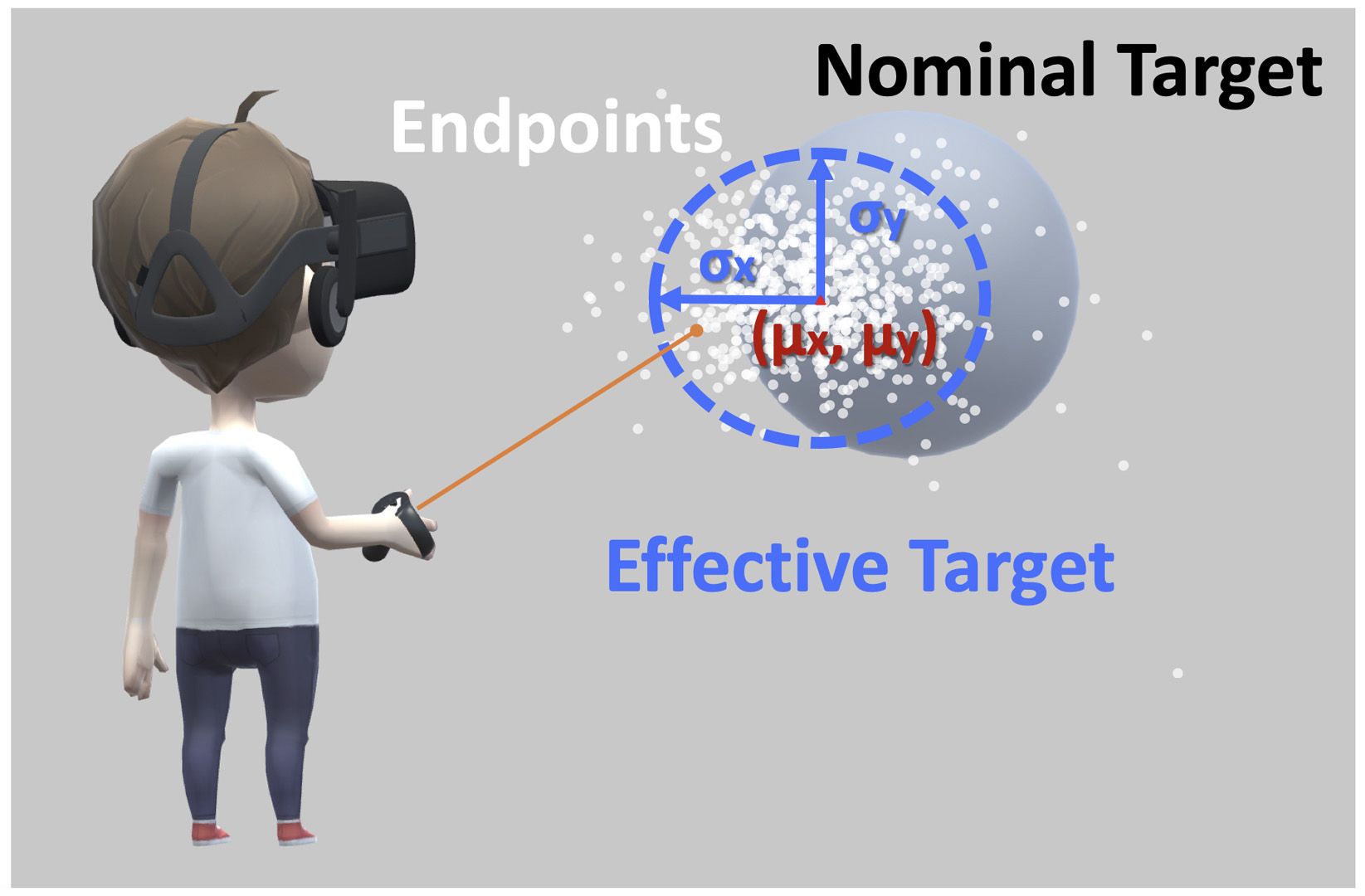
Understanding the endpoint distribution of pointing selection tasks can reveal the underlying patterns on how users tend to acquire a target, which is one of the most essential and pervasive tasks in interactive systems. It could further aid designers to create new graphical user interfaces and interaction techniques that are optimized for accuracy, efficiency, and ease of use. Previous research has explored the modeling of endpoint distribution outside of virtual reality (VR) systems that have shown to be useful in predicting selection accuracy and guide the design of new interactive techniques. This work aims at developing an endpoint distribution of selection tasks for VR systems which has resulted in EDModel, a novel model that can be used to predict endpoint distribution of pointing selection tasks in VR environments. The development of EDModel is based on two users studies that have explored how factors such as target size, movement amplitude, and target depth affect the endpoint distribution. The model is built from the collected data and its generalizability is subsequently tested in complex scenarios with more relaxed conditions. Three applications of EDModel inspired by previous research are evaluated to show the broad applicability and usefulness of the model: correcting the bias in Fitts’s law, predicting selection accuracy, and enhancing pointing selection techniques. Overall, EDModel can achieve high prediction accuracy and can be adapted to different types of applications in VR.
References:
1. Ferran Argelaguet and Carlos Andujar. 2009. Efficient 3D Pointing Selection in Cluttered Virtual Environments. IEEE Computer Graphics and Applications 29, 6 (Nov 2009), 34–43. Google ScholarCross Ref
2. Ferran Argelaguet and Carlos Andujar. 2013. A survey of 3D object selection techniques for virtual environments. Computers & Graphics 37, 3 (2013), 121–136.Google ScholarDigital Library
3. Marc Baloup, Thomas Pietrzak, and Géry Casiez. 2019. RayCursor: A 3D Pointing Facilitation Technique Based on Raycasting. In Proceedings of the 2019 CHI Conference on Human Factors in Computing Systems (CHI ’19). ACM, New York, NY, USA, Article 101, 12 pages. Google ScholarDigital Library
4. Nikola Banovic, Tovi Grossman, and George Fitzmaurice. 2013. The Effect of Time-based Cost of Error in Target-directed Pointing Tasks. In Proceedings of the SIGCHI Conference on Human Factors in Computing Systems (CHI ’13). ACM, New York, NY, USA, 1373–1382. Google ScholarDigital Library
5. Mayra Donaji Barrera Machuca and Wolfgang Stuerzlinger. 2019. The Effect of Stereo Display Deficiencies on Virtual Hand Pointing. In Proceedings of the 2019 CHI Conference on Human Factors in Computing Systems (CHI ’19). ACM, New York, NY, USA, Article 207, 14 pages. Google ScholarDigital Library
6. Dimitri P. Bertsekas and John N. Tsitsiklis. 2002. Introduction to probability. Vol. 1. Athena Scientific Belmont, MA.Google Scholar
7. Xiaojun Bi, Yang Li, and Shumin Zhai. 2013. FFitts Law: Modeling Finger Touch with Fitts’ Law. In Proceedings of the SIGCHI Conference on Human Factors in Computing Systems (CHI ’13). ACM, New York, NY, USA, 1363–1372. Google ScholarDigital Library
8. Xiaojun Bi and Shumin Zhai. 2013. Bayesian Touch: A Statistical Criterion of Target Selection with Finger Touch. In Proceedings of the 26th Annual ACM Symposium on User Interface Software and Technology (UIST ’13). ACM, New York, NY, USA, 51–60. Google ScholarDigital Library
9. Xiaojun Bi and Shumin Zhai. 2016. Predicting Finger-Touch Accuracy Based on the Dual Gaussian Distribution Model. In Proceedings of the 29th Annual Symposium on User Interface Software and Technology (UIST ’16). ACM, New York, NY, USA, 313–319. Google ScholarDigital Library
10. Doug Bowman, Ernst Kruijff, Joseph J LaViola Jr, and Ivan P Poupyrev. 2004. 3D User interfaces: theory and practice, CourseSmart eTextbook. Addison-Wesley.Google ScholarDigital Library
11. Doug Bowman, Chadwick Wingrave, Joshua Campbell, and Vinh Ly. 2001. Using pinch gloves ™ for both natural and abstract interaction techniques in virtual environments. (2001).Google Scholar
12. ERFW Crossman. 1957. The speed and accuracy of simple hand movements. The nature and acquisition of industrial skills (1957).Google Scholar
13. Paul M. Fitts. 1954. The information capacity of the human motor system in controlling the amplitude of movement. Journal of experimental psychology 47, 6 (1954), 381.Google ScholarCross Ref
14. Paul M. Fitts and Barbara K. Radford. 1966. Information capacity of discrete motor responses under different cognitive sets. Journal of Experimental Psychology 71, 4 (1966), 475.Google ScholarCross Ref
15. Joshua Goodman, Gina Venolia, Keith Steury, and Chauncey Parker. 2002. Language Modeling for Soft Keyboards. In Proceedings of the 7th International Conference on Intelligent User Interfaces (IUI ’02). ACM, New York, NY, USA, 194–195. Google ScholarDigital Library
16. Julien Gori, Olivier Rioul, and Yves Guiard. 2017. To Miss is Human: Information-Theoretic Rationale for Target Misses in Fitts’ Law. In Proceedings of the 2017 CHI Conference on Human Factors in Computing Systems (CHI ’17). ACM, New York, NY, USA, 260–264. Google ScholarDigital Library
17. Tovi Grossman and Ravin Balakrishnan. 2005. A Probabilistic Approach to Modeling Two-dimensional Pointing. ACM Trans. Comput.-Hum. Interact. 12, 3 (Sept. 2005), 435–459. Google ScholarDigital Library
18. Tovi Grossman, Nicholas Kong, and Ravin Balakrishnan. 2007. Modeling Pointing at Targets of Arbitrary Shapes. In Proceedings of the SIGCHI Conference on Human Factors in Computing Systems (CHI ’07). ACM, New York, NY, USA, 463–472. Google ScholarDigital Library
19. Yves Guiard, Halla B. Olafsdottir, and Simon T. Perrault. 2011. Fitt’s Law As an Explicit Time/Error Trade-off. In Proceedings of the SIGCHI Conference on Human Factors in Computing Systems (CHI ’11). ACM, New York, NY, USA, 1619–1628. Google ScholarDigital Library
20. Yves Guiard and Olivier Rioul. 2015. A Mathematical Description of the Speed/Accuracy Trade-off of Aimed Movement. In Proceedings of the 2015 British HCI Conference (British HCI ’15). ACM, New York, NY, USA, 91–100. Google ScholarDigital Library
21. Mark S. Hancock and Kellogg S. Booth. 2004. Improving Menu Placement Strategies for Pen Input. In Proceedings of Graphics Interface 2004 (GI ’04). Canadian Human-Computer Communications Society, School of Computer Science, University of Waterloo, Waterloo, Ontario, Canada, 221–230. http://dl.acm.org/citation.cfm?id=1006058.1006085Google Scholar
22. Jin Huang and Byungjoo Lee. 2019. Modeling Error Rates in Spatiotemporal Moving Target Selection. In Extended Abstracts of the 2019 CHI Conference on Human Factors in Computing Systems (CHI EA ’19). ACM, New York, NY, USA, Article LBW2411, 6 pages. Google ScholarDigital Library
23. Jin Huang, Feng Tian, Xiangmin Fan, Xiaolong (Luke) Zhang, and Shumin Zhai. 2018. Understanding the Uncertainty in 1D Unidirectional Moving Target Selection. In Proceedings of the 2018 CHI Conference on Human Factors in Computing Systems (CHI ’18). ACM, New York, NY, USA, Article 237, 12 pages. Google ScholarDigital Library
24. ISO. 2000. ISO 9241-9:2000. Ergonomic requirements for office work with visual display terminals (VDTs) – Part 9 – Requirements for non-keyboard input devices (2000).Google Scholar
25. ISO. 2009. ISO80000-2: 2009. Quantities and units-Part 2: Mathematical signs and symbols to be used in the natural sciences and technology (2009).Google Scholar
26. Regis Kopper, Doug A. Bowman, Mara G. Silva, and Ryan P. McMahan. 2010. A human motor behavior model for distal pointing tasks. International Journal of Human-Computer Studies 68, 10 (2010), 603 — 615. Google ScholarDigital Library
27. Samuel Kotz, Narayanaswamy Balakrishnan, and Norman L. Johnson. 2004. Continuous multivariate distributions, Volume 1: Models and applications. Vol. 1. John Wiley & Sons.Google Scholar
28. Byungjoo Lee, Sunjun Kim, Antti Oulasvirta, Jong-In Lee, and Eunji Park. 2018. Moving Target Selection: A Cue Integration Model. In Proceedings of the 2018 CHI Conference on Human Factors in Computing Systems (CHI ’18). ACM, New York, NY, USA, Article 230, 12 pages. Google ScholarDigital Library
29. Byungjoo Lee and Antti Oulasvirta. 2016. Modelling Error Rates in Temporal Pointing. In Proceedings of the 2016 CHI Conference on Human Factors in Computing Systems (CHI ’16). ACM, New York, NY, USA, 1857–1868. Google ScholarDigital Library
30. Injung Lee, Sunjun Kim, and Byungjoo Lee. 2019. Geometrically Compensating Effect of End-to-End Latency in Moving-Target Selection Games. In Proceedings of the 2019 CHI Conference on Human Factors in Computing Systems (CHI ’19). ACM, New York, NY, USA, 560:1–560:12. Google ScholarDigital Library
31. Nianlong Li, Feng Tian, Jin Huang, Xiangmin Fan, and Hongan Wang. 2018. 2D-BayesPointer: An Implicit Moving Target Selection Technique Enabled by Human Performance Modeling. In Extended Abstracts of the 2018 CHI Conference on Human Factors in Computing Systems (CHI EA ’18). ACM, New York, NY, USA, Article LBW125, 6 pages. Google ScholarDigital Library
32. I. Scott MacKenzie. 1992. Fitts’ law as a research and design tool in human-computer interaction. Human-computer interaction 7, 1 (1992), 91–139.Google Scholar
33. I. Scott MacKenzie and Poika Isokoski. 2008. Fitts’ Throughput and the Speed-accuracy Tradeoff. In Proceedings of the SIGCHI Conference on Human Factors in Computing Systems (CHI ’08). ACM, New York, NY, USA, 1633–1636. Google ScholarDigital Library
34. Atsuo Murata. 1999. Extending Effective Target Width in Fitts’ Law to a Two-Dimensional Pointing Task. International Journal of Human-Computer Interaction 11, 2 (1999), 137–152. Google ScholarCross Ref
35. Eunji Park, Hyunju Kim, Injung Lee, and Byungjoo Lee. 2018. Whether Moving or Not: Modeling and Predicting Error Rates in Pointing Regardless of Target Motion. arXiv preprint arXiv:1806.02973 (2018).Google Scholar
36. Julian Petford, Miguel A. Nacenta, and Carl Gutwin. 2018. Pointing All Around You: Selection Performance of Mouse and Ray-Cast Pointing in Full-Coverage Displays. In Proceedings of the 2018 CHI Conference on Human Factors in Computing Systems (CHI ’18). ACM, New York, NY, USA, Article 533, 14 pages. Google ScholarDigital Library
37. Réjean Plamondon and Adel M Alimi. 1997. Speed/accuracy trade-offs in target-directed movements. Behavioral and brain sciences 20, 2 (1997), 279–303.Google Scholar
38. Yuan Yuan Qian and Robert J. Teather. 2017. The Eyes Don’t Have It: An Empirical Comparison of Head-based and Eye-based Selection in Virtual Reality. In Proceedings of the 5th Symposium on Spatial User Interaction (SUI ’17). ACM, New York, NY, USA, 91–98. Google ScholarDigital Library
39. Richard A. Schmidt, Howard Zelaznik, Brian Hawkins, James S. Frank, and John T. Quinn Jr. 1979. Motor-output variability: a theory for the accuracy of rapid motor acts. Psychological review 86, 5 (1979), 415.Google Scholar
40. Richard A. Schmidt, Howard N. Zelaznik, and James S. Frank. 1978. 9 – Sources of Inaccuracy in Rapid Movement. In Information Processing in Motor Control and Learning, George E. Stelmach (Ed.). Academic Press, 183 — 203. Google ScholarCross Ref
41. R. William Soukoreff and I. Scott MacKenzie. 2004. Towards a standard for pointing device evaluation, perspectives on 27 years of Fitts’ law research in HCI. International journal of human-computer studies 61, 6 (2004), 751–789.Google Scholar
42. R. William Soukoreff and I. Scott MacKenzie. 2009. An informatic rationale for the speed-accuracy trade-off. In 2009 IEEE International Conference on Systems, Man and Cybernetics. 2890–2896. Google ScholarCross Ref
43. Huawei Tu, Susu Huang, Jiabin Yuan, Xiangshi Ren, and Feng Tian. 2019. Crossing-Based Selection with Virtual Reality Head-Mounted Displays. In Proceedings of the 2019 CHI Conference on Human Factors in Computing Systems (CHI ’19). ACM, New York, NY, USA, Article 618, 14 pages. Google ScholarDigital Library
44. Lode Vanacken, Tovi Grossman, and Karin Coninx. 2007. Exploring the Effects of Environment Density and Target Visibility on Object Selection in 3D Virtual Environments. In 2007 IEEE Symposium on 3D User Interfaces. Google ScholarCross Ref
45. Feng Wang and Xiangshi Ren. 2009. Empirical Evaluation for Finger Input Properties in Multi-touch Interaction. In Proceedings of the SIGCHI Conference on Human Factors in Computing Systems (CHI ’09). ACM, New York, NY, USA, 1063–1072. Google ScholarDigital Library
46. Alan Traviss Welford. 1968. Fundamentals of skill. (1968).Google Scholar
47. Chadwick A. Wingrave and Doug A. Bowman. 2005. Baseline Factors for Raycasting Selection. In Proceedings of Virtual Reality International.Google Scholar
48. Jacob O. Wobbrock, Edward Cutrell, Susumu Harada, and I. Scott MacKenzie. 2008. An Error Model for Pointing Based on Fitts’ Law. In Proceedings of the SIGCHI Conference on Human Factors in Computing Systems (CHI ’08). ACM, New York, NY, USA, 1613–1622. Google ScholarDigital Library
49. Jacob O. Wobbrock, Alex Jansen, and Kristen Shinohara. 2011a. Modeling and Predicting Pointing Errors in Two Dimensions. In Proceedings of the SIGCHI Conference on Human Factors in Computing Systems (CHI ’11). ACM, New York, NY, USA, 1653–1656. Google ScholarDigital Library
50. Jacob O. Wobbrock, Kristen Shinohara, and Alex Jansen. 2011b. The effects of task dimensionality, endpoint deviation, throughput calculation, and experiment design on pointing measures and models. In Proceedings of the SIGCHI Conference on Human Factors in Computing Systems. ACM, 1639–1648.Google ScholarDigital Library
51. Shota Yamanaka. 2018a. Effect of Gaps with Penal Distractors Imposing Time Penalty in Touch-pointing Tasks. In Proceedings of the 20th International Conference on Human-Computer Interaction with Mobile Devices and Services (MobileHCI ’18). ACM, New York, NY, USA, Article 21, 11 pages. Google ScholarDigital Library