“LuisaRender: A High-Performance Rendering Framework with Layered and Unified Interfaces on Stream Architectures” by Zheng, Zhou, Chen, Yan, Zhang, et al. …
Conference:
Type(s):
Title:
- LuisaRender: A High-Performance Rendering Framework with Layered and Unified Interfaces on Stream Architectures
Session/Category Title:
- Rendering Systems
Presenter(s)/Author(s):
Abstract:
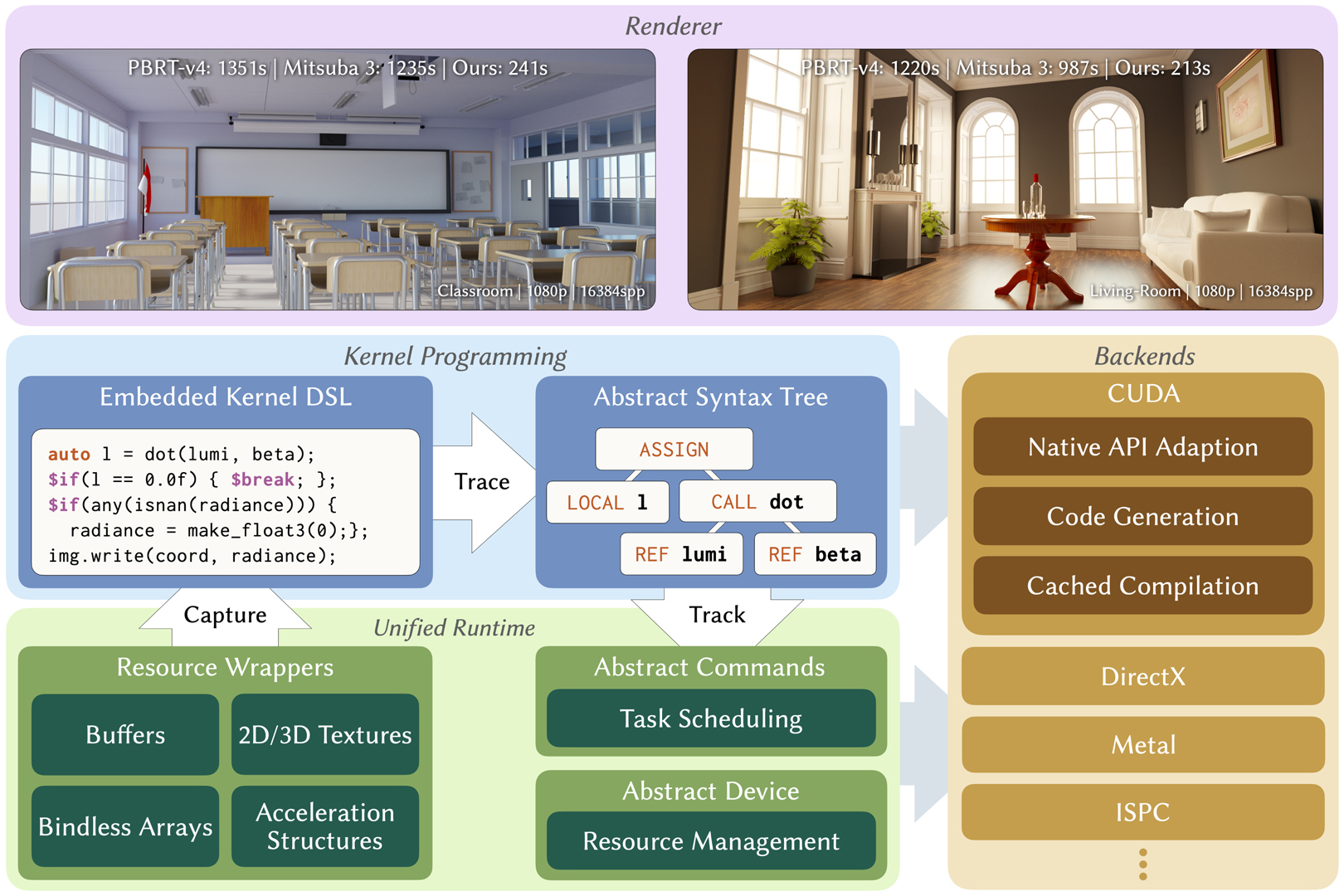
The advancements in hardware have drawn more attention than ever to high-quality offline rendering with modern stream processors, both in the industry and in research fields. However, the graphics APIs are fragmented and existing shading languages lack high-level constructs such as polymorphism, which adds complexity to developing and maintaining cross-platform high-performance renderers. We present LuisaRender1, a high-performance rendering framework for modern stream-architecture hardware. Our main contribution is an expressive C++-embedded DSL for kernel programming with JIT code generation and compilation. We also implement a unified runtime layer with resource wrappers and an optimized Monte Carlo renderer. Experiments on test scenes show that LuisaRender achieves much higher performance than existing research renderers on modern graphics hardware, e.g., 5–11× faster than PBRT-v4 and 4–16× faster than Mitsuba 3.
References:
1. Martin Abadi, Ashish Agarwal, Paul Barham, Eugene Brevdo, Zhifeng Chen, Craig Citro, Greg S. Corrado, Andy Davis, Jeffrey Dean, Matthieu Devin, Sanjay Ghemawat, Ian Goodfellow, Andrew Harp, Geoffrey Irving, Michael Isard, Yangqing Jia, Rafal Jozefowicz, Lukasz Kaiser, Manjunath Kudlur, Josh Levenberg, Dan Mané, Rajat Monga, Sherry Moore, Derek Murray, Chris Olah, Mike Schuster, Jonathon Shlens, Benoit Steiner, Ilya Sutskever, Kunal Talwar, Paul Tucker, Vincent Vanhoucke, Vijay Vasudevan, Fernanda Viégas, Oriol Vinyals, Pete Warden, Martin Wattenberg, Martin Wicke, Yuan Yu, and Xiaoqiang Zheng. 2015. TensorFlow: Large-Scale Machine Learning on Heterogeneous Systems. http://tensorflow.org/ Software available from tensorflow.org.
2. Andrew Adams, Karima Ma, Luke Anderson, Riyadh Baghdadi, Tzu-Mao Li, Michaël Gharbi, Benoit Steiner, Steven Johnson, Kayvon Fatahalian, Frédo Durand, and Jonathan Ragan-Kelley. 2019. Learning to Optimize Halide with Tree Search and Random Programs. ACM Trans. Graph. 38, 4, Article 121 (jul 2019), 12 pages.
3. Luke Anderson, Andrew Adams, Karima Ma, Tzu-Mao Li, Tian Jin, and Jonathan Ragan-Kelley. 2021. Efficient Automatic Scheduling of Imaging and Vision Pipelines for the GPU. Proc. ACM Program. Lang. 5, OOPSLA, Article 109 (oct 2021), 28 pages.
4. Luke Anderson, Tzu-Mao Li, Jaakko Lehtinen, and Frédo Durand. 2017. Aether: An Embedded Domain Specific Sampling Language for Monte Carlo Rendering. ACM Trans. Graph. 36, 4, Article 99 (jul 2017), 16 pages.
5. Apple. 2021. Metal. https://developer.apple.com/metal/
6. Benedikt Bitterli. 2016. Rendering resources. https://benedikt-bitterli.me/resources/
7. Blender Online Community. 2022. Blender – A 3D Modelling and Rendering Package. Blender Foundation, Stichting Blender Foundation, Amsterdam. http://www.blender.org
8. Zachary DeVito, James Hegarty, Alex Aiken, Pat Hanrahan, and Jan Vitek. 2013. Terra: A Multi-Stage Language for High-Performance Computing. SIGPLAN Not. 48, 6 (jun 2013), 105–116.
9. Zachary DeVito, Michael Mara, Michael Zollhöfer, Gilbert Bernstein, Jonathan Ragan-Kelley, Christian Theobalt, Pat Hanrahan, Matthew Fisher, and Matthias Niessner. 2017. Opt: A Domain Specific Language for Non-Linear Least Squares Optimization in Graphics and Imaging. ACM Trans. Graph. 36, 5, Article 171 (oct 2017), 27 pages.
10. Steven Diamond and Stephen Boyd. 2016. CVXPY: A Python-Embedded Modeling Language for Convex Optimization. J. Mach. Learn. Res. 17, 1 (jan 2016), 2909–2913.
11. Epic Games. 2019. Unreal Engine. https://www.unrealengine.com
12. Luca Fascione, Johannes Hanika, Mark Leone, Marc Droske, Jorge Schwarzhaupt, Tomáš Davidovič, Andrea Weidlich, and Johannes Meng. 2018. Manuka: A Batch-Shading Architecture for Spectral Path Tracing in Movie Production. ACM Trans. Graph. 37, 3, Article 31 (aug 2018), 18 pages.
13. Roy Frostig, Matthew Johnson, and Chris Leary. 2018. Compiling machine learning programs via high-level tracing. https://mlsys.org/Conferences/doc/2018/146.pdf
14. Yong He, Kayvon Fatahalian, and Tim Foley. 2018. Slang: Language Mechanisms for Extensible Real-Time Shading Systems. ACM Trans. Graph. 37, 4, Article 141 (jul 2018), 13 pages.
15. Yong He, Tim Foley, Teguh Hofstee, Haomin Long, and Kayvon Fatahalian. 2017. Shader Components: Modular and High Performance Shader Development. ACM Trans. Graph. 36, 4, Article 100 (jul 2017), 11 pages.
16. Felix Heide, Steven Diamond, Matthias Nießner, Jonathan Ragan-Kelley, Wolfgang Heidrich, and Gordon Wetzstein. 2016. ProxImaL: Efficient Image Optimization Using Proximal Algorithms. ACM Trans. Graph. 35, 4, Article 84 (jul 2016), 15 pages.
17. Shi-Min Hu, Dun Liang, Guo-Ye Yang, Guo-Wei Yang, and Wen-Yang Zhou. 2020b. Jittor: a novel deep learning framework with meta-operators and unified graph execution. Science China Information Sciences 63, 222103 (2020), 1–21.
18. Yuanming Hu, Luke Anderson, Tzu-Mao Li, Qi Sun, Nathan Carr, Jonathan Ragan-Kelley, and Frédo Durand. 2020a. DiffTaichi: Differentiable Programming for Physical Simulation. In Proceedings of ICLR 2020.
19. Yuanming Hu, Tzu-Mao Li, Luke Anderson, Jonathan Ragan-Kelley, and Frédo Durand. 2019. Taichi: A Language for High-Performance Computation on Spatially Sparse Data Structures. ACM Trans. Graph. 38, 6, Article 201 (nov 2019), 16 pages.
20. Yuanming Hu, Jiafeng Liu, Xuanda Yang, Mingkuan Xu, Ye Kuang, Weiwei Xu, Qiang Dai, William T. Freeman, and Frédo Durand. 2021. QuanTaichi: A Compiler for Quantized Simulations. ACM Trans. Graph. 40, 4, Article 182 (jul 2021), 16 pages.
21. Ignis. 2022. Ignis. https://github.com/PearCoding/Ignis
22. Wenzel Jakob. 2019. Enoki: structured vectorization and differentiation on modern processor architectures. https://github.com/mitsuba-renderer/enoki.
23. Wenzel Jakob, Sébastien Speierer, Nicolas Roussel, Merlin Nimier-David, Delio Vicini, Tizian Zeltner, Baptiste Nicolet, Miguel Crespo, Vincent Leroy, and Ziyi Zhang. 2022b. Mitsuba 3 renderer. https://mitsuba-renderer.org.
24. Wenzel Jakob, Sébastien Speierer, Nicolas Roussel, and Delio Vicini. 2022a. DR.JIT: A Just-in-Time Compiler for Differentiable Rendering. ACM Trans. Graph. 41, 4, Article 124 (jul 2022), 19 pages.
25. Simon Kallweit, Petrik Clarberg, Craig Kolb, Tom’aš Davidovič, Kai-Hwa Yao, Theresa Foley, Yong He, Lifan Wu, Lucy Chen, Tomas Akenine-Möller, Chris Wyman, Cyril Crassin, and Nir Benty. 2017. The Falcor Rendering Framework. https://github.com/NVIDIAGameWorks/Falcor https://github.com/NVIDIAGameWorks/Falcor.
26. Samuli Laine, Tero Karras, and Timo Aila. 2013. Megakernels Considered Harmful: Wavefront Path Tracing on GPUs. In Proceedings of the 5th High-Performance Graphics Conference (Anaheim, California) (HPG ’13). Association for Computing Machinery, New York, NY, USA, 137–143.
27. Chris Lattner and Vikram Adve. 2004. LLVM: A Compilation Framework for Lifelong Program Analysis & Transformation. In Proceedings of the International Symposium on Code Generation and Optimization: Feedback-Directed and Runtime Optimization (Palo Alto, California) (CGO ’04). IEEE Computer Society, USA, 75.
28. Mark Lee, Brian Green, Feng Xie, and Eric Tabellion. 2017. Vectorized Production Path Tracing. In Proceedings of High Performance Graphics (Los Angeles, California) (HPG ’17). Association for Computing Machinery, New York, NY, USA, Article 10, 11 pages.
29. Roland Leißa, Klaas Boesche, Sebastian Hack, Arsène Pérard-Gayot, Richard Membarth, Philipp Slusallek, André Müller, and Bertil Schmidt. 2018. AnyDSL: A Partial Evaluation Framework for Programming High-Performance Libraries. Proc. ACM Program. Lang. 2, OOPSLA, Article 119 (oct 2018), 30 pages.
30. Tzu-Mao Li, Michaël Gharbi, Andrew Adams, Frédo Durand, and Jonathan Ragan-Kelley. 2018. Differentiable Programming for Image Processing and Deep Learning in Halide. ACM Trans. Graph. 37, 4, Article 139 (jul 2018), 13 pages.
31. William R. Mark, R. Steven Glanville, Kurt Akeley, and Mark J. Kilgard. 2003. Cg: A System for Programming Graphics Hardware in a C-like Language. ACM Trans. Graph. 22, 3 (jul 2003), 896–907.
32. Michael D. McCool, Zheng Qin, and Tiberiu S. Popa. 2002. Shader Metaprogramming. In Proceedings of the ACM SIGGRAPH/EUROGRAPHICS Conference on Graphics Hardware (Saarbrucken, Germany) (HWWS ’02). Eurographics Association, Goslar, DEU, 57–68.
33. Ravi Teja Mullapudi, Andrew Adams, Dillon Sharlet, Jonathan Ragan-Kelley, and Kayvon Fatahalian. 2016. Automatically Scheduling Halide Image Processing Pipelines. ACM Trans. Graph. 35, 4, Article 83 (jul 2016), 11 pages.
34. Merlin Nimier-David, Sébastien Speierer, Benoît Ruiz, and Wenzel Jakob. 2020. Radiative Backpropagation: An Adjoint Method for Lightning-Fast Differentiable Rendering. ACM Trans. Graph. 39, 4, Article 146 (jul 2020), 15 pages.
35. Merlin Nimier-David, Delio Vicini, Tizian Zeltner, and Wenzel Jakob. 2019. Mitsuba 2: A Retargetable Forward and Inverse Renderer. ACM Trans. Graph. 38, 6, Article 203 (nov 2019), 17 pages.
36. NVIDIA. 2022. NVIDIA Warp. https://developer.nvidia.com/warp-python
37. Adam Paszke, Sam Gross, Francisco Massa, Adam Lerer, James Bradbury, Gregory Chanan, Trevor Killeen, Zeming Lin, Natalia Gimelshein, Luca Antiga, Alban Desmaison, Andreas Kopf, Edward Yang, Zachary DeVito, Martin Raison, Alykhan Tejani, Sasank Chilamkurthy, Benoit Steiner, Lu Fang, Junjie Bai, and Soumith Chintala. 2019. PyTorch: An Imperative Style, High-Performance Deep Learning Library. In Advances in Neural Information Processing Systems 32. Curran Associates, Inc., 8024–8035. http://papers.neurips.cc/paper/9015-pytorch-an-imperative-style-high-performance-deep-learning-library.pdf
38. Arsène Pérard-Gayot, Richard Membarth, Roland Leißa, Sebastian Hack, and Philipp Slusallek. 2019. Rodent: Generating Renderers without Writing a Generator. ACM Trans. Graph. 38, 4, Article 40 (jul 2019), 12 pages.
39. Matt Pharr, Wenzel Jakob, and Greg Humphreys. 2016. Physically Based Rendering: From Theory to Implementation (3rd ed.). Morgan Kaufmann Publishers Inc., San Francisco, CA, USA. https://github.com/mmp/pbrt-v4
40. Matt Pharr and William R. Mark. 2012. Ispc: A SPMD compiler for high-performance CPU programming. In 2012 Innovative Parallel Computing (InPar). 1–13.
41. Jonathan Ragan-Kelley, Andrew Adams, Sylvain Paris, Marc Levoy, Saman Amarasinghe, and Frédo Durand. 2012. Decoupling Algorithms from Schedules for Easy Optimization of Image Processing Pipelines. ACM Trans. Graph. 31, 4, Article 32 (jul 2012), 12 pages.
42. Jonathan Ragan-Kelley, Connelly Barnes, Andrew Adams, Sylvain Paris, Frédo Durand, and Saman Amarasinghe. 2013. Halide: A Language and Compiler for Optimizing Parallelism, Locality, and Recomputation in Image Processing Pipelines. In Proceedings of the 34th ACM SIGPLAN Conference on Programming Language Design and Implementation (Seattle, Washington, USA) (PLDI ’13). Association for Computing Machinery, New York, NY, USA, 519–530.
43. Kerry A. Seitz, Tim Foley, Serban D. Porumbescu, and John D. Owens. 2019. Staged Metaprogramming for Shader System Development. ACM Trans. Graph. 38, 6, Article 202 (nov 2019), 15 pages.
44. Walid Taha. 2004. A Gentle Introduction to Multi-stage Programming. Springer Berlin Heidelberg, Berlin, Heidelberg, 30–50.
45. Delio Vicini, Sébastien Speierer, and Wenzel Jakob. 2021. Path Replay Backpropagation: Differentiating Light Paths Using Constant Memory and Linear Time. ACM Trans.
46. Graph. 40, 4, Article 108 (jul 2021), 14 pages.
47. Fahad Zafar, Marc Olano, and Aaron Curtis. 2010. GPU Random Numbers via the Tiny Encryption Algorithm (HPG ’10). Eurographics Association, Goslar, DEU, 133–141.