“LOGAN: unpaired shape transform in latent overcomplete space” by Yin, Chen, Huang, Cohen-Or and Zhang
Conference:
Type(s):
Title:
- LOGAN: unpaired shape transform in latent overcomplete space
Session/Category Title:
- Geometry with Style
Presenter(s)/Author(s):
Moderator(s):
Abstract:
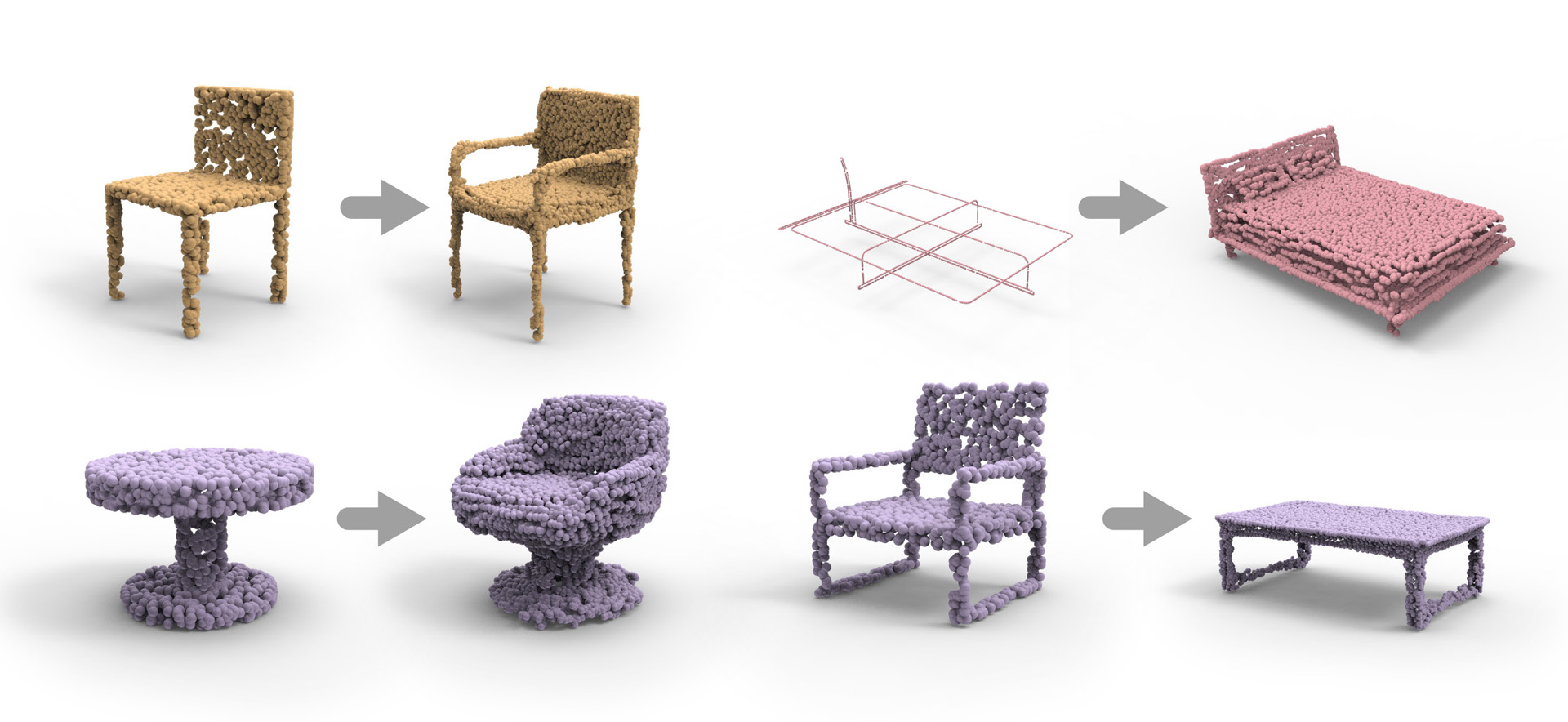
We introduce LOGAN, a deep neural network aimed at learning generalpurpose shape transforms from unpaired domains. The network is trained on two sets of shapes, e.g., tables and chairs, while there is neither a pairing between shapes from the domains as supervision nor any point-wise correspondence between any shapes. Once trained, LOGAN takes a shape from one domain and transforms it into the other. Our network consists of an autoencoder to encode shapes from the two input domains into a common latent space, where the latent codes concatenate multi-scale shape features, resulting in an overcomplete representation. The translator is based on a generative adversarial network (GAN), operating in the latent space, where an adversarial loss enforces cross-domain translation while a feature preservation loss ensures that the right shape features are preserved for a natural shape transform. We conduct ablation studies to validate each of our key network designs and demonstrate superior capabilities in unpaired shape transforms on a variety of examples over baselines and state-of-the-art approaches. We show that LOGAN is able to learn what shape features to preserve during shape translation, either local or non-local, whether content or style, depending solely on the input domains for training.
References:
1. Panos Achlioptas, Olga Diamanti, Ioannis Mitliagkas, and Leonidas Guibas. 2018. Learning Representations and Generative Models for 3D Point Clouds. In Proc. of ICML.Google Scholar
2. Ibraheem Alhashim, Honghua Li, Kai Xu, Junjie Cao, Rui Ma, and Hao Zhang. 2014. Topology-Varying 3D Shape Creation via Structural Blending. ACM Trans. on Graph 33, 4 (2014), Article 158.Google ScholarDigital Library
3. Amjad Almahairi, Sai Rajeswar, Alessandro Sordoni, Philip Bachman, and Aaron Courville. 2018. Augmented CycleGAN: Learning Many-to-Many Mappings from Unpaired Data. In Proc. of ICML.Google Scholar
4. Martin Arjovsky, Soumith Chintala, and Léon Bottou. 2017. Wasserstein Generative Adversarial Networks. In Proc. of ICML. 214–223.Google Scholar
5. Matan Atzmon, Haggai Maron, and Yaron Lipman. 2018. Point Convolutional Neural Networks by Extension Operators. ACM Trans. on Graph 37, 4 (2018).Google ScholarDigital Library
6. Sema Berkiten, Maciej Halber, Justin Solomon, Chongyang Ma, Hao Li, and Szymon Rusinkiewicz. 2017. Learning detail transfer based on geometric features. In Computer Graphics Forum (Eurographics), Vol. 36. 361–373.Google ScholarDigital Library
7. Arunkumar Byravan and Dieter Fox. 2017. SE3-Nets: Learning Rigid Body Motion using Deep Neural Networks. In Proc. of ICRA. IEEE, 173–180.Google ScholarCross Ref
8. Angel X. Chang, Thomas A. Funkhouser, Leonidas J. Guibas, Pat Hanrahan, Qi-Xing Huang, Zimo Li, Silvio Savarese, Manolis Savva, Shuran Song, Hao Su, Jianxiong Xiao, Li Yi, and Fisher Yu. 2015. ShapeNet: An Information-Rich 3D Model Repository. CoRR abs/1512.03012 (2015).Google Scholar
9. Massimiliano Corsini, Paolo Cignoni, and Roberto Scopigno. 2012. Efficient and flexible sampling with blue noise properties of triangular meshes. IEEE Trans. Vis. & Comp. Graphics 18, 6 (2012), 914–924.Google ScholarDigital Library
10. Zhicheng Cui, Wenlin Chen, and Yixin Chen. 2016. Multi-Scale Convolutional Neural Networks for Time Series Classification. CoRR abs/1603.06995 (2016). arXiv:1603.06995 http://arxiv.org/abs/1603.06995Google Scholar
11. Hao Dong, Paarth Neekhara, Chao Wu, and Yike Guo. 2017. Unsupervised image-to-image translation with generative adversarial networks. In Proc. of ICML.Google Scholar
12. David Eigen, Christian Puhrsch, and Rob Fergus. 2014. Depth Map Prediction from a Single Image Using a Multi-scale Deep Network. In NIPS. 2366–2374.Google Scholar
13. Haoqiang Fan, Hao Su, and Leonidas Guibas. 2017. A point set generation network for 3d object reconstruction from a single image. In Proc. of CVPR.Google ScholarCross Ref
14. Lin Gao, Jie Yang, Yi-Ling Qiao, Yu-Kun Lai, Paul L Rosin, Weiwei Xu, and Shihong Xia. 2018. Automatic unpaired shape deformation transfer. In ACM Trans. on Graph, Vol. 37. ACM, 1–15.Google ScholarDigital Library
15. Paul Guerrero, Yanir Kleiman, Maks Ovsjanikov, and Niloy J Mitra. 2018. PCPNET: Learning Local Shape Properties from Raw Point Clouds. In Computer Graphics Forum (Eurographics), Vol. 37. Wiley Online Library, 75–85.Google Scholar
16. Ishaan Gulrajani, Faruk Ahmed, Martin Arjovsky, Vincent Dumoulin, and Aaron C Courville. 2017. Improved training of Wasserstein GANs. In NIPS. 5767–5777.Google Scholar
17. Judy Hoffman, Eric Tzeng, Taesung Park, Jun-Yan Zhu, Phillip Isola, Kate Saenko, Alexei A Efros, and Trevor Darrell. 2018. CyCADA: Cycle-Consistent Adversarial Domain Adaptation. In Proc. of Machine Learning Research.Google Scholar
18. Yedid Hoshen and Lior Wolf. 2018. NAM: Non-Adversarial Unsupervised Domain Mapping. In Proc. of ECCV.Google ScholarCross Ref
19. Xun Huang, Ming-Yu Liu, Serge Belongie, and Jan Kautz. 2018. Multimodal Unsupervised Image-to-Image Translation. In Proc. of ECCV.Google ScholarCross Ref
20. Max Jaderberg, Karen Simonyan, Andrew Zisserman, et al. 2015. Spatial transformer networks. In NIPS. 2017–2025.Google Scholar
21. Hsin-Ying Lee, Hung-Yu Tseng, Jia-Bin Huang, Maneesh Singh, and Ming-Hsuan Yang. 2018. Diverse image-to-image translation via disentangled representations. In Proc. of ECCV, Vol. 1. 5.Google Scholar
22. Yangyan Li, Rui Bu, Mingchao Sun, Wei Wu, Xinhan Di, and Baoquan Chen. 2018. PointCNN: Convolution On X-Transformed Points. In NIPS. 828–838.Google Scholar
23. Ming-Yu Liu, Thomas Breuel, and Jan Kautz. 2017. Unsupervised image-to-image translation networks. In NIPS. 700–708.Google Scholar
24. Niloy Mitra, Michael Wand, Hao Zhang, Daniel Cohen-Or, Vladimir Kim, and Qi-Xing Huang. 2013. Structure-aware Shape Processing. In SIGGRAPH Asia 2013 Courses. 1:1–1:20.Google Scholar
25. Xue Bin Peng, Pieter Abbeel, Sergey Levine, and Michiel van de Panne. 2018. DeepMimic: Example-Guided Deep Reinforcement Learning of Physics-Based Character Skills. ACM Trans. on Graph 37, 4 (2018).Google ScholarDigital Library
26. Ori Press, Tomer Galanti, Sagie Benaim, and Lior Wolf. 2019. Emerging Disentanglement in Auto-Encoder Based Unsupervised Image Content Transfer. In Proc. of ICLR.Google Scholar
27. Charles R. Qi, Hao Su, Kaichun Mo, and Leonidas J. Guibas. 2017a. PointNet: Deep Learning on Point Sets for 3D Classification and Segmentation. In Proc. of CVPR.Google Scholar
28. Charles R. Qi, Li Yi, Hao Su, and Leonidas J. Guibas. 2017b. PointNet++: Deep Hierarchical Feature Learning on Point Sets in a Metric Space. In NIPS.Google Scholar
29. Yossi Rubner, Carlo Tomasi, and Leonidas J Guibas. 2000. The earth mover’s distance as a metric for image retrieval. Int. J. Comp. Vis. 40, 2 (2000), 99–121.Google ScholarDigital Library
30. Shuran Song, Fisher Yu, Andy Zeng, Angel X Chang, Manolis Savva, and Thomas Funkhouser. 2016. Semantic Scene Completion from a Single Depth Image. In Proc. of CVPR.Google Scholar
31. Olga Sorkine, Daniel Cohen-Or, Yaron Lipman, Marc Alexa, Chris Rössl, and Hans-Peter Seidel. 2004. Laplacian surface editing. In Symp. on Geom. Proc. ACM, 175–184.Google Scholar
32. Yaniv Taigman, Adam Polyak, and Lior Wolf. 2017. Unsupervised cross-domain image generation. In Proc. of ICLR.Google Scholar
33. Li Yi, Vladimir G Kim, Duygu Ceylan, I Shen, Mengyan Yan, Hao Su, Cewu Lu, Qixing Huang, Alla Sheffer, Leonidas Guibas, et al. 2016. A scalable active framework for region annotation in 3D shape collections. 35, 6 (2016).Google Scholar
34. Zili Yi, Hao Zhang, Ping Tan, and Minglun Gong. 2017. DualGAN: Unsupervised Dual Learning for Image-to-Image Translation. In Proc. of ICCV.Google ScholarCross Ref
35. Kangxue Yin, Hui Huang, Daniel Cohen-Or, and Hao Zhang. 2018. P2P-NET: Bidirectional Point Displacement Net for Shape Transform. ACM Trans. on Graph 37, 4 (2018), Article 152.Google ScholarDigital Library
36. Jun-Yan Zhu, Taesung Park, Phillip Isola, and Alexei A Efros. 2017. Unpaired image-to-image translation using cycle-consistent adversarial networks. In Proc. of ICCV.Google ScholarCross Ref