“Inovis: Instant Novel-View Synthesis” by Harrer, Franke, Fink and Weyrich
Conference:
Type(s):
Title:
- Inovis: Instant Novel-View Synthesis
Session/Category Title:
- View Synthesis
Presenter(s)/Author(s):
Abstract:
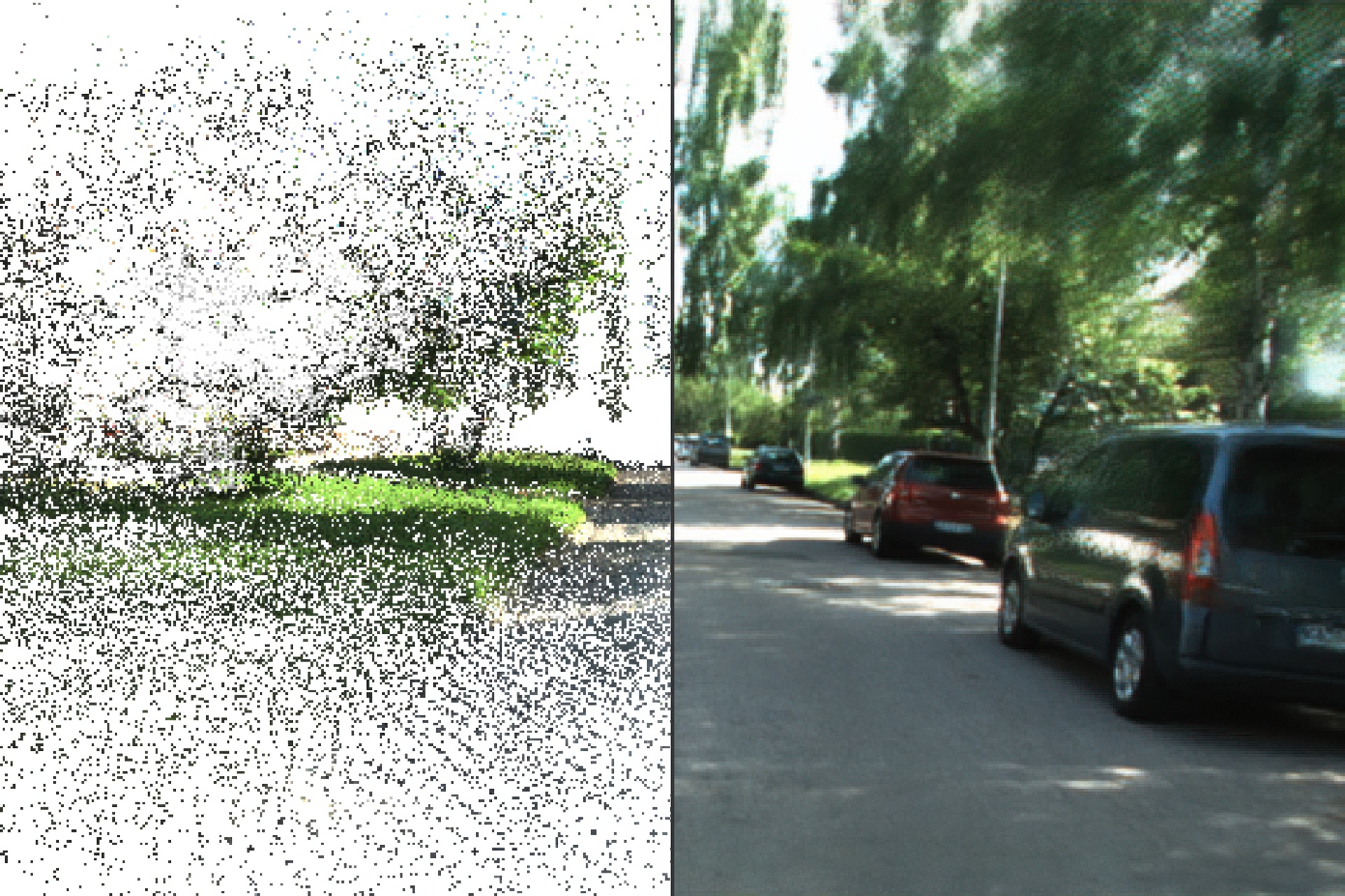
Novel-view synthesis is an ill-posed problem in that it requires inference of previously unseen information. Recently, reviving the traditional field of image-based rendering, neural methods proved particularly suitable for this interpolation/extrapolation task; however, they often require a-priori scene-completeness or costly pre-processing steps and generally suffer from long (scene-specific) training times. Our work draws from recent progress in neural spatio-temporal supersampling to enhance a state-of-the-art neural renderer’s ability to infer novel-view information at inference time. We adapt a supersampling architecture [Xiao et al. 2020], which resamples previously rendered frames, to instead recombine nearby camera images in a multi-view dataset. These input frames are warped into a joint target frame, guided by the most recent (point-based) scene representation, followed by neural interpolation. The resulting architecture gains sufficient robustness to significantly improve transferability to previously unseen datasets. In particular, this enables novel applications for neural rendering where dynamically streamed content is directly incorporated in a (neural) image-based reconstruction of a scene. As we will show, our method reaches state-of-the-art performance when compared to previous works that rely on static and sufficiently densely sampled scenes; in addition, we demonstrate our system’s particular suitability for dynamically streamed content, where our approach is able to produce high-fidelity novel-view synthesis even with significantly fewer available frames than competing neural methods.
References:
[1]
Kara-Ali Aliev, Artem Sevastopolsky, Maria Kolos, Dmitry Ulyanov, and Victor Lempitsky. 2020. Neural point-based graphics. In European Conference on Computer Vision. Springer, 696–712.
[2]
Jonathan T. Barron, Ben Mildenhall, Matthew Tancik, Peter Hedman, Ricardo Martin-Brualla, and Pratul P. Srinivasan. 2021. Mip-NeRF: A Multiscale Representation for Anti-Aliasing Neural Radiance Fields. In Proceedings of the IEEE/CVF International Conference on Computer Vision (ICCV). 5855–5864.
[3]
Chris Buehler, Michael Bosse, Leonard McMillan, Steven Gortler, and Michael Cohen. 2001. Unstructured Lumigraph Rendering. In Proceedings of the 28th Annual Conference on Computer Graphics and Interactive Techniques(SIGGRAPH ’01). Association for Computing Machinery, New York, NY, USA, 425–432. https://doi.org/10.1145/383259.383309
[4]
Carlos Campos, Richard Elvira, Juan J. Gómez, José M. M. Montiel, and Juan D. Tardós. 2021. ORB-SLAM3: An Accurate Open-Source Library for Visual, Visual-Inertial and Multi-Map SLAM. IEEE Transactions on Robotics 37, 6 (2021), 1874–1890.
[5]
Gaurav Chaurasia, Sylvain Duchene, Olga Sorkine-Hornung, and George Drettakis. 2013. Depth synthesis and local warps for plausible image-based navigation. ACM Transactions on Graphics (TOG) 32, 3 (2013), 1–12.
[6]
Anpei Chen, Zexiang Xu, Fuqiang Zhao, Xiaoshuai Zhang, Fanbo Xiang, Jingyi Yu, and Hao Su. 2021. Mvsnerf: Fast generalizable radiance field reconstruction from multi-view stereo. In Proceedings of the IEEE/CVF International Conference on Computer Vision. 14124–14133.
[7]
Julian Chibane, Aayush Bansal, Verica Lazova, and Gerard Pons-Moll. 2021. Stereo radiance fields (srf): Learning view synthesis for sparse views of novel scenes. In Proceedings of the IEEE/CVF Conference on Computer Vision and Pattern Recognition. 7911–7920.
[8]
Sungjoon Choi, Qian-Yi Zhou, Stephen Miller, and Vladlen Koltun. 2016. A Large Dataset of Object Scans. https://doi.org/10.48550/ARXIV.1602.02481
[9]
Ronald Clark. 2022. Volumetric bundle adjustment for online photorealistic scene capture. In Proceedings of the IEEE/CVF Conference on Computer Vision and Pattern Recognition. 6124–6132.
[10]
Angela Dai, Angel X. Chang, Manolis Savva, Maciej Halber, Thomas Funkhouser, and Matthias Nießner. 2017a. ScanNet: Richly-annotated 3D Reconstructions of Indoor Scenes. In Proc. Computer Vision and Pattern Recognition (CVPR), IEEE.
[11]
Angela Dai, Matthias Nießner, Michael Zollhöfer, Shahram Izadi, and Christian Theobalt. 2017b. Bundlefusion: Real-time globally consistent 3d reconstruction using on-the-fly surface reintegration. ACM Transactions on Graphics (ToG) 36, 4 (2017), 1.
[12]
Paul Debevec, Yizhou Yu, and George Borshukov. 1998. Efficient view-dependent image-based rendering with projective texture-mapping. In Eurographics Workshop on Rendering Techniques. Springer, 105–116.
[13]
Andrew Edelsten, Paula Jukarainen, and Anjul Patney. 2019. Truly next-gen: Adding deep learning to games and graphics. In In NVIDIA Sponsored Sessions (Game Developers Conference).
[14]
Jie Guo, Xihao Fu, Liqiang Lin, Hengjun Ma, Yanwen Guo, Shiqiu Liu, and Ling-Qi Yan. 2021. ExtraNet: real-time extrapolated rendering for low-latency temporal supersampling. ACM Transactions on Graphics (TOG) 40, 6 (2021), 1–16.
[15]
Peter Hedman, Julien Philip, True Price, Jan-Michael Frahm, George Drettakis, and Gabriel Brostow. 2018. Deep blending for free-viewpoint image-based rendering. ACM Transactions on Graphics (TOG) 37, 6 (2018), 1–15.
[16]
Justin Johnson, Alexandre Alahi, and Li Fei-Fei. 2016. Perceptual losses for real-time style transfer and super-resolution. In Computer Vision–ECCV 2016: 14th European Conference, Amsterdam, The Netherlands, October 11-14, 2016, Proceedings, Part II 14. Springer, 694–711.
[17]
Sing Bing Kang, Yin Li, Xin Tong, Heung-Yeung Shum, 2007. Image-based rendering. Foundations and Trends® in Computer Graphics and Vision 2, 3 (2007), 173–258.
[18]
Armin Kappeler, Seunghwan Yoo, Qiqin Dai, and Aggelos K Katsaggelos. 2016. Video super-resolution with convolutional neural networks. IEEE transactions on computational imaging 2, 2 (2016), 109–122.
[19]
Maik Keller, Damien Lefloch, Martin Lambers, Shahram Izadi, Tim Weyrich, and Andreas Kolb. 2013. Real-time 3D Reconstruction in Dynamic Scenes using Point-based Fusion. In Proc. of Joint 3DIM/3DPVT Conference (3DV). 1–8. Selected for oral presentation.
[20]
Arno Knapitsch, Jaesik Park, Qian-Yi Zhou, and Vladlen Koltun. 2017. Tanks and Temples: Benchmarking Large-Scale Scene Reconstruction. ACM Transactions on Graphics 36, 4 (2017).
[21]
Georgios Kopanas, Julien Philip, Thomas Leimkühler, and George Drettakis. 2021. Point-Based Neural Rendering with Per-View Optimization. In Computer Graphics Forum, Vol. 40. Wiley Online Library, 29–43.
[22]
Yiyi Liao, Jun Xie, and Andreas Geiger. 2022. KITTI-360: A novel dataset and benchmarks for urban scene understanding in 2d and 3d. IEEE Transactions on Pattern Analysis and Machine Intelligence 45, 3 (2022), 3292–3310.
[23]
Ce Liu and Deqing Sun. 2013. On Bayesian adaptive video super resolution. IEEE transactions on pattern analysis and machine intelligence 36, 2 (2013), 346–360.
[24]
Hongying Liu, Zhubo Ruan, Peng Zhao, Chao Dong, Fanhua Shang, Yuanyuan Liu, Linlin Yang, and Radu Timofte. 2022. Video super-resolution based on deep learning: a comprehensive survey. Artificial Intelligence Review (2022), 1–55.
[25]
Ben Mildenhall, Pratul P Srinivasan, Matthew Tancik, Jonathan T Barron, Ravi Ramamoorthi, and Ren Ng. 2021. Nerf: Representing scenes as neural radiance fields for view synthesis. Commun. ACM 65, 1 (2021), 99–106.
[26]
Thomas Müller, Alex Evans, Christoph Schied, Marco Foco, András Bódis-Szomorú, Isaac Deutsch, Michael Shelley, and Alexander Keller. 2022b. Instant neural radiance fields. In ACM SIGGRAPH 2022 Real-Time Live!1–2.
[27]
Thomas Müller, Alex Evans, Christoph Schied, and Alexander Keller. 2022a. Instant neural graphics primitives with a multiresolution hash encoding. ACM Transactions on Graphics (ToG) 41, 4 (2022), 1–15.
[28]
Thomas Neff, Pascal Stadlbauer, Mathias Parger, Andreas Kurz, Joerg H Mueller, Chakravarty R Alla Chaitanya, Anton Kaplanyan, and Markus Steinberger. 2021. DONeRF: Towards Real-Time Rendering of Compact Neural Radiance Fields using Depth Oracle Networks. In Computer Graphics Forum, Vol. 40. Wiley Online Library, 45–59.
[29]
Ruslan Rakhimov and Ardelean, Andrei-Timotei Rakhimov and Ardelean, Victor Lempitsky, and Evgeny Burnaev. 2022. NPBG++: Accelerating Neural Point-Based Graphics. In Proceedings of the IEEE/CVF Conference on Computer Vision and Pattern Recognition. 15969–15979.
[30]
Gernot Riegler and Vladlen Koltun. 2020. Free view synthesis. In European Conference on Computer Vision. Springer, 623–640.
[31]
Gernot Riegler and Vladlen Koltun. 2021. Stable view synthesis. In Proceedings of the IEEE/CVF Conference on Computer Vision and Pattern Recognition. 12216–12225.
[32]
Darius Rückert, Linus Franke, and Marc Stamminger. 2022. Adop: Approximate differentiable one-pixel point rendering. ACM Transactions on Graphics (TOG) 41, 4 (2022), 1–14.
[33]
Darius Rückert and Marc Stamminger. 2021. Snake-SLAM: Efficient global visual inertial SLAM using decoupled nonlinear optimization. In 2021 International Conference on Unmanned Aircraft Systems (ICUAS). IEEE, 219–228.
[34]
Johannes Lutz Schönberger, Enliang Zheng, Marc Pollefeys, and Jan-Michael Frahm. 2016. Pixelwise View Selection for Unstructured Multi-View Stereo. In European Conference on Computer Vision (ECCV).
[35]
Markus Schütz, Bernhard Kerbl, and Michael Wimmer. 2021. Rendering point clouds with compute shaders and vertex order optimization. In Computer Graphics Forum, Vol. 40. Wiley Online Library, 115–126.
[36]
Markus Schütz, Bernhard Kerbl, and Michael Wimmer. 2022. Software rasterization of 2 billion points in real time. Proceedings of the ACM on Computer Graphics and Interactive Techniques 5, 3 (2022), 1–17.
[37]
Markus Schütz, Katharina Krösl, and Michael Wimmer. 2019. Real-time continuous level of detail rendering of point clouds. In 2019 IEEE Conference on Virtual Reality and 3D User Interfaces (VR). IEEE, 103–110.
[38]
Harry Shum and Sing Bing Kang. 2000. Review of image-based rendering techniques. In Visual Communications and Image Processing 2000, Vol. 4067. SPIE, 2–13.
[39]
Edgar Sucar, Shikun Liu, Joseph Ortiz, and Andrew J Davison. 2021. iMAP: Implicit mapping and positioning in real-time. In Proceedings of the IEEE/CVF International Conference on Computer Vision. 6229–6238.
[40]
Matthew Tancik, Ben Mildenhall, Terrance Wang, Divi Schmidt, Pratul P Srinivasan, Jonathan T Barron, and Ren Ng. 2021. Learned initializations for optimizing coordinate-based neural representations. In Proceedings of the IEEE/CVF Conference on Computer Vision and Pattern Recognition. 2846–2855.
[41]
Xin Tao, Hongyun Gao, Renjie Liao, Jue Wang, and Jiaya Jia. 2017. Detail-revealing deep video super-resolution. In Proceedings of the IEEE International Conference on Computer Vision. 4472–4480.
[42]
Ayush Tewari, Ohad Fried, Justus Thies, Vincent Sitzmann, Stephen Lombardi, Kalyan Sunkavalli, Ricardo Martin-Brualla, Tomas Simon, Jason Saragih, Matthias Nießner, 2020. State of the art on neural rendering. In Computer Graphics Forum, Vol. 39. Wiley Online Library, 701–727.
[43]
Ayush Tewari, Justus Thies, Ben Mildenhall, Pratul Srinivasan, Edgar Tretschk, W Yifan, Christoph Lassner, Vincent Sitzmann, Ricardo Martin-Brualla, Stephen Lombardi, 2022. Advances in neural rendering. In Computer Graphics Forum, Vol. 41. Wiley Online Library, 703–735.
[44]
Justus Thies, Michael Zollhöfer, and Matthias Nießner. 2019. Deferred neural rendering: Image synthesis using neural textures. ACM Transactions on Graphics (TOG) 38, 4 (2019), 1–12.
[45]
Manu Mathew Thomas, Gabor Liktor, Christoph Peters, Sungye Kim, Karthik Vaidyanathan, and Angus G Forbes. 2022. Temporally Stable Real-Time Joint Neural Denoising and Supersampling. Proceedings of the ACM on Computer Graphics and Interactive Techniques 5, 3 (2022), 1–22.
[46]
Haithem Turki, Deva Ramanan, and Mahadev Satyanarayanan. 2022. Mega-NeRF: Scalable Construction of Large-Scale NeRFs for Virtual Fly-Throughs. In Proceedings of the IEEE/CVF Conference on Computer Vision and Pattern Recognition. 12922–12931.
[47]
Ashish Vaswani, Noam Shazeer, Niki Parmar, Jakob Uszkoreit, Llion Jones, Aidan N Gomez, Łukasz Kaiser, and Illia Polosukhin. 2017. Attention is all you need. Advances in neural information processing systems 30 (2017).
[48]
Qianqian Wang, Zhicheng Wang, Kyle Genova, Pratul Srinivasan, Howard Zhou, Jonathan T. Barron, Ricardo Martin-Brualla, Noah Snavely, and Thomas Funkhouser. 2021. IBRNet: Learning Multi-View Image-Based Rendering. In CVPR.
[49]
Zhou Wang, Alan C Bovik, Hamid R Sheikh, and Eero P Simoncelli. 2004. Image quality assessment: from error visibility to structural similarity. IEEE transactions on image processing 13, 4 (2004), 600–612.
[50]
Thomas Whelan, Renato F Salas-Moreno, Ben Glocker, Andrew J Davison, and Stefan Leutenegger. 2016. ElasticFusion: Real-time dense SLAM and light source estimation. The International Journal of Robotics Research 35, 14 (2016), 1697–1716.
[51]
Katja Wolff, Changil Kim, Henning Zimmer, Christopher Schroers, Mario Botsch, Olga Sorkine-Hornung, and Alexander Sorkine-Hornung. 2016. Point cloud noise and outlier removal for image-based 3D reconstruction. In 2016 Fourth International Conference on 3D Vision (3DV). IEEE, 118–127.
[52]
Lei Xiao, Salah Nouri, Matt Chapman, Alexander Fix, Douglas Lanman, and Anton Kaplanyan. 2020. Neural supersampling for real-time rendering. ACM Transactions on Graphics (TOG) 39, 4 (2020), 142–1.
[53]
Alex Yu, Vickie Ye, Matthew Tancik, and Angjoo Kanazawa. 2021. pixelnerf: Neural radiance fields from one or few images. In Proceedings of the IEEE/CVF Conference on Computer Vision and Pattern Recognition. 4578–4587.
[54]
Jiahui Yu, Zhe Lin, Jimei Yang, Xiaohui Shen, Xin Lu, and Thomas S Huang. 2019. Free-form image inpainting with gated convolution. In Proceedings of the IEEE/CVF international conference on computer vision. 4471–4480.
[55]
Kai Zhang, Gernot Riegler, Noah Snavely, and Vladlen Koltun. 2020. Nerf++: Analyzing and improving neural radiance fields. arXiv preprint arXiv:2010.07492 (2020).