
“Hybrid grains: adaptive coupling of discrete and continuum simulations of granular media”
Conference:
Type(s):
Title:
- Hybrid grains: adaptive coupling of discrete and continuum simulations of granular media
Session/Category Title:
- Structured simulation
Presenter(s)/Author(s):
Moderator(s):
Abstract:
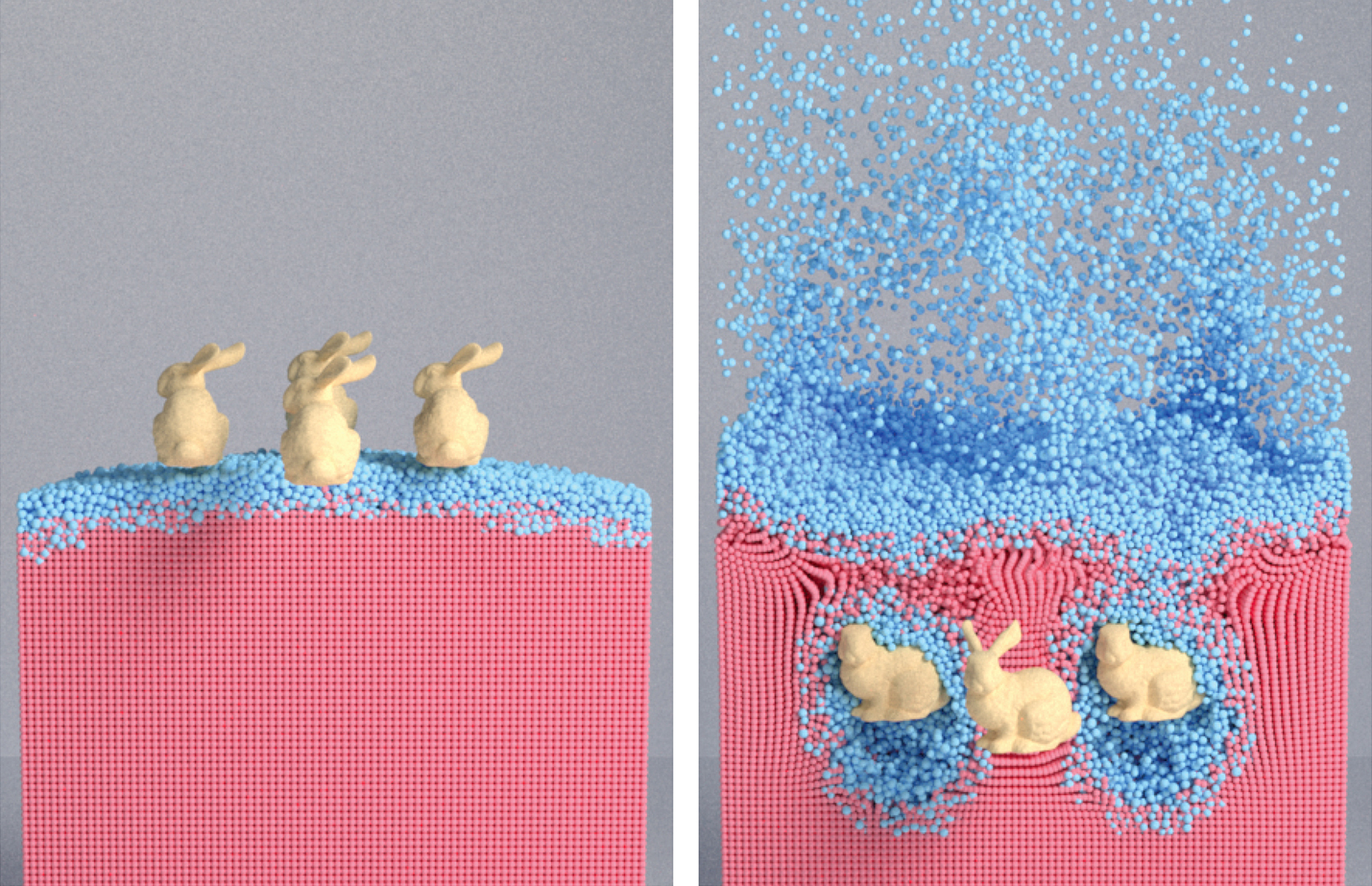
We propose a technique to simulate granular materials that exploits the dual strengths of discrete and continuum treatments. Discrete element simulations provide unmatched levels of detail and generality, but prove excessively costly when applied to large scale systems. Continuum approaches are computationally tractable, but limited in applicability due to built-in modeling assumptions; e.g., models suitable for granular flows typically fail to capture clogging, bouncing and ballistic motion. In our hybrid approach, an oracle dynamically partitions the domain into continuum regions where safe, and discrete regions where necessary. The domains overlap along transition zones, where a Lagrangian dynamics mass-splitting coupling principle enforces agreement between the two simulation states. Enrichment and homogenization operations allow the partitions to evolve over time. This approach accurately and efficiently simulates scenarios that previously required an entirely discrete treatment.
References:
1. Vincent Acary and Bernard Brogliato. 2008. Numerical Methods for Nonsmooth Dynamical Systems: Applications in Mechanics and Electronics. Vol. 35. Springer Science & Business Media.Google Scholar
2. Pierre Alart and Alain Curnier. 1991. A mixed formulation for frictional contact problems prone to Newton like solution methods. Computer Methods in Applied Mechanics and Engineering 92, 3 (Nov. 1991), 353–375. Google ScholarDigital Library
3. Berni Julian Alder and Thomas Everett Wainwright. 1957. Phase transition for a hard sphere system. The Journal of Chemical Physics 27, 5 (1957), 1208.Google ScholarCross Ref
4. Berni Julian Alder and Thomas Everett Wainwright. 1959. Studies in molecular dynamics. I. General method. The Journal of Chemical Physics 31, 2 (1959), 459–466.Google ScholarCross Ref
5. Berni Julian Alder and Thomas Everett Wainwright. 1960. Studies in molecular dynamics. II. Behavior of a small number of elastic spheres. The Journal of Chemical Physics 33, 5 (1960), 1439–1451.Google ScholarCross Ref
6. Iván Alduán and Miguel A. Otaduy. 2011. SPH Granular Flow with Friction and Cohesion. In Proceedings of the 2011 ACM SIGGRAPH/Eurographics Symposium on Computer Animation (SCA ’11). 25–32. Google ScholarDigital Library
7. Iván Alduán, Angel Tena, and Miguel A. Otaduy. 2009. Simulation of High-Resolution Granular Media.. In CEIG. 11–18.Google Scholar
8. Christoph Ammann, Doug Bloom, Jonathan M. Cohen, John Courte, Lucio Flores, Sho Hasegawa, Nikos Kalaitzidis, Terrance Tornberg, Laurence Treweek, Bob Winter, and Chris Yang. 2007. The Birth of Sandman. In ACM SIGGRAPH 2007 Sketches (SIGGRAPH ’07). Article 26. Google ScholarDigital Library
9. Mihai Anitescu and Gary D. Hart. 2004a. A constraint-stabilized time-stepping approach for rigid multibody dynamics with joints, contact and friction. Internat. J. Numer. Methods Engrg. 60, 14 (2004), 2335–2371.Google ScholarCross Ref
10. Mihai Anitescu and Gary D. Hart. 2004b. A fixed-point Iteration approach for multibody dynamics with contact and small friction. Mathematical Programming 101, 1 (2004), 3–32. Google ScholarDigital Library
11. Igor S. Aranson and Lev S. Tsimring. 2002. Continuum theory of partially fluidized granular flows. Physical Review E 65, 6 (2002), 061303.Google ScholarCross Ref
12. Jan A. Åström and Hans Jürgen Herrmann. 1998. Fragmentation of grains in a two-dimensional packing. The European Physical Journal B-Condensed Matter and Complex Systems 5, 3 (1998), 551–554.Google ScholarCross Ref
13. Neil J. Balmforth and Richard R. Kerswell. 2005. Granular collapse in two dimensions. Journal of Fluid Mechanics 538 (Sep 2005), 399 — 428.Google ScholarCross Ref
14. David Baraff. 1989. Analytical Methods for Dynamic Simulation of Non-penetrating Rigid Bodies. Computer Graphics 23 (1989), 223–232. Google ScholarDigital Library
15. Scott G. Bardenhagen and Edward M. Kober. 2004. The generalized interpolation material point method. Computer Modeling in Engineering and Sciences 5, 6 (2004), 477–496.Google Scholar
16. Nathan Bell, Yizhou Yu, and Peter J. Mucha. 2005. Particle-based simulation of granular materials. In Proceedings of the 2005 ACM SIGGRAPH/Eurographics symposium on Computer animation. ACM, 77–86. Google ScholarDigital Library
17. Oded Ben-Nun, Itai Einav, and Antoinette Tordesillas. 2010. Force attractor in confined comminution of granular materials. Physical Review Letters 104, 10 (2010), 108001.Google ScholarCross Ref
18. Miklós Bergou, Saurabh Mathur, Max Wardetzky, and Eitan Grinspun. 2007. TRACKS: Toward directable thin shells. SIGGRAPH (ACM Transactions on Graphics) 26, 3 (Jul 2007), 50. Google ScholarDigital Library
19. Wim A. Beverloo, H. A. Leniger, and J. Van de Velde. 1961. The flow of granular solids through orifices. Chemical Engineering Science 15, 3 (1961), 260–269.Google ScholarCross Ref
20. Olivier Bonnefon and Gilles Daviet. 2011. Quartic formulation of Coulomb 3D frictional contact. Technical Report RT-0400. INRIA.Google Scholar
21. Jean-Philippe Bouchaud, Michael E. Cates, Jagadeeshan Ravi Prakash, and Sam F. Edwards. 1994. A model for the dynamics of sandpile surfaces. Journal de Physique I 4, 10 (1994), 1383–1410.Google Scholar
22. Bernard Brogliato. 2012. Nonsmooth mechanics: models, dynamics and control. Springer Science & Business Media.Google Scholar
23. Eric Brown, Nicholas Rodenberg, John Amend, Annan Mozeika, Erik Steltz, Mitchell R. Zakin, Hod Lipson, and Heinrich M. Jaeger. 2010. Universal robotic gripper based on the jamming of granular material. Proceedings of the National Academy of Sciences 107, 44 (2010), 18809–18814.Google ScholarCross Ref
24. Benoit Chanclou, Annie Luciani, and Arash Habibi. 1996. Physical models of loose soils dynamically marked by a moving object. In Computer Animation ’96. Proceedings. 27–35. Google ScholarDigital Library
25. Nuttapong Chentanez, Matthias Müller, and Tae-Yong Kim. 2015. Coupling 3D Eulerian, Heightfield and Particle Methods for Interactive Simulation of Large Scale Liquid Phenomena. IEEE Transactions on Visualization and Computer Graphics 21, 10 (Oct 2015), 1116–1128. Google ScholarDigital Library
26. Jes Christoffersen, Morteza Monte Mehrabadi, and Sia Nemat-Nasser. 1981. A micromechanical description of granular material behavior. Journal of applied mechanics 48, 2 (1981), 339–344.Google ScholarCross Ref
27. Michael B. Cline and Dinesh K. Pai. 2003. Post-stabilization for rigid body simulation with contact and constraints. In Robotics and Automation, 2003. Proceedings. ICRA’03. IEEE International Conference on, Vol. 3. IEEE, 3744–3751.Google Scholar
28. Peter A. Cundall and Otto D. L. Strack. 1979. A discrete numerical model for granular assemblies. Géotechnique 29, 1 (1979), 47–65.Google ScholarCross Ref
29. Yannis F. Dafalias, Achilleas G. Papadimitriou, and Xiang S. Li. 2004. Sand plasticity model accounting for inherent fabric anisotropy. Journal of Engineering Mechanics 130, 11 (2004), 1319–1333.Google ScholarCross Ref
30. Gilles Daviet and Florence Bertails-Descoubes. 2016. A Semi-implicit Material Point Method for the Continuum Simulation of Granular Materials. ACM Trans. Graph. 35, 4 (July 2016), 102:1–102:13. Google ScholarDigital Library
31. Gilles Daviet, Florence Bertails-Descoubes, and Laurence Boissieux. 2011. A Hybrid Iterative Solver for Robustly Capturing Coulomb Friction in Hair Dynamics. ACM Trans. Graph. 30, 6 (2011), 139:1–139:12. Google ScholarDigital Library
32. Hachmi Ben Dhia. 1998. Multiscale mechanical problems: the Arlequin method. Comptes Rendus de l’Academie des Sciences Series IIB Mechanics Physics Astronomy 12, 326 (1998), 899–904.Google ScholarCross Ref
33. Joshua A Dijksman and Martin van Hecke. 2010. Granular flows in split-bottom geometries. Soft Matter 6, 13 (2010), 2901–2907.Google ScholarCross Ref
34. Sachith Dunatunga and Ken Kamrin. 2015. Continuum modelling and simulation of granular flows through their many phases. Journal of Fluid Mechanics 779 (2015), 483–513.Google ScholarCross Ref
35. Christian Duriez, Frederic Dubois, Abderrahmane Kheddar, and Claude Andriot. 2006. Realistic Haptic Rendering of Interacting Deformable Objects in Virtual Environments. IEEE Transactions on Visualization and Computer Graphics 12, 1 (Jan. 2006), 36–47. Google ScholarDigital Library
36. Kenny Erleben. 2007. Velocity-based Shock Propagation for Multibody Dynamics Animation. ACM Trans. Graph. 26, 2, Article 12 (June 2007). Google ScholarDigital Library
37. Florian Ferstl, Ryoichi Ando, Chris Wojtan, Rüdiger Westermann, and Nils Thuerey. 2016. Narrow Band FLIP for Liquid Simulations. Computer Graphics Forum 35, 2 (2016), 225–232.Google ScholarCross Ref
38. Daan Frenkel and Berend Smit. 2001. Understanding Molecular Simulation: From Algorithms to Applications. Vol. 1. Academic Press. Google ScholarDigital Library
39. Jason Alfredo Carlson Gallas, Hans Jürgen Herrmann, and Stefan Sokołowski. 1992. Convection cells in vibrating granular media. Physical Review Letters 69, 9 (1992), 1371.Google ScholarCross Ref
40. Ming Gao, Andre Pradhana, Xuchen Han, Qi Guo, Grant Kot, Eftychios Sifakis, and Chenfanfu Jiang. 2018. Animating Fluid Sediment Mixture in Particle-Laden Flows. ACM Transactions on Graphics (TOG) 37, 4 (2018). Google ScholarDigital Library
41. Ming Gao, Andre Pradhana Tampubolon, Chenfanfu Jiang, and Eftychios Sifakis. 2017. An adaptive generalized interpolation material point method for simulating elastoplastic materials. ACM Transactionson Graphics (TOG) 36, 6 (2017), 223. Google ScholarDigital Library
42. Abhinav Golas, Rahul Narain, Jason Sewall, Pavel Krajcevski, Pradeep Dubey, and Ming C. Lin. 2012. Large-scale Fluid Simulation Using Velocity-vorticity Domain Decomposition. ACM Trans.Graph. 31, 6, Article 148 (Nov. 2012), 9 pages. Google ScholarDigital Library
43. Groupement de Recherche Milieux Divisés (GDR MiDi). 2004. On dense granular flows. The European Physical Journal E 14, 4 (2004), 341–365.Google ScholarCross Ref
44. Peter K. Haff and Bradley T. Werner. 1986. Computer simulation of the mechanical sorting of grains. Powder Technology 48, 3 (1986), 239–245.Google ScholarCross Ref
45. Seth R. Holladay. 2013. Optimized Simulation of Granular Materials. Ph.D. Dissertation. Brigham Young University. Google ScholarDigital Library
46. Seth R. Holladay and Parris Egbert. 2012. Solid-state Culled Discrete Element Granular Systems. In Eurographics 2012-Short Papers, Carlos Andujar and Enrico Puppo (Eds.). The Eurographics Association.Google Scholar
47. William Graham Hoover. 1986. Molecular Dynamics. Springer-Verlag. Shu-Wei Hsu and John Keyser. 2010. Piles of Objects. ACM Trans. Graph. 29, 6 (Dec. 2010), 155:1–155:6. Google ScholarDigital Library
48. Yuanming Hu, Yu Fang, Ziheng Ge, Ziyin Qu, Yixin Zhu, Andre Pradhana, and Chenfanfu Jiang. 2018. A Moving Least Squares Material Point Method with Displacement Discontinuity and Two-Way Rigid Body Coupling. ACM Transactions on Graphics (TOG) 37, 4 (2018). Google ScholarDigital Library
49. Markus Ihmsen, Arthur Wahl, and Matthias Teschner. 2013. A Lagrangian framework for simulating granular material with high detail. Computers & Graphics 37, 7 (2013), 800–808. Google ScholarDigital Library
50. Heinrich M. Jaeger, Sidney R. Nagel, and Robert P. Behringer. 1996. Granular solids, liquids, and gases. Rev. Mod. Phys. 68 (Oct 1996), 1259–1273. Issue 4.Google ScholarCross Ref
51. Michel Jean. 1999. The Non-Smooth Contact Dynamics Method. Computer Methods in Applied Mechanical Engineering 177, 3–4 (1999), 235–257.Google ScholarCross Ref
52. Michel Jean and Jean-Jacques Moreau. 1992. Unilaterality and dry friction in the dynamics of rigid body collections. In Proceedings of Contact Mechanics International Symposium, Vol. 1. 31–48.Google Scholar
53. Chenfanfu Jiang, Craig Schroeder, Andrew Selle, Joseph Teran, and Alexey Stomakhin. 2015. The affine particle-in-cell method. ACM Transactions on Graphics (TOG) 34, 4 (2015), 51. Google ScholarDigital Library
54. Chenfanfu Jiang, Craig Schroeder, Joseph Teran, Alexey Stomakhin, and Andrew Selle. 2016. The Material Point Method for Simulating Continuum Materials. In ACM SIGGRAPH 2016 Courses (SIGGRAPH ’16). ACM, New York, NY, USA, Article 24, 52 pages. Google ScholarDigital Library
55. Pierre Jop, Yoël Forterre, and Olivier Pouliquen. 2006. A constitutive law for dense granular flows. Nature 441, 7094 (2006), 727–730.Google ScholarCross Ref
56. Franck Jourdan, Pierre Alart, and Michel Jean. 1998. A Gauss-Seidel like algorithm to solve frictional contact problems. Computer Methods in Applied Mechanics and Engineering 155, 1 (March 1998), 31–47.Google ScholarCross Ref
57. Ken Kamrin. 2008. Stochastic and Deterministic Models for Dense Granular Flow. Ph.D. Dissertation. Massachusetts Institute of Technology.Google Scholar
58. Ken Kamrin. 2010. Nonlinear elasto-plastic model for dense granular flow. International Journal of Plasticity 26, 2 (2010), 167–188.Google ScholarCross Ref
59. Ken Kamrin and Georg Koval. 2012. Nonlocal constitutive relation for steady granular flow. Physical Review Letters 108, 17 (2012), 178301.Google ScholarCross Ref
60. Ken Kamrin and Georg Koval. 2014. Effect of Particle Surface Friction on Nonlocal Constitutive Behavior of Flowing Granular Media. Computational Particle Mechanics 1, 2 (2014), 169–176.Google ScholarCross Ref
61. Danny M. Kaufman, Shinjiro Sueda, Doug L. James, and Dinesh K. Pai. 2008. Staggered Projections for Frictional Contact in Multibody Systems. ACM Trans. Graph. 27, 5 (2008), 164:1–164:11. Google ScholarDigital Library
62. Gergely Klár, Theodore Gast, Andre Pradhana, Chuyuan Fu, Craig Schroeder, Chenfanfu Jiang, and Joseph Teran. 2016. Drucker-prager Elastoplasticity for Sand Animation. ACM Trans. Graph. 35, 4, Article 103 (July 2016), 12 pages. Google ScholarDigital Library
63. Georg Koval, Jean-Noël Roux, Alain Corfdir, and François Chevoir. 2009. Annular shear of cohesionless granular materials: From the inertial to quasistatic regime. Physical Review E 79, 2 (2009), 021306.Google ScholarCross Ref
64. Harald Kruggel-Emden, Erdem Simsek, Stefan Rickelt, Siegmar Wirtz, and Viktor Scherer. 2007. Review and extension of normal force models for the discrete element method. Powder Technology 171, 3 (2007), 157–173.Google ScholarCross Ref
65. Pierre-Yves Lagrée, Lydie Staron, and Stéphane Popinet. 2011. The granular column collapse as a continuum: Validity of a two-dimensional Navier-Stokes model with a μ (I)-rheology. Journal of Fluid Mechanics 686 (Nov. 2011), 378–408.Google ScholarCross Ref
66. Cornelius Lanczos. 2012. The variational principles of mechanics.Google Scholar
67. Toon Lenaerts and Dutré Philip. 2009. Mixing Fluids and Granular Materials. Computer Graphics Forum 28, 2 (2009), 213–218.Google ScholarCross Ref
68. Xin Li and J. Michael Moshell. 1993. Modeling Soil: Realtime Dynamic Models for Soil Slippage and Manipulation. In Proceedings of the 20th Annual Conference on Computer Graphics and Interactive Techniques (SIGGRAPH ’93). 361–368. Google ScholarDigital Library
69. Gert Lube, Herbert E. Huppert, R. Stephen J. Sparks, and Armin Freundt. 2005. Collapses of two-dimensional granular columns. Phys. Rev. E 72 (Oct 2005), 10. Issue 4.Google ScholarCross Ref
70. Annie Luciani, Arash Habibi, and Emmanuel Manzotti. 1995. A multi-scale physical model of granular materials. In Graphics interface’95. 136–146.Google Scholar
71. Miles Macklin, Matthias Müller, Nuttapong Chentanez, and Tae-Yong Kim. 2014. Unified Particle Physics for Real-time Applications. ACM Trans. Graph. 33, 4, Article 153 (July 2014), 12 pages. Google ScholarDigital Library
72. Carter M. Mast, Pedro Arduino, Peter Mackenzie-Helnwein, and Gregory R. Miller. 2015. Simulating granular column collapse using the Material Point Method. Acta Geotechnica 10, 1 (2015), 101–116.Google ScholarCross Ref
73. Hammad Mazhar, Toby Heyn, Dan Negrut, and Alessandro Tasora. 2015. Using Nesterov’s Method to Accelerate Multibody Dynamics with Friction and Contact. ACM Trans. Graph. 34, 3, Article 32 (May 2015), 14 pages. Google ScholarDigital Library
74. Joseph J. McCarthy and Julio M. Ottino. 1998. Particle dynamics simulation: a hybrid technique applied to granular mixing. Powder Technology 97, 2 (1998), 91 — 99.Google ScholarCross Ref
75. Gavin Miller and Andrew Pearce. 1989. Globular dynamics: A connected particle system for animating viscous fluids. Computers & Graphics 13, 3 (1989), 305 — 309.Google ScholarCross Ref
76. Hiroshi Mio, Masatoshi Akashi, Atsuko Shimosaka, Yoshiyuki Shirakawa, Jusuke Hidaka, and Shinroku Matsuzaki. 2009. Speed-up of computing time for numerical analysis of particle charging process by using discrete element method. Chemical Engineering Science 64, 5 (2009), 1019 — 1026.Google ScholarCross Ref
77. L. Srinivasa Mohan, K. Kesava Rao, and Prabhu R. Nott. 2002. A frictional Cosserat model for the slow shearing of granular materials. Journal of Fluid Mechanics 457 (2002), 377–409.Google ScholarCross Ref
78. Jean-Jacques Moreau. 1983. Standard Inelastic Shocks and the Dynamics of Unilateral Constraints. Courses and Lectures, Vol. 288. International Centre for Mechanical Sciences, 173–221.Google Scholar
79. Jean-Jacques Moreau. 1988. Unilateral Contact and Dry Friction in Finite Freedom Dynamics. Nonsmooth Mechanics and Applications, CISM Courses and Lectures 302 (1988), 1–82.Google Scholar
80. Kevin W. Munns. 2015. Gaseous Particulate Interaction in a 3-Phase Granular Simulation. Master’s thesis. Brigham Young University.Google Scholar
81. Rahul Narain, Abhinav Golas, and Ming C. Lin. 2010. Free-flowing Granular Materials with Two-way Solid Coupling. ACM Trans. Graph. 29, 6, Article 173 (Dec. 2010), 10 pages. Google ScholarDigital Library
82. Duc-Hanh Nguyen, Emilien Azéma, Farhang Radjai, and Philippe Sornay. 2015. Numerical Modeling of Particle Breaking Process in Granular Materials: Compaction and Evolution of Size Distribution. In Bifurcation and Degradation of Geomaterials in the New Millennium. Springer, 161–167.Google Scholar
83. Koichi Onoue and Tomoyuki Nishita. 2003. Virtual sandbox. In 11th Pacific Conference onComputer Graphics and Applications, 2003. Proceedings. 252–259. Google ScholarDigital Library
84. Marta Pla-Castells, Ignacio García-Fernandez, and Rafael J. Martinez-Dura. 2008. Physically-Based Interactive Sand Simulation. In Eurographics 2008 – Short Papers.Google Scholar
85. Thorsten Pöschel and Thomas Schwager. 2005. Computational Granular Dynamics: Models and Algorithms. Springer Science & Business Media.Google Scholar
86. Olivier Pouliquen. 1999. Scaling laws in granular flows down rough inclined planes. Physics of Fluids (1994-present) 11, 3 (1999), 542–548.Google Scholar
87. Tobias Preclik. 2014. Models and Algorithms for Ultrascale Simulations of Non-smooth Granular Dynamics. Ph.D. Dissertation. Friedrich-Alexander-Universität Erlangen-Nürnberg (FAU).Google Scholar
88. Dennis C. Rapaport. 2004. The Art of Molecular Dynamics Simulation. Cambridge University Press. Google ScholarDigital Library
89. Patrick Richard, Mario Nicodemi, Renaud Delannay, Philippe Ribière, and Daniel Bideau. 2005. Slow relaxation and compaction of granular systems. Nature Materials. 4 (2005), 121–128.Google ScholarCross Ref
90. Leo Rothenburg and Richard J. Bathurst. 1989. Analytical study of induced anisotropy in idealized granular materials. Géotechnique 39, 4 (1989), 601–614.Google ScholarCross Ref
91. Witawat Rungjiratananon, Zoltan Szego, Yoshihiro Kanamori, and Tomoyuki Nishita. 2008. Real-time Animation of Sand-Water Interaction. In Computer Graphics Forum, Vol. 27. 1887–1893.Google ScholarCross Ref
92. Chris H. Rycroft, Ken Kamrin, and Martin Z. Bazant. 2009. Assessing continuum postulates in simulations of granular flow. Journal of the Mechanics and Physics of Solids 57, 5 (2009), 828–839.Google ScholarCross Ref
93. Andrew Schofield and Peter Wroth. 1968. Critical State Soil Mechanics. McGraw-Hill, London.Google Scholar
94. Ahmed A. Shabana. 2013. Dynamics of multibody systems. Cambridge university press.Google Scholar
95. J. Shäfer, S. Dippel, and D. E. Wolf. 1996. Force schemes in simulations of granular materials. Journal de Physique I 6, 1 (1996), 5–20.Google Scholar
96. Hannah G. Sheldon and Douglas J. Durian. 2010. Granular discharge and clogging for tilted hoppers. Granular Matter 12, 6 (2010), 579–585.Google ScholarCross Ref
97. Tomotsugu Shimokawa, Toshiyasu Kinari, and S Shintaku. 2007. Interaction mechanism between edge dislocations and asymmetrical tilt grain boundaries investigated via quasicontinuum simulations. Physical Review B 75, 14 (2007), 144108.Google ScholarCross Ref
98. Juan C. Simo and Thomas J. R. Hughes. 1998. Computational Inelasticity. Springer.Google Scholar
99. Breannan Smith, Danny M. Kaufman, Etienne Vouga, Rasmus Tamstorf, and Eitan Grinspun. 2012. Reflections on Simultaneous Impact. ACM Trans. Graph. 31, 4 (July 2012), 106:1–106:12. Google ScholarDigital Library
100. Gregory S. Smith, Ellad B. Tadmor, Noam Bernstein, and Efthimios Kaxiras. 2001. Multiscale simulations of silicon nanoindentation. Acta Materialia 49, 19 (2001), 4089–4101.Google ScholarCross Ref
101. Russell Smith and others. 2005. Open dynamics engine. (2005).Google Scholar
102. Lydie Staron and John E. Hinch. 2005. Study of the collapse of granular columns using two-dimensional discrete-grain simulation. Journal of Fluid Mechanics 545 (2005), 1–27.Google ScholarCross Ref
103. Michael Steffen, Robert M. Kirby, and Martin Berzins. 2008. Analysis and reduction of quadrature errors in the material point method (MPM). Internat. J. Numer. Methods Engrg. 76, 6 (2008), 922–948.Google ScholarCross Ref
104. David E. Stewart. 2000. Rigid-body dynamics with friction and impact. SIAM review 42, 1 (2000), 3–39. Google ScholarDigital Library
105. David E. Stewart. 2001. Finite-dimensional contact mechanics. Phil. Trans. R. Soc. Lond. A 359 (2001), 2467–2482.Google ScholarCross Ref
106. David E. Stewart. 2011. Dynamics with Inequalities: Impacts and Hard Constraints. SIAM. Google ScholarDigital Library
107. David E. Stewart and Jeff C. Trinkle. 1996. An Implicit Time-Stepping Scheme for Rigid Body Dynamics with Coulomb Friction. Internat. J. Numer. Methods Engrg. 39, 15 (1996), 2673–2691.Google ScholarCross Ref
108. Alexey Stomakhin, Craig Schroeder, Lawrence Chai, Joseph Teran, and Andrew Selle. 2013. A Material Point Method for Snow Simulation. ACM Trans. Graph. 32, 4, Article 102 (July 2013), 10 pages. Google ScholarDigital Library
109. Deborah Sulsky, Zhen Chen, and Howard L. Schreyer. 1994. A particle method for history-dependent materials. Computer methods in applied mechanics and engineering 118, 1 (1994), 179–196.Google Scholar
110. Robert W. Sumner, James F. O’Brien, and Jessica K. Hodgins. 1999. Animating Sand, Mud, and Snow. Computer Graphics Forum 18, 1 (1999), 17–26.Google ScholarCross Ref
111. Ellad B. Tadmor, Rob Phillips, and Michael Ortiz. 1996. Mixed atomistic and continuum models of deformation in solids. Langmuir 12, 19 (1996), 4529–4534.Google ScholarCross Ref
112. Andre Pradhana Tampubolon, Theodore Gast, Gergely Klár, Chuyuan Fu, Joseph Teran, Chenfanfu Jiang, and Ken Museth. 2017. Multi-species Simulation of Porous Sand and Water Mixtures. ACM Trans. Graph. 36, 4, Article 105 (July 2017), 11 pages. Google ScholarDigital Library
113. Richard Tonge, Feodor Benevolenski, and Andrey Voroshilov. 2012. Mass Splitting for Jitter-free Parallel Rigid Body Simulation. ACM Trans. Graph. 31, 4, Article 105 (July 2012), 8 pages. Google ScholarDigital Library
114. Andrea Toselli and Olof Widlund. 2006. Domain decomposition methods-algorithms and theory. Vol. 34. Springer Science & Business Media.Google Scholar
115. Olivier Tsoungui, Denis Vallet, and Jean-Claude Charmet. 1999. Numerical model of crushing of grains inside two-dimensional granular materials. Powder Technology 105, 1 (1999), 190–198.Google ScholarCross Ref
116. Thomas K. Uchida, Michael A. Sherman, and Scott L. Delp. 2015. Making a meaningful impact: Modelling simultaneous frictional collisions in spatial multibody systems. In Proceedings of the Royal Society of London A: Mathematical, Physical and Engineering Sciences, Vol. 471. The Royal Society, 20140859.Google Scholar
117. Otis R. Walton and Robert L. Braun. 1986. Viscosity, granular-temperature, and stress calculations for shearing assemblies of inelastic, frictional disks. Journal of Rheology 30, 5 (1986), 949–980.Google ScholarCross Ref
118. Chang-bo Wang, Qiang Zhang, Fan-long Kong, and Hong Qin. 2013. Hybrid particle-grid fluid animation with enhanced details. The Visual Computer 29, 9 (01 Sep 2013), 937–947. Google ScholarDigital Library
119. Christian Wellmann and Peter Wriggers. 2012. A two-scale model of granular materials. Computer Methods in Applied Mechanics and Engineering 205–208, Supplement C (2012), 46 — 58.Google Scholar
120. Zdzisław Więckowski. 2004. The material point method in large strain engineering problems. Computer methods in applied mechanics and engineering 193, 39–41 (2004), 4417–4438.Google Scholar
121. Beichuan Yan, Richard A. Regueiro, and Stein Sture. 2010. Three-dimensional ellipsoidal discrete element modeling of granular materials and its coupling with finite element facets. Engineering Computations 27, 4 (2010), 519–550.Google ScholarCross Ref
122. Yonghao Yue, Breannan Smith, Christopher Batty, Changxi Zheng, and Eitan Grinspun. 2015. Continuum Foam: A Material Point Method for Shear-Dependent Flows. ACM Trans. Graph. 34, 5, Article 160 (Nov. 2015), 20 pages. Google ScholarDigital Library
123. Zhennan Zhang and Xiurun Ge. 2005. A new quasi-continuum constitutive model for crack growth in an isotropic solid. European Journal of Mechanics-A/Solids 24, 2 (2005), 243–252.Google ScholarCross Ref
124. Bo Zhu and Xubo Yang. 2010. Animating sand as a surface flow. Eurographics 2010, Short Papers (2010).Google Scholar
125. Yongning Zhu and Robert Bridson. 2005. Animating sand as a fluid. 24, 3 (2005), 965–972. Google ScholarDigital Library
126. Olgierd Cecil Zienkiewicz and Robert L. Taylor. 2000. The finite element method: The basis (5 ed.). Vol. 1. Butterworth and Heinemann.Google Scholar



