“Holographic near-eye display with expanded eye-box”
Conference:
Type(s):
Title:
- Holographic near-eye display with expanded eye-box
Session/Category Title:
- Mixed reality
Presenter(s)/Author(s):
Moderator(s):
Abstract:
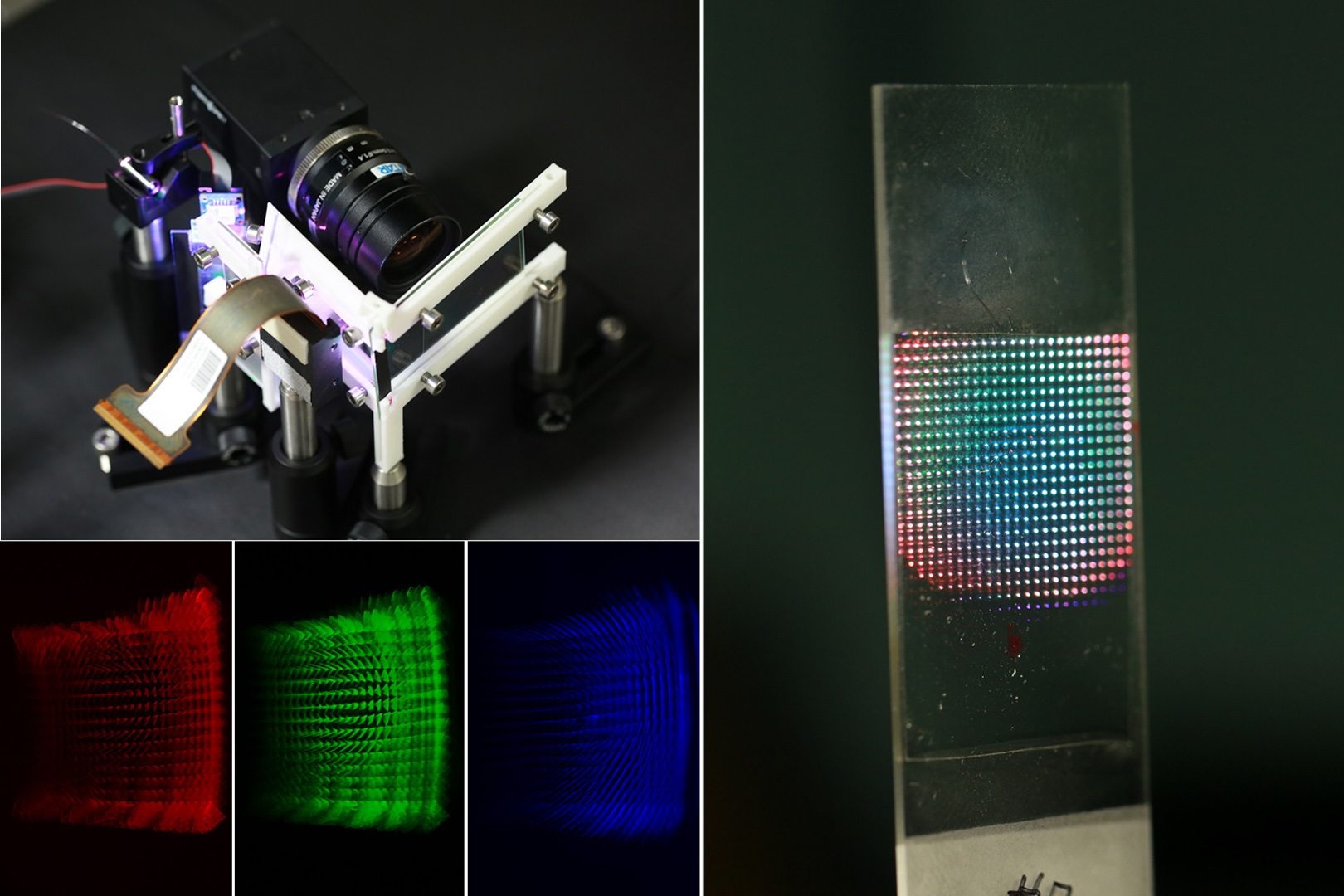
Holographic displays have great potential to realize mixed reality by modulating the wavefront of light in a fundamental manner. As a computational display, holographic displays offer a large degree of freedom, such as focus cue generation and vision correction. However, the limited bandwidth of spatial light modulator imposes an inherent trade-off relationship between the field of view and eye-box size. Thus, we demonstrate the first practical eye-box expansion method for a holographic near-eye display. Instead of providing an intrinsic large exit-pupil, we shift the optical system’s exit-pupil to cover the expanded eye-box area with pupil-tracking. For compact implementation, a pupil-shifting holographic optical element (PSHOE) is proposed that can reduce the form factor for exit-pupil shifting. A thorough analysis of the design parameters and display performance are provided. In particular, we provide a comprehensive analysis of the incorporation of the holographic optical element into a holographic display system. The influence of holographic optical elements on the intrinsic exit-pupil and pupil switching is revealed by numerical simulation and Wigner distribution function analysis.
References:
1. Horst Berneth, Friedrich K Bruder, Thomas Fäcke, Rainer Hagen, Dennis Hönel, David Jurbergs, Thomas Rölle, and Marc-Stephan Weiser. 2011. Holographic recording aspects of high-resolution Bayfol HX photopolymer. In Practical Holography XXV: Materials and Applications, Vol. 7957. International Society for Optics and Photonics, 79570H.Google ScholarCross Ref
2. Geoffrey Brooker. 2003. Modern Classical Optics. Oxford University Press, Oxford.Google Scholar
3. DH Close. 1975. Holographic optical elements. Optical Engineering 14, 5 (1975), 145408.Google ScholarCross Ref
4. Yuanbo Deng and Daping Chu. 2017. Coherence properties of different light sources and their effect on the image sharpness and speckle of holographic displays. Scientific Reports 7, 1 (2017), 5893.Google ScholarCross Ref
5. J. R. Fienup. 1982. Phase retrieval algorithms: a comparison. Appl. Opt. 21, 15 (Aug 1982), 2758–2769.Google ScholarCross Ref
6. Qiankun Gao, Juan Liu, Xinhui Duan, Tao Zhao, Xin Li, and Peilin Liu. 2017. Compact see-through 3D head-mounted display based on wavefront modulation with holographic grating filter. Opt. Express 25, 7 (Apr 2017), 8412–8424.Google Scholar
7. A Georgiou, J Christmas, N Collings, J Moore, and W A Crossland. 2008. Aspects of hologram calculation for video frames. Journal of Optics A: Pure and Applied Optics 10, 3 (2008), 035302.Google ScholarCross Ref
8. Benedikt Groever, Wei Ting Chen, and Federico Capasso. 2017. Meta-lens doublet in the visible region. Nano letters 17, 8 (2017), 4902–4907.Google Scholar
9. Matthew Harker and Paul O’Leary. 2008. Least squares surface reconstruction from measured gradient fields. In Computer Vision and Pattern Recognition, 2008. CVPR 2008. IEEE Conference on. IEEE, 1–7.Google ScholarCross Ref
10. R Häussler, S Reichelt, N Leister, E Zschau, R Missbach, and A Schwerdtner. 2009. Large real-time holographic displays: from prototypes to a consumer product. In Stereoscopic Displays and Applications XX, Vol. 7237. International Society for Optics and Photonics, 72370S.Google ScholarCross Ref
11. Keehoon Hong, Jiwoon Yeom, Changwon Jang, Jisoo Hong, and Byoungho Lee. 2014. Full-color lens-array holographic optical element for three-dimensional optical see-through augmented reality. Opt. Lett. 39, 1 (Jan 2014), 127–130.Google ScholarCross Ref
12. CK Hsueh and AA Sawchuk. 1978. Computer-generated double-phase holograms. Applied optics 17, 24 (1978), 3874–3883.Google Scholar
13. Changwon Jang, Kiseung Bang, Seokil Moon, Jonghyun Kim, Seungjae Lee, and Byoungho Lee. 2017. Retinal 3D: augmented reality near-eye display via pupil-tracked light field projection on retina. ACM Transactions on Graphics (TOG) 36, 6 (2017), 190. Google ScholarDigital Library
14. Changwon Jang, Chang-Kun Lee, Jinsoo Jeong, Gang Li, Seungjae Lee, Jiwoon Yeom, Keehoon Hong, and Byoungho Lee. 2016. Recent progress in see-through three-dimensional displays using holographic optical elements. Applied optics 55, 3 (2016), A71–A85.Google Scholar
15. A. Kaczorowski, G. S. Gordon, A. Palani, S. Czerniawski, and T. D. Wilkinson. 2015. Optimization-Based Adaptive Optical Correction for Holographic Projectors. Journal of Display Technology 11, 7 (July 2015), 596–603.Google ScholarCross Ref
16. Moritz Kassner, William Patera, and Andreas Bulling. 2014. Pupil: an open source platform for pervasive eye tracking and mobile gaze-based interaction. In Proceedings of the 2014 ACM international joint conference on pervasive and ubiquitous computing: Adjunct publication. ACM, 1151–1160. Google ScholarDigital Library
17. Tapani Levola. 2006. Diffractive optics for virtual reality displays. Journal of the Society for Information Display 14, 5 (2006), 467–475.Google ScholarCross Ref
18. Gang Li, Jinsoo Jeong, Dukho Lee, Jiwoon Yeom, Changwon Jang, Seungjae Lee, and Byoungho Lee. 2015. Space bandwidth product enhancement of holographic display using high-order diffraction guided by holographic optical element. Optics express 23, 26 (2015), 33170–33183.Google Scholar
19. Gang Li, Dukho Lee, Youngmo Jeong, Jaebum Cho, and Byoungho Lee. 2016. Holographic display for see-through augmented reality using mirror-lens holographic optical element. Optics letters 41, 11 (2016), 2486–2489.Google Scholar
20. Andrew Maimone, Renjie Chen, Henry Fuchs, Ramesh Raskar, and Gordon Wetzstein. 2014. Wide field of view compressive light field display using a multilayer architecture and tracked viewers. In SID Symposium Digest of Technical Papers, Vol. 45. Wiley Online Library, 509–512.Google ScholarCross Ref
21. Andrew Maimone, Andreas Georgiou, and Joel S Kollin. 2017. Holographic near-eye displays for virtual and augmented reality. ACM Transactions on Graphics (TOG) 36, 4 (2017), 85. Google ScholarDigital Library
22. Yutaka Mori, Takahiko Fukuoka, and Takanori Nomura. 2014. Speckle reduction in holographic projection by random pixel separation with time multiplexing. Applied optics 53, 35 (2014), 8182–8188.Google Scholar
23. Yuechao Pan, Xuewu Xu, Sanjeev Solanki, Xinan Liang, Ridwan Bin Adrian Tanjung, Chiwei Tan, and Tow-Chong Chong. 2009. Fast cgh computation using s-lut on gpu. Optics Express 17, 21 (2009), 18543–18555.Google ScholarCross Ref
24. Jae-Hyeung Park. 2017. Recent progress in computer-generated holography for three-dimensional scenes. Journal of Information Display 18, 1 (2017), 1–12.Google ScholarCross Ref
25. Soon-gi Park, Jong-Young Hong, Chang-Kun Lee, and Byoungho Lee. 2015. Real-mode depth-fused display with viewer tracking. Optics express 23, 20 (2015), 26710–26722.Google Scholar
26. Haichao Peng, Dewen Cheng, Jian Han, Chen Xu, Weitao Song, Liuzhu Ha, Jian Yang, Quanxing Hu, and Yongtian Wang. 2014. Design and fabrication of a holographic head-up display with asymmetric field of view. Applied optics 53, 29 (2014), H177–H185.Google Scholar
27. Liang Shi, Fu-Chung Huang, Ward Lopes, Wojciech Matusik, and David Luebke. 2017. Near-eye light field holographic rendering with spherical waves for wide field of view interactive 3d computer graphics. ACM Transactions on Graphics (TOG) 36, 6 (2017), 236. Google ScholarDigital Library
28. Arnab Sinha, George Barbastathis, Wenhai Liu, and Demetri Psaltis. 2004. Imaging using volume holograms. Optical Engineering 43, 9 (2004), 1959–1973.Google ScholarCross Ref
29. Yasuhiro Takaki and Masahito Yokouchi. 2011. Speckle-free and grayscale hologram reconstruction using time-multiplexing technique. Opt. Express 19, 8 (Apr 2011), 7567–7579.Google ScholarCross Ref
30. Naoya Uchida. 1973. Calculation of diffraction efficiency in hologram gratings attenuated along the direction perpendicular to the grating vector. JOSA 63, 3 (1973), 280–287.Google ScholarCross Ref
31. Koki Wakunami, Po-Yuan Hsieh, Ryutaro Oi, Takanori Senoh, Hisayuki Sasaki, Yasuyuki Ichihashi, Makoto Okui, Yi-Pai Huang, and Kenji Yamamoto. 2016. Projection-type see-through holographic three-dimensional display. Nature communications 7 (2016), 12954.Google Scholar
32. Fahri Yaraş, Hoonjong Kang, and Levent Onural. 2010. State of the art in holographic displays: a survey. Journal of display technology 6, 10 (2010), 443–454.Google ScholarCross Ref
33. Han-Ju Yeom, Hee-Jae Kim, Seong-Bok Kim, HuiJun Zhang, BoNi Li, Yeong-Min Ji, Sang-Hoo Kim, and Jae-Hyeung Park. 2015. 3D holographic head mounted display using holographic optical elements with astigmatism aberration compensation. Optics express 23, 25 (2015), 32025–32034.Google Scholar
34. Chao Yu, Yifan Peng, Qing Zhao, Haifeng Li, and Xu Liu. 2017. Highly efficient waveguide display with space-variant volume holographic gratings. Appl. Opt. 56, 34 (Dec 2017), 9390–9397.Google ScholarCross Ref
35. Zhengyun Zhang and M. Levoy. 2009. Wigner distributions and how they relate to the light field. In 2009 IEEE International Conference on Computational Photography (ICCP). 1–10.Google Scholar
36. Received June 2018; revised September 2018; final version September 2018; accepted September 2018Google Scholar