
“Halftone QR codes”
Conference:
Type(s):
Title:
- Halftone QR codes
Session/Category Title:
- Rendering and Thinking Inside the Box
Presenter(s)/Author(s):
Abstract:
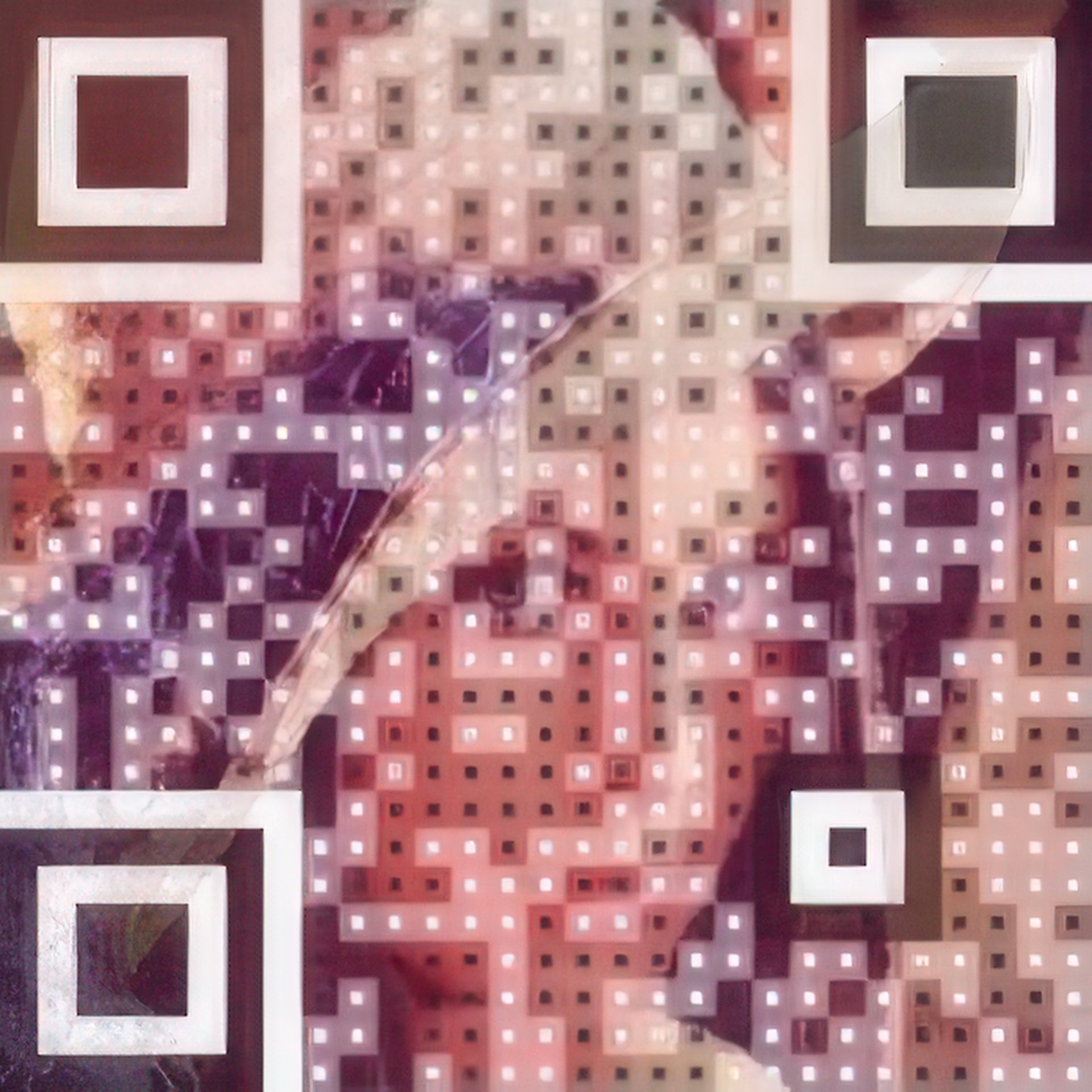
QR code is a popular form of barcode pattern that is ubiquitously used to tag information to products or for linking advertisements. While, on one hand, it is essential to keep the patterns machine-readable; on the other hand, even small changes to the patterns can easily render them unreadable. Hence, in absence of any computational support, such QR codes appear as random collections of black/white modules, and are often visually unpleasant. We propose an approach to produce high quality visual QR codes, which we call halftone QR codes, that are still machine-readable. First, we build a pattern readability function wherein we learn a probability distribution of what modules can be replaced by which other modules. Then, given a text tag, we express the input image in terms of the learned dictionary to encode the source text. We demonstrate that our approach produces high quality results on a range of inputs and under different distortion effects.
References:
1. A. T. Communications Co., L., 2007. LogoQnet. http://logoq.net/.
2. Boykov, Y., Veksler, O., and Zabih, R. 2001. Fast approximate energy minimization via graph cuts. IEEE Trans. Pattern Anal. Mach. Intell. 23, 11, 1222–1239.
3. Brown, J., 2007. Zbar bar code reader. http://zbar.sourceforge.net/.
4. Chan, H., 2011. HOWTO: Make Your QR Codes More Beautiful. http://mashable.com/2011/04/18/qr-code-design-tips/.
5. Chang, J., Alain, B., and Ostromoukhov, V. 2009. Structure-aware error diffusion. ACM Trans. Graph. (Proc. SIGGRAPH Asia) 28, 5, 162:1–162:8.
6. Chu, H.-K., Hsu, W.-H., Mitra, N. J., Cohen-Or, D., Wong, T.-T., and Lee, T.-Y. 2010. Camouflage images. ACM Trans. Graph. (Proc. SIGGRAPH) 29, 51:1–51:8.
7. Cox, R., 2012. QArt Codes. http://research.swtch.com/qart.
8. DENSO WAVE, 2003. QR code.com. http://www.qrcode.com/en/.
9. D’Haem, J., 2010. QR Code® Artist. http://www.qrcartist.com/.
10. flickr, 2009. QR code Art. http://www.flickr.com/groups/qr-art/.
11. Gal, R., Sorkine, O., Popa, T., Sheffer, A., and CohenOr, D. 2007. 3D collage: Expressive non-realistic modeling. In Proc. of NPAR, ACM, 14.
12. Huang, H., Zhang, L., and Zhang, H.-C. 2011. Arcimboldo-like collage using internet images. ACM Trans. Graph. (Proc. SIGGRAPH Asia) 30, 6 (Dec.), 155:1–155:8.
13. ISO/IEC 18004, 2006. Information technology – Automatic identification and data capture techniques – QR Code 2005 bar code symbology specification.
14. Kentaro, F., 2006. QRencode. http://fukuchi.org/works/qrencode/.
15. Kopf, J., and Lischinski, D. 2011. Depixelizing pixel art. ACM Trans. Graph. (Proc. SIGGRAPH) 30, 4, 99:1–99:8.
16. Kyprianidis, J. E., and Döllner, J. 2008. Image abstraction by structure adaptive filtering. In Proc. EG UK Theory and Practice of Computer Graphics, 51–58.
17. Laporte, A., 2012. Unitag. http://www.unitaglive.com/qrcode.
18. Maharik, R., Bessmeltsev, M., Sheffer, A., Shamir, A., and Carr, N. 2011. Digital micrography. ACM Trans. Graph. (Proc. SIGGRAPH) 30, 4, 100:1–100:12.
19. Mitra, N. J., and Pauly, M. 2009. Shadow art. ACM Trans. Graph. (Proc. SIGGRAPH Asia) 28, 5, 156:1–156:7.
20. Pang, W.-M., Qu, Y., Wong, T.-T., Cohen-Or, D., and Heng, P.-A. 2008. Structure-aware halftoning. ACM Trans. Graph. (Proc. SIGGRAPH) 27, 3, 89:1–89:8.
21. Peled, U., 2012. Visualead. http://www.visualead.com/.
22. Scheib, V., 2010. QR Code hacks: modifying and altering for artistic fun. http://beautifulpixels.blogspot.tw/2010/08/qr-codehacks-modifying-and-altering.html.
23. Wang, Z., Bovik, A. C., Sheikh, H. R., and Simoncelli, E. P. 2004. Image quality assessment: From error visibility to structural similarity. IEEE Trans. on Vis. and Comp. Graphics 13, 4, 600–612.
24. Winter, M. 2011. Scan Me: Everybody’s Guide to the Magical World of QR Codes. Westsong Publishing.
25. Xu, X., Zhang, L., and Wong, T.-T. 2010. Structure-based ascii art. ACM Trans. Graph. (Proc. SIGGRAPH) 29, 52:1–52:10.



