
“Free-flowing granular materials with two-way solid coupling”
Conference:
Type(s):
Title:
- Free-flowing granular materials with two-way solid coupling
Session/Category Title:
- Fluids and flows
Presenter(s)/Author(s):
Moderator(s):
Abstract:
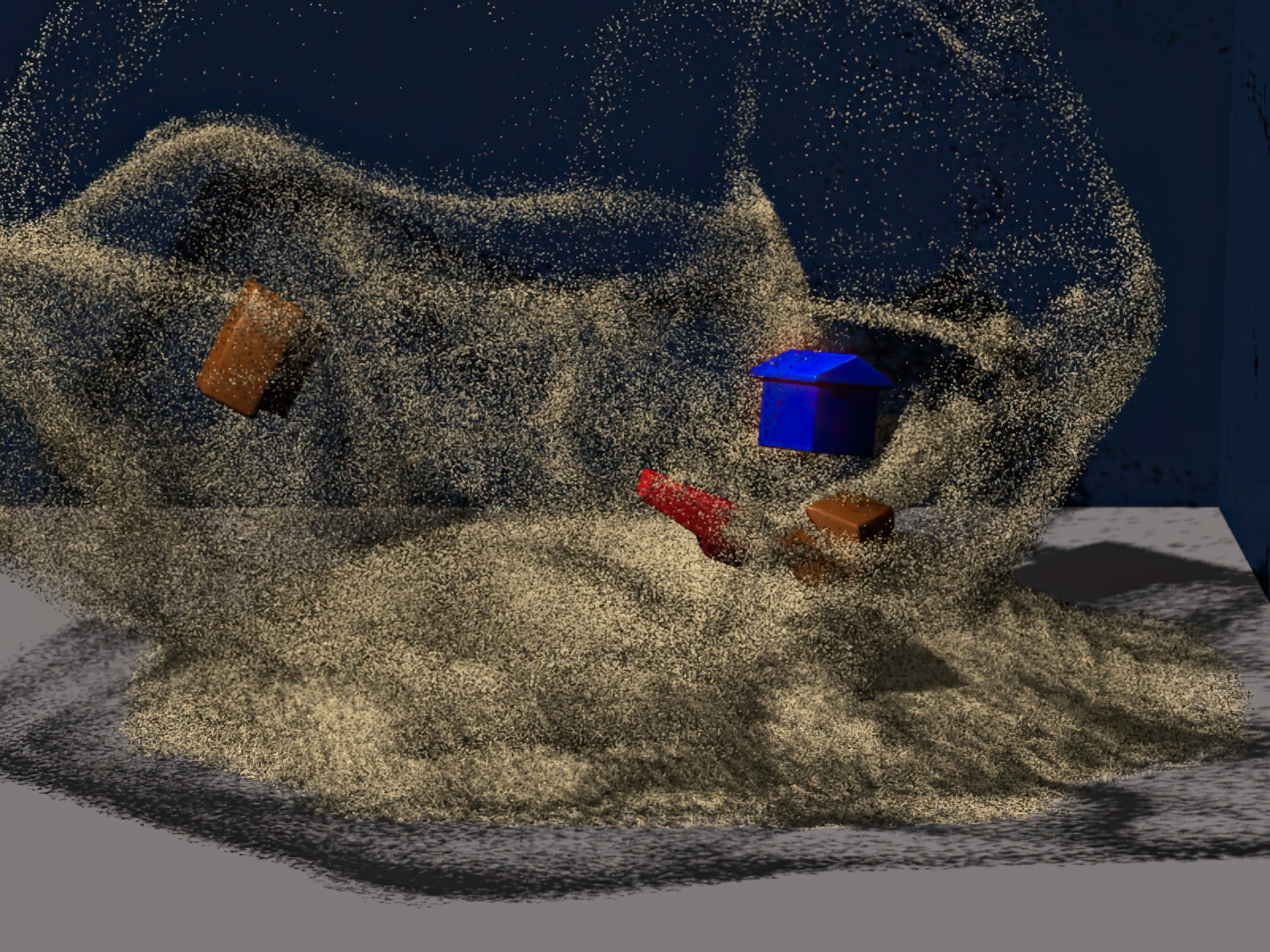
We present a novel continuum-based model that enables efficient simulation of granular materials. Our approach fully solves the internal pressure and frictional stresses in a granular material, thereby allows visually noticeable behaviors of granular materials to be reproduced, including freely dispersing splashes without cohesion, and a global coupling between friction and pressure. The full treatment of internal forces in the material also enables two-way interaction with solid bodies. Our method achieves these results at only a very small fraction of computational costs of the comparable particle-based models for granular flows.
References:
1. Adams, B., Pauly, M., Keiser, R., and Guibas, L. J. 2007. Adaptively sampled particle fluids. In SIGGRAPH ’07: ACM SIGGRAPH 2007 papers, ACM, 48. Google ScholarDigital Library
2. Alduán, I., Tena, A., and Otaduy, M. A. 2009. Simulation of high-resolution granular media. In Proc. of Congreso Español de Informática Gráfica.Google Scholar
3. Aranson, I. S., and Tsimring, L. S. 2001. Continuum description of avalanches in granular media. Phys. Rev. E 64, 2 (Jul), 020301.Google ScholarCross Ref
4. Batty, C., Bertails, F., and Bridson, R. 2007. A fast variational framework for accurate solid-fluid coupling. ACM Trans. Graph. 26, 3, 100. Google ScholarDigital Library
5. Behringer, R., Jaeger, H., and Nagel, S. 1999. Introduction to the focus issue on granular materials. Chaos: An Interdisciplinary Journal of Nonlinear Science 9, 3, 509–510.Google ScholarCross Ref
6. Bell, N., Yu, Y., and Mucha, P. J. 2005. Particle-based simulation of granular materials. In Proc. ACM SIGGRAPH / Eurographics Symposium on Computer animation, ACM, 77–86. Google ScholarDigital Library
7. Bićanić, N. 2004. Discrete element methods. In Encyclopedia of Computational Mechanics, E. Stein, R. de Borst, and T. J. Hughes, Eds., vol. 1. Wiley, ch. 11.Google Scholar
8. Brackbill, J. U., and Ruppel, H. M. 1986. Flip: A method for adaptively zoned, particle-in-cell calculations of fluid flows in two dimensions. J. Comput. Phys. 65, 2, 314–343. Google ScholarDigital Library
9. Bridson, R., and Müller-Fischer, M. 2007. Fluid simulation. In ACM SIGGRAPH 2007 courses, 1–81. Google ScholarDigital Library
10. Chanclou, B., Luciani, A., and Habibi, A. 1996. Physical models of loose soils dynamically marked by a moving object. In Computer Animation ’96 Proceedings, 27–35. Google ScholarDigital Library
11. Dostál, Z., and Schöberl, J. 2005. Minimizing quadratic functions subject to bound constraints with the rate of convergence and finite termination. Comput. Optim. Appl. 30, 1, 23–43. Google ScholarDigital Library
12. Goktekin, T. G., Bargteil, A. W., and O’Brien, J. F. 2004. A method for animating viscoelastic fluids. ACM Transactions on Graphics (Proc. of ACM SIGGRAPH 2004) 23, 3, 463–468. Google ScholarDigital Library
13. Josserand, C., Lagrée, P.-Y., and Lhuillier, D. 2004. Stationary shear flows of dense granular materials: a tentative continuum modelling. The European Physical Journal E: Soft Matter and Biological Physics 14 (06), 127–135.Google ScholarCross Ref
14. Kaufman, D. M., Sueda, S., James, D. L., and Pai, D. K. 2008. Staggered projections for frictional contact in multibody systems. ACM Transactions on Graphics (SIGGRAPH Asia 2008) 27, 5, 164:1–164:11. Google ScholarDigital Library
15. Lenaerts, T., and Dutré, P. 2009. Mixing fluids and granular materials. Computer Graphics Forum 28, 213–218(6).Google ScholarCross Ref
16. Li, X., and Moshell, J. M. 1993. Modeling soil: realtime dynamic models for soil slippage and manipulation. In SIGGRAPH ’93, ACM, 361–368. Google ScholarDigital Library
17. Luciani, A., Habibi, A., and Manzotti, E. 1995. A multi-scale physical model of granular materials. In Proceedings of Graphics Interface.Google Scholar
18. Miller, G., and Pearce, A. 1989. Globular dynamics: A connected particle system for animating viscous fluids. Computers and Graphics 13, 3, 305–309.Google ScholarCross Ref
19. Narain, R., Golas, A., Curtis, S., and Lin, M. C. 2009. Aggregate dynamics for dense crowd simulation. ACM Trans. Graph. 28, 5, 1–8. Google ScholarDigital Library
20. Onoue, K., and Nishita, T. 2003. Virtual sandbox. In Pacific Conference on Computer Graphics and Applications, IEEE Computer Society, 252. Google ScholarDigital Library
21. Pla-Castells, M., Garćia-Fernández, I., and Martínez, R. J. 2006. Interactive terrain simulation and force distribution models in sand piles. In Cellular Automata. 392–401. Google ScholarDigital Library
22. Quecedo, M., Pastor, M., Herreros, M. I., and Merodo, J. A. F. 2004. Numerical modelling of the propagation of fast landslides using the finite element method. International Journal for Numerical Methods in Engineering 59, 6, 755–794.Google ScholarCross Ref
23. Simo, J., and Hughes, T. 1998. Computational Inelasticity. Springer.Google Scholar
24. Sumner, R. W., O’Brien, J. F., and Hodgins, J. K. 1999. Animating sand, mud, and snow. Computer Graphics Forum 18, 1, 17–26.Google ScholarCross Ref
25. Zhu, Y., and Bridson, R. 2005. Animating sand as a fluid. In ACM SIGGRAPH 2005 Papers, ACM, 965–972. Google ScholarDigital Library
26. Zhu, B., and Yang, X. 2010. Animating sand as a surface flow. In Eurographics 2010, Short Papers.Google Scholar



