
“Fine-grained semi-supervised labeling of large shape collections” by Huang, Su and Guibas
Conference:
Type(s):
Title:
- Fine-grained semi-supervised labeling of large shape collections
Session/Category Title:
- Shape and Machine Learning
Presenter(s)/Author(s):
Abstract:
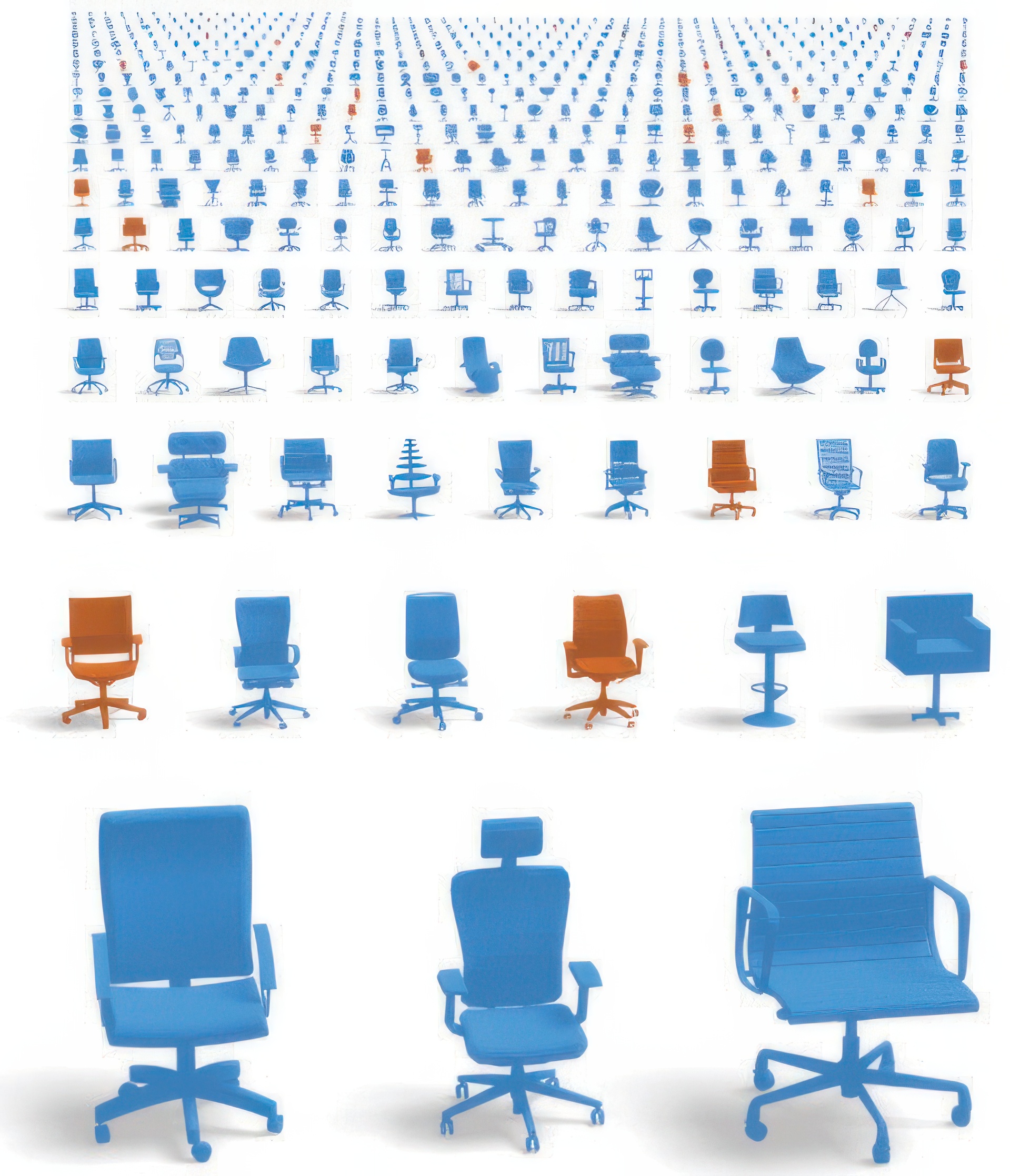
In this paper we consider the problem of classifying shapes within a given category (e.g., chairs) into finer-grained classes (e.g., chairs with arms, rocking chairs, swivel chairs). We introduce a multi-label (i.e., shapes can belong to multiple classes) semi-supervised approach that takes as input a large shape collection of a given category with associated sparse and noisy labels, and outputs cleaned and complete labels for each shape. The key idea of the proposed approach is to jointly learn a distance metric for each class which captures the underlying geometric similarity within that class, e.g., the distance metric for swivel chairs evaluates the global geometric resemblance of chair bases. We show how to achieve this objective by first geometrically aligning the input shapes, and then learning the class-specific distance metrics by exploiting the feature consistency provided by this alignment. The learning objectives consider both labeled data and the mutual relations between the distance metrics. Given the learned metrics, we apply a graph-based semi-supervised classification technique to generate the final classification results.In order to evaluate the performance of our approach, we have created a benchmark data set where each shape is provided with a set of ground truth labels generated by Amazon’s Mechanical Turk users. The benchmark contains a rich variety of shapes in a number of categories. Experimental results show that despite this variety, given very sparse and noisy initial labels, the new method yields results that are superior to state-of-the-art semi-supervised learning techniques.
References:
1. Amit, Y., Fink, M., Srebro, N., and Ullman, S. 2007. Uncovering shared structures in multiclass classification. ICML ’07, 17–24.
2. Baghshah, M. S., and Shouraki, S. B. 2009. Semi-supervised metric learning using pairwise constraints. IJCAI’09, 1217–1222.
3. Boyd, S., Parikh, N., Chu, E., Peleato, B., and Eckstein, J. 2011. Distributed optimization and statistical learning via the alternating direction method of multipliers. Found. Trends Mach. Learn. 3, 1 (Jan.), 1–122.
4. Candès, E. J., and Recht, B. 2009. Exact matrix completion via convex optimization. Found. Comput. Math. 9, 6 (Dec.), 717–772.
5. Chen, D.-Y., Tian, X.-P., Shen, Y.-T., and Ouhyoung, M. 2003. On visual similarity based 3d model retrieval. Comput. Graph. Forum 22, 3, 223–232.
6. Chen, G., Song, Y., Wang, F., and Zhang, C. 2008. Semi-supervised multi-label learning by solving a sylvester equation. In SDM, SIAM, 410–419.
7. Coifman, R. R., Lafon, S., Lee, A. B., Maggioni, M., Warner, F., and Zucker, S. 2005. Geometric diffusions as a tool for harmonic analysis and structure definition of data: Diffusion maps. In PNAS, 7426–7431.
8. Crandall, D., Owens, A., Snavely, N., and Huttenlocher, D. 2011. Discrete-continuous optimization for large-scale structure from motion. CVPR ’11, 3001–3008.
9. da Fontoura Costa, L., and Cesar Jr., R. M. 2009. Shape Classification and Analysis: Theory and Practice, 2nd ed. CRC Press, Inc., Boca Raton, FL, USA.
10. Deng, J., Krause, J., and Fei-Fei, L. 2013. Fine-grained crowd-sourcing for fine-grained recognition. In CVPR’13.
11. Fergus, R., Weiss, Y., and Torralba, A. 2009. Semi-supervised learning in gigantic image collections. In NIPS, 522–530.
12. Hoi, S. C., Liu, W., and Chang, S.-F. 2010. Semi-supervised distance metric learning for collaborative image retrieval and clustering. ACM Trans. Multimedia Comput. Commun. Appl. 6, 3 (Aug.), 18:1–18:26.
13. Holland, P. W., and Welsch, R. E. 1977. Robust regression using iteratively reweighted least-squares. Communications in Statistics: Theory and Methods A6, 813–827.
14. Huang, Q.-X., Zhang, G.-X., Gao, L., Hu, S.-M., Butscher, A., and Guibas, L. 2012. An optimization approach for extracting and encoding consistent maps in a shape collection. ACM Trans. Graph. 31, 6 (Nov.), 167:1–167:11.
15. Huber, D. 2002. Automatic Three-dimensional Modeling from Reality. PhD thesis, Robotics Institute, Carnegie Mellon University, Pittsburgh, PA.
16. Johnson, A. E., and Hebert, M. 1999. Using spin images for efficient object recognition in cluttered 3d scenes. IEEE Trans. Pattern Anal. Mach. Intell. 21, 5 (May), 433–449.
17. Kalogerakis, E., Chaudhuri, S., Koller, D., and Koltun, V. 2012. A probabilistic model for component-based shape synthesis. ACM Trans. Graph. 31, 4 (July), 55:1–55:11.
18. Kazhdan, M., Funkhouser, T., and Rusinkiewicz, S. 2003. Rotation invariant spherical harmonic representation of 3d shape descriptors. SGP ’03, 156–164.
19. Kim, V. G., Li, W., Mitra, N. J., DiVerdi, S., and Funkhouser, T. 2012. Exploring collections of 3d models using fuzzy correspondences. ACM Trans. Graph. 31, 4 (July), 54:1–54:11.
20. Kim, V. G., Li, W., Mitra, N. J., Chaudhuri, S., DiVerdi, S., and Funkhouser, T. 2013. Learning part-based templates from large collections of 3d shapes. ACM Trans. Graph. 32, 4 (July), 70:1–70:12.
21. Leordeanu, M., and Hebert, M. 2006. Efficient map approximation for dense energy functions. ICML ’06, 545–552.
22. Li, H., Sumner, R. W., and Pauly, M. 2008. Global correspondence optimization for non-rigid registration of depth scans. In SGP, 1421–1430.
23. Liu, W., Wang, J., and Chang, S.-F. 2012. Robust and scalable graph-based semisupervised learning. Proceedings of the IEEE 100, 9, 2624–2638.
24. Loeff, N., Farhadi, A., Endres, I., and Forsyth, D. 2009. Unlabeled data improves word prediction. In ICCV’09, 956–962.
25. Miller, G. A. 1995. Wordnet: A lexical database for english. Communications of the ACM 38, 39–41.
26. Osada, R., Funkhouser, T., Chazelle, B., and Dobkin, D. 2002. Shape distributions. ACM Trans. Graph. 21 (October), 807–832.
27. Sederberg, T. W., and Parry, S. R. 1986. Free-form deformation of solid geometric models. SIGGRAPH ’86, 151–160.
28. Shi, J., and Malik, J. 2000. Normalized cuts and image segmentation. IEEE Trans. Pattern Anal. Mach. Intell. 22 (August), 888–905.
29. Tsoumakas, G., and Katakis, I. 2007. Multi-label classification: An overview. Int J Data Ware. and Mining 2007, 1–13.
30. Wang, Y., Asafi, S., van Kaick, O., Zhang, H., Cohen-Or, D., and Chen, B. 2012. Active co-analysis of a set of shapes. ACM Trans. Graph. 31, 6, 165.
31. Xu, K., Li, H., Zhang, H., Cohen-Or, D., Xiong, Y., and Cheng, Z.-Q. 2010. Style-content separation by anisotropic part scales. SIGGRAPH ASIA ’10, 184:1–184:10.
32. Yang, L., and Jin, R. 2006. Distance metric learning: A comprehensive survey.
33. Yao, B., Khosla, A., and Fei-Fei, L. 2011. Combining randomization and discrimination for fine-grained image categorization. In CVPR ’11, 1577–1584.
34. Zhu, X. 2006. Semi-supervised learning literature survey. Computer Sciences TR 1530, University of Wisconsin Madison.



