“Falling and landing motion control for character animation”
Conference:
Type(s):
Title:
- Falling and landing motion control for character animation
Session/Category Title:
- Full-Body Character Animation
Presenter(s)/Author(s):
Abstract:
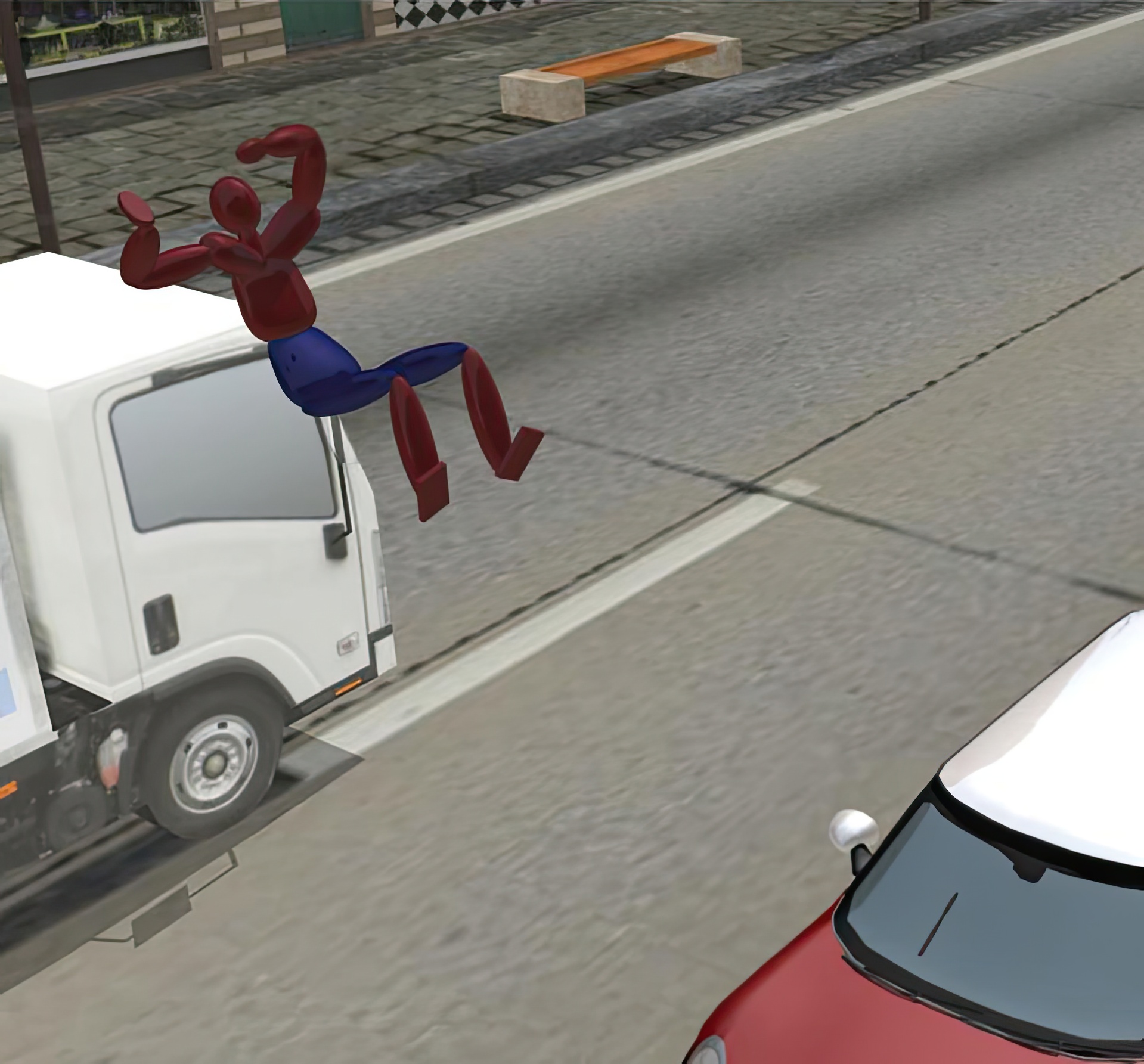
We introduce a new method to generate agile and natural human landing motions in real-time via physical simulation without using any mocap or pre-scripted sequences. We develop a general controller that allows the character to fall from a wide range of heights and initial speeds, continuously roll on the ground, and get back on its feet, without inducing large stress on joints at any moment. The character’s motion is generated through a forward simulator and a control algorithm that consists of an airborne phase and a landing phase. During the airborne phase, the character optimizes its moment of inertia to meet the ideal relation between the landing velocity and the angle of attack, under the laws of conservation of momentum. The landing phase can be divided into three stages: impact, rolling, and getting-up. To reduce joint stress at landing, the character leverages contact forces to control linear momentum and angular momentum, resulting in a rolling motion which distributes impact over multiple body parts. We demonstrate that our control algorithm can be applied to a variety of initial conditions with different falling heights, orientations, and linear and angular velocities. Simulated results show that our algorithm can effectively create realistic action sequences comparable to real world footage of experienced freerunners.
References:
1. 2011. Advanced Parkour Roll Techniques, http://youtu.be/bbs7wDqViY4.
2. Coros, S., Beaudoin, P., and van de Panne, M. 2009. Robust task-based control policies for physics-based characters. In ACM Trans. Graph, vol. 28.
3. Coros, S., Beaudoin, P., and van de Panne, M. 2010. Generalized biped walking control. ACM Trans. Graph. 29 (July), 130:1–130:9.
4. Coros, S., Karpathy, A., Jones, B., Reveret, L., and Van De Panne, M. 2011. Locomotion skills for simulated quadrupeds. 1–11.
5. da Silva, M., Abe, Y., and Popović, J. 2008. Interactive simulation of stylized human locomotion. In ACM SIGGRAPH 2008 papers, 82:1–82:10.
6. Edwardes, D. 2009. The Parkour and Freerunning Handbook. It Books, August.
7. Faloutsos, P., van de Panne, M., and Terzopoulos, D. 2001. Composable controllers for physics-based character animation. In SIGGRAPH, 251–260.
8. Fang, A. C., and Pollard, N. S. 2003. Efficient synthesis of physically valid human motion. ACM Trans. on Graphics (SIGGRAPH) (July), 417–426.
9. Fujiwara, K., Kanehiro, F., Kajita, S., Kaneko, K., Yokoi, K., and Hirukawa, H. 2002. UKEMI: Falling motion control to minimize damage to biped humanoid robot. In Intelligent Robots and Systems, 2002. IEEE/RSJ International Conference on, IEEE, vol. 3, 2521–2526.
10. Fujiwara, K., Kajita, S., Harada, K., Kaneko, K., Morisawa, M., Kanehiro, F., Nakaoka, S., and Hirukawa, H. 2007. An optimal planning of falling motions of a humanoid robot. In Intelligent Robots and Systems, 2007. IROS 2007. IEEE/RSJ International Conference on, IEEE, no. Table I, 456–462.
11. 2011. How to Land a Jump in Parkour, http://www.wikihow.com/Land-a-Jump-in-Parkour.
12. Hodgins, J. K., Wooten, W. L., Brogan, D. C., and O’Brien, J. F. 1995. Animating human athletics. In SIGGRAPH, 71–78.
13. Kalyanakrishnan, S., Goswami, A., Kim, J., Kim, Y., Hurst, J., Liu, J., Xue, F., Chen, X., Kim, M., Gong, L., and Others. 2011. Learning to predict humanoid fall. LEARNING 8, 2, 245.
14. Kane, T. R., and Scher, M. P. 1969. A dynamical explanation of the falling cat phenomenon. Int J Solids structures, 55, 663–670.
15. Lasa, M. D., Mordatch, I., and Hertzmann, A. 2010. Feature-based locomotion controllers. ACM Transactions on Graphics (TOG) 29.
16. Libby, T., Moore, T. Y., Chang-Siu, E., Li, D., Cohen, D. J., Jusufi, A., and Full, R. J. 2012. Tail-assisted pitch control in lizards, robots and dinosaurs. Nature advance online publication (January).
17. Liu, C. K., and Popović, Z. 2002. Synthesis of complex dynamic character motion from simple animations. ACM Trans. on Graphics (SIGGRAPH) 21, 3 (July), 408–416.
18. Liu, L., Yin, K., van de Panne, M., Shao, T., and Xu, W. 2010. Sampling-based contact-rich motion control. ACM Transactions on Graphics (TOG) 29, 4, 128.
19. Majkowska, A., and Faloutsos, P. 2007. Flipping with physics: motion editing for acrobatics. In Proceedings of the 2007 ACM SIGGRAPH/Eurographics symposium on Computer animation, 35–44.
20. Miller, G. 1989. Goal-directed snake motion over uneven terrain. In Computer Graphics ’89, Blenheim Online Ltd., Middlesex HA5 2AE, UK, Blenheim Online Publications, 257–272.
21. Montgomery, R. 1993. Gauge theory of the falling cat. In Dynamics and Control of Mechanical Systems, American Mathematical Society, M. J. Enos, Ed., 193–218.
22. Mordatch, I., de Lasa, M., and Hertzmann, A. 2010. Robust physics-based locomotion using low-dimensional planning. ACM Trans. Graph. 29 (July), 71:1–71:8.
23. Muico, U., Lee, Y., Popović, J., and Popović, Z. 2009. Contact-aware nonlinear control of dynamic characters. In ACM SIGGRAPH 2009 papers, ACM, New York, NY, USA, SIGGRAPH ’09, 81:1–81:9.
24. Ros, I. G., Bassman, L. C., Badger, M. A., Pierson, A. N., and Biewener, A. A. 2011. Pigeons steer like helicopters and generate down- and upstroke lift during low speed turns. Proceedings of the National Academy of Sciences (PNAS) 108, 50.
25. Safonova, A., Hodgins, J. K., and Pollard, N. S. 2004. Synthesizing physically realistic human motion in low-dimensinal, behavior-specific spaces. ACM Trans. on Graphics (SIGGRAPH) 23, 3, 514–521.
26. Shapiro, a., Pighin, F., and Faloutsos, P. 2003. Hybrid control for interactive character animation. Computer Graphics and Applications, 455–461.
27. Sok, K. W., Yamane, K., Lee, J., and Hodgins, J. 2010. Editing dynamic human motions via momentum and force. ACM SIGGRAPH/Eurographics Symposium on Computer Animation.
28. Sulejmanpašić, A., and Popović, J. 2004. Adaptation of performed ballistic motion. ACM Trans. on Graphics 24, 1.
29. Tan, J., Gu, Y., Turk, G., and Liu, C. K. 2011. Articulated swimming creatures. In ACM SIGGRAPH 2011 papers, 58:1–58:12.
30. Wooten, W. L. 1998. Simulation of Leaping, Tumbling, Landing, and Balancing Humans. PhD thesis, Georgia Institute of Technology.
31. Wu, J., and Popović, Z. 2003. Realistic modeling of bird flight animations. vol. 22, 888–895.
32. Wu, J.-c., and Popović, Z. 2010. Terrain-adaptive bipedal locomotion control. ACM Trans. Graph. 29 (July), 72:1–72:10.
33. Yin, K., Loken, K., and van de Panne, M. 2007. Simbicon: simple biped locomotion control. In SIGGRAPH, 105.
34. Yun, S.-k., Goswami, A., and Sakagami, Y. 2009. Safe fall: Humanoid robot fall direction change through intelligent stepping and inertia shaping. 2009 IEEE International Conference on Robotics and Automation (May), 781–787.
35. Zhao, P., and van de Panne, M. 2005. User interfaces for interactive control of physics-based 3d characters. I3D: ACM SIGGRAPH 2005 Symposium on Interactive 3D Graphics and Games.