
“Extrusion-based ceramics printing with strictly-continuous deposition” by Hergel, Hinz, Lefebvre and Thomaszewski
Conference:
Type(s):
Title:
- Extrusion-based ceramics printing with strictly-continuous deposition
Session/Category Title:
- Building Knowledge
Presenter(s)/Author(s):
Moderator(s):
Abstract:
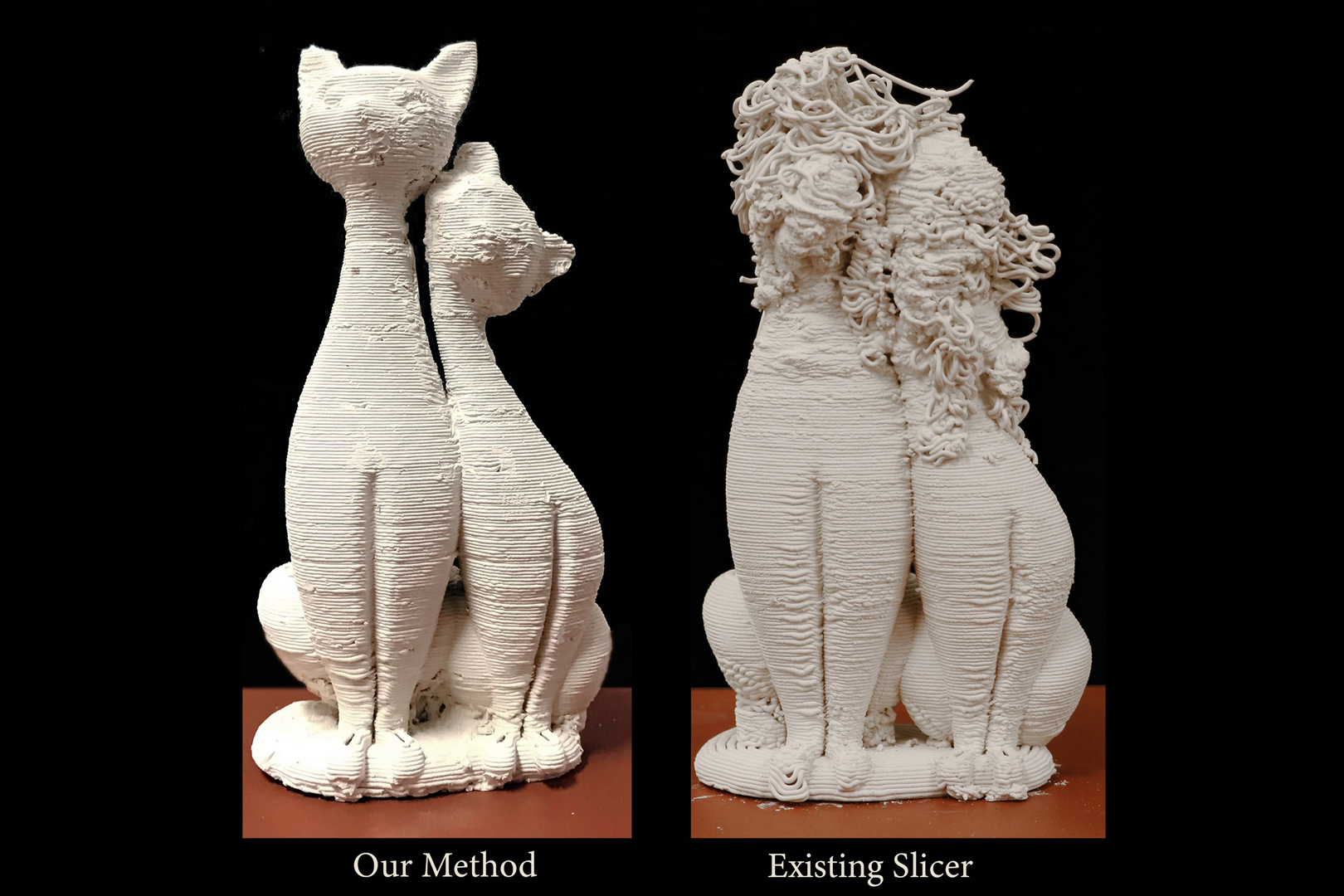
We propose a method for integrated tool path planning and support structure generation tailored to the specific constraints of extrusion-based ceramics printing. Existing path generation methods for thermoplastic materials rely on transfer moves to navigate between different print paths in a given layer. However, when printing with clay, these transfer moves can lead to severe artifacts and failure. Our method eliminates transfer moves altogether by generating deposition paths that are continuous within and across layers. Our algorithm is implemented as a sequential top-down pass through the layer stack. In each layer, we detect points that require support, connect support points and model paths, and optimize the shape of the resulting continuous path with respect to length, smoothness, and distance to the model. For each of these subproblems, we propose dedicated solutions that take into account the fabrication constraints imposed by printable clay. We evaluate our method on a set of examples with multiple disconnected components and challenging support requirements. Comparisons to existing path generation methods designed for thermoplastic materials show that our method substantially improves print quality and often makes the difference between success and failure.
References:
1. Stephen Allen and Deboyjoti Dutta. 1995. Determination and evaluation of support structures in layered manufacturing. Journal of Design and Manufacturing 5 (1995), 153–162.Google Scholar
2. Amir Armani, Wenbin Li, Ming Leu, and Gregory Hilmas. 2016. A novel extrusion-based additive manufacturing process for ceramic parts. In Proceedings of the 27th Annual Conference on Solid Freeform Fabrication. 1519–1529.Google Scholar
3. Miklós Bergou, Basile Audoly, Etienne Vouga, Max Wardetzky, and Eitan Grinspun. 2010. Discrete Viscous Threads. ACM Trans. Graph. 29, 4, Article 116 (July 2010), 10 pages. Google ScholarDigital Library
4. Richard A. Buswell, Wilson Ricardo Leal da Silva, Scott Z. Jones, and Justin Dirrenberger. 2018. 3D printing using concrete extrusion: A roadmap for research. Cement and Concrete Research 112 (2018), 37 — 49. SI : Digital concrete 2018. Google ScholarCross Ref
5. Kumar Chalasani and Larry Roscoe. 1995. Support Generation for Fused Deposition Modeling. In Proc. of Solid Freeform Fabrication Symposium ’95. 229–241.Google Scholar
6. Zhangwei Chen, Ziyong Li, Junjie Li, Chengbo Liu, Changshi Lao, Yuelong Fu, Changyong Liu, Yang Li, Pei Wang, and Yi He. 2018. 3D printing of ceramics: A review. Journal of the European Ceramic Society (2018). Google ScholarCross Ref
7. Jordan J. Cox, Yasuko Takezaki, Helaman R.P. Ferguson, Kent E. Kohkonen, and Eric L. Mulkay. 1994. Space-filling curves in tool-path applications. Computer-Aided Design 26, 3 (1994), 215 — 224. Special Issue:NC machining and cutter-path generation. Google ScholarCross Ref
8. Chengkai Dai, Charlie C. L. Wang, Chenming Wu, Sylvain Lefebvre, Guoxin Fang, and Yong-Jin Liu. 2018. Support-free Volume Printing by Multi-axis Motion. ACM Trans. Graph. 37, 4, Article 134 (July 2018), 14 pages. Google ScholarDigital Library
9. Donghong Ding, Zengxi (Stephen) Pan, Dominic Cuiuri, and Huijun Li. 2014. A tool-path generation strategy for wire and arc additive manufacturing. The International Journal of Advanced Manufacturing Technology 73, 1 (01 Jul 2014), 173–183. Google ScholarCross Ref
10. Jérémie Dumas, Jean Hergel, and Sylvain Lefebvre. 2014. Bridging the Gap: Automated Steady Scaffoldings for 3D Printing. ACM Trans. Graph. 33, 4, Article 98 (July 2014), 10 pages. Google ScholarDigital Library
11. Chloë Fleming, Stephanie Walker, Callie Branyan, Austin Nicolai, G. Hollinger, and Yigit Mengüç. 2017. Toolpath Planning for Continuous Extrusion Additive Manufacturing. Technical Report. Oregon State University.Google Scholar
12. Google. 2018. Google OR Tools. https://developers.google.com/optimization/.Google Scholar
13. Clement Gosselin, Romain Duballet, Philippe Roux, Nadja Gaudillière, Justin Dirrenberger, and Philippe Morel. 2016. Large-scale 3D printing of ultra-high performance concrete – a new processing route for architects and builders. Materials and Design 100 (2016), 102 — 109. Google ScholarCross Ref
14. Frank Händle. 2007. Extrusion in Ceramics (1 ed.). Springer. Google ScholarCross Ref
15. Jean Hergel and Sylvain Lefebvre. 2014. Clean color: Improving multi-filament 3D prints. Computer Graphics Forum 33, 2 (2014), 469–478. Google ScholarDigital Library
16. Samuel Hornus and Sylvain Lefebvre. 2018. Iterative Carving for Self-supporting 3D Printed Cavities. In Proceedings of the 39th Annual European Association for Computer Graphics Conference: Short Papers (EG). Eurographics Association, 41–44. http://dl.acm.org/citation.cfm?id=3308470.3308484Google ScholarDigital Library
17. Samuel Hornus, Sylvain Lefebvre, Jérémie Dumas, and Frédéric Claux. 2016. Tight Printable Enclosures and Support Structures for Additive Manufacturing. In Proceedings of the Eurographics Workshop on Graphics for Digital Fabrication (GraDiFab ’16). Eurographics Association, 11–21. Google ScholarCross Ref
18. Yijiang Huang, Juyong Zhang, Xin Hu, Guoxian Song, Zhongyuan Liu, Lei Yu, and Ligang Liu. 2016. FrameFab: Robotic Fabrication of Frame Shapes. ACM Trans. Graph. 35, 6, Article 224 (Nov. 2016), 11 pages. Google ScholarDigital Library
19. Timothy Langlois, Ariel Shamir, Daniel Dror, Wojciech Matusik, and David I. W. Levin. 2016. Stochastic Structural Analysis for Context-aware Design and Fabrication. ACM Trans. Graph. 35, 6, Article 226 (Nov. 2016), 13 pages. Google ScholarDigital Library
20. Lin Lu, Andrei Sharf, Haisen Zhao, Yuan Wei, Qingnan Fan, Xuelin Chen, Yann Savoye, Changhe Tu, Daniel Cohen-Or, and Baoquan Chen. 2014. Build-to-last: Strength to Weight 3D Printed Objects. ACM Trans. Graph. 33, 4, Article 97 (July 2014), 10 pages. Google ScholarDigital Library
21. Francesco Mezzadri, Vladimir Bouriakov, and Xiaoping Qian. 2018. Topology optimization of self-supporting support structures for additive manufacturing. Additive Manufacturing 21, April (2018), 666–682. Google ScholarCross Ref
22. Stefanie Mueller, Sangha Im, Serafima Gurevich, Alexander Teibrich, Lisa Pfisterer, François Guimbretière, and Patrick Baudisch. 2014. WirePrint: 3D Printed Previews for Fast Prototyping. In Proceedings of the 27th Annual ACM Symposium on User Interface Software and Technology (UIST ’14). ACM, 273–280. Google ScholarDigital Library
23. Cengiz Oztireli, Gaël Guennebaud, and Markus Gross. 2009. Feature Preserving Point Set Surfaces based on Non-Linear Kernel Regression. Computer Graphics Forum (2009). Google ScholarCross Ref
24. Ryan Schmidt and Nobuyuki Umetani. 2014. Branching support structures for 3D printing. In SIGGRAPH Studio. ACM, 9:1.Google Scholar
25. Ondrej Stava, Juraj Vanek, Bedrich Benes, Nathan Carr, and Radomír Měch. 2012. Stress Relief: Improving Structural Strength of 3D Printable Objects. ACM Trans. Graph. 31, 4, Article 48 (July 2012), 11 pages. Google ScholarDigital Library
26. Giorgio. Strano, Liang. Hao, Richard M. Everson, and Ken E. Evans. 2013. A new approach to the design and optimisation of support structures in additive manufacturing. The International Journal of Advanced Manufacturing Technology 66, 9 (01 Jun 2013), 1247–1254. Google ScholarCross Ref
27. Jie Sun, Weibiao Zhou, Liangkun Yan, Dejian Huang, and Lien ya Lin. 2018. Extrusion-based food printing for digitalized food design and nutrition control. Journal of Food Engineering 220 (2018), 1 — 11. Google ScholarCross Ref
28. Thibault Tricard, Frédéric Claux, and Sylvain Lefebvre. 2019. Ribbed Support Vaults for 3D Printing of Hollowed Objects. Computer Graphics Forum 0, 0 (2019). arXiv:https://onlinelibrary.wiley.com/doi/pdf/10.1111/cgf.13750 Google ScholarCross Ref
29. Nobuyuki Umetani and Ryan Schmidt. 2013. Cross-sectional Structural Analysis for 3D Printing Optimization. In SIGGRAPH Asia 2013 Technical Briefs (SA ’13). ACM, Article 5, 4 pages. Google ScholarDigital Library
30. Ranji. Vaidyanathan, Joseph Walish, John L. Lombardi, Sridhar Kasichainula, Paul W. Calvert, and Kenneth Cooper. 2000. The extrusion freeforming of functional ceramic prototypes. The Journal of The Minerals, Metals and Materials Society 52, 12 (01 Dec 2000), 34–37. Google ScholarCross Ref
31. Juraj Vanek, Jorge Galica Galicia, and Benes Benes. 2014. Clever Support: Efficient Support Structure Generation for Digital Fabrication. In Proceedings of the Symposium on Geometry Processing (SGP ’14). Eurographics Association, 117–125. Google ScholarDigital Library
32. Weiming Wang, Yong-Jin Liu, Jun Wu, Shengjing Tian, Charlie C. L. Wang, Ligang Liu, and Xiuping Liu. 2018. Support-Free Hollowing. Transaction on Visualization and Computer Graphics 24, 10 (2018), 2787–2798.Google ScholarDigital Library
33. Weiming Wang, Tuanfeng Y. Wang, Zhouwang Yang, Ligang Liu, Xin Tong, Weihua Tong, Jiansong Deng, Falai Chen, and Xiuping Liu. 2013. Cost-effective Printing of 3D Objects with Skin-frame Structures. ACM Trans. Graph. 32, 6, Article 177 (Nov. 2013), 10 pages. Google ScholarDigital Library
34. Chenming Wu, Chengkai Dai, Guoxin Fang, Yong-Jin Liu, and Charlie C. L. Wang. 2017. RoboFDM: A robotic system for support-free fabrication using FDM. In 2017 IEEE International Conference on Robotics and Automation (ICRA). 1175–1180. Google ScholarCross Ref
35. Jun Wu, Niels Aage, Rüdiger Westermann, and Ole Sigmund. 2018. Infill Optimization for Additive Manufacturing—Approaching Bone-Like Porous Structures. IEEE Transactions on Visualization and Computer Graphics 24, 2 (Feb 2018), 1127–1140. Google ScholarCross Ref
36. Jun Wu, Charlie C.L. Wang, Xiaoting Zhang, and Rüdiger Westermann. 2016b. Self-supporting rhombic infill structures for additive manufacturing. Computer-Aided Design 80 (2016), 32 — 42. Google ScholarCross Ref
37. Rundong Wu, Huaishu Peng, François Guimbretière, and Steve Marschner. 2016a. Printing Arbitrary Meshes with a 5DOF Wireframe Printer. ACM Trans. Graph. 35, 4, Article 101 (July 2016), 9 pages. Google ScholarDigital Library
38. Y. Yang, Han Tong Loh, Jerry Fuh Ying Hsi, and Y.G. Wang. 2002. Equidistant path generation for improving scanning efficiency in layered manufacturing. Rapid Prototyping Journal 8, 1 (2002), 30–37. arXiv:https://doi.org/10.1108/13552540210413284 Google ScholarCross Ref
39. Jonas Zehnder, Stelian Coros, and Bernhard Thomaszewski. 2016. Designing Structurally-sound Ornamental Curve Networks. 35, 4, Article 99 (2016), 99:1–99:10 pages.Google Scholar
40. Jonas Zehnder, Espen Knoop, Moritz Bächer, and Bernhard Thomaszewski. 2017. Metasilicone: design and fabrication of composite silicone with desired mechanical properties. ACM Trans. Graph. 36, 6 (2017), 240:1–240:13. Google ScholarDigital Library
41. Xiaoting Zhang, Xinyi Le, Athina Panotopoulou, Emily Whiting, and Charlie C. L. Wang. 2015. Perceptual Models of Preference in 3D Printing Direction. ACM Trans. Graph. 34, 6, Article 215 (Oct. 2015), 12 pages. Google ScholarDigital Library
42. Haisen Zhao, Fanglin Gu, Qi-Xing Huang, Jorge Garcia, Yong Chen, Changhe Tu, Bedrich Benes, Hao Zhang, Daniel Cohen-Or, and Baoquan Chen. 2016. Connected Fermat Spirals for Layered Fabrication. ACM Trans. Graph. 35, 4, Article 100 (July 2016), 10 pages. Google ScholarDigital Library
43. Haisen Zhao, Hao Zhang, Shiqing Xin, Yuanmin Deng, Changhe Tu, Wenping Wang, Daniel Cohen-Or, and Baoquan Chen. 2018. DSCarver: Decompose-and-spiral-carve for Subtractive Manufacturing. ACM Trans. Graph. 37, 4, Article 137 (July 2018), 14 pages. Google ScholarDigital Library
44. Qingnan Zhou, Julian Panetta, and Denis Zorin. 2013. Worst-case Structural Analysis. ACM Trans. Graph. 32, 4, Article 137 (July 2013), 12 pages. Google ScholarDigital Library
45. Andrea Zocca, Paolo Colombo, Cynthia M. Gomes, and Jens Günster. 2015. Additive Manufacturing of Ceramics: Issues, Potentialities, and Opportunities. Journal of the American Ceramic Society 98, 7 (2015), 1983–2001. Google ScholarCross Ref



