“Direct acquisition of volumetric scattering phase function using speckle correlations” by Alterman, Saiko and Levin
Conference:
Type(s):
Title:
- Direct acquisition of volumetric scattering phase function using speckle correlations
Session/Category Title:
- Material and Rendering
Presenter(s)/Author(s):
Abstract:
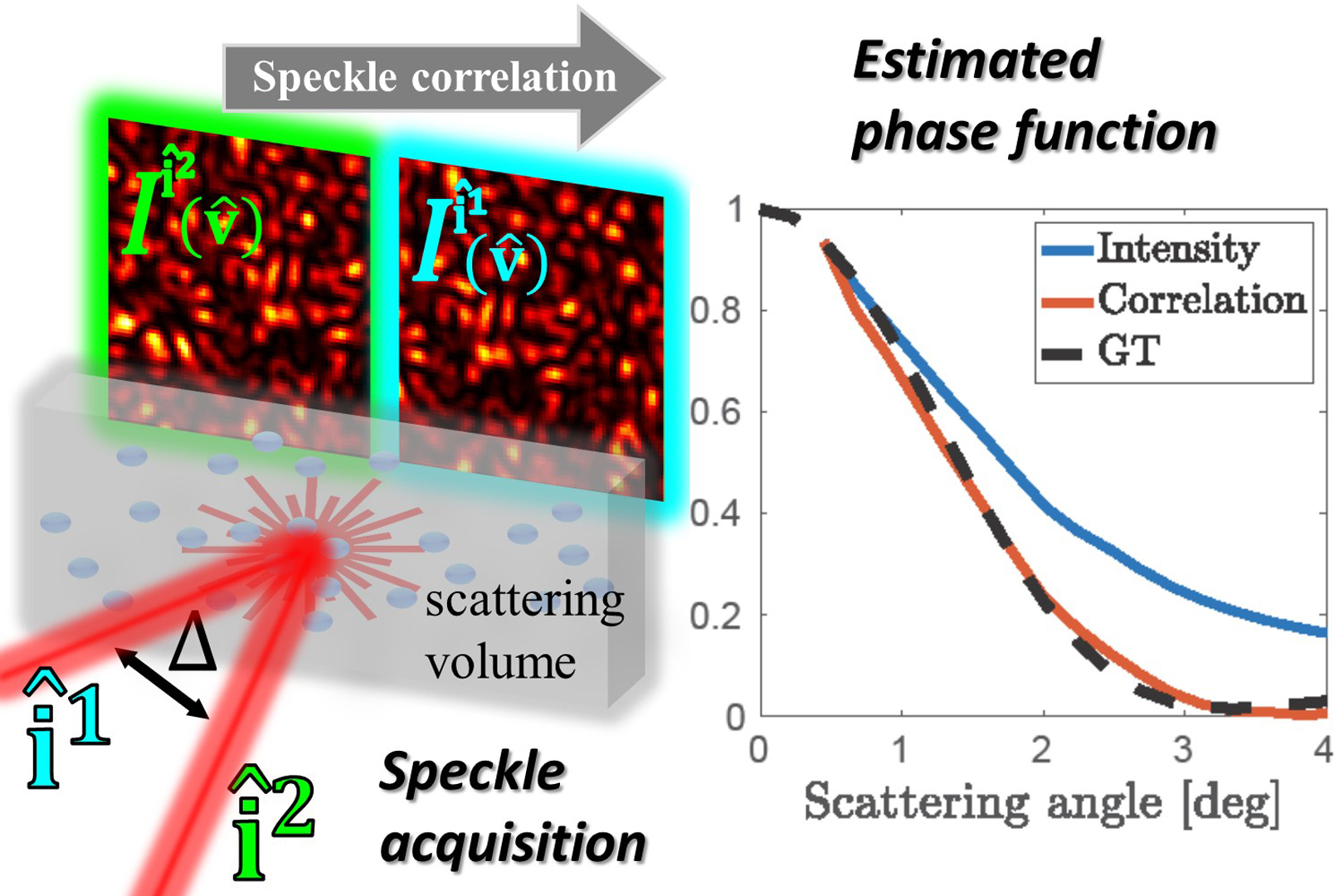
In material acquisition we want to infer the internal properties of materials from the way they scatter light. In particular, we are interested in measuring the phase function of the material, governing the amount of energy scattered towards different directions. This phase function has been shown to carry a lot of information about the type and size of particles dispersed in the medium, and is therefore essential for its characterization. Previous approaches to this task have relied on computationally costly inverse rendering optimization. Alternatively, if the material can be made optically thin enough so that most light paths scatter only once, this optimization can be avoided and the phase function can be directly read from the profile of light scattering at different angles. However, in many realistic applications, it is not easy to slice or dilute the material so that it is thin enough for such a single scattering model to hold. In this work we suggest a simple closed-form approach for acquiring material parameters from thick samples, avoiding costly optimization. Our approach is based on imaging the material of interest under coherent laser light and capturing speckle patterns. We show that memory-effect correlations between speckle patterns produced under nearby illumination directions provide a gating mechanism, allowing us to measure the singly scattered component of the light, even when observing thick samples where most light is scattered multiple times. We have built an experimental prototype capable of measuring phase functions over a narrow angular cone. We test the accuracy of our approach using validation materials whose ground truth phase function is known; and we use it to capture a set of everyday materials.