“Digital reconstruction of halftoned color comics” by Kopf and Lischinski
Conference:
Type(s):
Title:
- Digital reconstruction of halftoned color comics
Session/Category Title:
- Comics, Texture and Scribbles
Presenter(s)/Author(s):
Abstract:
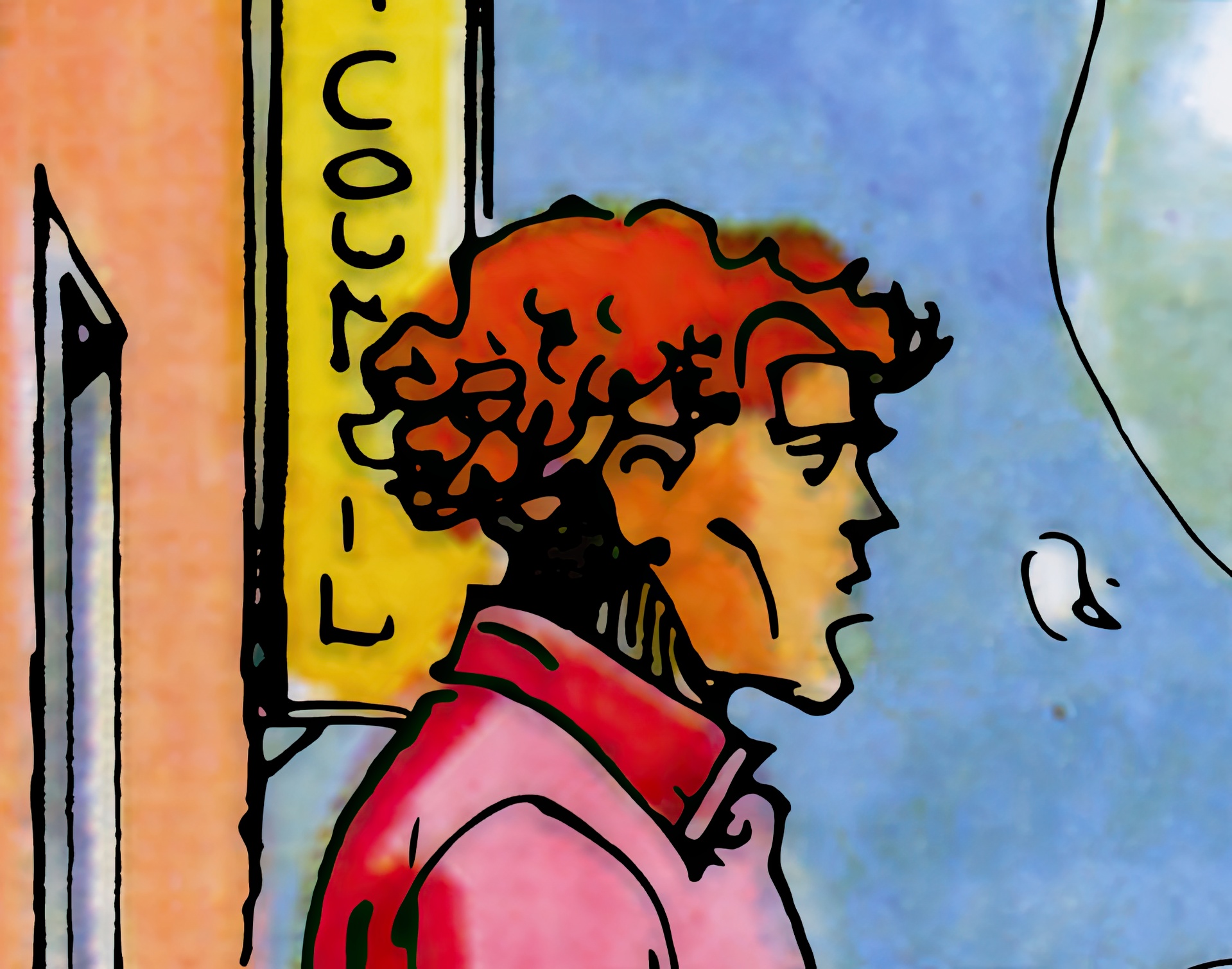
We introduce a method for automated conversion of scanned color comic books and graphical novels into a new high-fidelity rescalable digital representation. Since crisp black line artwork and lettering are the most important structural and stylistic elements in this important genre of color illustrations, our digitization process is geared towards faithful reconstruction of these elements. This is a challenging task, because commercial presses perform halftoning (screening) to approximate continuous tones and colors with overlapping grids of dots. Although a large number of inverse haftoning (descreening) methods exist, they typically blur the intricate black artwork. Our approach is specifically designed to descreen color comics, which typically reproduce color using screened CMY inks, but print the black artwork using non-screened solid black ink. After separating the scanned image into three screening grids, one for each of the CMY process inks, we use non-linear optimization to fit a parametric model describing each grid, and simultaneously recover the non-screened black ink layer, which is then vectorized. The result of this process is a high quality, compact, and rescalable digital representation of the original artwork.
References:
1. Abel, J., and Madden, M. 2008. Drawing Words, Writing Pictures: making comics from manga to graphic novels. First Second, New York, NY.
2. Bayer, B. E. 1973. An optimum method for two-level rendition of continuous-tone pictures. IEEE Intl. Conf. on Communications 1, 2611–2615.
3. Boykov, Y., Veksler, O., and Zabih, R. 2001. Fast approximate energy minimization via graph cuts. IEEE Trans. Pattern Anal. Mach. Intell. 23, 11 (Nov.), 1222–1239.
4. Chastain, S., 2012. How to remove Moire patterns from scanned photos in Photoshop and Elements. http://graphicssoft.about.com/cs/photoshop/ht/-apsremovemoire.htm, January.
5. Diamond Comic Distributors, 2012. Publisher market shares: April 2010. http://www.diamondcomics.com/Home/-1/1/3/237?articleID=94940, April.
6. Farbman, Z., Fattal, R., Lischinski, D., and Szeliski, R. 2008. Edge-preserving decompositions for multi-scale tone and detail manipulation. ACM Trans. Graph. 27, 3, Article 67.
7. Floyd, R. W., and Steinberg, L. 1976. An adaptive algorithm for spatial grey scale. Proc. Soc. Inf. Display 17, 75–77.
8. GIMP, 2011. GNU Image Manipulation Program. http://www.gimp.org.
9. Grais, S., 2012. Comics color. http://facweb.cs.depaul.edu/sgrais/comics_color.htm, April.
10. Hoppe, H. 1996. Progressive meshes. SIGGRAPH96, 99–108.
11. Jaimes, A., Mintzer, F. C., Rao, A. R., and Thompson, G. 1998. Segmentation and automatic descreening of scanned documents. Proc. SPIE 3648, 517–528.
12. Kipphan, H. 2001. Handbook of Print Media: Technologies and Production Methods. Springer-Verlag.
13. Kite, T. D., Venkata, N. D., Evans, B. L., and Bovik, A. C. 2000. A fast, high-quality inverse halftoning algorithm for error diffused halftones. IEEE Trans. Image Proc. 9, 1583–1592.
14. Kolmogorov, V., and Zabin, R. 2004. Fast approximate energy minimization via graph cuts. IEEE Trans. Pattern Anal. Mach. Intell. 26, 2 (Feb.), 147–159.
15. Liu, X. 1996. Analysis and Reduction of Moire Patterns in Scanned Halftone Pictures. PhD thesis, Virginia Polytechnic Institute and State University.
16. Mahy, M., and Delabastita, P. 1996. Inversion of the Neugebauer equations. Color Research & Application 21, 6, 404–411.
17. Neelamani, R. N., Nowak, R. D., and Baraniuk, R. G. 2000. Model-based inverse halftoning with wavelet-vaguelette deconvolution. Proc. IEEE ICIP, Vol III: 973–976.
18. Neugebauer, H. E. J. 1937. Die theoretischen grundlagen des mehrfarbenbuchdrucks. Zeitschrift für wissenschaftliche Photographie Photophysik und Photochemie 36, 4, 73–89.
19. Nocedal, J., and Wright, S. J. 2000. Numerical Optimization. Springer.
20. Park, M., Brocklehurst, K., Collins, R., and Liu, Y. 2009. Deformed lattice detection in real-world images using mean-shift belief propagation. IEEE Trans. PAMI 31, 10 (Oct.).
21. Sattva, 2011. Descreen 5.0 plug-in for Adobe Photoshop. http://www.descreen.net/eng/soft/descreen/descreen.htm.
22. Siddiqui, H., and Bouman, C. A. 2007. Training-based descreening. IEEE Trans. Image Proc. 16, 3, 789–802.
23. Siddiqui, H., Boutin, M., and Bouman, C. 2010. Hardware-friendly descreening. IEEE Trans. Image Proc. 19, 3, 746–757.
24. Smith, S. M., and Brady, J. M. 1997. SUSAN — a new approach to low level image processing. Int. J. Comput. Vision 23, 45–78.
25. Stanger, C. J., Tran, T., and Barney Smith, E. H. 2011. Descreening of color halftone images in the frequency domain. Proc. SPIE 7866, 78661H.
26. Stevenson, R. 1997. Inverse halftoning via MAP estimation. IEEE Trans. Image Proc. 6, 4, 574–583.
27. Stoffel, J., and Moreland, J. 1981. A survey of electronic techniques for pictorial image reproduction. IEEE Trans. Commun. 29, 12, 1898–1925.
28. Subr, K., Soler, C., and Durand, F. 2009. Edge-preserving multiscale image decomposition based on local extrema. ACM Trans. Graph. 28, 5, Article 147.
29. Weiner, R. G., Ed. 2010. Graphic Novels and Comics in Libraries and Archives. McFarland & Company, Inc., Publishers, Jefferson, North Carolina.
30. Wong, P. W. 1995. Inverse halftoning and kernel estimation for error diffusion. IEEE Trans. Image Proc. 4, 4, 486–498.