“Differentiable Simulation of Inertial Musculotendons” by Wang, Verheul, Yeo, Kalantari and Sueda
Conference:
Type(s):
Title:
- Differentiable Simulation of Inertial Musculotendons
Session/Category Title:
- Simulation of Everything
Presenter(s)/Author(s):
Abstract:
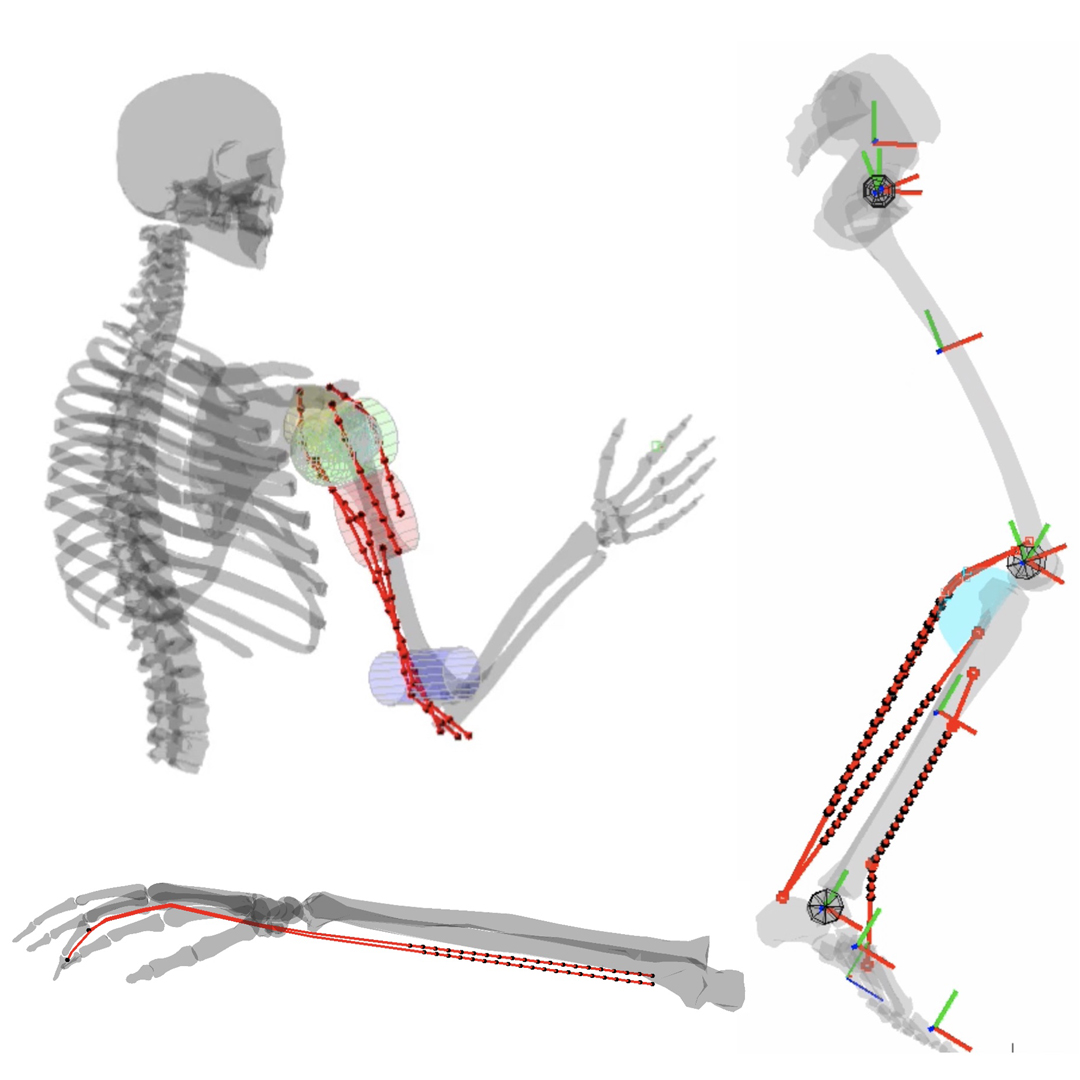
We propose a simple and practical approach for incorporating the effects of muscle inertia, which has been ignored by previous musculoskeletal simulators in both graphics and biomechanics. We approximate the inertia of the muscle by assuming that muscle mass is distributed along the centerline of the muscle. We express the motion of the musculotendons in terms of the motion of the skeletal joints using a chain of Jacobians, so that at the top level, only the reduced degrees of freedom of the skeleton are used to completely drive both bones and musculotendons. Our approach can handle all commonly used musculotendon path types, including those with multiple path points and wrapping surfaces. For muscle paths involving wrapping surfaces, we use neural networks to model the Jacobians, trained using existing wrapping surface libraries, which allows us to effectively handle the Jacobian discontinuities that occur when musculotendon paths collide with wrapping surfaces. We demonstrate support for higher-order time integrators, complex joints, inverse dynamics, Hill-type muscle models, and differentiability. In the limit, as the muscle mass is reduced to zero, our approach gracefully degrades to traditional simulators without support for muscle inertia. Finally, it is possible to mix and match inertial and non-inertial musculotendons, depending on the application.
References:
1. Autodesk. 2011. Maya Muscle. Autodesk.
2. Edward K Chadwick, Dimitra Blana, Robert F Kirsch, and Antonie J Van Den Bogert. 2014. Real-time simulation of three-dimensional shoulder girdle and arm dynamics. IEEE Transactions on Biomedical Engineering 61, 7 (2014), 1947–1956.
3. David T. Chen and David Zeltzer. 1992. Pump It up: Computer Animation of a Biomechanically Based Model of Muscle Using the Finite Element Method. SIGGRAPH Comput. Graph. 26, 2 (Jul. 1992), 89–98.
4. Michael Damsgaard, John Rasmussen, Søren Tørholm Christensen, Egidijus Surma, and Mark De Zee. 2006. Analysis of musculoskeletal systems in the AnyBody Modeling System. Simulation Modelling Practice and Theory 14, 8 (2006), 1100–1111.
5. Ye Fan, Joshua Litven, and Dinesh K. Pai. 2014. Active Volumetric Musculoskeletal Systems. ACM Trans. Graph. 33, 4, Article 152 (Jul. 2014), 9 pages.
6. Brian A Garner and Marcus G Pandy. 2000. The obstacle-set method for representing muscle paths in musculoskeletal models. Computer methods in biomechanics and biomedical engineering 3, 1 (2000), 1–30.
7. Thomas Geijtenbeek, Michiel van de Panne, and A. Frank van der Stappen. 2013. Flexible Muscle-Based Locomotion for Bipedal Creatures. ACM Trans. Graph. 32, 6, Article 206 (Nov. 2013), 11 pages.
8. Moritz Geilinger, David Hahn, Jonas Zehnder, Moritz Bächer, Bernhard Thomaszewski, and Stelian Coros. 2020. ADD: Analytically Differentiable Dynamics for Multi-Body Systems with Frictional Contact. ACM Trans. Graph. 39, 6, Article 190 (Nov. 2020).
9. Jianqiao Guo, Hongshi Huang, Yuanyuan Yu, Zixuan Liang, Jorge Ambrósio, Zhihua Zhao, Gexue Ren, and Yingfang Ao. 2020. Modeling muscle wrapping and mass flow using a mass-variable multibody formulation. Multibody System Dynamics (2020), 1–22.
10. Ernst Hairer, Christian Lubich, and Gerhard Wanner. 2006. Geometric numerical integration: structure-preserving algorithms for ordinary differential equations. Vol. 31. Springer Science & Business Media.
11. Minyeon Han, Jisoo Hong, and FC Park. 2015. Musculoskeletal dynamics simulation using shape-varying muscle mass models. Multibody System Dynamics 33, 4 (2015), 367–388.
12. Junggon Kim and Nancy S. Pollard. 2011. Fast Simulation of Skeleton-driven Deformable Body Characters. ACM Trans. Graph. 30, 5, Article 121 (Oct. 2011), 19 pages.
13. Jeong Ho Kim, Lovenoor Aulck, Michael C. Bartha, Christy A. Harper, and Peter W. Johnson. 2014. Differences in typing forces, muscle activity, comfort, and typing performance among virtual, notebook, and desktop keyboards. Applied Ergonomics 45, 6 (2014), 1406–1413.
14. Diederik P. Kingma and Jimmy Ba. 2015. Adam: A Method for Stochastic Optimization. In 3rd International Conference on Learning Representations, ICLR 2015, San Diego, CA, USA, May 7–9, 2015.
15. Taku Komura, Yoshihisa Shinagawa, and Tosiyasu L Kunii. 1997. A Muscle-based Feed-forward Controller of the Human Body. In Computer Graphics Forum, Vol. 16. Wiley Online Library, C165–C176.
16. Taku Komura, Yoshihisa Shinagawa, and Tosiyasu L Kunii. 2000. Creating and retargetting motion by the musculoskeletal human body model. The visual computer 16, 5 (2000), 254–270.
17. Taku Komura, Yoshihisa Shinagawa, and Tosiyasu L Kunii. 2001. An inverse kinematics method based on muscle dynamics. In Proceedings. Computer Graphics International 2001. IEEE, 15–22.
18. Jong Hwa Lee, Deanna S Asakawa, Jack T Dennerlein, and Devin L Jindrich. 2015. Finger muscle attachments for an OpenSim upper-extremity model. PloS one 10, 4 (2015), e0121712.
19. Seunghwan Lee, Moonseok Park, Kyoungmin Lee, and Jehee Lee. 2019. Scalable Muscle-Actuated Human Simulation and Control. ACM Trans. Graph. 38, 4, Article 73 (July 2019).
20. Seunghwan Lee, Ri Yu, Jungnam Park, Mridul Aanjaneya, Eftychios Sifakis, and Jehee Lee. 2018. Dexterous Manipulation and Control with Volumetric Muscles. ACM Trans. Graph. 37, 4, Article 57 (Jul. 2018), 13 pages.
21. Sung-Hee Lee, Eftychios Sifakis, and Demetri Terzopoulos. 2009. Comprehensive Biomechanical Modeling and Simulation of the Upper Body. ACM Trans. Graph. 28, 4, Article 99 (Sep. 2009), 17 pages.
22. Sung-Hee Lee and Demetri Terzopoulos. 2006. Heads up! Biomechanical Modeling and Neuromuscular Control of the Neck. ACM Trans. Graph. 25, 3 (Jul. 2006), 1188–1198.
23. Sung-Hee Lee and Demetri Terzopoulos. 2008. Spline Joints for Multibody Dynamics. ACM Trans. Graph. 27, 3, Article 22 (Aug. 2008), 8 pages.
24. Yoonsang Lee, Moon Seok Park, Taesoo Kwon, and Jehee Lee. 2014. Locomotion Control for Many-Muscle Humanoids. ACM Trans. Graph. 33, 6, Article 218 (Nov. 2014), 11 pages.
25. Robson Lemos, Marcelo Epstein, Walter Herzog, and Brian Wyvill. 2001. Realistic skeletal muscle deformation using finite element analysis. In Proceedings XIV Brazilian Symposium on Computer Graphics and Image Processing. IEEE, 192–199.
26. John E Lloyd, François Roewer-Després, and Ian Stavness. 2020. Muscle Path Wrapping on Arbitrary Surfaces. IEEE Trans. Biomedical Engineering 68, 2 (2020), 628–638.
27. Elaine Marieb and Katja Hoehn. 2010. Human Anatomy & Physiology (8 ed.). Benjamin Cummings.
28. Antoine McNamara, Adrien Treuille, Zoran Popović, and Jos Stam. 2004. Fluid Control Using the Adjoint Method. ACM Trans. Graph. 23, 3 (Aug. 2004), 449–456.
29. Matthew Millard, Thomas Uchida, Ajay Seth, and Scott L Delp. 2013. Flexing computational muscle: modeling and simulation of musculotendon dynamics. Journal of biomechanical engineering 135, 2 (2013), 021005.
30. Sehee Min, Jungdam Won, Seunghwan Lee, Jungnam Park, and Jehee Lee. 2019. SoftCon: Simulation and Control of Soft-Bodied Animals with Biomimetic Actuators. ACM Trans. Graph. 38, 6, Article 208 (Nov. 2019), 12 pages.
31. Akihiko Murai, Kosuke Kurosaki, Katsu Yamane, and Yoshihiko Nakamura. 2010. Musculoskeletal-see-through mirror: Computational modeling and algorithm for whole-body muscle activity visualization in real time. Progress in biophysics and molecular biology 103, 2–3 (2010), 310–317.
32. Richard M Murray, Zexiang Li, and S Shankar Sastry. 2017. A mathematical introduction to robotic manipulation. CRC press.
33. Victor Ng-Thow-Hing. 2001. Anatomically-based models for physical & geometric reconstruction of humans & other animals. Ph. D. Dissertation. University of Toronto.
34. Dinesh K Pai. 2010. Muscle mass in musculoskeletal models. Journal of Biomechanics 43, 11 (2010), 2093–2098.
35. Hoseok Ryu, Minseok Kim, Seungwhan Lee, Moon Seok Park, Kyoungmin Lee, and Jehee Lee. 2021. Functionality-Driven Musculature Retargeting. In Computer Graphics Forum, Vol. 40. Wiley Online Library, 341–356.
36. Prashant Sachdeva, Shinjiro Sueda, Susanne Bradley, Mikhail Fain, and Dinesh K. Pai. 2015. Biomechanical Simulation and Control of Hands and Tendinous Systems. ACM Trans. Graph. 34, 4, Article 42 (Jul. 2015), 10 pages.
37. Ferdi Scheepers, Richard E. Parent, Wayne E. Carlson, and Stephen F. May. 1997. Anatomy-based modeling of the human musculature. In Proc. SIGGRAPH 97 (Annual Conference Series). ACM, 163–172.
38. Andreas Scholz, Michael Sherman, Ian Stavness, Scott Delp, and Andrés Kecskeméthy. 2016. A fast multi-obstacle muscle wrapping method using natural geodesic variations. Multibody System Dynamics 36, 2 (2016), 195–219.
39. Ajay Seth, Jennifer L Hicks, Thomas K Uchida, Ayman Habib, Christopher L Dembia, James J Dunne, Carmichael F Ong, Matthew S DeMers, Apoorva Rajagopal, Matthew Millard, et al. 2018. OpenSim: Simulating musculoskeletal dynamics and neuromuscular control to study human and animal movement. PLoS computational biology 14, 7 (2018), e1006223.
40. Ajay Seth, Michael Sherman, Peter Eastman, and Scott Delp. 2010. Minimal formulation of joint motion for biomechanisms. Nonlinear dynamics 62, 1 (2010), 291–303.
41. Ahmed A Shabana. 2013. Dynamics of Multibody Systems. Cambridge University press.
42. Weiguang Si, Sung-Hee Lee, Eftychios Sifakis, and Demetri Terzopoulos. 2015. Realistic Biomechanical Simulation and Control of Human Swimming. ACM Trans. Graph. 34, 1, Article 10 (Dec. 2015), 15 pages.
43. Eftychios Sifakis, Igor Neverov, and Ronald Fedkiw. 2005. Automatic Determination of Facial Muscle Activations from Sparse Motion Capture Marker Data. ACM Trans. Graph. 24, 3 (Jul. 2005), 417–425.
44. Shinjiro Sueda, Garrett L. Jones, David I. W. Levin, and Dinesh K. Pai. 2011. Large-Scale Dynamic Simulation of Highly Constrained Strands. ACM Trans. Graph. 30, 4, Article 39 (Jul. 2011), 10 pages.
45. Shinjiro Sueda, Andrew Kaufman, and Dinesh K. Pai. 2008. Musculotendon Simulation for Hand Animation. ACM Trans. Graph. 27, 3 (Aug. 2008), 1–8.
46. Joseph Teran, Silvia Blemker, Victor Ng-Thow-Hing, and Ronald Fedkiw. 2003. Finite Volume Methods for the Simulation of Skeletal Muscle. In Proc. ACM SIGGRAPH / Eurographics Symp. Comput. Anim. (San Diego, California). 68–74.
47. Joseph Teran, Eftychios Sifakis, Silvia S. Blemker, Victor Ng-Thow-Hing, Cynthia Lau, and Ronald Fedkiw. 2005. Creating and Simulating Skeletal Muscle from the Visible Human Data Set. IEEE TVCG 11, 3 (May 2005), 317–328.
48. Demetri Terzopoulos and Keith Waters. 1990. Physically-based facial modelling, analysis, and animation. Journal of Vis. & Comp. Anim. 1, 2 (1990), 73–80.
49. Jack M. Wang, Samuel R. Hamner, Scott L. Delp, and Vladlen Koltun. 2012. Optimizing Locomotion Controllers Using Biologically-Based Actuators and Objectives. ACM Trans. Graph. 31, 4, Article 25 (Jul. 2012), 11 pages.
50. Ying Wang, Nicholas J. Weidner, Margaret A. Baxter, Yura Hwang, Danny M. Kaufman, and Shinjiro Sueda. 2019. RedMax: Efficient & Flexible Approach for Articulated Dynamics. ACM Trans. Graph. 38, 4, Article 104 (Jul. 2019), 10 pages.
51. Samuel R Ward, Carolyn M Eng, Laura H Smallwood, and Richard L Lieber. 2009. Are current measurements of lower extremity muscle architecture accurate? Clinical orthopaedics and related research 467, 4 (2009), 1074–1082.
52. Keith Waters. 1987. A muscle model for animation three-dimensional facial expression. ACM SIGGRAPH Computer Graphics 21, 4 (1987), 17–24.
53. Keith Waters and Demetri Terzopoulos. 1990. A physical model of facial tissue and muscle articulation. In Proc. Conf. on Vis. in Biomedical Computing. IEEE, 77–78.
54. Jane Wilhelms and Allen Van Gelder. 1997. Anatomically based modeling. In Proc. SIGGRAPH 97 (Annual Conference Series). ACM, 173–180.
55. Jie Xu, Tao Chen, Lara Zlokapa, Wojciech Matusik, Shinjiro Sueda, and Pulkit Agrawal. 2021. An End-to-End Differentiable Framework for Contact-Aware Robot Design. In Robotics: Science and Systems.
56. Felix E Zajac. 1989. Muscle and tendon: properties, models, scaling, and application to biomechanics and motor control. Critical reviews in biomedical engineering 17, 4 (1989), 359–411.
57. Qing-hong Zhu, Yan Chen, and Arie Kaufman. 1998. Real-time biomechanically-based muscle volume deformation using FEM. In Computer Graphics Forum, Vol. 17. Wiley Online Library, 275–284.
58. Ziva Dynamics. 2018. Ziva VFX. https://zivadynamics.com/ziva-vfx.