
“Differentiable Rendering Using RGBXY Derivatives and Optimal Transport” by Xing, Luan, Yan, Hu, Qian, et al. …
Conference:
Type(s):
Title:
- Differentiable Rendering Using RGBXY Derivatives and Optimal Transport
Session/Category Title:
- Differentiable Rendering
Presenter(s)/Author(s):
Abstract:
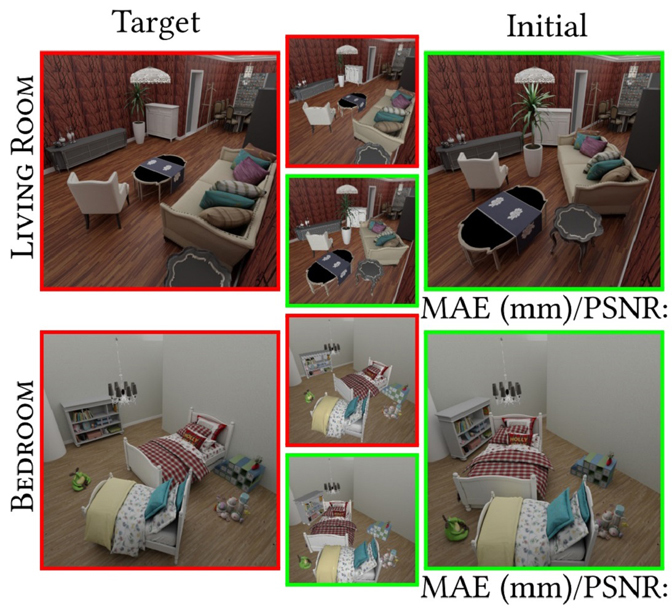
Traditional differentiable rendering approaches are usually hard to converge in inverse rendering optimizations, especially when initial and target object locations are not so close. Inspired by Lagrangian fluid simulation, we present a novel differentiable rendering method to address this problem. We associate each screen-space pixel with the visible 3D geometric point covered by the center of the pixel and compute derivatives on geometric points rather than on pixels. We refer to the associated geometric points as point proxies of pixels. For each point proxy, we compute its 5D RGBXY derivatives which measures how its 3D RGB color and 2D projected screen-space position change with respect to scene parameters. Furthermore, in order to capture global and long-range object motions, we utilize optimal transport based pixel matching to design a more sophisticated loss function. We have conducted experiments to evaluate the effectiveness of our proposed method on various inverse rendering applications and have demonstrated superior convergence behavior compared to state-of-the-art baselines.
References:
1. Sai Praveen Bangaru, Tzu-Mao Li, and Frédo Durand. 2020. Unbiased warped-area sampling for differentiable rendering. ACM Transactions on Graphics (TOG) 39, 6 (2020), 1–18.
2. Nicolas Bonneel and David Coeurjolly. 2019. SPOT: Sliced Partial Optimal Transport. ACM Transactions on Graphics (SIGGRAPH) 38, 4 (2019).
3. Nicolas Bonneel, Gabriel Peyré, and Marco Cuturi. 2016. Wasserstein barycentric coordinates: histogram regression using optimal transport. ACM Trans. Graph. 35, 4 (2016), 71–1.
4. Nicolas Bonneel, Michiel Van De Panne, Sylvain Paris, and Wolfgang Heidrich. 2011. Displacement interpolation using Lagrangian mass transport. In Proceedings of the 2011 SIGGRAPH Asia conference. 1–12.
5. Robert Bridson. 2008. Fluid Simulation for Computer Graphics. A K Peters/CRC Press.
6. Guangyan Cai, Kai Yan, Zhao Dong, Ioannis Gkioulekas, and Shuang Zhao. 2022. Physics-Based Inverse Rendering using Combined Implicit and Explicit Geometries. arXiv preprint arXiv:2205.01242 (2022).
7. Chengqian Che, Fujun Luan, Shuang Zhao, Kavita Bala, and Ioannis Gkioulekas. 2020. Towards learning-based inverse subsurface scattering. In 2020 IEEE International Conference on Computational Photography (ICCP). IEEE, 1–12.
8. David F. Crouse. 2016. On implementing 2D rectangular assignment algorithms. IEEE Trans. Aerospace Electron. Systems 52, 4 (2016), 1679–1696.
9. Marco Cuturi. 2013. Sinkhorn distances: Lightspeed computation of optimal transport. Advances in neural information processing systems 26 (2013).
10. Xi Deng, Fujun Luan, Bruce Walter, Kavita Bala, and Steve Marschner. 2022. Reconstructing Translucent Objects using Differentiable Rendering. In Special Interest Group on Computer Graphics and Interactive Techniques Conference Proceedings. 1–10.
11. Mathieu Desbrun and Marie-Paule Gascuel. 1996. Smoothed Particles: A New Paradigm for Animating Highly Deformable Bodies. In Proceedings of the Eurographics Workshop on Computer Animation and Simulation ’96 (Poitiers, France). Springer-Verlag, Berlin, Heidelberg, 61–76.
12. Ronald Fedkiw, Jos Stam, and Henrik Wann Jensen. 2001. Visual Simulation of Smoke. In Proceedings of the 28th Annual Conference on Computer Graphics and Interactive Techniques (SIGGRAPH ’01). Association for Computing Machinery, New York, NY, USA, 15–22.
13. Jean Feydy, Thibault Séjourné, François-Xavier Vialard, Shun-ichi Amari, Alain Trouve, and Gabriel Peyré. 2019. Interpolating between Optimal Transport and MMD using Sinkhorn Divergences. In The 22nd International Conference on Artificial Intelligence and Statistics. 2681–2690.
14. Huan Fu, Bowen Cai, Lin Gao, Ling-Xiao Zhang, Jiaming Wang, Cao Li, Qixun Zeng, Chengyue Sun, Rongfei Jia, Binqiang Zhao, et al. 2021. 3D-Front: 3D Furnished Rooms with Layouts and Semantics. In Proceedings of the IEEE/CVF International Conference on Computer Vision. 10933–10942.
15. Duan Gao, Xiao Li, Yue Dong, Pieter Peers, Kun Xu, and Xin Tong. 2019. Deep inverse rendering for high-resolution SVBRDF estimation from an arbitrary number of images. ACM Trans. Graph. 38, 4 (2019), 134–1.
16. Yu Guo, Cameron Smith, Miloš Hašan, Kalyan Sunkavalli, and Shuang Zhao. 2020. MaterialGAN: reflectance capture using a generative SVBRDF model. arXiv preprint arXiv:2010.00114 (2020).
17. Jon Hasselgren, Jacob Munkberg, Jaakko Lehtinen, Miika Aittala, and Samuli Laine. 2021. Appearance-Driven Automatic 3D Model Simplification. In Eurographics Symposium on Rendering.
18. Shi-Min Hu, Dun Liang, Guo-Ye Yang, Guo-Wei Yang, and Wen-Yang Zhou. 2020. Jittor: a novel deep learning framework with meta-operators and unified graph execution. Science China Information Sciences 63, 222103 (2020), 1–222103. https://github.com/Jittor/jrender
19. E. Ilg, N. Mayer, T. Saikia, M. Keuper, A. Dosovitskiy, and T. Brox. 2017. FlowNet 2.0: Evolution of Optical Flow Estimation with Deep Networks. In IEEE Conference on Computer Vision and Pattern Recognition (CVPR). http://lmb.informatik.unifreiburg.de//Publications/2017/IMKDB17
20. Leonid V Kantorovich. 1942. On the translocation of masses. In Dokl. Akad. Nauk. USSR (NS), Vol. 37. 199–201.
21. Hiroharu Kato, Deniz Beker, Mihai Morariu, Takahiro Ando, Toru Matsuoka, Wadim Kehl, and Adrien Gaidon. 2020a. Differentiable rendering: A survey. arXiv preprint arXiv:2006.12057 (2020).
22. Hiroharu Kato, Deniz Beker, Mihai Morariu, Takahiro Ando, Toru Matsuoka, Wadim Kehl, and Adrien Gaidon. 2020b. Differentiable Rendering: A Survey.
23. Hiroharu Kato, Yoshitaka Ushiku, and Tatsuya Harada. 2018. Neural 3d mesh renderer. In Proceedings of the IEEE conference on computer vision and pattern recognition. 3907–3916.
24. Diederik P Kingma and Jimmy Ba. 2014. Adam: A method for stochastic optimization. arXiv preprint arXiv:1412.6980 (2014).
25. H. W. Kuhn and Bryn Yaw. 1955. The Hungarian method for the assignment problem. Naval Res. Logist. Quart (1955), 83–97.
26. Samuli Laine, Janne Hellsten, Tero Karras, Yeongho Seol, Jaakko Lehtinen, and Timo Aila. 2020. Modular primitives for high-performance differentiable rendering. ACM Transactions on Graphics (TOG) 39, 6 (2020), 1–14.
27. J. P. Lewis, Ken Anjyo, Taehyun Rhee, Mengjie Zhang, Fred Pighin, and Zhigang Deng. 2014. Practice and Theory of Blendshape Facial Models. In Eurographics 2014 – State of the Art Reports, Sylvain Lefebvre and Michela Spagnuolo (Eds.). The Eurographics Association.
28. Tzu-Mao Li, Miika Aittala, Frédo Durand, and Jaakko Lehtinen. 2018. Differentiable monte carlo ray tracing through edge sampling. ACM Transactions on Graphics (TOG) 37, 6 (2018), 1–11.
29. Shichen Liu, Tianye Li, Weikai Chen, and Hao Li. 2019. Soft rasterizer: A differentiable renderer for image-based 3d reasoning. In Proceedings of the IEEE/CVF International Conference on Computer Vision. 7708–7717.
30. Matthew Loper, Naureen Mahmood, Javier Romero, Gerard Pons-Moll, and Michael J. Black. 2015. SMPL: A Skinned Multi-Person Linear Model. ACM Trans. Graphics (Proc. SIGGRAPH Asia) 34, 6 (Oct. 2015), 248:1–248:16.
31. Matthew M Loper and Michael J Black. 2014. OpenDR: An approximate differentiable renderer. In European Conference on Computer Vision. Springer, 154–169.
32. Guillaume Loubet, Nicolas Holzschuch, and Wenzel Jakob. 2019. Reparameterizing discontinuous integrands for differentiable rendering. ACM Transactions on Graphics (TOG) 38, 6 (2019), 1–14.
33. Fujun Luan, Shuang Zhao, Kavita Bala, and Zhao Dong. 2021. Unified shape and svbrdf recovery using differentiable monte carlo rendering. In Computer Graphics Forum, Vol. 40. Wiley Online Library, 101–113.
34. Ben Mildenhall, Pratul P Srinivasan, Matthew Tancik, Jonathan T Barron, Ravi Ramamoorthi, and Ren Ng. 2020. Nerf: Representing scenes as neural radiance fields for view synthesis. In European conference on computer vision. Springer, 405–421.
35. Gaspard Monge. 1781. Mémoire sur la théorie des déblais et des remblais. Histoire de l’Académie Royale des Sciences de Paris (1781).
36. Matthias Müller, David Charypar, and Markus Gross. 2003. Particle-Based Fluid Simulation for Interactive Applications. In Proceedings of the 2003 ACM SIGGRAPH/Eurographics Symposium on Computer Animation (San Diego, California) (SCA ’03). Eurographics Association, Goslar, DEU, 154–159.
37. Jacob Munkberg, Jon Hasselgren, Tianchang Shen, Jun Gao, Wenzheng Chen, Alex Evans, Thomas Müller, and Sanja Fidler. 2021. Extracting Triangular 3D Models, Materials, and Lighting From Images. arXiv preprint arXiv:2111.12503 (2021).
38. Baptiste Nicolet, Alec Jacobson, and Wenzel Jakob. 2021. Large steps in inverse rendering of geometry. ACM Transactions on Graphics (TOG) 40, 6 (2021), 1–13.
39. Lois Paulin, Nicolas Bonneel, David Coeurjolly, Jean-Claude Iehl, Antoine Webanck, Mathieu Desbrun, and Victor Ostromoukhov. 2020. Sliced optimal transport sampling. ACM Trans. Graph. 39, 4 (2020), 99.
40. Gabriel Peyré, Marco Cuturi, et al. 2019. Computational optimal transport: With applications to data science. Foundations and Trends® in Machine Learning 11, 5–6 (2019), 355–607.
41. Simon Premžoe, Tolga Tasdizen, James Bigler, Aaron Lefohn, and Ross T. Whitaker. 2003. Particle-Based Simulation of Fluids. Computer Graphics Forum 22, 3 (2003), 401–410.
42. Nikhila Ravi, Jeremy Reizenstein, David Novotny, Taylor Gordon, Wan-Yen Lo, Justin Johnson, and Georgia Gkioxari. 2020. Accelerating 3d deep learning with pytorch3d. arXiv preprint arXiv:2007.08501 (2020).
43. Liang Shi, Beichen Li, Miloš Hašan, Kalyan Sunkavalli, Tamy Boubekeur, Radomir Mech, and Wojciech Matusik. 2020. MATch: Differentiable material graphs for procedural material capture. (2020).
44. Justin Solomon, Fernando De Goes, Gabriel Peyré, Marco Cuturi, Adrian Butscher, Andy Nguyen, Tao Du, and Leonidas Guibas. 2015. Convolutional wasserstein distances: Efficient optimal transportation on geometric domains. ACM Transactions on Graphics (ToG) 34, 4 (2015), 1–11.
45. Jos Stam. 1999. Stable Fluids. In Proceedings of the 26th Annual Conference on Computer Graphics and Interactive Techniques (SIGGRAPH ’99). ACM Press/Addison-Wesley Publishing Co., USA, 121–128.
46. Prune Truong, Martin Danelljan, Fisher Yu, and Luc Van Gool. 2022. Probabilistic Warp Consistency for Weakly-Supervised Semantic Correspondences. In IEEE/CVF Conference on Computer Vision and Pattern Recognition, CVPR. https://arxiv.org/abs/2203.04279
47. Delio Vicini, Sébastien Speierer, and Wenzel Jakob. 2022. Differentiable signed distance function rendering. ACM Transactions on Graphics (TOG) 41, 4 (2022), 1–18.
48. Zhou Wang, Eero P Simoncelli, and Alan C Bovik. 2003. Multiscale structural similarity for image quality assessment. In The Thrity-Seventh Asilomar Conference on Signals, Systems & Computers, 2003, Vol. 2. Ieee, 1398–1402.
49. Cheng Zhang, Bailey Miller, Kan Yan, Ioannis Gkioulekas, and Shuang Zhao. 2020. Path-space differentiable rendering. ACM transactions on graphics 39, 4 (2020).
50. Cheng Zhang, Zihan Yu, and Shuang Zhao. 2021. Path-space differentiable rendering of participating media. ACM Transactions on Graphics (TOG) 40, 4 (2021), 1–15.
51. Richard Zhang, Phillip Isola, Alexei A Efros, Eli Shechtman, and Oliver Wang. 2018. The unreasonable effectiveness of deep features as a perceptual metric. In Proceedings of the IEEE conference on computer vision and pattern recognition. 586–595.
52. Shuang Zhao, Ioannis Gkioulekas, and Sai Bangaru. 2021. CVPR 2021 Tutorial on Physics-Based Differentiable Rendering. https://www.diff-render.org/.



