
“Design and structural optimization of topological interlocking assemblies” by Wang, Song, Isvoranu and Pauly
Conference:
Type(s):
Title:
- Design and structural optimization of topological interlocking assemblies
Session/Category Title:
- Building Knowledge
Presenter(s)/Author(s):
Moderator(s):
Abstract:
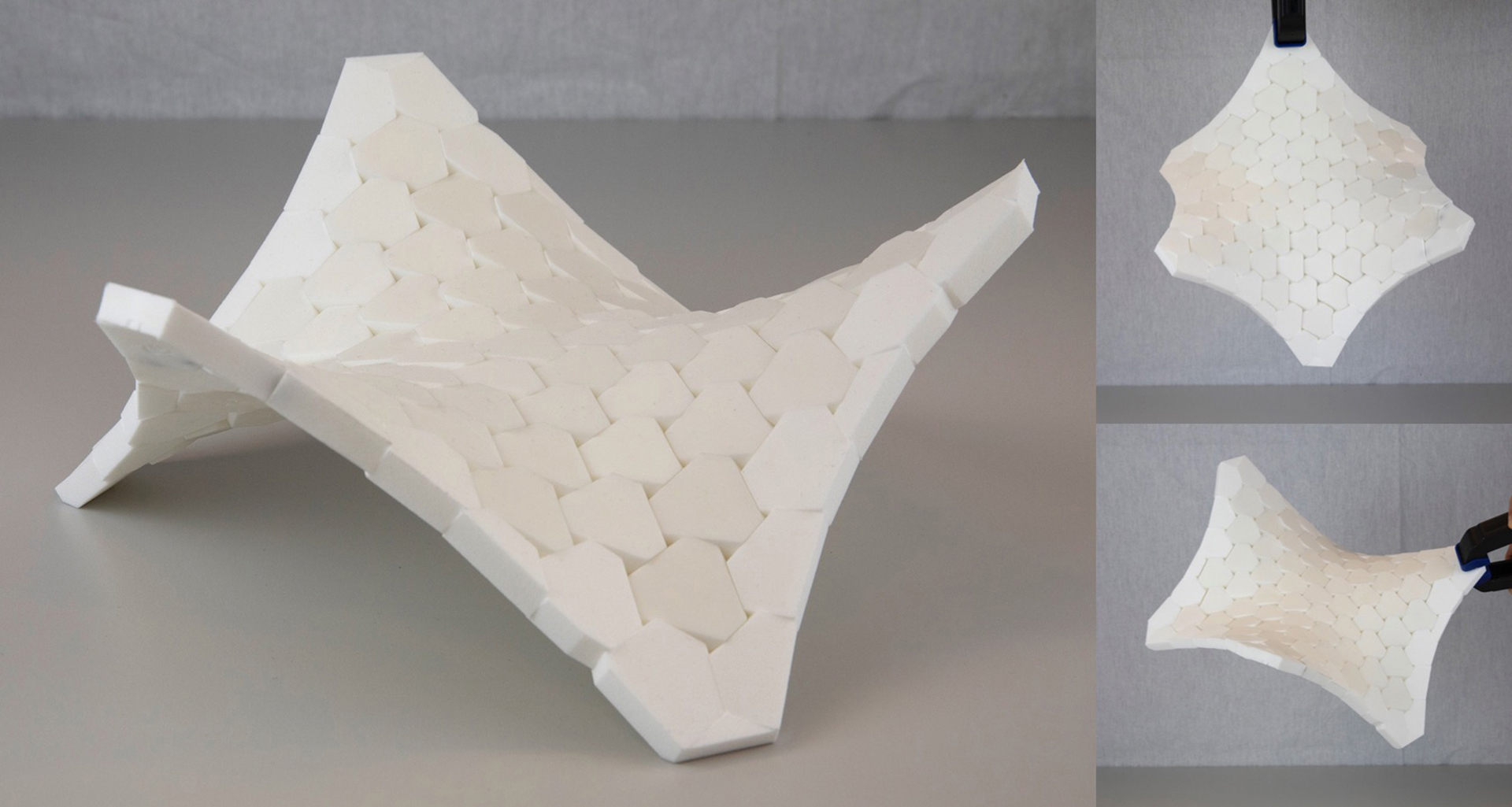
We study assemblies of convex rigid blocks regularly arranged to approximate a given freeform surface. Our designs rely solely on the geometric arrangement of blocks to form a stable assembly, neither requiring explicit connectors or complex joints, nor relying on friction between blocks. The convexity of the blocks simplifies fabrication, as they can be easily cut from different materials such as stone, wood, or foam. However, designing stable assemblies is challenging, since adjacent pairs of blocks are restricted in their relative motion only in the direction orthogonal to a single common planar interface surface. We show that despite this weak interaction, structurally stable, and in some cases, globally interlocking assemblies can be found for a variety of freeform designs. Our optimization algorithm is based on a theoretical link between static equilibrium conditions and a geometric, global interlocking property of the assembly—that an assembly is globally interlocking if and only if the equilibrium conditions are satisfied for arbitrary external forces and torques. Inspired by this connection, we define a measure of stability that spans from single-load equilibrium to global interlocking, motivated by tilt analysis experiments used in structural engineering. We use this measure to optimize the geometry of blocks to achieve a static equilibrium for a maximal cone of directions, as opposed to considering only self-load scenarios with a single gravity direction. In the limit, this optimization can achieve globally interlocking structures. We show how different geometric patterns give rise to a variety of design options and validate our results with physical prototypes.
References:
1. A. D. Alexandrov. 2005. Convex Polyhedra. Springer.Google Scholar
2. MOSEK ApS. 2019. MOSEK software package. (2019). https://www.mosek.com/.Google Scholar
3. Artelys. 2019. Knitro software package. (2019). https://www.artelys.com/solvers/knitro/.Google Scholar
4. Andres Bejarano and Christoph Hoffmann. 2019. A Generalized Framework for Designing Topological Interlocking Configurations. International Journal of Architectural Computing (2019). online article.Google ScholarCross Ref
5. Sofien Bouaziz, Mario Deuss, Yuliy Schwartzburg, Thibaut Weise, and Mark Pauly. 2012. Shape-Up: Shaping Discrete Geometry with Projections. Comp. Graph. Forum (SGP) 31, 5 (2012), 1657–1667.Google ScholarDigital Library
6. M. Brocato and L. Mondardini. 2012. A New Type of Stone Dome Based on Abeille’s Bond. International Journal of Solids and Structures 49, 13 (2012).Google ScholarCross Ref
7. Joseph K. Davidson and Kenneth H. Hunt. 2004. Robots and Screw Theory: Applications of Kinematics and Statics to Robotics. Oxford University Press.Google Scholar
8. Fernando de Goes, Pierre Alliez, Houman Owhadi, and Mathieu Desbrun. 2013. On the Equilibrium of Simplicial Masonry Structures. ACM Trans. on Graph. (SIGGRAPH) 32, 4 (2013). Article No. 93.Google ScholarDigital Library
9. Mario Deuss, Anders Holden Deleuran, Sofien Bouaziz, Bailin Deng, Daniel Piker, and Mark Pauly. 2015. ShapeOp – A Robust and Extensible Geometric Modelling Paradigm. In Design Modelling Symposium. 505–515. https://www.shapeop.org/.Google Scholar
10. Arcady Dyskin, Elena Pasternak, and Yuri Estrin. 2013. Topological Interlocking as a Design Principle for Hybrid Materials. In Proceedings of the 8th Pacific Rim International Congress on Advanced Materials and Processing. 1525–1534.Google ScholarCross Ref
11. A. V. Dyskin, Y. Estrin, A. J. Kanel-Belov, and E. Pasternak. 2003a. Topological Interlocking of Platonic Solids: A Way to New Materials and Structures. Philosophical Magazine Letters 83, 3 (2003), 197–203.Google ScholarCross Ref
12. A. V. Dyskin, Yuri Estrin, and E. Pasternak. 2019. Topological Interlocking Materials. In Architectured Materials in Nature and Engineering, Yuri Estrin, Yves Bréchet, John Dunlop, and Peter Fratzl (Eds.). Springer International Publishing, Chapter 2, 23–49.Google Scholar
13. A. V. Dyskin, Y. Estrin, E. Pasternak, H. C. Khor, and A. J. Kanel-Belov. 2003b. Fracture Resistant Structures Based on Topological Interlocking with Non-planar Contacts. Advanced Engineering Materials 5, 3 (2003), 116–119.Google ScholarCross Ref
14. Giuseppe Fallacara, Maurizio Barberio, and Micaela Colella. 2019. Topological Interlocking Blocks for Architecture: From Flat to Curved Morphologies. In Architectured Materials in Nature and Engineering, Yuri Estrin, Yves Bréchet, John Dunlop, and Peter Fratzl (Eds.). Springer International Publishing, Chapter 14, 423–445.Google Scholar
15. Julius Farkas. 1902. Theorie der Einfachen Ungleichungen. Journal für die Reine und Angewandte Mathematik 124 (1902), 1 — 27.Google Scholar
16. Chi-Wing Fu, Peng Song, Xiaoqi Yan, Lee Wei Yang, Pradeep Kumar Jayaraman, and Daniel Cohen-Or. 2015. Computational Interlocking Furniture Assembly. ACM Trans. on Graph. (SIGGRAPH) 34, 4 (2015). Article No. 91.Google ScholarDigital Library
17. Michael Glickman. 1984. The G-block System of Vertically Interlocking Paving. In Proceedings of the 2nd International Conference on Concrete Block Paving. 345–348.Google Scholar
18. Jacques Heyman. 1966. The Stone Skeleton. International Journal of Solids and Structures 2, 2 (1966), 249 — 279.Google ScholarCross Ref
19. Anooshe Rezaee Javan, Hamed Seifi, Shanqing Xu, and Yi Min Xie. 2016. Design of A New Type of Interlocking Brick and Evaluation of Its Dynamic Performance. In Proceedings of the International Association for Shell and Spatial Structures Annual Symposium. 1–8.Google Scholar
20. Danny M. Kaufman, Shinjiro Sueda, Doug L. James, and Dinesh K. Pai. 2008. Staggered Projections for Frictional Contact in Multibody Systems. ACM Trans. on Graph. (SIGGRAPH Asia) 27, 5 (2008). Article No. 164.Google Scholar
21. Yang Liu, Hao Pan, John Snyder, Wenping Wang, and Baining Guo. 2013. Computing Self-Supporting Surfaces by Regular Triangulation. ACM Trans. on Graph. (SIGGRAPH) 32, 4 (2013). Article No. 92.Google ScholarDigital Library
22. Masaaki Miki, Takeo Igarashi, and Philippe Block. 2015. Parametric Self-supporting Surfaces via Direct Computation of Airy Stress Functions. ACM Trans. on Graph. (SIGGRAPH) 34, 4 (2015). Article No. 89.Google ScholarDigital Library
23. Mohammad Mirkhalaf, Tao Zhou, and Francois Barthelat. 2018. Simultaneous Improvements of Strength and Toughness in Topologically Interlocked Ceramics. Proceedings of the National Academy of Sciences of the United States of America 115, 37 (2018), 9128–9133.Google ScholarCross Ref
24. John Allen Ochsendorf. 2002. Collapse of Masonry Structures. Ph.D. Dissertation. Massachusetts Institute of Technology, Cambridge, Massachusetts, USA.Google Scholar
25. Daniele Panozzo, Philippe Block, and Olga Sorkine-Hornung. 2013. Designing Unreinforced Masonry Models. ACM Trans. on Graph. (SIGGRAPH) 32, 4 (2013). Article No. 91.Google ScholarDigital Library
26. Nico Pietroni, Marco Tarini, Amir Vaxman, Daniele Panozzo, and Paolo Cignoni. 2017. Position-based Tensegrity Design. ACM Trans. on Graph. (SIGGRAPH Asia) 36, 6 (2017). Article No. 172.Google ScholarDigital Library
27. Matthias Rippmann, Tom Van Mele, Mariana Popescu, Edyta Augustynowicz, Tomás Méndez Echenagucia, Cristián Calvo Barentin, Ursula Frick, and Philippe Block. 2016. The Armadillo Vault: Computational design and digital fabrication of a freeform stone shell. In Advances in Architectural Geometry. 344–363.Google Scholar
28. Stephan Schaare, Werner Riehemann, and Yuri Estrin. 2009. Damping Properties of an Assembly of Topologically Interlocked Cubes. Materials Science and Engineering A 521–522 (2009), 380–383.Google Scholar
29. Hijung V. Shin, Christopher F. Porst, Etienne Vouga, John Ochsendorf, and Frédo Durand. 2016. Reconciling Elastic and Equilibrium Methods for Static Analysis. ACM Trans. on Graph. 35, 2 (2016). Article No. 13.Google ScholarDigital Library
30. Thomas Siegmund, Francois Barthelat, Raymond Cipra, Ed Habtour, and Jaret Riddick. 2016. Manufacture and Mechanics of Topologically Interlocked Material Assemblies. Applied Mechanics Reviews 68, 4 (2016), 040803:1–15.Google ScholarCross Ref
31. Peng Song, Bailin Deng, Ziqi Wang, Zhichao Dong, Wei Li, Chi-Wing Fu, and Ligang Liu. 2016. CofiFab: Coarse-to-Fine Fabrication of Large 3D Objects. ACM Trans. on Graph. (SIGGRAPH) 35, 4 (2016). Article No. 45.Google ScholarDigital Library
32. Peng Song, Chi-Wing Fu, and Daniel Cohen-Or. 2012. Recursive Interlocking Puzzles. ACM Trans. on Graph. (SIGGRAPH Asia) 31, 6 (2012). Article No. 128.Google ScholarDigital Library
33. Peng Song, Chi-Wing Fu, Yueming Jin, Hongfei Xu, Ligang Liu, Pheng-Ann Heng, and Daniel Cohen-Or. 2017. Reconfigurable Interlocking Furniture. ACM Trans. on Graph. (SIGGRAPH Asia) 36, 6 (2017). Article No. 174.Google Scholar
34. Peng Song, Zhongqi Fu, Ligang Liu, and Chi-Wing Fu. 2015. Printing 3D Objects with Interlocking Parts. Comp. Aided Geom. Des. 35–36 (2015), 137–148.Google Scholar
35. Chengcheng Tang, Xiang Sun, Alexandra Gomes, Johannes Wallner, and Helmut Pottmann. 2014. Form-finding with Polyhedral Meshes Made Simple. ACM Trans. on Graph. (SIGGRAPH) 33, 4 (2014). Article No. 70.Google ScholarDigital Library
36. Keke Tang, Peng Song, Xiaofei Wang, Bailin Deng, Chi-Wing Fu, and Ligang Liu. 2019. Computational Design of Steady 3D Dissection Puzzles. Comp. Graph. Forum (Eurographics) 38, 2 (2019), 291–303.Google ScholarCross Ref
37. Oliver Tessmann. 2012. Topological Interlocking Assemblies. In Physical Digitality: Proceedings of the 30th eCAADe Conference, Vol. 2. 211–219.Google Scholar
38. M. F. Thorpe and P. M. Duxbury. 2002. Rigidity Theory and Applications. Kluwer Academic Publishers.Google Scholar
39. Irina Miodragovic Vella and Toni Kotnik. 2016. Geometric Versatility of Abeille Vault: A Stereotomic Topological Interlocking Assembly. In Complexity & Simplicity: Proceedings of the 34th eCAADe Conference, Vol. 2. 391–397.Google Scholar
40. Etienne Vouga, Mathias Höbinger, Johannes Wallner, and Helmut Pottmann. 2012. Design of Self-supporting Surfaces. ACM Trans. on Graph. (SIGGRAPH) 31, 4 (2012). Article No. 87.Google ScholarDigital Library
41. Ziqi Wang, Peng Song, and Mark Pauly. 2018. DESIA: A General Framework for Designing Interlocking Assemblies. ACM Trans. on Graph. (SIGGRAPH Asia) 37, 6 (2018). Article No. 191.Google Scholar
42. Michael Weizmann, Oded Amir, and Yasha Jacob Grobman. 2016. Topological Interlocking in Buildings: A Case for the Design and Construction of Floors. Automation in Construction 72, 1 (2016), 18–25.Google ScholarCross Ref
43. Michael Weizmann, Oded Amir, and Yasha Jacob Grobman. 2017. Topological Interlocking in Architecture: A New Design Method and Computational Tool forGoogle Scholar
44. Designing Building Floors. International Journal of Architectural Computing 15, 2 (2017), 107–118.Google Scholar
45. Emily Whiting, John Ochsendorf, and Frédo Durand. 2009. Procedural Modeling of Structurally-Sound Masonry Buildings. ACM Trans. Graph. (SIGGRAPH Asia) 28, 5 (2009). Article 112.Google Scholar
46. Emily Whiting, Hijung Shin, Robert Wang, John Ochsendorf, and Frédo Durand. 2012. Structural Optimization of 3D Masonry Buildings. ACM Trans. Graph. (SIGGRAPH Asia) 31, 6 (2012). Article 159.Google Scholar
47. Randall H. Wilson and Toshihiro Matsui. 1992. Partitioning an Assembly for Infinitesimal Motions in Translation and Rotation. In IEEE/RSJ Intl. Conf. on Intelligent Robots and Systems. 1311–1318.Google Scholar
48. Shi-Qing Xin, Chi-Fu Lai, Chi-Wing Fu, Tien-Tsin Wong, Ying He, and Daniel Cohen-Or. 2011. Making Burr Puzzles from 3D Models. ACM Trans. on Graph. (SIGGRAPH) 30, 4 (2011). Article No. 97.Google ScholarDigital Library
49. Jiaxian Yao, Danny M. Kaufman, Yotam Gingold, and Maneesh Agrawala. 2017b. Interactive Design and Stability Analysis of Decorative Joinery for Furniture. ACM Trans. on Graph. 36, 2 (2017). Article No. 20.Google ScholarDigital Library
50. Miaojun Yao, Zhili Chen, Weiwei Xu, and Huamin Wang. 2017a. Modeling, Evaluation and Optimization of Interlocking Shell Pieces. Comp. Graph. Forum 36, 7 (2017), 1–13.Google ScholarCross Ref
51. Jennifer Furstenau Zessin. 2012. Collapse Analysis of Unreinforced Masonry Domes and Curving Walls. Ph.D. Dissertation. Massachusetts Institute of Technology, Cambridge, Massachusetts, USA.Google Scholar
52. Yinan Zhang and Devin Balkcom. 2016. Interlocking Structure Assembly with Voxels. In IEEE/RSJ Intl. Conf. on Intelligent Robots and Systems. 2173–2180.Google Scholar



