
“Data-driven suggestions for creativity support in 3D modeling”
Conference:
Type(s):
Title:
- Data-driven suggestions for creativity support in 3D modeling
Session/Category Title:
- 3D modeling
Presenter(s)/Author(s):
Moderator(s):
Abstract:
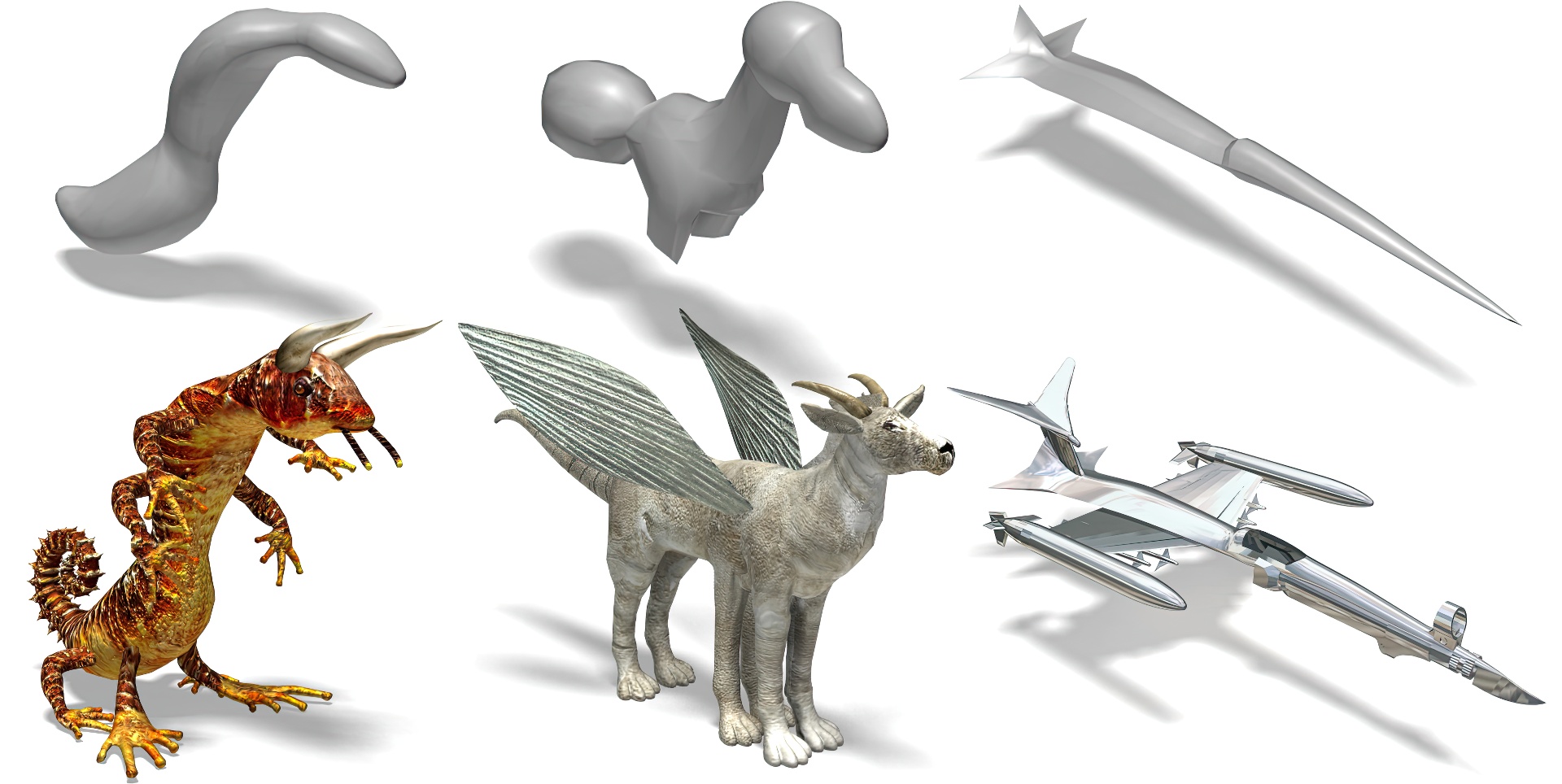
We introduce data-driven suggestions for 3D modeling. Data-driven suggestions support open-ended stages in the 3D modeling process, when the appearance of the desired model is ill-defined and the artist can benefit from customized examples that stimulate creativity. Our approach computes and presents components that can be added to the artist’s current shape. We describe shape retrieval and shape correspondence techniques that support the generation of data-driven suggestions, and report preliminary experiments with a tool for creative prototyping of 3D models.
References:
1. Aiger, D., Mitra, N. J., and Cohen-Or, D. 2008. 4-points congruent sets for robust pairwise surface registration. In Proc. SIGGRAPH, ACM. Google ScholarDigital Library
2. Boden, M. A. 1990. The Creative Mind: Myths and Mechanisms. George Weidenfeld and Nicolson Ltd. Google ScholarDigital Library
3. Carbonell, J., and Goldstein, J. 1998. The use of MMR, diversity-based reranking for reordering documents and producing summaries. In Proc. SIGIR Conference on Research and Development in Information Retrieval, ACM, 335–336. Google ScholarDigital Library
4. Collingwood, R. G. 1938. The Principles of Art. Clarendon Press.Google Scholar
5. Cross, N. 2001. Design cognition: results from protocol and other empirical studies of design activity. In Design Knowing and Learning, C. Eastman, M. McCracken, and M. Newstetter, Eds. Elsevier Science, 79–103.Google Scholar
6. Finke, R. A., Ward, T. B., and Smith, S. M. 1992. Creative Cognition: Theory, Research, and Applications. MIT Press.Google Scholar
7. Flickr, 2010. http://www.flickr.com/.Google Scholar
8. Funkhouser, T., Kazhdan, M., Shilane, P., Min, P., Kiefer, W., Tal, A., Rusinkiewicz, S., and Dobkin, D. 2004. Modeling by example. In Proc. SIGGRAPH, ACM. Google ScholarDigital Library
9. Gal, R., Sorkine, O., Popa, T., Sheffer, A., and Cohen-Or, D. 2007. 3D collage: expressive non-realistic modeling. In Proceedings of 5th International Symposium on Non-Photorealistic Animation and Rendering. Google ScholarDigital Library
10. Grauman, K., and Darrell, T. 2007. The pyramid match kernel: efficient learning with sets of features. Journal of Machine Learning Research 8, 725–760. Google ScholarDigital Library
11. Hartmann, B., MacDougall, D., Brandt, J., and Klemmer, S. R. 2010. What would other programmers do? Suggesting solutions to error messages. In Proc. ACM Conference on Human Factors in Computing Systems. Google ScholarDigital Library
12. Hays, J., and Efros, A. A. 2007. Scene completion using millions of photographs. In Proc. SIGGRAPH, ACM. Google ScholarDigital Library
13. Huang, Q.-X., Wicke, M., Adams, B., and Guibas, L. J. 2009. Shape decomposition using modal analysis. Computer Graphics Forum 28, 2, 407–416.Google ScholarCross Ref
14. Igarashi, T., and Hughes, J. F. 2001. A suggestive interface for 3D drawing. In Proc. ACM Symposium on User Interface Software and Technology. Google ScholarDigital Library
15. Indyk, P., and Motwani, R. 1998. Approximate nearest neighbors: towards removing the curse of dimensionality. In Proc. ACM Symposium on Theory of Computing. Google ScholarDigital Library
16. Johnson, A. E. 1997. Spin-Images: A Representation for 3D Surface Matching. PhD thesis, Carnegie Mellon University.Google Scholar
17. Kalogerakis, E., Hertzmann, A., and Singh, K. 2010. Learning 3D mesh segmentation and labeling. In Proc. SIGGRAPH, ACM. Google ScholarDigital Library
18. Kraevoy, V., Julius, D., and Sheffer, A. 2007. Model composition from interchangeable components. In Proc. Pacific Graphics, IEEE Computer Society. Google ScholarDigital Library
19. Kulis, B., and Grauman, K. 2009. Kernelized locality-sensitive hashing for scalable image search. In Proc. International Conference on Computer Vision, IEEE Computer Society.Google Scholar
20. Lalonde, J.-F., Hoiem, D., Efros, A. A., Rother, C., Winn, J., and Criminisi, A. 2007. Photo clip art. In Proc. SIGGRAPH, ACM. Google ScholarDigital Library
21. Lee, B., Srivastava, S., Kumar, R., Brafman, R., and Klemmer, S. R. 2010. Designing with interactive example galleries. In Proc. ACM Conference on Human Factors in Computing Systems. Google ScholarDigital Library
22. Lien, J.-M., and Amato, N. M. 2007. Approximate convex decomposition of polyhedra. In Proc. ACM Symposium on Solid and Physical Modeling. Google ScholarDigital Library
23. Ling, H., and Soatto, S. 2007. Proximity distribution kernels for geometric context in category recognition. In Proc. International Conference on Computer Vision, IEEE Computer Society.Google Scholar
24. Maji, S., Berg, A. C., and Malik, J. 2008. Classification using intersection kernel support vector machines is efficient. In Proc. IEEE Conference on Computer Vision and Pattern Recognition, IEEE Computer Society.Google Scholar
25. Marsh, R. L., Landau, J. D., and Hicks, J. L. 1996. How examples may (and may not) constrain creativity. Memory and Cognition 24, 5, 669–680.Google ScholarCross Ref
26. Matejka, J., Li, W., Grossman, T., and Fitzmaurice, G. 2009. CommunityCommands: command recommendations for software applications. In Proc. ACM Symposium on User Interface Software and Technology. Google ScholarDigital Library
27. Nickerson, R. S. 1999. Enhancing creativity. In Handbook of Creativity, R. J. Sternberg, Ed. Cambridge University Press, 392–430.Google Scholar
28. Odone, F., Barla, A., and Verri, A. 2005. Building kernels from binary strings for image matching. IEEE Transactions on Image Processing 14, 2, 169–180. Google ScholarDigital Library
29. Osada, R., Funkhouser, T., Chazelle, B., and Dobkin, D. 2002. Shape distributions. ACM Transactions on Graphics 21, 4, 807–832. Google ScholarDigital Library
30. Ovsjanikov, M., Bronstein, A. M., Bronstein, M. M., and Guibas, L. 2009. ShapeGoogle: a computer vision approach for invariant shape retrieval. In Proc. ICCV Workshop on Non-Rigid Shape Analysis and Deformable Image Alignment.Google Scholar
31. Pauly, M., Mitra, N. J., Giesen, J., Gross, M., and Guibas, L. J. 2005. Example-based 3D scan completion. In Proc. Symposium on Geometry Processing. Google ScholarDigital Library
32. Podolak, J., Shilane, P., Golovinskiy, A., Rusinkiewicz, S., and Funkhouser, T. 2006. A planar-reflective symmetry transform for 3D shapes. In Proc. SIGGRAPH, ACM. Google ScholarDigital Library
33. Resnick, M., Myers, B., Nakakoji, K., Shneiderman, B., Pausch, R., Selker, T., and Eisenberg, M. 2005. Design principles for tools to support creative thinking. In NSF Workshop Report on Creativity Support Tools. 25–35.Google Scholar
34. Reuter, M. 2010. Hierarchical shape segmentation and registration via topological features of Laplace-Beltrami eigenfunctions. International Journal of Computer Vision 89, 2, 287–308. Google ScholarDigital Library
35. Shapira, L., Shamir, A., and Cohen-Or, D. 2008. Consistent mesh partitioning and skeletonisation using the shape diameter function. Visual Computer 24, 4, 249–259. Google ScholarDigital Library
36. Sharf, A., Blumenkrants, M., Shamir, A., and Cohen-Or, D. 2006. SnapPaste: an interactive technique for easy mesh composition. Visual Computer 22, 9, 835–844. Google ScholarDigital Library
37. Shneiderman, B., et al. 2006. Creativity support tools: report from a U.S. National Science Foundation sponsored workshop. International Journal of Human-Computer Interaction 20, 2, 61–77.Google ScholarCross Ref
38. Shneiderman, B. 2007. Creativity support tools: accelerating discovery and innovation. Communications of the ACM 50, 12, 20–32. Google ScholarDigital Library
39. Sternberg, R. J. 1999. Handbook of Creativity. Cambridge University Press.Google Scholar
40. Swain, M. J., and Ballard, D. H. 1991. Color indexing. International Journal of Computer Vision 7, 1, 11–32. Google ScholarDigital Library
41. Talton, J. O., Gibson, D., Yang, L., Hanrahan, P., and Koltun, V. 2009. Exploratory modeling with collaborative design spaces. In Proc. SIGGRAPH Asia, ACM. Google ScholarDigital Library
42. Terry, M. A., and Mynatt, E. D. 2002. Side views: persistent, on-demand previews for open-ended tasks. In Proc. ACM Symposium on User Interface Software and Technology. Google ScholarDigital Library
43. Terry, M. A., Mynatt, E. D., Nakakoji, K., and Yamamoto, Y. 2004. Variation in element and action: supporting simultaneous development of alternative solutions. In Proc. ACM Conference on Human Factors in Computing Systems. Google ScholarDigital Library
44. Treisman, A. M., and Gelade, G. 1980. A feature-integration theory of attention. Cognitive Psychology 12, 97–136.Google ScholarCross Ref
45. Weisberg, R. W. 2006. Creativity: Understanding Innovation in Problem Solving, Science, Invention, and the Arts. John Wiley & Sons, Inc.Google Scholar



