“Data-driven authoring of large-scale ecosystems” by Kapp, Gain, Guérin, Galin and Peytavie
Conference:
Type(s):
Title:
- Data-driven authoring of large-scale ecosystems
Session/Category Title:
- Generation and Inference from Images
Presenter(s)/Author(s):
Abstract:
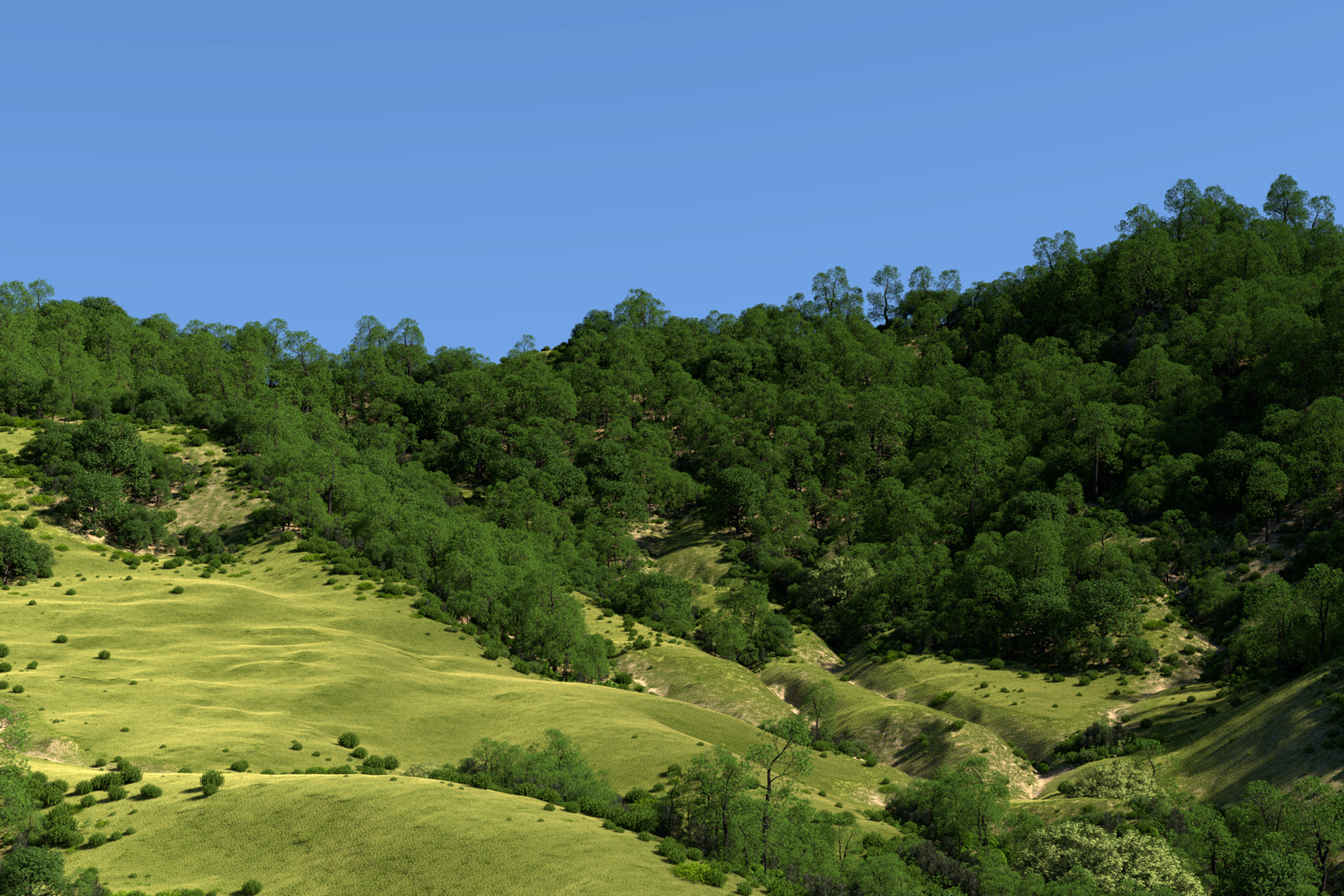
In computer graphics populating a large-scale natural scene with plants in a fashion that both reflects the complex interrelationships and diversity present in real ecosystems and is computationally efficient enough to support iterative authoring remains an open problem. Ecosystem simulations embody many of the botanical influences, such as sunlight, temperature, and moisture, but require hours to complete, while synthesis from statistical distributions tends not to capture fine-scale variety and complexity.Instead, we leverage real-world data and machine learning to derive a canopy height model (CHM) for unseen terrain provided by the user. Trees in the canopy layer are then fitted to the resulting CHM through a constrained iterative process that optimizes for a given distribution of species, and, finally, an understorey layer is synthesised using distributions derived from biome-specific undergrowth simulations. Such a hybrid data-driven approach has the advantage that it incorporates subtle biotic, abiotic, and disturbance factors implicitly encoded in the source data and evidences accepted biological behaviour, such as self-thinning, climatic adaptation, and gap dynamics.
References:
1. M. Alsweis and O. Deussen. 2005. Modeling and Visualization of symmetric and asymmetric plant competition. In Eurographics Workshop on Natural Phenomena, P. Poulin and E. Galin (Eds.). The Eurographics Association, 83–88.Google Scholar
2. M. Alsweis and O. Deussen. 2006. Wang-tiles for the simulation and visualization of plant competition. In Computer Graphics International: Advances in Computer Graphics. Springer, 1–11.Google Scholar
3. C. Andújar, A. Chica, M. Vico, S. Moya, and P. Brunet. 2014. Inexpensive Reconstruction and Rendering of Realistic Roadside Landscapes. Computer Graphics Forum 33, 6 (2014), 101–117.Google ScholarDigital Library
4. M. Aono and T. L. Kunii. 1984. Botanical Tree Image Generation. IEEE Computer Graphics and Applications 4, 5 (1984), 10–34.Google ScholarDigital Library
5. B. Benes, N. Andrysco, and O. Stava. 2009. Interactive Modeling of Virtual Ecosystems. In Proceedings of the Fifth Eurographics Conference on Natural Phenomena. Eurographics Association, 9–16.Google Scholar
6. S. Bornhofen and C. Lattaud. 2009. Competition and evolution in virtual plant communities: a new modeling approach. Natural Computing 8, 2 (2009), 349–385.Google ScholarDigital Library
7. G. Bradbury, K. Subr, C. Koniaris, K. Mitchell, and T. Weyrich. 2015. Guided Ecological Simulation for Artistic Editing of Plant Distributions in Natural Scenes. Journal of Computer Graphics Techniques 4, 4 (2015), 28–53.Google Scholar
8. D. Bradley, D. Nowrouzezahrai, and P. Beardsley. 2013. Image-Based Reconstruction and Synthesis of Dense Foliage. ACM Transactions on Graphics 32, 4 (2013).Google ScholarDigital Library
9. B. Cade, J. Terrell, and R. Schroeder. 1999. Estimating effects of limitings factors with regression quantiles. Ecology 80, 1 (1999), 311–323.Google ScholarCross Ref
10. E. Ch’Ng. 2013. Model resolution in complex systems simulation: Agent pREFERENCES, behavior, dynamics and n-tiered networks. Simulation 89, 5 (May 2013), 635–639.Google Scholar
11. J. S. Clark, M. Silman, R. Kern, E. Macklin, and J. HilleRisLambers. 1999. Seed dispersal near and far: patterns accross temperate and tropical forests. Ecology 80, 5 (1999), 1475–1494.Google ScholarCross Ref
12. G. Cordonnier, J. Braun, M.-P. Cani, B. Benes, E. Galin, A. Peytavie, and E. Guérin. 2016. Large Scale Terrain Generation from Tectonic Uplift and Fluvial Erosion. Computer Graphics Forum 35, 2 (2016), 165–175.Google ScholarCross Ref
13. G. Cordonnier, E. Galin, J. Gain, B. Benes, E. Guérin, A. Peytavie, and M.-P. Cani. 2017. Authoring Landscapes by Combining Ecosystem and Terrain Erosion Simulation. ACM Transactions on Graphics 36, 4 (2017), 12.Google ScholarDigital Library
14. O. Deussen, P. Hanrahan, B. Lintermann, R. Měch, M. Pharr, and P. Prusinkiewicz. 1998. Realistic Modeling and Rendering of Plant Ecosystems. In Proceedings of the 25th Annual Conference on Computer Graphics and Interactive Techniques (SIGGRAPH ’98). ACM, New York, NY, USA, 275–286.Google Scholar
15. M. C. Dietze, A. Sala, M. S. Carbone, C. I. Czimczik, J. A. Mantooth, A. D. Richardson, and R. Vargas. 2014. Nonstructural Carbon in Woody Plants. Annual Review of Plant Biology 65, 1 (2014), 667–687.Google ScholarCross Ref
16. R. Dubaya and G. Hurtt. 2014. UMD-NASA Carbon Mapping /Sonoma County Vegetation Mapping and LiDAR Program. Data provided and funded by the Sonoma County Vegetation Mapping and Lidar Program, and the University of Maryland under grant NNX13AP69G from NASA’s Carbon Monitoring System. Distributed by OpenTopography.Google Scholar
17. P. Ecormier-Nocca, P. Memari, J. Gain, and M.-P. Cani. 2019. Accurate Synthesis of Multi-Class Disk Distributions. Computer Graphics Forum 38, 2 (2019), 157–168.Google ScholarCross Ref
18. A. Emilien, U. Vimont, M.-P. Cani, P. Poulin, and B. Benes. 2015. WorldBrush: Interactive Example-based Synthesis of Procedural Virtual Worlds. ACM Transactions on Graphics 34, 4 (2015), 106:1–106:11.Google ScholarDigital Library
19. J. Foley, I. Prentice, N. Ramankutty, S. Levis, D. Pollard, S. Sitch, and A. Haxeltine. 1996. An integrated biosphere model of land surface processes, terrestrial carbon balance, and vegetation dynamics. Global Biogeochemical Cycles 10, 4 (1996), 603–628.Google ScholarCross Ref
20. J. F. Franklin, H. H. Shugart, and M. E. Harmon. 1987. Tree Death as an Ecological Process. BioScience 37, 8 (1987), 550–556.Google ScholarCross Ref
21. J. Gain, H. Long, G. Cordonnier, and M.-P. Cani. 2017. EcoBrush: Interactive Control of Visually Consistent Large-Scale Ecosystems. Computer Graphics Forum 36, 2 (2017), 63–73.Google ScholarDigital Library
22. E. Guérin, J. Digne, E. Galin, A. Peytavie, C. Wolf, B. Benes, and B. Martinez. 2017. Interactive Example-Based Terrain Authoring with Conditional Generative Adversarial Networks. ACM Transactions on Graphics (proceedings of Siggraph Asia 2017) 36, 6 (2017), 13.Google Scholar
23. T. Hadrich, B. Benes, O. Deussen, and S. Pirk. 2017. Interactive Modeling and Authoring of Climbing Plants. Computer Graphics Forum 36, 2 (2017), 49–61.Google ScholarDigital Library
24. C. Hawkes. 2000. Woody plant mortality algorithms: description, problems and progress. Ecological Modelling 126, 2 (2000), 225 — 248.Google ScholarCross Ref
25. P. Isola, J.-Y. Zhu, T. Zhou, and A. Efros. 2017. Image-To-Image Translation With Conditional Adversarial Networks. In The IEEE Conference on Computer Vision and Pattern Recognition (CVPR). 1125–1134.Google Scholar
26. W. Jakob. 2010. Mitsuba renderer. http://www.mitsuba-renderer.org.Google Scholar
27. H. Kaartinen, J. Hyyppä, X. Yu, M. Vastaranta, H. Hyyppä, A. Kukko, M. Holopainen, C. Heipke, M. Hirschmugl, F. Morsdorf, E. NÃęsset, J. Pitkänen, S. Popescu, S. Solberg, B. Wolf, and J.-C. Wu. 2012. An International Comparison of Individual Tree Detection and Extraction Using Airborne Laser Scanning. Remote Sensing 4, 4 (2012), 950–974.Google ScholarCross Ref
28. T. Kim, M. Cha, H. Kim, J. K. Lee, and J. Kim. 2017. Learning to Discover Cross-Domain Relations with Generative Adversarial Networks. In Proceedings of the 34th International Conference on Machine Learning – Volume 70 (ICML’17). JMLR.org, 1857–1865.Google Scholar
29. B. Lane and P. Prusinkiewicz. 2002. Generating spatial distributions for multilevel models of plant communities. In Graphics Interface ’02. Canadian Human-Computer Communications Society, 69–80.Google Scholar
30. C. Li, O. Deussen, Y.-Z. Song, P. Willis, and P. Hall. 2011. Modeling and Generating Moving Trees from Video. ACM Transactions on Graphics 30, 6 (2011), 1–12.Google ScholarDigital Library
31. J. Li, X. Gu, X. Li, J. Tan, and J. She. 2018. Procedural Generation of Large-Scale Forests Using a Graph-Based Neutral Landscape Model. ISPRS International Journal of Geo-Information 7, 3 (2018), 127–142.Google ScholarCross Ref
32. M. Makowski, T. Hädrich, J. Scheffczyk, D. Michels, S. Pirk, and W. Pałubicki. 2019. Synthetic Silviculture: Multi-Scale Modeling of Plant Ecosystems. ACM Transactions on Graphics 38, 4 (2019).Google ScholarDigital Library
33. N. Maréchal, E. Guérin, E. Galin, and S. Akkouche. 2010. Component-Based Model Synthesis for Low Polygonal Models. In Proceedings of Graphics Interface. 217–224.Google Scholar
34. R. Měch and P. Prusinkiewicz. 1996. Visual Models of Plants Interacting with Their Environment. In Proceedings of the 23rd Annual Conference on Computer Graphics and Interactive Techniques (SIGGRAPH ’96). ACM, New York, NY, USA, 397–410.Google Scholar
35. R. Nathan and H. C. Muller-Landau. 2000. Spatial patterns of seed dispersal, their determinants and consequences for recruitment. Trends in Ecology and Evolution 15, 7 (2000), 278–285.Google ScholarCross Ref
36. R. Nathan, F. M. Schurr, O. Spiegel, O. Steinitz, A. Trakhtenbrot, and A. Tsoar. 2008. Mechanisms of long-distance seed dispersal. Trends in Ecology and Evolution 23, 11 (2008), 638–647.Google ScholarCross Ref
37. G. L.W. Perry and N. J. Enright. 2006. Spatial modelling of vegetation change in dynamic landscapes: a review of methods and applications. Progress in Physical Geography: Earth and Environment 30, 1 (2006), 47–72.Google ScholarCross Ref
38. Z. Pödör, M. Manninger, and L. Jereb. 2014. Application of Sigmoid Models for Growth Investigations of Forest Trees. In Advanced Computational Methods for Knowledge Engineering, Tien van Do, Hoai An Le Thi, and Ngoc Thanh Nguyen (Eds.). Springer International Publishing, Cham, 353–364.Google Scholar
39. H. Pretzsch, P. Biber, E. Uhl, J. Dahlhausen, T. Rotzer, J. Caldentey, T. Koike, T. van Con, A. Chavanne, T. Seifert, B. du Toit, C. Farnden, and S. Pauleit. 2015. Crown size and growing space requirement of common tree species in urban centres, parks, and forests. Urban Forestry and Urban Greening 14, 3 (2015), 466–479.Google ScholarCross Ref
40. P. Prusinkiewicz. 1986. Graphical applications of L-systems. In Proceedings of Graphics Interface’86. 247–253.Google Scholar
41. P. Prusinkiewicz, L. Mündermann, R. Karwowski, and B. Lane. 2001. The Use of Positional Information in the Modeling of Plants. In Proceedings of the 28th Annual Conference on Computer Graphics and Interactive Techniques (SIGGRAPH ’01). ACM, New York, NY, USA, 289–300.Google Scholar
42. K. Randolph, S. Campbell, and G. Christensen. 2010. Descriptive statistics of tree crown condition in California, Oregon, and Washington. Technical Report. Southern Research Station, USDA Forest Service.Google Scholar
43. H. Sato, A. Itoh, and T. Kohyama. 2007. SEIB-DGVM: A new Dynamic Global Vegetation Model using a spatially explicit individual-based approach. Ecological Modelling 200, 3–4 (2007), 279–307.Google ScholarCross Ref
44. R. Seidl, W. Rammer, R. M. Scheller, and T. A. Spies. 2012. An individual-based process model to simulate landscape-scale forest ecosystem dynamics. Ecological Modelling 231 (2012), 87–100.Google ScholarCross Ref
45. S. Sitch, C. Huntingford, N. Gedney, P. Levy, M. Lomas, S. L. Piao, R. Betts, P. Ciais, P. Cox, P. Friedlingstein, C. D. Jones, I. Prentice, and F. Woodward. 2008. Evaluation of the terrestrial carbon cycle, future plant geography and climate-carbon cycle feedbacks using five Dynamic Global Vegetation Models (DGVMs). Global Change Biology 14, 9 (2008), 2015–2039.Google ScholarCross Ref
46. J. Wither, F. Boudon, M.-P. Cani, and C. Godin. 2009. Structure from silhouettes: a new paradigm for fast sketch-based design of trees. Computer Graphics Forum 28, 2 (2009), 541–550.Google ScholarCross Ref
47. K. Xie, F. Yan, A. Sharf, O. Deussen, H. Huang, and B. Chen. 2016. Tree Modeling with Real Tree-Parts Examples. IEEE Transactions on Visualization and Computer Graphics 22, 12 (2016), 2608–2618.Google ScholarDigital Library
48. H. Zhang, T. Xu, H. Li, S. Zhang, X. Wang, X. Huang, and D. N. Metaxas. 2017. StackGAN: Text to Photo-Realistic Image Synthesis With Stacked Generative Adversarial Networks. In The IEEE International Conference on Computer Vision (ICCV).Google Scholar
49. J. Zhang, C. Wang, C. Li, and H. Qin. 2019. Example-based rapid generation of vegetation on terrain via CNN-based distribution learning. The Visual Computer 35, 6 (2019), 1181–1191.Google ScholarDigital Library
50. Z. Zhen, L. Quackenbush, and L. Zhang. 2016. Trends in Automatic Individual Tree Crown Detection and Delineation – Evolution of LiDAR Data. Remote Sensing 8, 4 (2016).Google Scholar