
“Boundary aligned smooth 3D cross-frame field”
Conference:
Type(s):
Title:
- Boundary aligned smooth 3D cross-frame field
Session/Category Title:
- Quads and Friends
Presenter(s)/Author(s):
Abstract:
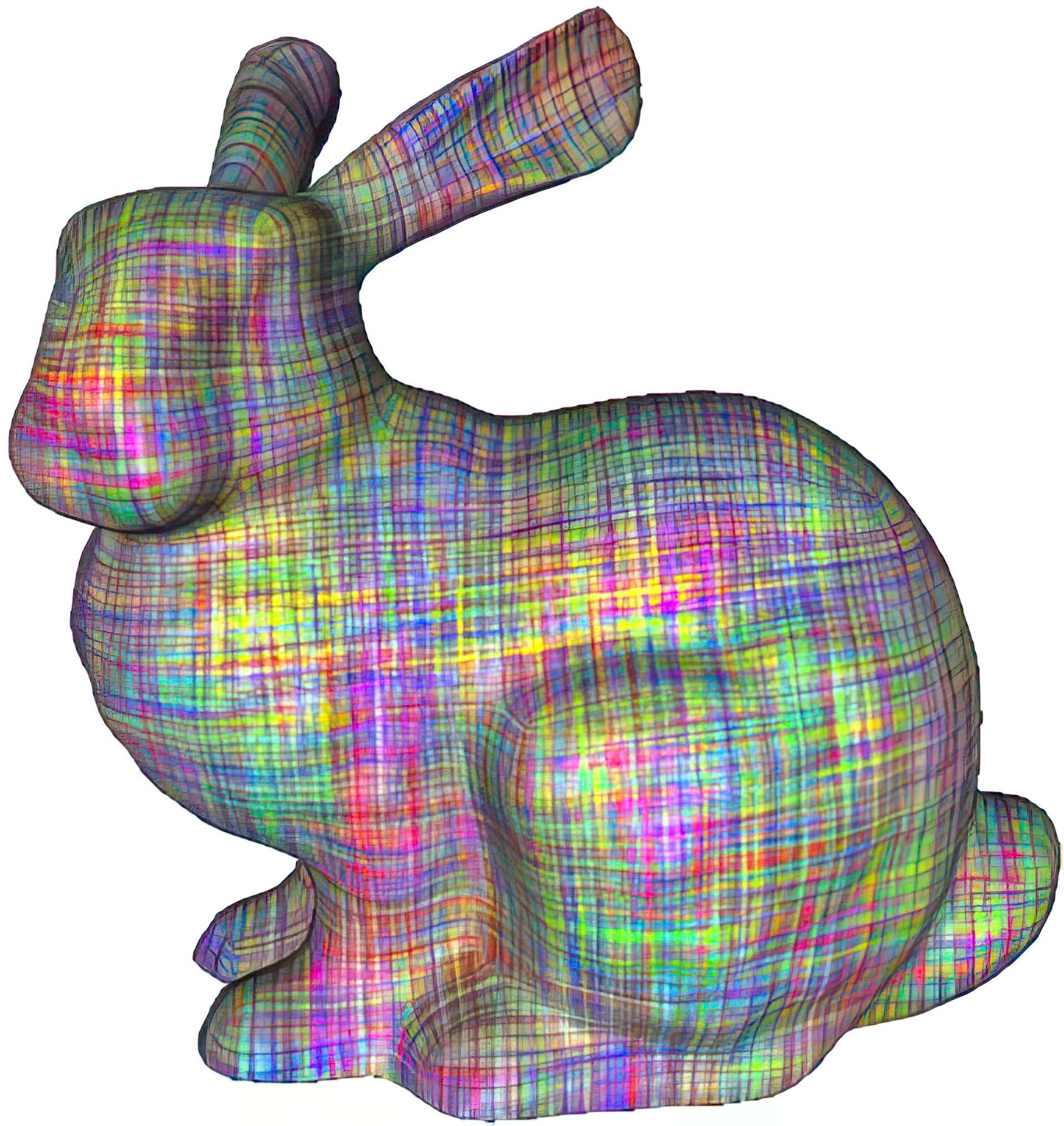
In this paper, we present a method for constructing a 3D cross-frame field, a 3D extension of the 2D cross-frame field as applied to surfaces in applications such as quadrangulation and texture synthesis. In contrast to the surface cross-frame field (equivalent to a 4-Way Rotational-Symmetry vector field), symmetry for 3D cross-frame fields cannot be formulated by simple one-parameter 2D rotations in the tangent planes. To address this critical issue, we represent the 3D frames by spherical harmonics, in a manner invariant to combinations of rotations around any axis by multiples of π/2. With such a representation, we can formulate an efficient smoothness measure of the cross-frame field. Through minimization of this measure under certain boundary conditions, we can construct a smooth 3D cross-frame field that is aligned with the surface normal at the boundary. We visualize the resulting cross-frame field through restrictions to the boundary surface, streamline tracing in the volume, and singularities. We also demonstrate the application of the 3D cross-frame field to producing hexahedron-dominant meshes for given volumes, and discuss its potential in high-quality hexahedralization, much as its 2D counterpart has shown in quadrangulation.
References:
1. Bochkanov, S., n.d. Alglib. http://www.alglib.net/.Google Scholar
2. Bommes, D., Zimmer, H., and Kobbelt, L. 2009. Mixed-integer quadrangulation. ACM Trans. Graph. (SIGGRAPH) 28, 3 (July), 77:1–77:10. Google ScholarDigital Library
3. Carbonera, C. D., and Shepherd, J. F. 2010. A constructive approach to constrained hexahedral mesh generation. Eng. with Comput. 26, 4 (August), 341–350. Google ScholarDigital Library
4. Cheng, Y. 1995. Mean shift, mode seeking, and clustering. IEEE Trans. Pattern Anal. Mach. Intell. 17, 8 (August), 790–799. Google ScholarDigital Library
5. Comaniciu, D., Meer, P., and Member, S. 2002. Mean shift: A robust approach toward feature space analysis. IEEE Transactions on Pattern Analysis and Machine Intelligence 24, 5, 603–619. Google ScholarDigital Library
6. Cook, W., and Oakes, W. 1982. Mapping methods for generating three-dimensional meshes. Computers In Mechanical Engineering, pp.67–72.Google Scholar
7. dlib, n.d. dlib c++ library. http://dlib.net/.Google Scholar
8. Dong, S., Bremer, P.-T., Garland, M., Pascucci, V., and Hart, J. C. 2006. Spectral surface quadrangulation. ACM Trans. Graph. (SIGGRAPH) 25, 3, 1057–1066. Google ScholarDigital Library
9. Edelsbrunner, H., Harer, J., and Zomorodian, A. 2001. Hierarchical Morse-Smale complexes for piecewise linear 2-manifolds. Discrete and Computational Geometry (SoCG) 30, 1 (July), 87–107.Google Scholar
10. Eppstein, D. 1996. Linear complexity hexahedral mesh generation. In Proc. 12th Symp. Computational Geometry, ACM, 58–67. Google ScholarDigital Library
11. Green, R. 2003. Spherical Harmonic Lighting: The Gritty Details. Archives of the Game Developers Conference (Mar.).Google Scholar
12. Gregson, J., Sheffer, A., and Zhang, E. 2011. All-hex mesh generation via volumetric polycube deformation. Computer Graphics Forum (SGP) 30:5, 1407–1416.Google ScholarCross Ref
13. Kälberer, F., Nieser, M., and Polthier, K. 2007. Quadcover – surface parameterization using branched coverings. Computer Graphics Forum 26, 3 (Sept.), 375–384.Google ScholarCross Ref
14. Kazhdan, M. 2007. An approximate and efficient method for optimal rotation alignment of 3d models. IEEE Trans. Pattern Anal. Mach. Intell. 29, 7, 1221–1229. Google ScholarDigital Library
15. Lai, Y.-K., Jin, M., Xie, X., He, Y., Palacios, J., Zhang, E., Hu, S.-M., and Gu, X. 2010. Metric-driven rosy field design and remeshing. IEEE Transactions on Visualization and Computer Graphics 16, 1, 95–108. Google ScholarDigital Library
16. Lévy, B., and Liu, Y. 2010. Lp centroidal Voronoi tessellation and its applications. ACM Trans. Graph. (SIGGRAPH) 29, 4 (July), 119:1–119:11. Google ScholarDigital Library
17. Makadia, A., and Daniilidis, K. 2003. Direct 3d-rotation estimation from spherical images via a generalized shift theorem. In IEEE Conference on Computer Vision and Pattern Recognition, 217–226.Google Scholar
18. Mann, S., and Rockwood, A. 2002. Computing singularities of 3d vector fields with geometric algebra. In Proceedings of the Conference on Visualization ’02, IEEE Computer Society, Washington, DC, USA, VIS ’02, 283–290. Google ScholarDigital Library
19. Meshkat, S., and Talmor, D. 2000. Generating a mixed mesh of hexahedra, pentahedra and tetrahedra from an underlying tetrahedral mesh. International Journal for Numerical Methods in Engineering 49, 1–2, 17–30.Google ScholarCross Ref
20. Nieser, M., Reitebuch, U., and Polthier, K. 2011. Cube-Cover – parameterization of 3d volumes. Computer Graphics Forum (SGP) 30:5, 1397–1406.Google ScholarCross Ref
21. Palacios, J., and Zhang, E. 2007. Rotational symmetry field design on surfaces. ACM Trans. Graph. (SIGGRAPH) 26:3, 55. Google ScholarDigital Library
22. Palacios, J., and Zhang, E. 2011. Interactive visualization of rotational symmetry fields on surfaces. IEEE Transactions on Visualization and Computer Graphics 17, 7, 947–955. Google ScholarDigital Library
23. Pointwise, 2009. Gridgen – reliable cfd meshing. http://www.pointwise.com/gridgen/.Google Scholar
24. Ray, N., Li, W. C., Lévy, B., Sheffer, A., and Alliez, P. 2006. Periodic global parameterization. ACM Trans. Graph. 25, 4, 1460–1485. Google ScholarDigital Library
25. Ray, N., Vallet, B., Li, W.-C., and Lévy, B. 2008. N-symmetry direction field design. ACM Transactions on Graphics 27:2, 10:1–10:13. Google ScholarDigital Library
26. Roca, X. 2009. Paving the path towards automatic hexahedral mesh generation. PhD thesis, Applied Mathematics, UPC, Barcelona.Google Scholar
27. Ruiz-Gironés, E., and Sarrate, J. 2010. Generation of structured hexahedral meshes in volumes with holes. Finite Elem. Anal. Des. 46, 10 (October), 792–804. Google ScholarDigital Library
28. Schöberl, J. 1997. Netgen – an advancing front 2d/3d mesh generator based on abstract rules. Comput and Vis in Science 1, 1, 41–52.Google ScholarCross Ref
29. Scott, M. A., Earp, M. N., Benzley, S. E., and Stephenson, M. B. 2005. Adaptive sweeping techniques. In Proceedings, 14th International Meshing Roundtable.Google Scholar
30. Shepherd, J. 2007. Topologic and geometric constraint-based hexahedral mesh generation. PhD thesis, University of Utah. Google ScholarDigital Library
31. Takayama, K., Okabe, M., Ijiri, T., and Igarashi, T. 2008. Lapped solid textures: filling a model with anisotropic textures. ACM Trans. Graph. (SIGGRAPH) 27, 3 (August), 53:1–53:9. Google ScholarDigital Library
32. Tautges, T. J. 2001. The generation of hexahedral meshes for assembly geometry: survey and progress. International Journal for Numerical Methods in Engineering 50:12, pp. 2617–2642.Google ScholarCross Ref
33. Vyas, V., and Shimada, K. 2009. Tensor-guided hex-dominant mesh generation with targeted all-hex regions. In Proceedings of the 18th International Meshing Roundtable, B. W. Clark, Ed. Springer Berlin Heidelberg, 377–396.Google Scholar
34. Yamakawa, S., and Shimada, K. 2003. Fully-automated hexdominant mesh generation with directionality control via packing rectangular solid cells. International Journal for Numerical Methods in Engineering 57, 15, 2099–2129.Google ScholarCross Ref
35. Zhang, G.-X., Du, S.-P., Lai, Y.-K., Ni, T., and Hu, S.-M. 2010. Sketch guided solid texturing. Graphical Models 73:3, 59–73.Google ScholarCross Ref
36. Zhang, M., Huang, J., Liu, X., and Bao, H. 2010. A wave-based anisotropic quadrangulation method. ACM Trans. Graph. (SIGGRAPH) 29, 4 (July), 118:1–118:8. Google ScholarDigital Library



