
“Blocking harmful blue light while preserving image color appearance” by Shih, Liu, Shyu, Yeh and Chen
Conference:
Type(s):
Title:
- Blocking harmful blue light while preserving image color appearance
Session/Category Title:
- All About Seeing
Presenter(s)/Author(s):
Abstract:
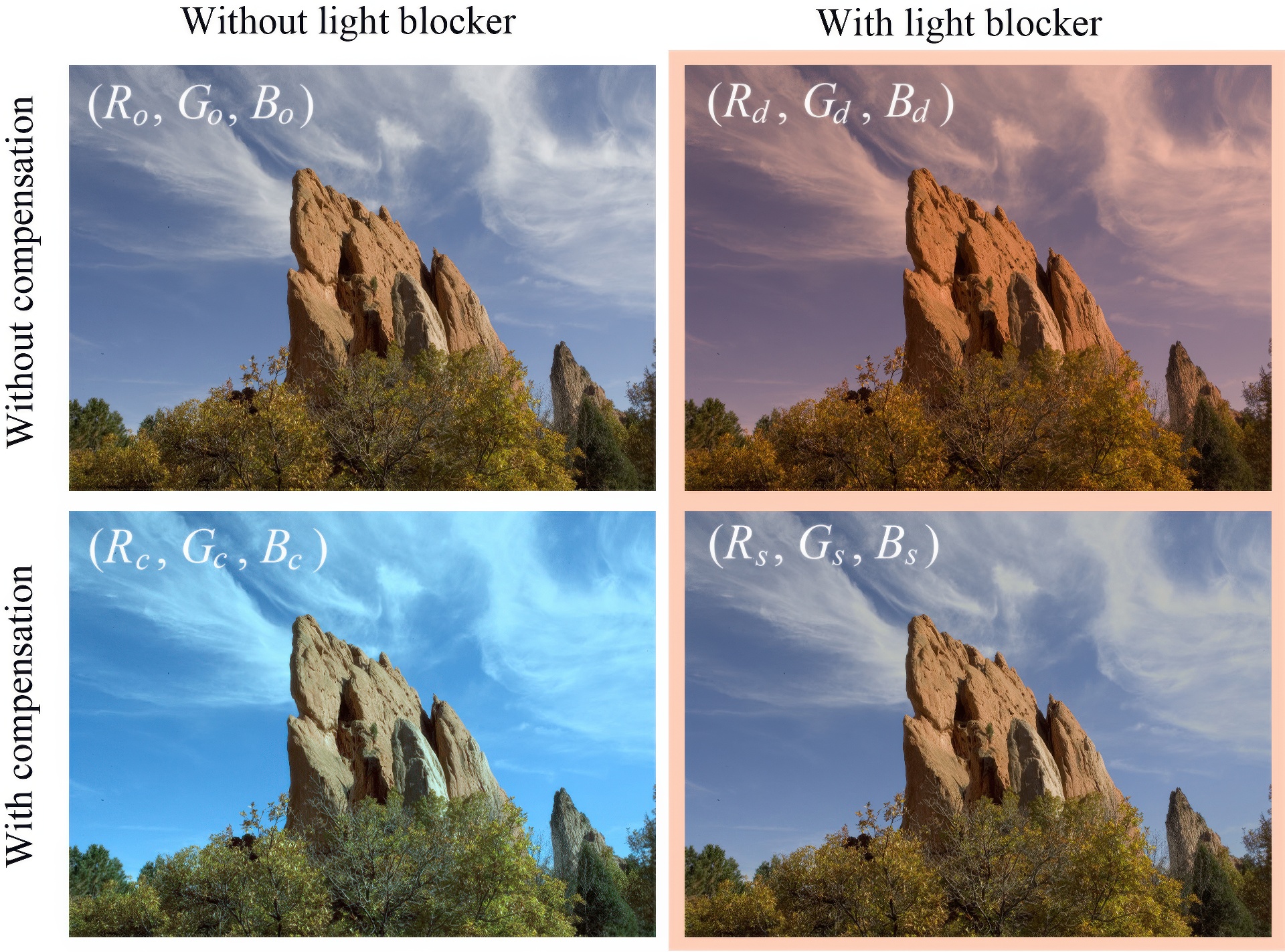
Recent study in vision science has shown that blue light in a certain frequency band affects human circadian rhythm and impairs our health. Although applying a light blocker to an image display can block the harmful blue light, it inevitably makes an image look like an aged photo. In this paper, we show that it is possible to reduce harmful blue light while preserving the blue appearance of an image. Moreover, we optimize the spectral transmittance profile of blue light blocker based on psychophysical data and develop a color compensation algorithm to minimize color distortion. A prototype using notch filters is built as a proof of concept.
References:
1. Berson, D. M., Dunn, F. A., and Takao M. 2002. Phototransduction by retinal ganglion cells that set the circadian clock. Science, vol. 295, 5557, 1070–1073.
2. Berson, D. M. 2003. Strange vision: ganglion cells as circadian photoreceptors. Trends in Neurosciences, vol. 26, 6, 314–320. Cross Ref
3. Chang, A. M., Aeschbach, D., Duffy, J. F., and Czeisler, C. A. 2015. Evening use of light-emitting eReaders negatively affects sleep, circadian timing, and next-morning alertness. In Proceedings of the National Academy of Sciences, 112, 4, 1232–1237. Cross Ref
4. Dacey, D. M., Liao H. W., Peterson, B. B., Robinson, F. R., Smith, V. C., Pokorny, J., Yau, K.-W., and Gamlin., P. D. 2005. Melanopsin-expressing ganglion cells in primate retina signal colour and irradiance and project to the LGN. Nature 433, 749–754. Cross Ref
5. Fairchild, M. D. 2005. Color Appearance Models, 2nd ed. Wiley-IS&T, Chichester, UK.
6. Galindo-Romeroa, C., Jiménez-Lópeza, M., García-Ayusoa, D., Salinas-Navarroa, M., Nadal-Nicolása, F.M., Agudo-Barriusoa, M., Villegas-Péreza, M.P., Avilés-Triguerosa, M., and Vidal-Sanza, M. 2013. Number and spatial distribution of intrinsically photosensitive retinal ganglion cells in the adult albino rat. Experimental Eye Research, vol. 108, 84–93. Cross Ref
7. Gamlin, P. D. R., McDougal, D. H., Pokorny, J, Smith, V. C., Yau, K.-W., and Dacey, D. M. 2007. Human and macaque pupil responses driven by melanopsin-containing retinal ganglion cells. Vision Research, vol. 47, 7, 946–954. Cross Ref
8. Harvard Health Letter, 2012. Blue light has a dark side. http://www.health.harvard.edu/staying-healthy/blue-light-has-a-dark-side.
9. Lely, S., Frey, S., Garbazza, C., Wirz-Justice, A., Jenni, O.G., Steiner, R., Wolf, S., Cajochen, C., Bromundt, V., and Schmidt, C. 2014. Blue blocker glasses as a countermeasure for alerting effects of evening light-emitting diode screen exposure in male teenagers. Journal of Adolescent Health, vol. 56, 1, 113–119. Cross Ref
10. Lindbloom, B. J. 1989. Accurate color reproduction for computer graphics applications. ACM Computer Graphics, vol. 23, 3, 117–126.
11. Liu, J.-S., Shih, K.-T., and Chen, H. H. 2015. Preserving image color appearance on non-white projection surfaces. In Proceedings of IEEE Int. Conf. Multimedia & Expo, 1–6.
12. Miyazaki, D., Nakamura, K., Baba, M, Furukawa R., Aoyama, M., Hiura, S., and Asada, N. 2012. A first introduction to metamerism art. SIGGRAPH Asia Posters, 17.
13. Morovic, J. 2008. Color gamut mapping. John Wiley & Sons.
14. Reinhard, E., Pouli, T., Kunkel, T., Long, B., Ballestad, A., and Damberg, A. 2012. Calibrared Image Appearance Reproduction. ACM Transactions on Graphics, vol. 31, 6, 201.
15. Roecklein, K. A., Rohan, K. J., Duncan, W. C., Rollag, M. D., Rosenthal, N. E., Lipsky, R. H., and Provencio, I. 2009. A missense variant (P10L) of the melanopsin (Opn4) gene is associated with seasonal affective disorder. Journal of Affective Disorders, vol. 114, 1–3, 279–285. Cross Ref
16. Shapira, L. and Oicherman, B. 2012. Black is green: adaptive color transformation for reduced ink usage. Comput. Graph. Forum, vol.31, 2, 365–372.
17. Shih, K.-T. and Chen, H. H. 2016. Exploiting perceptual anchoring for color image enhancement. IEEE Transactions on Multimedia, vol.18, 2, 300–310. Cross Ref
18. Shih, K.-T., Chen, H. H., and Liu, Y.-N. 2016. Image processing system and method. Publication No. US20160093268 A1. Filed Sept. 30, 2014.
19. Smith, T. and Guild, J. 1931. The C.I.E. colorimetric standards and their use. Trans. Optical Soc., vol. 33, 3, 73–134. Cross Ref
20. Stevens, R. G., Blask, D. E., Brainard, G. C., Hansen, J., Lockley, S. W., Provencio, I., Rea, M. S. and Reinlib, L. 2007. Meeting report: The role of environmental lighting and circadian disruption in cancer and other diseases. Environmental Health Perspectives, vol. 115, 9, 1357–1362. Cross Ref
21. Stevens, R. G. 2009. Light-at-night, circadian disruption and breast cancer: assessment of existing evidence. International Journal of Epidemiology, vol. 38, 4, 963–970. Cross Ref
22. Wanat, R. and Mantuik, R. K. 2014. Simulating and compensating changes in appearance between day and night vision. ACM Transactions on Graphics, vol. 33, 4, 1–12.
23. Wong, K. Y. 2012. A retinal ganglion cell that can signal irradiance continuously for 10 hours. Journal of Neuroscience, vol. 32(33), 11478–11485. Cross Ref
24. Zaidi, F. H., Hull, J. T., Peirson, S. N., Wulff, K., Aeschbach, D., Gooley, J. J., Brainard, G. C., Gregory-Evans, K., Rizzo III, J. F., Czeisler, C. A., Foster, R. G., Moseley, M. J., and Lockley, S. W. 2007. Short-wavelength light sensitivity of circadian, pupillary, and visual awareness in humans lacking an outer retina. Current Biology, vol. 17, 24, 2122–2128. Cross Ref



