
“Bilateral blue noise sampling”
Conference:
Type(s):
Title:
- Bilateral blue noise sampling
Session/Category Title:
- Rendering and Thinking Inside the Box
Presenter(s)/Author(s):
Abstract:
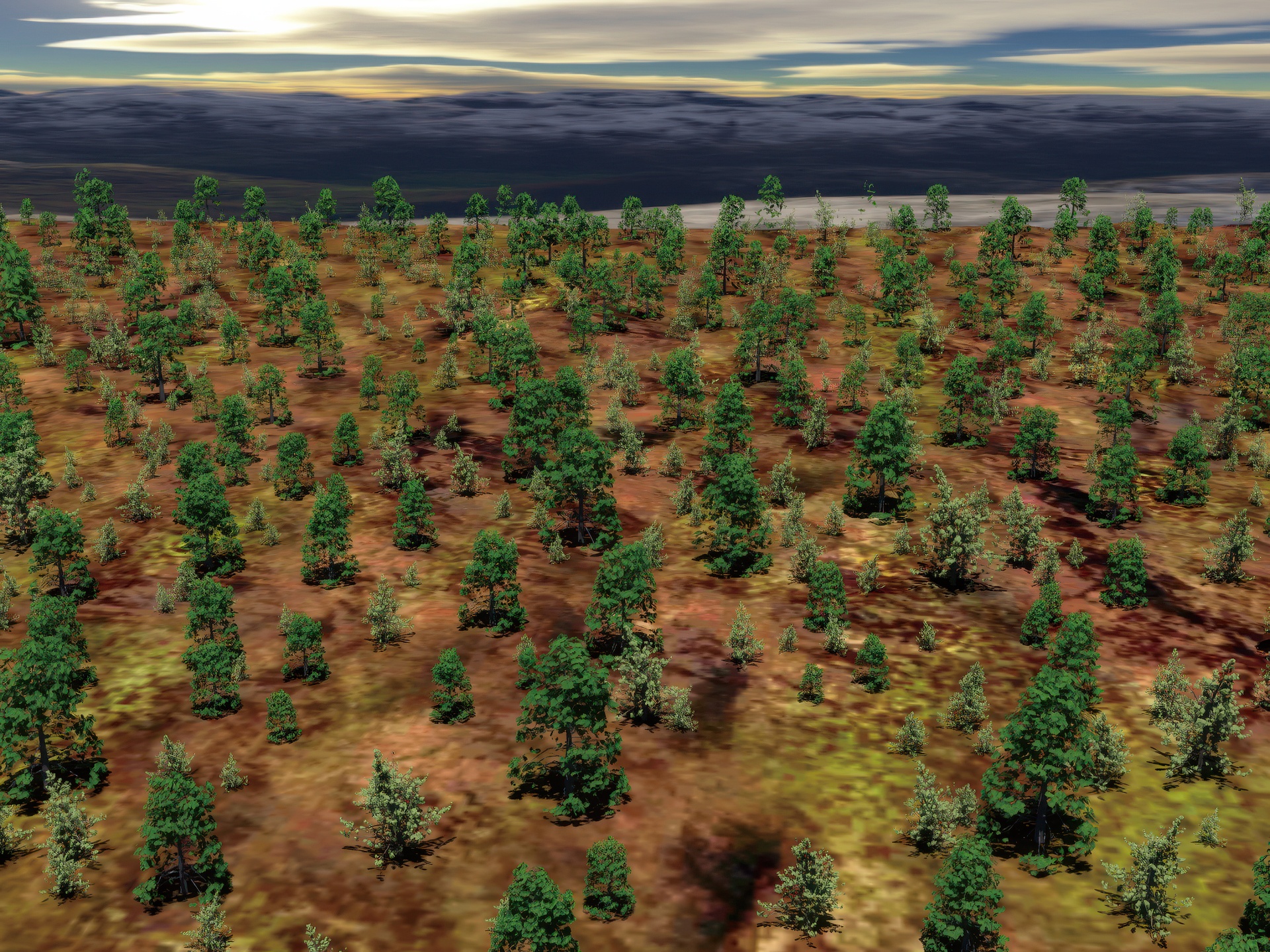
Blue noise sampling is an important component in many graphics applications, but existing techniques consider mainly the spatial positions of samples, making them less effective when handling problems with non-spatial features. Examples include biological distribution in which plant spacing is influenced by non-positional factors such as tree type and size, photon mapping in which photon flux and direction are not a direct function of the attached surface, and point cloud sampling in which the underlying surface is unknown a priori. These scenarios can benefit from blue noise sample distributions, but cannot be adequately handled by prior art.Inspired by bilateral filtering, we propose a bilateral blue noise sampling strategy. Our key idea is a general formulation to modulate the traditional sample distance measures, which are determined by sample position in spatial domain, with a similarity measure that considers arbitrary per sample attributes. This modulation leads to the notion of bilateral blue noise whose properties are influenced by not only the uniformity of the sample positions but also the similarity of the sample attributes. We describe how to incorporate our modulation into various sample analysis and synthesis methods, and demonstrate applications in object distribution, photon density estimation, and point cloud sub-sampling.
References:
1. Balzer, M., Schlömer, T., and Deussen, O. 2009. Capacity-constrained point distributions: A variant of Lloyd’s method. ACM Trans. Graph. 28, 3, 86:1–86:8.
2. Bao, G., Li, H., Zhang, X., and Dong, W. 2012. Large-scale forest rendering: Real-time, realistic, and progressive. Comput. Graph. 36, 3, 140–151.
3. Bolander, J., and Saito, S. 1998. Fracture analyses using spring networks with random geometry. Engineering Fracture Mechanics 61, 5, 569–591.
4. Bowers, J., Wang, R., Wei, L.-Y., and Maletz, D. 2010. Parallel Poisson disk sampling with spectrum analysis on surfaces. ACM Trans. Graph. 29, 6, 166:1–166:10.
5. Burkhart, H., and Tomé, M. 2012. Indices of individual-tree competition. In Modeling Forest Trees and Stands. Springer Netherlands, 201–232.
6. Chang, J., Alain, B., and Ostromoukhov, V. 2009. Structure-aware error diffusion. ACM Trans. Graph. 28, 5, 162:1–162:8.
7. Cook, R. L. 1986. Stochastic sampling in computer graphics. ACM Trans. Graph. 5, 1, 51–72.
8. de Goes, F., Breeden, K., Ostromoukhov, V., and Desbrun, M. 2012. Blue noise through optimal transport. ACM Trans. Graph. 31, 6, 171:1–171:11.
9. Diggle, P., Eglen, S., and Troy, J. 2006. Modelling the bivariate spatial distribution of amacrine cells. In Case Studies in Spatial Point Process Modeling, Lecture Notes in Statistics 185. Springer New York, 215–233.
10. Ebeida, M. S., Davidson, A. A., Patney, A., Knupp, P. M., Mitchell, S. A., and Owens, J. D. 2011. Efficient maximal Poisson-disk sampling. ACM Trans. Graph. 30, 4, 49:1–49:12.
11. Fattal, R. 2011. Blue-noise point sampling using kernel density model. ACM Trans. Graph. 30, 4, 48:1–48:12.
12. Ge, X., Wei, L.-Y., Wang, Y., and Wang, H. 2013. Bilateral blue noise sampling: Additional algorithms and applications. Tech. Rep. OSU-CISRC-8/13-TR17, The Ohio State University – Department of Computer Science and Engineering. ftp://ftp.cse.ohio-state.edu/pub/tech-report/2013/TR17.pdf.
13. Hachisuka, T., Ogaki, S., and Jensen, H. W. 2008. Progressive photon mapping. ACM Trans. Graph. 27, 5, 130:1–130:8.
14. Huang, H., Wu, S., Gong, M., Cohen-Or, D., Ascher, U., and Zhang, H. R. 2013. Edge-aware point set resampling. ACM Trans. Graph. 32, 1, 9:1–9:12.
15. Illian, J., Penttinen, A., Stoyan, H., and Stoyan, D. 2008. Statistical Analysis and Modelling of Spatial Point Patterns. John Wiley & Sons, Ltd.
16. Jensen, H. W., and Christensen, P. H. 1998. Efficient simulation of light transport in scenes with participating media using photon maps. In SIGGRAPH ’98, 311–320.
17. Jensen, H. W. 1996. Global illumination using photon maps. In Proceedings of the Eurographics Workshop on Rendering Techniques ’96, 21–30.
18. Kopf, J., Cohen-Or, D., Deussen, O., and Lischinski, D. 2006. Recursive Wang tiles for real-time blue noise. ACM Trans. Graph. 25, 3, 509–518.
19. Lagae, A., and Dutré, P. 2008. A comparison of methods for generating Poisson disk distributions. Comput. Graph. Forum 27, 1, 114–129.
20. Lévy, B., and Liu, Y. 2010. Lp centroidal Voronoi tessellation and its applications. ACM Trans. Graph. 29, 4, 119:1–119:11.
21. Li, H., Wei, L.-Y., Sander, P. V., and Fu, C.-W. 2010. Anisotropic blue noise sampling. ACM Trans. Graph. 29, 6, 167:1–167:12.
22. Lipman, Y., Cohen-Or, D., Levin, D., and Tal-Ezer, H. 2007. Parameterization-free projection for geometry reconstruction. ACM Trans. Graph. 26, 3, 22:1–22:6.
23. Lloyd, S. 1982. Least squares quantization in PCM. IEEE Transactions on Information Theory 28, 2, 129–137.
24. Nash, J. 1954. C1–isometric imbeddings. Annals of Mathematics 60, 3, 383–396.
25. Öztireli, A. C., and Gross, M. 2012. Analysis and synthesis of point distributions based on pair correlation. ACM Trans. Graph. 31, 6, 170:1–170:10.
26. Öztireli, A. C., Alexa, M., and Gross, M. 2010. Spectral sampling of manifolds. ACM Trans. Graph. 29, 6, 168:1–168:8.
27. Pirk, S., Stava, O., Kratt, J., Said, M. A. M., Neubert, B., Měch, R., Benes, B., and Deussen, O. 2012. Plastic trees: Interactive self-adapting botanical tree models. ACM Trans. Graph. 31, 4, 50:1–50:10.
28. Pommerening, A. 2002. Approaches to quantifying forest structures. Forestry 75, 3, 305–324.
29. Schechter, H., and Bridson, R. 2012. Ghost SPH for animating water. ACM Trans. Graph. 31, 4, 61:1–61:8.
30. Schjøth, L., Sporring, J., and Olsen, O. F. 2008. Diffusion based photon mapping. Comput. Graph. Forum 27, 8, 2114–2127.
31. Schmaltz, C., Gwosdek, P., Bruhn, A., and Weickert, J. 2010. Electrostatic halftoning. Comput. Graph. Forum 29, 8, 2313–2327.
32. Schmaltz, C., Gwosdek, P., and Weickert, J. 2012. Multiclass anisotropic electrostatic halftoning. Comput. Graph. Forum 31, 6, 1924–1935.
33. Schregle, R. 2003. Bias compensation for photon maps. Comput. Graph. Forum 22, 4, 729–742.
34. Spencer, B., and Jones, M. W. 2009. Into the blue: Better caustics through photon relaxation. Comput. Graph. Forum 28, 2, 319–328.
35. Spencer, B., and Jones, M. W. 2013. Photon parameterisation for robust relaxation constraints. Comput. Graph. Forum 32, 2, to appear.
36. Spencer, B., and Jones, M. W. 2013. Progressive photon relaxation. ACM Trans. Graph. 32, 1, 7:1–7:11.
37. Sun, X., Zhou, K., Guo, J., Xie, G., Pan, J., Wang, W., and Guo, B. 2013. Line segment sampling with blue-noise properties. ACM Trans. Graph. 32, 4, 127:1–127:14.
38. Tomasi, C., and Manduchi, R. 1998. Bilateral filtering for gray and color images. In ICCV ’98, 839–839.
39. Turk, G. 1992. Re-tiling polygonal surfaces. In SIGGRAPH ’92, 55–64.
40. Ulichney, R. A. 1987. Digital Halftoning. MIT Press, Cambridge, MA.
41. Wei, L.-Y., and Wang, R. 2011. Differential domain analysis for non-uniform sampling. ACM Trans. Graph. 30, 4, 50:1–50:10.
42. Wei, L.-Y. 2008. Parallel Poisson disk sampling. ACM Trans. Graph. 27, 3, 20:1–20:9.
43. Wei, L.-Y. 2010. Multi-class blue noise sampling. ACM Trans. Graph. 29, 4, 79:1–79:8.
44. Yan, D.-M., and Wonka, P. 2013. Gap processing for adaptive maximal Poisson-disk sampling. ACM Trans. Graph., to appear.
45. Yellott, J. I. J. 1983. Spectral consequences of photoreceptor sampling in the rhesus retina. Science 221, 382–385.
46. Zhou, Y., Huang, H., Wei, L.-Y., and Wang, R. 2012. Point sampling with general noise spectrum. ACM Trans. Graph. 31, 4, 76:1–76:11.



