
“Appearance-preserving tactile optimization” by Tymms, Wang and Zorin
Conference:
Type(s):
Title:
- Appearance-preserving tactile optimization
Session/Category Title:
- Fabrication: Computational Design
Presenter(s)/Author(s):
Abstract:
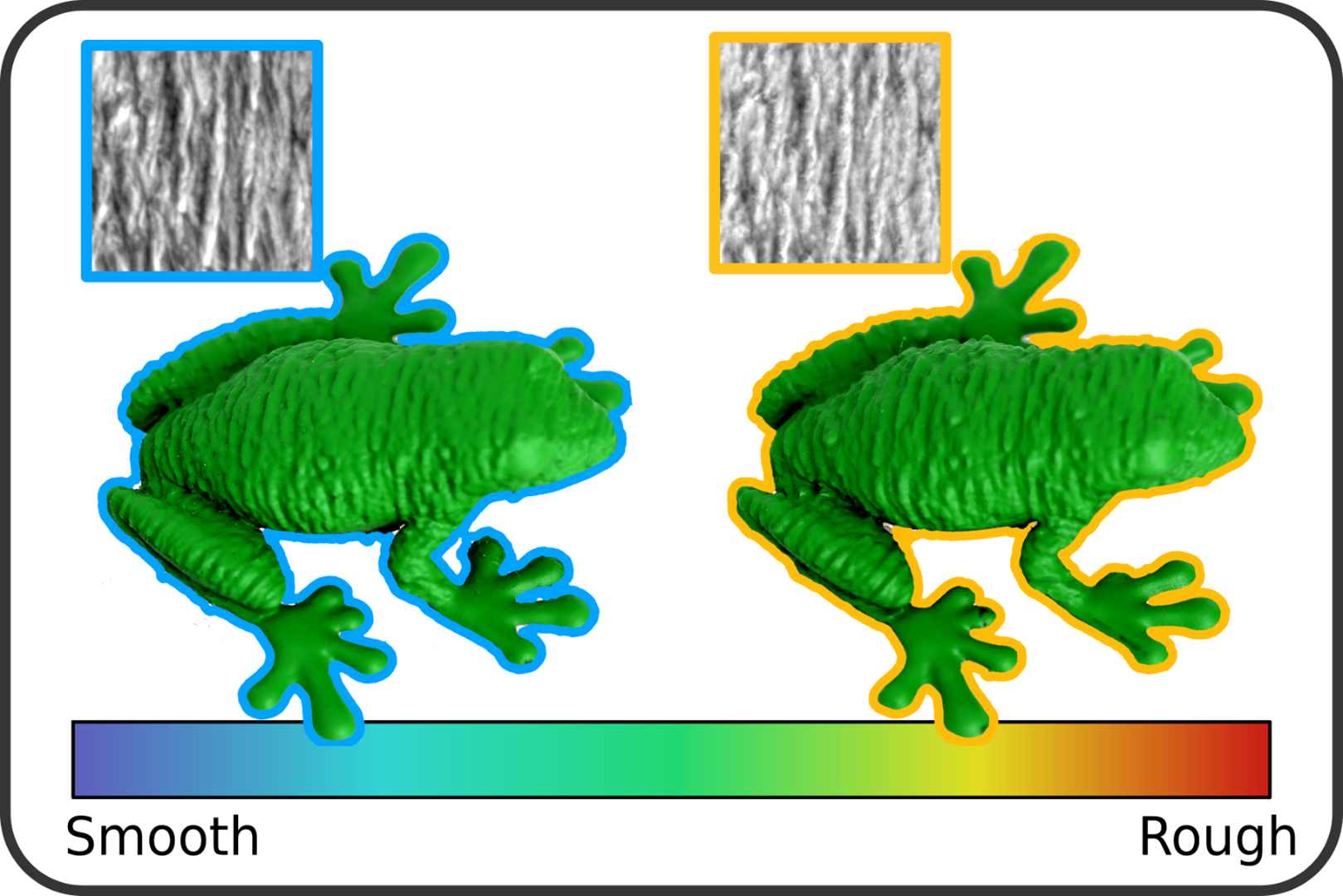
Textures are encountered often on various common objects and surfaces. Many textures combine visual and tactile aspects, each serving important purposes; most obviously, a texture alters the object’s appearance or tactile feeling as well as serving for visual or tactile identification and improving usability. The tactile feel and visual appearance of objects are often linked, but they may interact in unpredictable ways. Advances in high-resolution 3D printing enable highly flexible control of geometry to permit manipulation of both visual appearance and tactile properties. In this paper, we propose an optimization method to independently control the tactile properties and visual appearance of a texture. Our optimization is enabled by neural network-based models, and allows the creation of textures with a desired tactile feeling while preserving a desired visual appearance at a relatively low computational cost, for use in a variety of applications.
References:
1. Connelly Barnes and Fang-Lue Zhang. 2016. A survey of the state-of-the-art in patch-based synthesis. Computational Visual Media (2016), 1–18. Google ScholarCross Ref
2. Phil Brodatz. 1966. Testures: A Photographic Album for Artists and Designers. Dover.Google Scholar
3. Desai Chen, David IW Levin, Piotr Didyk, Pitchaya Sitthi-Amorn, and Wojciech Matusik. 2013. Spec2Fab: a reducer-tuner model for translating specifications to 3D prints. ACM Transactions on Graphics (TOG) 32, 4 (2013), 135.Google ScholarDigital Library
4. M. Cimpoi, S. Maji, I. Kokkinos, S. Mohamed, and A. Vedaldi. 2014. Describing Textures in the Wild. In Proceedings of the IEEE Conf. on Computer Vision and Pattern Recognition (CVPR).Google Scholar
5. Charles E Connor, Steven S Hsiao, John R Phillips, and Kenneth O Johnson. 1990. Tactile roughness: neural codes that account for psychophysical magnitude estimates. The Journal of neuroscience 10, 12 (1990), 3823–3836.Google ScholarCross Ref
6. Donald Degraen, André Zenner, and Antonio Krüger. 2019. Enhancing Texture Perception in Virtual Reality Using 3D-Printed Hair Structures. (2019).Google Scholar
7. Alexei A Efros and Thomas K Leung. 1999. Texture synthesis by non-parametric sampling. In iccv. IEEE, 1033.Google Scholar
8. Oskar Elek, Denis Sumin, Ran Zhang, Tim Weyrich, Karol Myszkowski, Bernd Bickel, Alexander Wilkie, and Jaroslav Křivánek. 2017. Scattering-aware texture reproduction for 3D printing. ACM Transactions on Graphics (TOG) 36, 6 (2017), 241.Google ScholarDigital Library
9. Galal Elkharraz, Stefan Thumfart, Diyar Akay, Christian Eitzinger, and Benjamin Henson. 2014. Making tactile textures with predefined affective properties. Affective Computing, IEEE Transactions on 5, 1 (2014), 57–70.Google ScholarCross Ref
10. Alexander IJ Forrester and Andy J Keane. 2009. Recent advances in surrogate-based optimization. Progress in aerospace sciences 45, 1–3 (2009), 50–79.Google Scholar
11. Leon Gatys, Alexander S Ecker, and Matthias Bethge. 2015. Texture synthesis using convolutional neural networks. In Advances in neural information processing systems. 262–270.Google Scholar
12. Bjoern Haefner, Yvain Quéau, Thomas Möllenhoff, and Daniel Cremers. 2018. Fight ill-posedness with ill-posedness: Single-shot variational depth super-resolution from shading. In Proceedings of the IEEE Conference on Computer Vision and Pattern Recognition. 164–174.Google ScholarCross Ref
13. Jan S Hesthaven and Stefano Ubbiali. 2018. Non-intrusive reduced order modeling of nonlinear problems using neural networks. J. Comput. Phys. 363 (2018), 55–78.Google ScholarDigital Library
14. Mark Hollins and Sliman J Bensmaïa. 2007. The coding of roughness. Canadian Journal of Experimental Psychology/Revue canadienne de psychologie experimentale 61, 3 (2007), 184.Google Scholar
15. Mark Hollins and S Ryan Risner. 2000. Evidence for the duplex theory of tactile texture perception. Perception & psychophysics 62, 4 (2000), 695–705.Google Scholar
16. Phillip Isola, Jun-Yan Zhu, Tinghui Zhou, and Alexei A Efros. 2017. Image-to-image translation with conditional adversarial networks. arXiv preprint (2017).Google Scholar
17. Diederik P Kingma and Jimmy Ba. 2014. Adam: A method for stochastic optimization. arXiv preprint arXiv:1412.6980 (2014).Google Scholar
18. Tzu-Mao Li, Miika Aittala, Frédo Durand, and Jaakko Lehtinen. 2018. Differentiable Monte Carlo Ray Tracing through Edge Sampling. ACM Trans. Graph. (Proc. SIGGRAPH Asia) 37, 6 (2018), 222:1–222:11.Google Scholar
19. Louise R Manfredi, Hannes P Saal, Kyler J Brown, Mark C Zielinski, John F Dammann, Vicky S Polashock, and Sliman J Bensmaia. 2014. Natural scenes in tactile texture. Journal of neurophysiology 111, 9 (2014), 1792–1802.Google ScholarCross Ref
20. Rafat Mantiuk, Kil Joong Kim, Allan G Rempel, and Wolfgang Heidrich. 2011. HDR-VDP-2: a calibrated visual metric for visibility and quality predictions in all luminance conditions. In ACM Transactions on graphics (TOG), Vol. 30. ACM, 40.Google Scholar
21. Rodrigo Martín, Min Xue, Reinhard Klein, Matthias B Hullin, and Michael Weinmann. 2019. Using patch-based image synthesis to measure perceptual texture similarity. Computers & Graphics 81 (2019), 104–116.Google ScholarCross Ref
22. MITMediaLab. 1995. Vision texture, VisTexdatabase. http://vismod.media.mit.edu/vismod/imagery/VisionTexture/Google Scholar
23. Michal Piovarči, David I.W. Levin, Jason Rebello, Desai Chen, Roman Ďurikovič, Hanspeter Pfister, Wojciech Matusik, and Piotr Didyk. 2016. An Interaction-Aware, Perceptual Model For Non-Linear Elastic Objects. ACM Transactions on Graphics (Proc. SIGGRAPH) 35, 4 (2016).Google ScholarDigital Library
24. Javier Portilla and Eero P Simoncelli. 2000. A parametric texture model based on joint statistics of complex wavelet coefficients. International journal of computer vision 40, 1 (2000), 49–70.Google Scholar
25. M Raissi, P Perdikaris, and GE Karniadakis. 2019. Physics-informed neural networks: A deep learning framework for solving forward and inverse problems involving nonlinear partial differential equations. J. Comput. Phys. 378 (2019), 686–707.Google ScholarCross Ref
26. Olivier Rouiller, Bernd Bickel, Jan Kautz, Wojciech Matusik, and Marc Alexa. 2013. 3D-printing spatially varying BRDFs. IEEE computer graphics and applications 33, 6 (2013), 48–57.Google ScholarDigital Library
27. Christian Schüller, Daniele Panozzo, and Olga Sorkine-Hornung. 2014. Appearance-mimicking surfaces. ACM Transactions on Graphics (TOG) 33, 6 (2014), 216.Google ScholarDigital Library
28. Liang Shi, Vahid Babaei, Changil Kim, Michael Foshey, Yuanming Hu, Pitchaya Sitthi-Amorn, Szymon Rusinkiewicz, and Wojciech Matusik. 2018. Deep multispectral painting reproduction via multi-layer, custom-ink printing. In SIGGRAPH Asia 2018 Technical Papers. ACM, 271.Google Scholar
29. Wouter M Bergmann Tiest. 2010. Tactual perception of material properties. Vision research 50, 24 (2010), 2775–2782.Google Scholar
30. Wouter M Bergmann Tiest and Astrid ML Kappers. 2009. Tactile perception of thermal diffusivity. Attention, perception, & psychophysics 71, 3 (2009), 481–489.Google Scholar
31. Cesar Torres, Tim Campbell, Neil Kumar, and Eric Paulos. 2015. HapticPrint: Designing Feel Aesthetics for Digital Fabrication. In Proceedings of the 28th Annual ACM Symposium on User Interface Software & Technology. ACM, 583–591.Google ScholarDigital Library
32. Chelsea Tymms, Esther P Gardner, and Denis Zorin. 2018. A Quantitative Perceptual Model for Tactile Roughness. ACM Transactions on Graphics (TOG) 37, 5 (2018), 168.Google ScholarDigital Library
33. Chelsea Tymms, Denis Zorin, and Esther P Gardner. 2017. Tactile perception of the roughness of 3D-printed textures. Journal of Neurophysiology 119, 3 (2017), 862–876.Google ScholarCross Ref
34. Dmitry Ulyanov, Vadim Lebedev, Andrea Vedaldi, and Victor S Lempitsky. 2016. Texture Networks: Feed-forward Synthesis of Textures and Stylized Images.. In ICML. 1349–1357.Google ScholarDigital Library
35. Thomas SA Wallis, Christina M Funke, Alexander S Ecker, Leon A Gatys, Felix A Wichmann, and Matthias Bethge. 2017. A parametric texture model based on deep convolutional features closely matches texture appearance for humans. Journal of vision 17, 12 (2017), 5–5.Google ScholarCross Ref
36. Kai Wang, Guillaume Lavoué, Florence Denis, and Atilla Baskurt. 2008. A comprehensive survey on three-dimensional mesh watermarking. IEEE Transactions on Multimedia 10, 8 (2008), 1513–1527.Google ScholarDigital Library
37. Xin Wang, Man Jiang, Zuowan Zhou, Jihua Gou, and David Hui. 2017. 3D printing of polymer matrix composites: A review and prospective. Composites Part B: Engineering 110 (2017), 442–458.Google ScholarCross Ref
38. Zhou Wang, Alan C Bovik, Hamid R Sheikh, and Eero P Simoncelli. 2004. Image quality assessment: from error visibility to structural similarity. IEEE transactions on image processing 13, 4 (2004), 600–612.Google ScholarDigital Library
39. Zhou Wang, Eero P Simoncelli, and Alan C Bovik. 2003. Multiscale structural similarity for image quality assessment. In The Thrity-Seventh Asilomar Conference on Signals, Systems & Computers, 2003, Vol. 2. Ieee, 1398–1402.Google ScholarCross Ref
40. Li-Yi Wei and Marc Levoy. 2000. Fast texture synthesis using tree-structured vector quantization. In Proceedings of the 27th annual conference on Computer graphics and interactive techniques. ACM Press/Addison-Wesley Publishing Co., 479–488.Google ScholarDigital Library
41. YahooJAPAN. 2013. Frog. https://www.thingiverse.com/thing:182144 Modified.Google Scholar
42. Ying Yang, Ruggero Pintus, Holly Rushmeier, and Ioannis Ivrissimtzis. 2017. A 3D steganalytic algorithm and steganalysis-resistant watermarking. IEEE transactions on visualization and computer graphics 23, 2 (2017), 1002–1013.Google ScholarDigital Library
43. Ning Yu, Connelly Barnes, Eli Shechtman, Sohrab Amirghodsi, and Michal Lukac. 2019. Texture Mixer: A Network for Controllable Synthesis and Interpolation of Texture. In The IEEE Conference on Computer Vision and Pattern Recognition (CVPR).Google Scholar
44. Lin Zhang, Lei Zhang, Xuanqin Mou, David Zhang, et al. 2011. FSIM: a feature similarity index for image quality assessment. IEEE transactions on Image Processing 20, 8 (2011), 2378–2386.Google Scholar
45. Richard Zhang, Phillip Isola, Alexei A. Efros, Eli Shechtman, and Oliver Wang. 2018. The Unreasonable Effectiveness of Deep Features as a Perceptual Metric. In The IEEE Conference on Computer Vision and Pattern Recognition (CVPR).Google ScholarCross Ref
46. Xiaoting Zhang, Guoxin Fang, Chengkai Dai, Jouke Verlinden, Jun Wu, Emily Whiting, and Charlie CL Wang. 2017. Thermal-comfort design of personalized casts. In Proceedings of the 30th Annual ACM Symposium on User Interface Software and Technology. ACM, 243–254.Google ScholarDigital Library
47. Yang Zhou, Zhen Zhu, Xiang Bai, Dani Lischinski, Daniel Cohen-Or, and Hui Huang. 2018. Non-stationary Texture Synthesis by Adversarial Expansion. ACM Transactions on Graphics (Proc. SIGGRAPH) 37, 4 (2018), 49:1–49:13.Google Scholar



