
“Anti-Aliased Neural Implicit Surfaces with Encoding Level of Detail” by Zhuang, Zhang, Feng, Zhu, Yao, et al. …
Conference:
Type(s):
Title:
- Anti-Aliased Neural Implicit Surfaces with Encoding Level of Detail
Session/Category Title:
- Neural Shape Representation
Presenter(s)/Author(s):
Abstract:
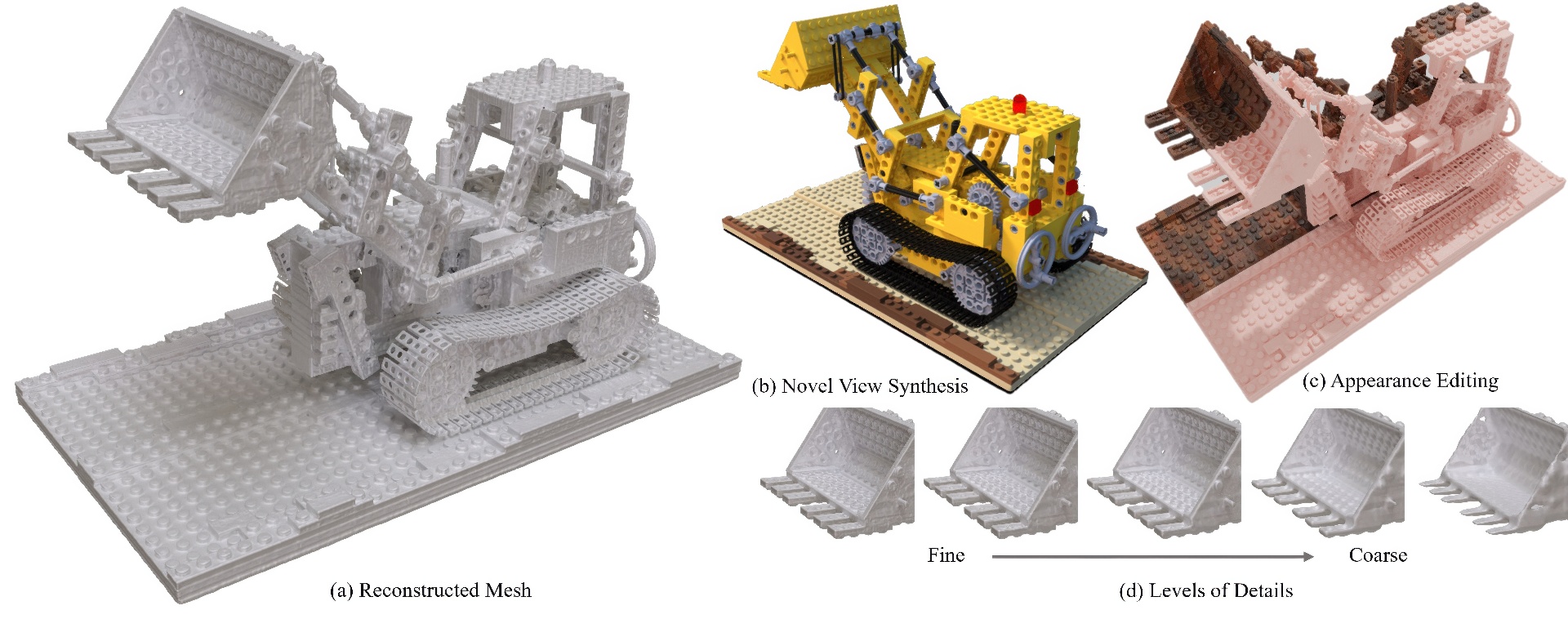
We present LoD-NeuS, an efficient neural representation for high-frequency geometry detail recovery and anti-aliased novel view rendering. Drawing inspiration from voxel-based representations with the level of detail (LoD), we introduce a multi-scale tri-plane-based scene representation that is capable of capturing the LoD of the signed distance function (SDF) and the space radiance. Our representation aggregates space features from a multi-level convolved featurization within a conical frustum along a ray and optimizes the LoD feature volume through differentiable rendering. Additionally, we propose an error-guided sampling strategy to guide the growth of the SDF during the optimization. Both qualitative and quantitative evaluations demonstrate that our method achieves superior surface reconstructions and photorealistic view synthesis compared to state-of-the-art approaches.
References:
[1]
Henrik Aanæs, Rasmus Ramsbøl Jensen, George Vogiatzis, Engin Tola, and Anders Bjorholm Dahl. 2016. Large-scale data for multiple-view stereopsis. International Journal of Computer Vision 120 (2016), 153–168.
[2]
Connelly Barnes, Eli Shechtman, Adam Finkelstein, and Dan B Goldman. 2009. PatchMatch: A randomized correspondence algorithm for structural image editing. ACM Trans. Graph. 28, 3 (2009), 24.
[3]
Jonathan T Barron, Ben Mildenhall, Dor Verbin, Pratul P Srinivasan, and Peter Hedman. 2022. Mip-nerf 360: Unbounded anti-aliased neural radiance fields. In CVPR. 5470–5479.
[4]
Fausto Bernardini, Joshua Mittleman, Holly Rushmeier, Cláudio Silva, and Gabriel Taubin. 1999. The ball-pivoting algorithm for surface reconstruction. IEEE transactions on visualization and computer graphics 5, 4 (1999), 349–359.
[5]
Adrian Broadhurst, Tom W Drummond, and Roberto Cipolla. 2001. A probabilistic framework for space carving. In Proceedings eighth IEEE international conference on computer vision. ICCV 2001, Vol. 1. IEEE, 388–393.
[6]
Neill DF Campbell, George Vogiatzis, Carlos Hernández, and Roberto Cipolla. 2008. Using multiple hypotheses to improve depth-maps for multi-view stereo. In Computer Vision–ECCV 2008: 10th European Conference on Computer Vision, Marseille, France, October 12-18, 2008, Proceedings, Part I 10. Springer, 766–779.
[7]
Rohan Chabra, Jan E Lenssen, Eddy Ilg, Tanner Schmidt, Julian Straub, Steven Lovegrove, and Richard Newcombe. 2020. Deep local shapes: Learning local sdf priors for detailed 3d reconstruction. In European conference on computer vision. 608–625.
[8]
Eric R Chan, Connor Z Lin, Matthew A Chan, Koki Nagano, Boxiao Pan, Shalini De Mello, Orazio Gallo, Leonidas J Guibas, Jonathan Tremblay, Sameh Khamis, 2022. Efficient geometry-aware 3D generative adversarial networks. In Proceedings of the IEEE/CVF Conference on Computer Vision and Pattern Recognition. 16123–16133.
[9]
Anpei Chen, Zexiang Xu, Andreas Geiger, Jingyi Yu, and Hao Su. 2022a. Tensorf: Tensorial radiance fields. In Computer Vision–ECCV 2022: 17th European Conference, Tel Aviv, Israel, October 23–27, 2022, Proceedings, Part XXXII. Springer, 333–350.
[10]
Xingyu Chen, Qi Zhang, Xiaoyu Li, Yue Chen, Ying Feng, Xuan Wang, and Jue Wang. 2022b. Hallucinated neural radiance fields in the wild. In Proceedings of the IEEE/CVF Conference on Computer Vision and Pattern Recognition. 12943–12952.
[11]
Robert L Cook. 1986. Stochastic sampling in computer graphics. ACM Transactions on Graphics (TOG) 5, 1 (1986), 51–72.
[12]
Angela Dai, Matthias Nießner, Michael Zollhöfer, Shahram Izadi, and Christian Theobalt. 2017. Bundlefusion: Real-time globally consistent 3d reconstruction using on-the-fly surface reintegration. ACM Transactions on Graphics (ToG) 36, 4 (2017), 1.
[13]
François Darmon, Bénédicte Bascle, Jean-Clément Devaux, Pascal Monasse, and Mathieu Aubry. 2022. Improving neural implicit surfaces geometry with patch warping. In CVPR. 6260–6269.
[14]
Jeremy S De Bonet and Paul Viola. 1999. Poxels: Probabilistic voxelized volume reconstruction. In Proceedings of International Conference on Computer Vision (ICCV), Vol. 2. 3.
[15]
Qiancheng Fu, Qingshan Xu, Yew Soon Ong, and Wenbing Tao. 2022. Geo-neus: Geometry-consistent neural implicit surfaces learning for multi-view reconstruction. Advances in Neural Information Processing Systems 35 (2022), 3403–3416.
[16]
Yasutaka Furukawa and Jean Ponce. 2009. Accurate, dense, and robust multiview stereopsis. IEEE transactions on pattern analysis and machine intelligence 32, 8 (2009), 1362–1376.
[17]
Kyle Genova, Forrester Cole, Avneesh Sud, Aaron Sarna, and Thomas Funkhouser. 2020. Local deep implicit functions for 3d shape. In CVPR. 4857–4866.
[18]
Amos Gropp, Lior Yariv, Niv Haim, Matan Atzmon, and Yaron Lipman. 2020. Implicit geometric regularization for learning shapes. In Proceedings of the 37th International Conference on Machine Learning. 3789–3799.
[19]
Xian-Feng Han, Hamid Laga, and Mohammed Bennamoun. 2019. Image-based 3D object reconstruction: State-of-the-art and trends in the deep learning era. IEEE T-PAMI 43, 5 (2019), 1578–1604.
[20]
Hugues Hoppe, Tony DeRose, Tom Duchamp, John McDonald, and Werner Stuetzle. 1992. Surface reconstruction from unorganized points. In Proceedings of the 19th annual conference on computer graphics and interactive techniques. 71–78.
[21]
Xin Huang, Qi Zhang, Ying Feng, Hongdong Li, and Qing Wang. 2023. Inverting the Imaging Process by Learning an Implicit Camera Model. In Proceedings of the IEEE/CVF Conference on Computer Vision and Pattern Recognition. 21456–21465.
[22]
Xin Huang, Qi Zhang, Ying Feng, Hongdong Li, Xuan Wang, and Qing Wang. 2022. Hdr-nerf: High dynamic range neural radiance fields. In Proceedings of the IEEE/CVF Conference on Computer Vision and Pattern Recognition. 18398–18408.
[23]
Shahram Izadi, David Kim, Otmar Hilliges, David Molyneaux, Richard Newcombe, Pushmeet Kohli, Jamie Shotton, Steve Hodges, Dustin Freeman, Andrew Davison, 2011. Kinectfusion: real-time 3d reconstruction and interaction using a moving depth camera. In Proceedings of the 24th annual ACM symposium on User interface software and technology. 559–568.
[24]
Michael Kazhdan, Matthew Bolitho, and Hugues Hoppe. 2006. Poisson surface reconstruction. In Proceedings of the fourth Eurographics symposium on Geometry processing, Vol. 7. 0.
[25]
Kiriakos N Kutulakos and Steven M Seitz. 2000. A theory of shape by space carving. International journal of computer vision 38 (2000), 199–218.
[26]
Patrick Labatut, Jean-Philippe Pons, and Renaud Keriven. 2007. Efficient multi-view reconstruction of large-scale scenes using interest points, delaunay triangulation and graph cuts. In 2007 IEEE 11th international conference on computer vision. IEEE, 1–8.
[27]
Erich Liang, Kenan Deng, Xi Zhang, and Chun-Kai Wang. 2023. HR-NeuS: Recovering High-Frequency Surface Geometry via Neural Implicit Surfaces. arxiv:2302.06793 [cs.CV]
[28]
Li Ma, Xiaoyu Li, Jing Liao, Qi Zhang, Xuan Wang, Jue Wang, and Pedro V Sander. 2022. Deblur-nerf: Neural radiance fields from blurry images. In Proceedings of the IEEE/CVF Conference on Computer Vision and Pattern Recognition. 12861–12870.
[29]
Nelson Max. 1995. Optical models for direct volume rendering. IEEE Transactions on Visualization and Computer Graphics 1, 2 (1995), 99–108.
[30]
Paul Merrell, Amir Akbarzadeh, Liang Wang, Philippos Mordohai, Jan-Michael Frahm, Ruigang Yang, David Nistér, and Marc Pollefeys. 2007. Real-time visibility-based fusion of depth maps. In 2007 IEEE 11th International Conference on Computer Vision. Ieee, 1–8.
[31]
Lars Mescheder, Michael Oechsle, Michael Niemeyer, Sebastian Nowozin, and Andreas Geiger. 2019. Occupancy networks: Learning 3d reconstruction in function space. In CVPR. 4460–4470.
[32]
B Mildenhall, PP Srinivasan, M Tancik, JT Barron, R Ramamoorthi, and R Ng. 2020. Nerf: Representing scenes as neural radiance fields for view synthesis. In European conference on computer vision.
[33]
Thomas Müller, Alex Evans, Christoph Schied, and Alexander Keller. 2022. Instant neural graphics primitives with a multiresolution hash encoding. ACM Transactions on Graphics (ToG) 41, 4 (2022), 1–15.
[34]
Matthias Nießner, Michael Zollhöfer, Shahram Izadi, and Marc Stamminger. 2013. Real-time 3D reconstruction at scale using voxel hashing. ACM Transactions on Graphics (ToG) 32, 6 (2013), 1–11.
[35]
Michael Oechsle, Songyou Peng, and Andreas Geiger. 2021. Unisurf: Unifying neural implicit surfaces and radiance fields for multi-view reconstruction. In ICCV. 5589–5599.
[36]
Johannes L Schonberger and Jan-Michael Frahm. 2016. Structure-from-motion revisited. In Proceedings of the IEEE conference on computer vision and pattern recognition. 4104–4113.
[37]
Johannes L Schönberger, Enliang Zheng, Jan-Michael Frahm, and Marc Pollefeys. 2016. Pixelwise view selection for unstructured multi-view stereo. In Computer Vision–ECCV 2016: 14th European Conference, Amsterdam, The Netherlands, October 11-14, 2016, Proceedings, Part III 14. Springer, 501–518.
[38]
Steven M Seitz and Charles R Dyer. 1999. Photorealistic scene reconstruction by voxel coloring. International journal of computer vision 35 (1999), 151–173.
[39]
Vincent Sitzmann, Justus Thies, Felix Heide, Matthias Nießner, Gordon Wetzstein, and Michael Zollhofer. 2019. Deepvoxels: Learning persistent 3d feature embeddings. In CVPR. 2437–2446.
[40]
Pratul P Srinivasan, Boyang Deng, Xiuming Zhang, Matthew Tancik, Ben Mildenhall, and Jonathan T Barron. 2021. Nerv: Neural reflectance and visibility fields for relighting and view synthesis. In CVPR. 7495–7504.
[41]
Towaki Takikawa, Joey Litalien, Kangxue Yin, Karsten Kreis, Charles Loop, Derek Nowrouzezahrai, Alec Jacobson, Morgan McGuire, and Sanja Fidler. 2021. Neural geometric level of detail: Real-time rendering with implicit 3D shapes. In Proceedings of the IEEE/CVF Conference on Computer Vision and Pattern Recognition. 11358–11367.
[42]
Ayush Tewari, Justus Thies, Ben Mildenhall, Pratul Srinivasan, Edgar Tretschk, Wang Yifan, Christoph Lassner, Vincent Sitzmann, Ricardo Martin-Brualla, Stephen Lombardi, 2022. Advances in neural rendering. In Computer Graphics Forum, Vol. 41. Wiley Online Library, 703–735.
[43]
Engin Tola, Christoph Strecha, and Pascal Fua. 2012. Efficient large-scale multi-view stereo for ultra high-resolution image sets. Machine Vision and Applications 23 (2012), 903–920.
[44]
Dor Verbin, Peter Hedman, Ben Mildenhall, Todd Zickler, Jonathan T Barron, and Pratul P Srinivasan. 2022. Ref-nerf: Structured view-dependent appearance for neural radiance fields. In CVPR. IEEE, 5481–5490.
[45]
Peng Wang, Lingjie Liu, Yuan Liu, Christian Theobalt, Taku Komura, and Wenping Wang. 2021. NeuS: Learning Neural Implicit Surfaces by Volume Rendering for Multi-view Reconstruction. Advances in Neural Information Processing Systems 34 (2021), 27171–27183.
[46]
Yiqun Wang, Ivan Skorokhodov, and Peter Wonka. 2022. Hf-neus: Improved surface reconstruction using high-frequency details. Advances in Neural Information Processing Systems 35 (2022), 1966–1978.
[47]
Yiqun Wang, Ivan Skorokhodov, and Peter Wonka. 2023. PET-NeuS: Positional Encoding Triplanes for Neural Surfaces. (2023).
[48]
Menghua Wu, Hao Zhu, Linjia Huang, Yiyu Zhuang, Yuanxun Lu, and Xun Cao. 2023. High-fidelity 3D Face Generation from Natural Language Descriptions. In Proceedings of IEEE/CVF Conference on Computer Vision and Pattern Recognition (CVPR).
[49]
Huang Xin, Zhang Qi, Feng Ying, Li Xiaoyu, Wang Xuan, and Wang Qing. 2023. Local Implicit Ray Function for Generalizable Radiance Field Representation. In Proceedings of the IEEE/CVF Conference on Computer Vision and Pattern Recognition.
[50]
Lior Yariv, Jiatao Gu, Yoni Kasten, and Yaron Lipman. 2021. Volume rendering of neural implicit surfaces. Advances in Neural Information Processing Systems 34 (2021), 4805–4815.
[51]
Lior Yariv, Yoni Kasten, Dror Moran, Meirav Galun, Matan Atzmon, Basri Ronen, and Yaron Lipman. 2020. Multiview neural surface reconstruction by disentangling geometry and appearance. Advances in Neural Information Processing Systems 33 (2020), 2492–2502.
[52]
Zehao Yu, Songyou Peng, Michael Niemeyer, Torsten Sattler, and Andreas Geiger. 2022. Monosdf: Exploring monocular geometric cues for neural implicit surface reconstruction. arXiv preprint arXiv:2206.00665 (2022).
[53]
Christopher Zach, Thomas Pock, and Horst Bischof. 2007. A globally optimal algorithm for robust tv-l 1 range image integration. In 2007 IEEE 11th International Conference on Computer Vision. IEEE, 1–8.
[54]
Yichao Zhou, Haozhi Qi, and Yi Ma. 2019. End-to-end wireframe parsing. In Proceedings of the IEEE/CVF International Conference on Computer Vision. 962–971.
[55]
Junyu Zhu, Hao Zhu, Qi Zhang, Fang Zhu, Zhan Ma, and Xun Cao. 2023. Pyramid NeRF: Frequency Guided Fast Radiance Field Optimization. International Journal of Computer Vision (2023), 1–16.
[56]
Yiyu Zhuang, Qi Zhang, Xuan Wang, Hao Zhu, Ying Feng, Xiaoyu Li, Ying Shan, and Xun Cao. 2023. NeAI: A Pre-convoluted Representation for Plug-and-Play Neural Ambient Illumination. arXiv preprint arXiv:2304.08757 (2023).
[57]
Yiyu Zhuang, Hao Zhu, Xusen Sun, and Xun Cao. 2022. Mofanerf: Morphable facial neural radiance field. In European conference on computer vision.



