“Analysis, reconstruction and manipulation using arterial snakes”
Conference:
Type(s):
Title:
- Analysis, reconstruction and manipulation using arterial snakes
Session/Category Title:
- Reconstructing and editing geometry
Presenter(s)/Author(s):
Moderator(s):
Abstract:
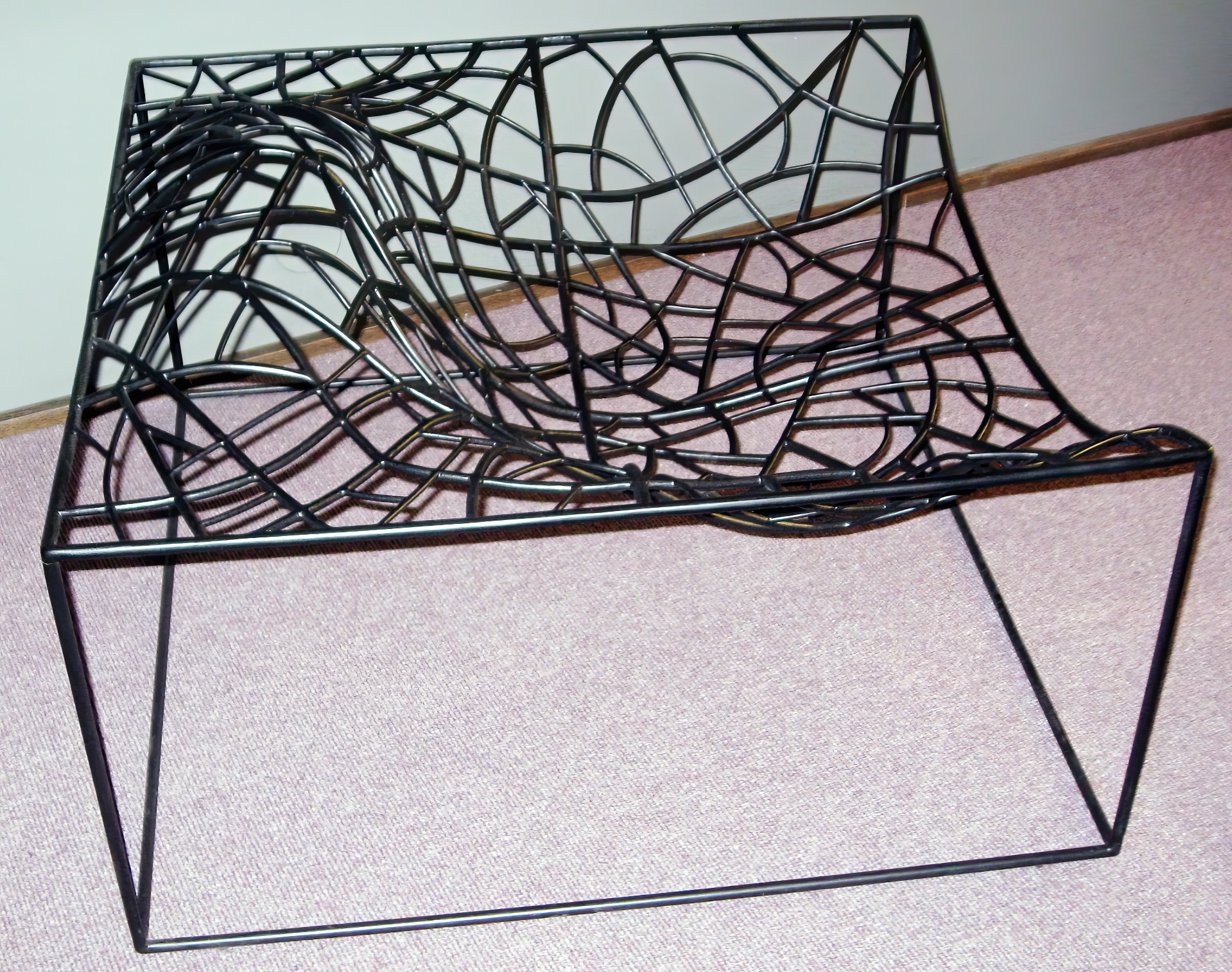
Man-made objects often consist of detailed and interleaving structures, which are created using cane, coils, metal wires, rods, etc. The delicate structures, although manufactured using simple procedures, are challenging to scan and reconstruct. We observe that such structures are inherently 1D, and hence are naturally represented using an arrangement of generating curves. We refer to the resultant surfaces as arterial surfaces. In this paper we approach for analyzing, reconstructing, and manipulating such arterial surfaces.The core of the algorithm is a novel deformable model, called arterial snake, that simultaneously captures the topology and geometry of the arterial objects. The recovered snakes produce a natural decomposition of the raw scans, with the decomposed parts often capturing meaningful object sections. We demonstrate the robustness of our algorithm on a variety of arterial objects corrupted with noise, outliers, and with large parts missing. We present a range of applications including reconstruction, topology repairing, and manipulation of arterial surfaces by directly controlling the underlying curve network and the associated sectional profiles, which are otherwise challenging to perform.
References:
1. Allen, B., Curless, B., and Popović, Z. 2003. The space of human body shapes: reconstruction and parameterization from range scans. ACM Trans. on Graph 22, 3, 587–594. Google ScholarDigital Library
2. Attene, M., Katz, S., Mortara, M., Patane, G., Spagnuolo, M., and Tal, A. 2006. Mesh segmentation – a comparative study. In Proc. Conf. on Shape Modeling and Appl., 14–25. Google ScholarDigital Library
3. Au, O. K.-C., Tai, C.-L., Chu, H.-K., Cohen-Or, D., and Lee, T.-Y. 2008. Skeleton extraction by mesh contraction. ACM Trans. on Graph 27, 3, 44–52. Google ScholarDigital Library
4. Botsch, M., and Kobbelt, L. 2003. Multiresolution surface representation based on displacement volumes. In Eurographics, 483–491.Google Scholar
5. Cao, J., Tagliasacchi, A., Olson, M., Zhang, H., and Su, Z. 2010. Point cloud skeletons via laplacian-based contraction. In Proc. Conf. on Shape Modeling and Appl. Google ScholarDigital Library
6. Chen, X., Golovinskiy, A., and Funkhouser, T. 2009. A benchmark for 3D mesh segmentation. ACM Trans. on Graph 28, 3, #73. Google ScholarDigital Library
7. Cornea, N. D., Silver, D., and Min, P. 2007. Curve-skeleton properties, applications, and algorithms. IEEE Trans. Vis. & Comp. Graphics 13, 3, 530–548. Google ScholarDigital Library
8. Dey, T. K., and Sun, J. 2006. Defining and computing curve-skeletons with medial geodesic function. In Proc. Symp. on Geometry Processing, 143–152. Google ScholarDigital Library
9. Duan, Y., and Qin, H. 2004. Intelligent balloon: A subdivision based deformable model for surface reconstruction of unknown topology. Graphical Models 66, 4, 181–202. Google ScholarDigital Library
10. Esteban, C. H., and Schmitt, F. 2003. A snake approach for high quality image-based 3D object modeling. In Variational, Geometric and Level Set Methods in Comp. Vision, 241–248.Google Scholar
11. Esteve, J., Brunet, P., and Vinacua, A. 2005. Approximation of a variable density cloud of points by shrinking a discrete membrane. Computer Graphics Forum 24, 2, 791–807.Google ScholarCross Ref
12. Gal, R., Sorkine, O., Mitra, N. J., and Cohen-Or, D. 2009. iWIRES: an analyze-and-edit approach to shape manipulation. ACM Trans. on Graph 28, 3, #33. Google ScholarDigital Library
13. Giesen, J., Miklos, B., Pauly, M., and Wormser, C. 2009. The scale axis transform. In Proc. of Symp. on Computational Geometry, 106–115. Google ScholarDigital Library
14. Hilaga, M., Shinagawa, Y., Kohmura, T., and Kunii, T. L. 2001. Topology matching for fully automatic similarity estimation of 3D shapes. In Proc. ACM SIGGRAPH, 203–212. Google ScholarDigital Library
15. Igarashi, T., and Mitani, J. 2010. Apparent layer operations for the manipulation of deformable objects. ACM Trans. on Graph 29, 4, #110. Google ScholarDigital Library
16. Kass, M., Witkin, A., and Terzopoulos, D. 1988. Snakes: Active contour models. International journal of computer vision 1, 4, 321–331.Google Scholar
17. Kazhdan, M., Bolitho, M., and Hoppe, H. 2006. Poisson surface reconstruction. In Proc. Symp. on Geometry Processing, 61–70. Google ScholarDigital Library
18. Kirbas, C., and Quek, F. 2004. A review of vessel extraction techniques and algorithms. ACM Computing Surveys 36, 2, 81–121. Google ScholarDigital Library
19. Kobbelt, L., Campagna, S., Vorsatz, J., and Seidel, H.-P. 1998. Interactive multi-resolution modeling on arbitrary meshes. In Proc. ACM SIGGRAPH, 105–114. Google ScholarDigital Library
20. Lee, Y., and Lee, S. 2002. Geometric snakes for triangular meshes. Computer Graphics Forum 21, 3, 229–238.Google ScholarCross Ref
21. Lee, Y., Lee, S., Shamir, A., Cohen-Or, D., and Seidel, H.-P. 2005. Mesh scissoring with minima rule and part salience. Computer Aided Geometric Design 22, 5, 444–465. Google ScholarDigital Library
22. Lipman, Y., Sorkine, O., Levin, D., and Cohen-Or, D. 2005. Linear rotation-invariant coordinates for meshes. ACM Trans. on Graph 24, 479–487. Google ScholarDigital Library
23. Liu, S., Martin, R. R., Langbein, F. C., and Rosin, P. L. 2006. Segmenting reliefs on triangle meshes. In Proc. ACM Symp. Solid and Physical Modeling. Google ScholarDigital Library
24. Liu, L., Tai, C.-L., Ji, Z., and Wang, G. 2007. Non-iterative approach for global mesh optimization. Computer-Aided Design 39, 9, 772–782. Google ScholarDigital Library
25. Liu, S., Martin, R. R., Langbein, F. C., and Rosin, P. L. 2007. Segmenting periodic reliefs on triangle meshes. In Mathematics of Surfaces XII. Google ScholarDigital Library
26. Livny, Y., Yan, F., Olson, M., Chen, B., Zhang, H., and El-Sana, J. 2010. Automatic reconstruction of tree skeletal structures from point clouds. ACM Trans. on Graph 29, 5, to appear. Google ScholarDigital Library
27. Mehra, R., Zhou, Q., Long, J., Sheffer, A., Gooch, A., and Mitra, N. J. 2009. Abstraction of man-made shapes. ACM Trans. on Graph 28, 5, #137. Google ScholarDigital Library
28. Miklos, B., Giesen, J., and Pauly, M. 2010. Discrete scale axis representations for 3D geometry. ACM Trans. on Graph 29, 3. Google ScholarDigital Library
29. Mitra, N. J., Nguyen, A., and Guibas, L. 2004. Estimating surface normals in noisy point cloud data. International Journal of Computational Geometry and Applications 14, 4–5, 261–276.Google ScholarCross Ref
30. Mitra, N. J., Guibas, L., and Pauly, M. 2007. Symmetrization. ACM Trans. on Graph 26, 3, #63. Google ScholarDigital Library
31. Ohtake, Y., Belyaev, A., Alexa, M., Turk, G., and Seidel, H.-P. 2003. Multi-level partition of unity implicits. ACM Trans. on Graph 22, 3, 463–470. Google ScholarDigital Library
32. Oztireli, C., Guennebaud, G., and Gross, M. 2009. Feature preserving point set surfaces based on non-linear kernel regression. Computer Graphics Forum 28, 2, 493–501.Google ScholarCross Ref
33. Patané, G., Spagnuolo, M., and Falcidieno, B. 2008. Reeb graph computation based on a minimal contouring. In Proc. Shape Modeling and Applications, 73–82.Google Scholar
34. Shamir, A. 2008. A survey on mesh segmentation techniques. Computer Graphics Forum 27, 6, 1539–1556.Google ScholarCross Ref
35. Sharf, A., Lewiner, T., Shamir, A., Kobbelt, L., and Cohen-Or, D. 2006. Competing fronts for coarse-to-fine surface reconstruction. Computer Graphics Forum 25, 3, 389–398.Google ScholarCross Ref
36. Sharf, A., Lewiner, T., and Shamir, A. 2007. On-the-fly curve-skeleton computation for 3D shapes. Computer Graphics Forum 26, 3, 323–328.Google ScholarCross Ref
37. Siddiqi, K., and Pizer, S. 2008. Medial Representations: Mathematics, Algorithms and Applications. Springer. Google ScholarCross Ref
38. Simari, P., Kalogerakis, E., and Singh, K. 2006. Folding meshes: hierarchical mesh segmentation based on planar symmetry. In Proc. Symp. on Geometry Processing, 111–119. Google ScholarDigital Library
39. Sorkine, O., Lipman, Y., Cohen-Or, D., Alexa, M., Rössl, C., and Seidel, H.-P. 2004. Laplacian surface editing. In Proc. Symp. on Geometry Processing, 179–188. Google ScholarDigital Library
40. Tagliasacchi, A., Zhang, H., and Cohen-Or, D. 2009. Curve skeleton extraction from incomplete point cloud. ACM Trans. on Graph 28, 3, #71. Google ScholarDigital Library
41. Wang, W., Jüttler, B., Zheng, D., and Liu, Y. 2008. Computation of rotation minimizing frames. ACM Trans. on Graph 27, 1, 1–18. Google ScholarDigital Library
42. Weyrich, T., Deng, J., Barnes, C., Rusinkiewicz, S., and Finkelstein, A. 2007. Digital bas-relief from 3D scenes. ACM Trans. on Graph 26, 3, 32. Google ScholarDigital Library
43. Zatzarinni, R., Tal, A., and Shamir, A. 2009. Relief analysis and extraction. ACM Trans. on Graph 28, 5, #136. Google ScholarDigital Library
44. Zhang, E., Hays, J., and Turk, G. 2007. Interactive tensor field design and visualization on surfaces. IEEE Transactions on Visualization and Computer Graphics 13, 1, 94–107. Google ScholarDigital Library
45. Zhou, K., Huang, X., Wang, X., Tong, Y., Desbrun, M., Guo, B., and Shum, H.-Y. 2006. Mesh quilting for geometric texture synthesis. ACM Trans. on Graph 25, 3, 690–697. Google ScholarDigital Library