
“An implicit updated lagrangian formulation for liquids with large surface energy” by Hyde, Gagniere, Marquez-Razon and Teran
Conference:
Type(s):
Title:
- An implicit updated lagrangian formulation for liquids with large surface energy
Session/Category Title:
- Animation: Pretty Solid Physics Research
Presenter(s)/Author(s):
Abstract:
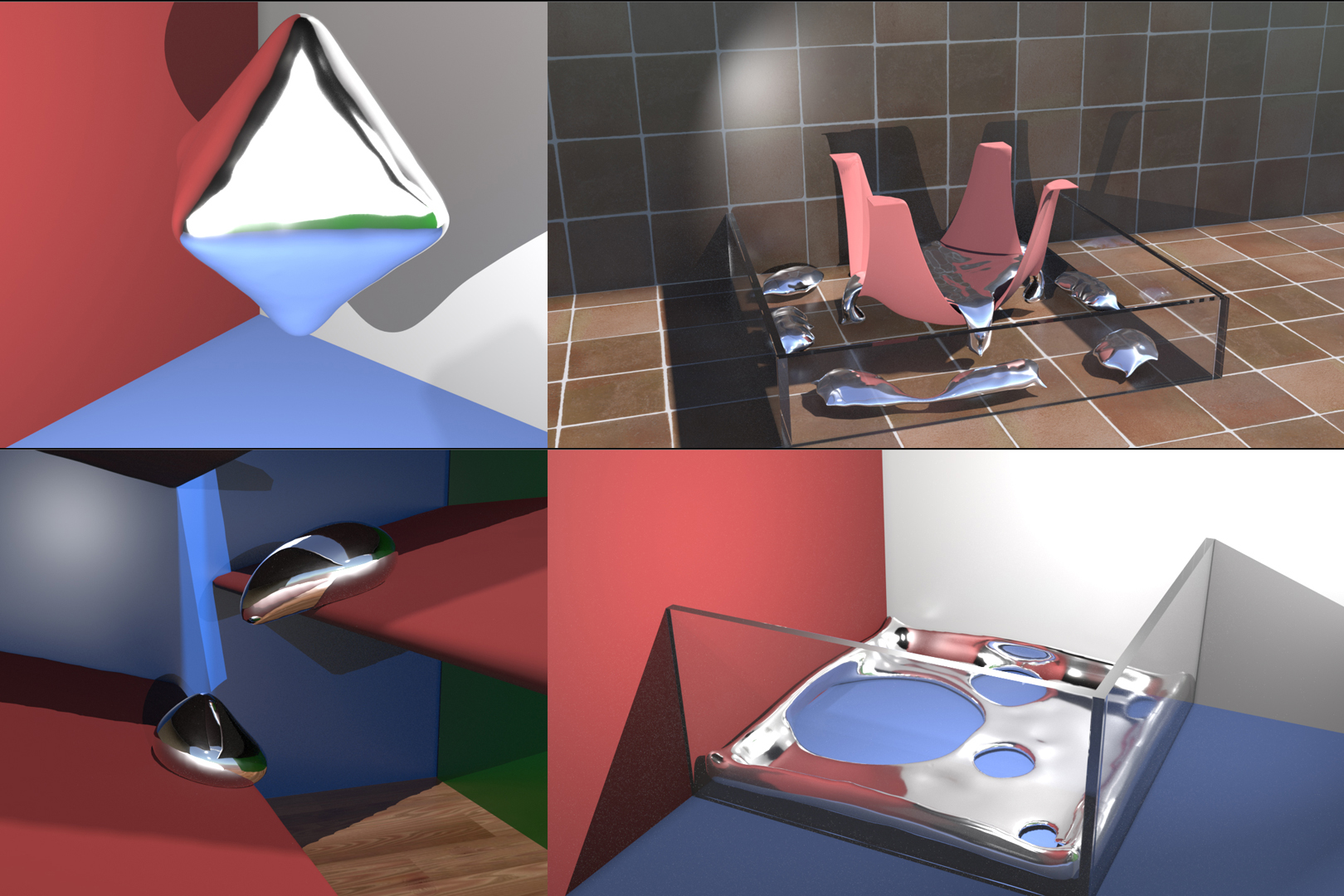
We present an updated Lagrangian discretization of surface tension forces for the simulation of liquids with moderate to extreme surface tension effects. The potential energy associated with surface tension is proportional to the surface area of the liquid. We design discrete forces as gradients of this energy with respect to the motion of the fluid over a time step. We show that this naturally allows for inversion of the Hessian of the potential energy required with the use of Newton’s method to solve the systems of nonlinear equations associated with implicit time stepping. The rotational invariance of the surface tension energy makes it non-convex and we define a definiteness fix procedure as in [Teran et al. 2005]. We design a novel level-set-based boundary quadrature technique to discretize the surface area calculation in our energy based formulation. Our approach works most naturally with Particle-In-Cell [Harlow 1964] techniques and we demonstrate our approach with a weakly incompressible model for liquid discretized with the Material Point Method [Sulsky et al. 1994]. We show that our approach is essential for allowing efficient implicit numerical integration in the limit of high surface tension materials like liquid metals.
References:
1. A. Adamson and A. Gast. 1967. Physical chemistry of surfaces. Vol. 150. Interscience Publishers New York.Google Scholar
2. N. Akinci, G. Akinci, and M. Teschner. 2013. Versatile surface tension and adhesion for SPH fluids. ACM Trans Graph (TOG) 32, 6 (2013), 1–8.Google ScholarDigital Library
3. R. Ando, N. Thurey, and C. Wojtan. 2013. Highly adaptive liquid simulations on tetrahedral meshes. ACM Trans Graph 32, 4 (2013), 103:1–103:10.Google ScholarDigital Library
4. O. Azencot, O. Vantzos, M. Wardetzky, M. Rumpf, and M. Ben-Chen. 2015. Functional thin films on surfaces. In Proc 14th ACM SIGGRAPH/Eurograph Symp Comp Anim. 137–146.Google Scholar
5. E. Bänsch. 2001. Finite element discretization of the Navier-Stokes equations with a free capillary surface. Num Math 88, 2 (2001), 203–235.Google ScholarCross Ref
6. C. Batty, A. Uribe, B. Audoly, and E. Grinspun. 2012. Discrete viscous sheets. ACM Trans Graph (TOG) 31, 4 (2012), 1–7.Google ScholarDigital Library
7. C. Batty, S. Xenos, and B. Houston. 2010. Tetrahedral embedded boundary methods for accurate and flexible adaptive fluids. In Comp Graph For, Vol. 29. Wiley Online Library, 695–704.Google Scholar
8. M. Becker and M. Teschner. 2007. Weakly Compressible SPH for Free Surface Flows. In Proc ACM SIGGRAPH/Eurograph Symp Comp Anim. 209–217.Google Scholar
9. T. Belytschko, W. Liu, B. Moran, and K. Elkhodary. 2013. Nonlinear finite elements for continua and structures. John Wiley and sons.Google Scholar
10. J. Bonet and R. Wood. 2008. Nonlinear continuum mechanics for finite element analysis. Cambridge University Press.Google Scholar
11. L. Boyd and R. Bridson. 2012. MultiFLIP for energetic two-phase fluid simulation. ACM Trans Graph 31, 2 (2012), 16:1–16:12.Google ScholarDigital Library
12. J. Brackbill, D. Kothe, and C. Zemach. 1992. A continuum method for modeling surface tension. J Comp Phys 100, 2 (1992), 335–354.Google ScholarDigital Library
13. R. Bridson. 2008. Fluid simulation for computer graphics. Taylor & Francis.Google ScholarDigital Library
14. T. Brochu, C. Batty, and R. Bridson. 2010. Matching fluid simulation elements to surface geometry and topology. ACM Trans Graph 29, 4 (2010), 47:1–47:9.Google ScholarDigital Library
15. T. Brochu and R. Bridson. 2009. Robust topological operations for dynamic explicit surfaces. SIAM J Sci Comp 31, 4 (2009), 2472–2493. Google ScholarDigital Library
16. G. Buscaglia and R. Ausas. 2011. Variational formulations for surface tension, capillarity and wetting. Comp Meth App Mech Eng 200, 45–46 (2011), 3011–3025.Google ScholarCross Ref
17. P. Clausen, M. Wicke, J. R. Shewchuk, and J. F. O’brien. 2013. Simulating liquids and solid-liquid interactions with Lagrangian meshes. ACM Transactions on Graphics (TOG) 32, 2 (2013), 17.Google ScholarDigital Library
18. S. Clavet, P. Beaudoin, and P. Poulin. 2005. Particle-based viscoelastic fluid simulation. In Proc 2005 ACM SIGGRAPH/Eurograph Symp Comp Anim. 219–228.Google Scholar
19. D. Cohen-Steiner and J. Morvan. 2003. Restricted delaunay triangulations and normal cycle. In Proc 19th Comp Geometry. 312–321.Google Scholar
20. F. Da, C. Batty, and E. Grinspun. 2014. Multimaterial mesh-based surface tracking. ACM Trans Graph 33, 4 (2014), 112:1–112:11. Google ScholarDigital Library
21. F. Da, C. Batty, C. Wojtan, and E. Grinspun. 2015. Double bubbles sans toil and trouble: discrete circulation-preserving vortex sheets for soap films and foams. ACM Trans Graph (SIGGRAPH 2015) (2015).Google Scholar
22. F. Da, D. Hahn, C. Batty, C. Wojtan, and E. Grinspun. 2016. Surface-only liquids. ACM Trans Graph (TOG) 35, 4 (2016), 1–12.Google ScholarDigital Library
23. F. de Goes, C. Wallez, J. Huang, D. Pavlov, and M. Desbrun. 2015. Power particles: an incompressible fluid solver based on power diagrams. ACM Trans. Graph. 34, 4 (2015), 50–1.Google ScholarDigital Library
24. F. Denner and B. van Wachem. 2015. Numerical time-step restrictions as a result of capillary waves. J Comp Phys 285 (2015), 24–40.Google ScholarDigital Library
25. G. Dilts. 2000. Moving least-squares particle hydrodynamics II: conservation and boundaries. Int J Num Meth Eng 48, 10 (2000), 1503–1524.Google ScholarCross Ref
26. I. Eckstein, J. Pons, Y. Tong, C. Kuo, and M. Desbrun. 2007. Generalized surface flows for mesh processing. In Proc Eurograph Symp Geom Proc. Eurographics Association, 183–192.Google Scholar
27. D. Enright, R. Fedkiw, J. Ferziger, and I. Mitchell. 2002. A Hybrid Particle Level Set Method for Improved Interface Capturing. J. Comput. Phys. 183, 1 (2002), 83–116.Google ScholarDigital Library
28. D. Enright, D. Nguyen, F. Gibou, and R. Fedkiw. 2003. Using the particle level set method and a second order accurate pressure boundary condition for free surface flows. In ASME/JSME 2003 4th Joint Fluids Summer Engineering Conference. ASMEDC, 337–342.Google Scholar
29. Y. Fei, C. Batty, E. Grinspun, and C. Zheng. 2018. A multi-scale model for simulating liquid-fabric interactions. ACM Trans Graph 37, 4 (2018), 51:1–51:16. Google ScholarDigital Library
30. T. Gast, C. Schroeder, A. Stomakhin, C. Jiang, and J. Teran. 2015. Optimization Integrator for Large Time Steps. IEEE Trans Vis Comp Graph 21, 10 (2015), 1103–1115.Google ScholarDigital Library
31. F. Gibou, R. P. Fedkiw, L.-T. Cheng, and M. Kang. 2002. A Second-Order-Accurate Symmetric Discretization of the Poisson Equation on Irregular Domains. J. Comput. Phys. 176, 1 (2002), 205–227.Google ScholarDigital Library
32. O. Gonzalez and A. Stuart. 2008. A first course in continuum mechanics. Cambridge University Press.Google Scholar
33. A. Haque and G. Dilts. 2007. Three-dimensional boundary detection for particle methods. J Comp Phys 226, 2 (2007), 1710–1730.Google ScholarDigital Library
34. F. Harlow. 1964. The particle-in-cell method for numerical solution of problems in fluid dynamics. Meth Comp Phys 3 (1964), 319–343.Google Scholar
35. X. He, N. Liu, G. Wang, F. Zhang, S. Li, S. Shao, and H. Wang. 2012. Staggered meshless solid-fluid coupling. ACM Trans Graph (TOG) 31, 6 (2012), 1–12.Google ScholarDigital Library
36. J. Hochstein and T. Williams. 1996. An implicit surface tension model. In 34th Aerospace Sciences Meeting and Exhibit. 599.Google Scholar
37. T. Hou, J. Lowengrub, and M. Shelley. 1994. Removing the stiffness from interfacial flows with surface tension. J Comp Phys 114, 2 (1994), 312–338.Google ScholarCross Ref
38. D.A.B. Hyde, S.W. Gagniere, A. Marquez-Razon, and J. Teran. 2020. Supplementary Technical Document. Technical Report.Google Scholar
39. S. Hysing. 2006. A new implicit surface tension implementation for interfacial flows. Int J Num Meth Fl 51, 6 (2006), 659–672.Google ScholarCross Ref
40. A. Jarauta, P. Ryzhakov, J. Pons-Prats, and M. Secanell. 2018. An implicit surface tension model for the analysis of droplet dynamics. J Comp Phys 374 (2018), 1196–1218.Google ScholarCross Ref
41. C. Jiang, C. Schroeder, A. Selle, J. Teran, and A. Stomakhin. 2015. The Affine Particle-In-Cell Method. ACM Trans Graph 34, 4 (2015), 51:1–51:10.Google ScholarDigital Library
42. C. Jiang, C. Schroeder, J. Teran, A. Stomakhin, and A. Selle. 2016. The Material Point Method for Simulating Continuum Materials. In ACM SIGGRAPH 2016 Course. 24:1–24:52.Google Scholar
43. T. Kim, F. De Goes, and H. Iben. 2019. Anisotropic elasticity for inversion-safety and element rehabilitation. ACM Trans Graph (TOG) 38, 4 (2019), 1–15.Google ScholarDigital Library
44. W. Li, D. Liu, M. Desbrun, J. Huang, and X. Liu. 2020. Kinetic-based Multiphase Flow Simulation. IEEE Trans Vis Comp Graph (2020).Google Scholar
45. O. Mercier, C. Beauchemin, N. Thuerey, T. Kim, and D. Nowrouzezahrai. 2015. Surface turbulence for particle-based liquid simulations. ACM Trans Graph 34(6) (Nov 2015), 10.Google Scholar
46. M. Misztal and J. Bærentzen. 2012. Topology-adaptive interface tracking using the deformable simplicial complex. ACM Trans Graph (TOG) 31, 3 (2012), 1–12.Google ScholarDigital Library
47. M. Misztal, K. Erleben, A. Bargteil, J. Fursund, B. Christensen, J. Bærentzen, and R. Bridson. 2013. Multiphase flow of immiscible fluids on unstructured moving meshes. IEEE Trans Vis Comp Graph 20, 1 (2013), 4–16.Google ScholarDigital Library
48. J. Morris. 2000. Simulating surface tension with smoothed particle hydrodynamics. Int J Num Meth Fl 33, 3 (2000), 333–353.Google ScholarCross Ref
49. M. Müller. 2009. Fast and robust tracking of fluid surfaces. In Proc ACM SIGGRAPH/Eurograph Symp Comp Anim. ACM, 237–245. Google ScholarDigital Library
50. M. Müller, D. Charypar, and M. Gross. 2003. Particle-based fluid simulation for interactive applications. In Proc 2003 ACM SIGGRAPH/Eurograph Symp Comp Anim. Eurographics Association, 154–159.Google ScholarDigital Library
51. J. Orthmann, H. Hochstetter, B. Julian J. Bader, S. Bayraktar, and A. Kolb. 2013. Consistent surface model for SPH-based fluid transport. In Proc 12th ACM SIGGRAPH/Eurograph Symp Comp Anim. 95–103.Google Scholar
52. T. Patterson, N. Mitchell, and E. Sifakis. 2012. Simulation of complex nonlinear elastic bodies using lattice deformers. ACM Trans Graph (TOG) 31, 6 (2012), 1–10.Google ScholarDigital Library
53. S. Popinet. 2018. Numerical models of surface tension. Annual Rev Fluid Mech 50 (2018), 49–75.Google ScholarCross Ref
54. D. Ram, T. Gast, C. Jiang, C. Schroeder, A. Stomakhin, J. Teran, and P. Kavehpour. 2015. A material point method for viscoelastic fluids, foams and sponges. In Proc ACM SIGGRAPH/Eurograph Symp Comp Anim. 157–163.Google Scholar
55. M. Sandim, D. Cedrim, L. Nonato, P. Pagliosa, and A. Paiva. 2016. Boundary detection in particle-based fluids. Comp Graph For 35, 2 (2016), 215–224. Google ScholarCross Ref
56. C. Schroeder, W. Zheng, and R. Fedkiw. 2012. Semi-implicit surface tension formulation with a Lagrangian surface mesh on an Eulerian simulation grid. J Comp Phys 231, 4 (2012), 2092–2115.Google ScholarDigital Library
57. E. Sifakis and J. Barbic. 2012. FEM simulation of 3D deformable solids: a practitioner’s guide to theory, discretization and model reduction. In ACM SIGGRAPH 2012 Courses (Los Angeles, California) (SIGGRAPH ’12). ACM, New York, NY, USA, 20:1–20:50. Google ScholarDigital Library
58. F. Sin, A. Bargteil, and J. Hodgins. 2009. A point-based method for animating incompressible flow. In Proc 2009 ACM SIGGRAPH/Eurographics Symp Comp Anim. 247–255.Google Scholar
59. B. Smith, F. Goes, and T. Kim. 2019. Analytic Eigensystems for Isotropic Distortion Energies. ACM Trans Graph (TOG) 38, 1 (2019), 1–15.Google ScholarDigital Library
60. A. Stomakhin, C. Schroeder, L. Chai, J. Teran, and A. Selle. 2013. A Material Point Method for snow simulation. ACM Trans Graph 32, 4 (2013), 102:1–102:10.Google ScholarDigital Library
61. D. Sulsky, Z. Chen, and H. Schreyer. 1994. A particle method for history-dependent materials. Comp Meth App Mech Eng 118, 1 (1994), 179–196.Google ScholarCross Ref
62. M. Sussman and M. Ohta. 2009. A stable and efficient method for treating surface tension in incompressible two-phase flow. SIAM J Sci Comp 31, 4 (2009), 2447–2471.Google ScholarDigital Library
63. J. Teran, E. Sifakis, G. Irving, and R. Fedkiw. 2005. Robust quasistatic finite elements and flesh simulation. In Proc 2005 ACM SIGGRAPH/Eurograph Symp Comp Anim. 181–190.Google Scholar
64. N. Thürey, C. Wojtan, M. Gross, and G. Turk. 2010. A multiscale approach to mesh-based surface tension flows. ACM Trans Graph (TOG) 29, 4 (2010), 1–10.Google ScholarDigital Library
65. X. Wang, M. Li, Y. Fang, X. Zhang, M. Gao, M. Tang, D. Kaufman, and C. Jiang. 2020. Hierarchical optimization time integration for CFL-rate MPM stepping. ACM Trans Graph (TOG) 39, 3 (2020), 1–16.Google ScholarDigital Library
66. P. Weisensee, J. Tian, N. Miljkovic, and W. King. 2016. Water droplet impact on elastic superhydrophobic surfaces. Scientific Reports 6 (2016). Issue 1. Google ScholarCross Ref
67. M. Wicke, D. Ritchie, B. Klingner, S. Burke, J. Shewchuk, and J. O’Brien. 2010. Dynamic local remeshing for elastoplastic simulation. ACM Trans Graph 29, 4 (2010), 49:1–11.Google ScholarDigital Library
68. C. Wojtan, N. Thürey, M. Gross, and G. Turk. 2010. Physics-inspired topology changes for thin fluid features. ACM Trans Graph 29, 4 (2010), 50:1–50:8. Google ScholarDigital Library
69. C. Wojtan and G. Turk. 2008. Fast viscoelastic behavior with thin features. ACM Trans Graph 27, 3 (2008), 1–8. Google ScholarDigital Library
70. S. Yang, X. He, H. Wang, S. Li, G. Wang, E. Wu, and K. Zhou. 2016. Enriching SPH simulation by approximate capillary waves. In Symp Comp Anim. 29–36.Google Scholar
71. J. Yu, C. Wojtan, G. Turk, and C. Yap. 2012. Explicit mesh surfaces for particle based fluids. Comp Graph Forum 31, 2pt4 (2012), 815–824. Google ScholarDigital Library
72. Y. Zhang, B. Solenthaler, and R. Pajarola. 2008. Adaptive sampling and rendering of fluids on the GPU. In Proc Symp Point-Based Graph. 137–146. Google ScholarCross Ref
73. X. Zhao, S. Xu, and J. Liu. 2017. Surface tension of liquid metal: role, mechanism and application. Front Energy 11, 4 (2017), 535–567.Google ScholarCross Ref
74. W. Zheng, B. Zhu, B. Kim, and R. Fedkiw. 2015. A new incompressibility discretization for a hybrid particle MAC grid representation with surface tension. J Comp Phys 280 (2015), 96–142.Google ScholarDigital Library
75. B. Zhu, E. Quigley, M. Cong, J. Solomon, and R. Fedkiw. 2014. Codimensional surface tension flow on simplicial complexes. ACM Trans Graph (TOG) 33, 4 (2014), 1–11.Google ScholarDigital Library
76. F. Zorilla, M. Ritter, J. Sappl, W. Rauch, and M. Harders. 2020. Accelerating surface tension calculation in SPH via particle classification and Monte Carlo integration. Computers 9, 2 (2020), 23.Google ScholarCross Ref



