
“An adaptive parameterization for efficient material acquisition and rendering”
Conference:
Type(s):
Title:
- An adaptive parameterization for efficient material acquisition and rendering
Session/Category Title:
- IM-material
Presenter(s)/Author(s):
Moderator(s):
Abstract:
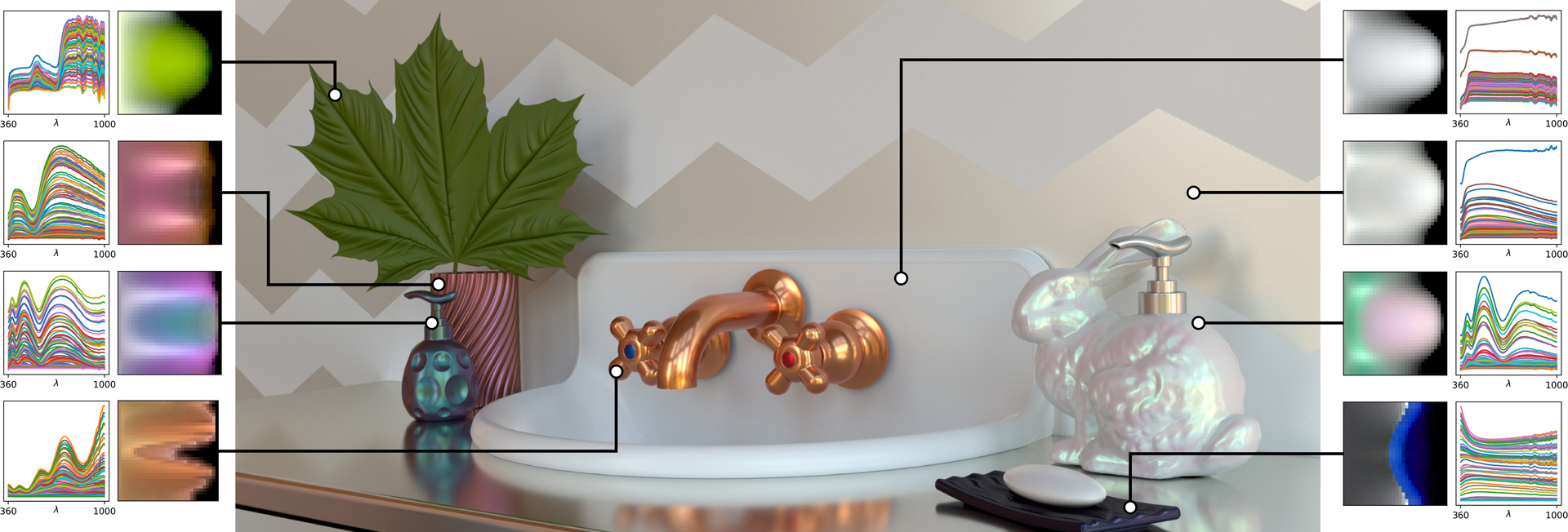
One of the key ingredients of any physically based rendering system is a detailed specification characterizing the interaction of light and matter of all materials present in a scene, typically via the Bidirectional Reflectance Distribution Function (BRDF). Despite their utility, access to real-world BRDF datasets remains limited: this is because measurements involve scanning a four-dimensional domain at sufficient resolution, a tedious and often infeasibly time-consuming process.We propose a new parameterization that automatically adapts to the behavior of a material, warping the underlying 4D domain so that most of the volume maps to regions where the BRDF takes on non-negligible values, while irrelevant regions are strongly compressed. This adaptation only requires a brief 1D or 2D measurement of the material’s retro-reflective properties. Our parameterization is unified in the sense that it combines several steps that previously required intermediate data conversions: the same mapping can simultaneously be used for BRDF acquisition, storage, and it supports efficient Monte Carlo sample generation.We observe that the above desiderata are satisfied by a core operation present in modern rendering systems, which maps uniform variates to direction samples that are proportional to an analytic BRDF. Based on this insight, we define our adaptive parameterization as an invertible, retro-reflectively driven mapping between the parametric and directional domains. We are able to create noise-free renderings of existing BRDF datasets after conversion into our representation with the added benefit that the warped data is significantly more compact, requiring 16KiB and 544KiB per spectral channel for isotropic and anisotropic specimens, respectively.Finally, we show how to modify an existing gonio-photometer to provide the needed retro-reflection measurements. Acquisition then proceeds within a 4D space that is warped by our parameterization. We demonstrate the efficacy of this scheme by acquiring the first set of spectral BRDFs of surfaces exhibiting arbitrary roughness, including anisotropy.
References:
1. Peter Apian-Bennewitz. 2013. Building material example BSDF data. http://www.pab.eu/gonio-photometer/demodata/bme/. (2013). Accessed: 2018-01-09.Google Scholar
2. Michael Ashikhmin and Simon Premože. 2007. Distribution-based BRDFs. Technical Report, University of Utah (2007).Google Scholar
3. Mahdi M. Bagher, John Snyder, and Derek Nowrouzezahrai. 2016. A Non-Parametric Factor Microfacet Model for Isotropic BRDFs. ACM Trans. Graph. 35, 5 (2016), 159:1–159:16. Google ScholarDigital Library
4. M. M. Bagher, C. Soler, and N. Holzschuch. 2012. Accurate fitting of measured reflectances using a Shifted Gamma micro-facet distribution. Comput. Graph. Forum 31, 4 (2012), 1509–1518. Google ScholarDigital Library
5. Pascal Barla, Laurent Belcour, and Romain Pacanowski. 2015. In praise of an alternative brdf parametrization. In Workshop on Material Appearance Modeling. Google ScholarDigital Library
6. Laurent Belcour and Pascal Barla. 2017. A Practical Extension to Microfacet Theory for the Modeling of Varying Iridescence. ACM Transactions on Graphics 36, 4 (July 2017), 65. Google ScholarDigital Library
7. James F Blinn. 1977. Models of light reflection for computer synthesized pictures. In ACM SIGGRAPH Computer Graphics, Vol. 11. ACM, 192–198. Google ScholarDigital Library
8. Marilyne Andersen Boris Karamata. 2013. Revisiting parallel catadioptric goniophotometers. Proc.SPIE 8788 (2013), 8788 — 8788 – 11.Google Scholar
9. Pierre Bouguer. 1760. Traité d’optique sur la gradation de la lumière. De l’imprimerie de HL Guerin & LF Delatour.Google Scholar
10. Brent Burley. 2012. Physically-based shading at Disney. In ACM SIGGRAPH 2012 Courses (SIGGRAPH ’12). ACM, New York, NY, USA.Google Scholar
11. Petrik Clarberg, Wojciech Jarosz, Tomas Akenine-Möller, and Henrik Wann Jensen. 2005. Wavelet Importance Sampling: Efficiently Evaluating Products of Complex Functions. ACM Trans. Graph. 24, 3 (July 2005), 1166–1175. Google ScholarDigital Library
12. Kristin J Dana, Bram Van Ginneken, Shree K Nayar, and Jan J Koenderink. 1999. Reflectance and texture of real-world surfaces. ACM Transactions On Graphics (TOG) 18, 1 (1999), 1–34. Google ScholarDigital Library
13. Zhao Dong, Bruce Walter, Steve Marschner, and Donald P. Greenberg. 2015. Predicting Appearance from Measured Microgeometry of Metal Surfaces. ACM Trans. Graph. 35, 1, Article 9 (Dec. 2015), 9:1–9:13 pages. Google ScholarDigital Library
14. Frederike Dümbgen, Majed El Helou, Sabine Susstrunk, and Natalija Gucevska. 2018. Near-Infrared Fusion for Photorealistic Image Dehazing. IS&T EI Proceedings (2018).Google Scholar
15. Jonathan Dupuy, Eric Heitz, and Eugene d’Eon. 2016. Additional progress towards the unification of microfacet and microflake theories. In Proceedings of the Eurographics Symposium on Rendering: Experimental Ideas & Implementations. Eurographics Association, 55–63. Google ScholarDigital Library
16. Jonathan Dupuy, Eric Heitz, Jean-Claude Iehl, Pierre Poulin, Fabrice Neyret, and Victor Ostromoukhov. 2013. Linear Efficient Antialiased Displacement and Reflectance Mapping. ACM Trans. Graph. 32, 6, Article 211 (Nov. 2013), 211:1–11 pages. Google ScholarDigital Library
17. Jonathan Dupuy, Eric Heitz, Jean-Claude Iehl, Pierre Poulin, and Victor Ostromoukhov. 2015. Extracting Microfacet-based BRDF Parameters from Arbitrary Materials with Power Iterations. In Computer Graphics Forum, Vol. 34. Wiley Online Library, 21–30. Google ScholarDigital Library
18. Jirí Filip and Radomír Vávra. 2014. Template-Based Sampling of Anisotropic BRDFs. In Computer Graphics Forum, Vol. 33. Wiley Online Library, 91–99. Google ScholarDigital Library
19. Jirí Filip, Radomír Vávra, and Michal Havlícek. 2014. Effective acquisition of dense anisotropic BRDF. In Pattern Recognition (ICPR), 2014 22nd International Conference on. IEEE, 2047–2052. Google ScholarDigital Library
20. Abhijeet Ghosh, Shruthi Achutha, Wolfgang Heidrich, and Matthew O’Toole. 2007. BRDF acquisition with basis illumination. In Computer Vision, 2007. ICCV 2007. IEEE 11th International Conference on. IEEE, 1–8.Google ScholarCross Ref
21. Dar’ya Guarnera, Giuseppe Claudio Guarnera, Abhijeet Ghosh, Cornelia Denk, and Mashhuda Glencross. 2016. Brdf representation and acquisition. In Computer Graphics Forum, Vol. 35. Wiley Online Library, 625–650.Google Scholar
22. Eric Heitz. 2014. Understanding the Masking-Shadowing Function in Microfacet-Based BRDFs. Journal of Computer Graphics Techniques (JCGT) 3, 2 (30 June 2014), 48–107.Google Scholar
23. Eric Heitz and Eugene d’Eon. 2014. Importance Sampling Microfacet-Based BSDFs using the Distribution of Visible Normals. In Computer Graphics Forum, Vol. 33. 103–112.Google ScholarDigital Library
24. Eric Heitz, Johannes Hanika, Eugene d’Eon, and Carsten Dachsbacher. 2016. Multiple-scattering microfacet BSDFs with the Smith model. ACM Transactions on Graphics (TOG) 35, 4 (2016), 58. Google ScholarDigital Library
25. Nicolas Holzschuch and Romain Pacanowski. 2017. A two-scale microfacet reflectance model combining reflection and diffraction. ACM Transactions on Graphics 36, 4 (2017), 12. Google ScholarDigital Library
26. Wenzel Jakob, Miloš Hašan, Ling-Qi Yan, Jason Lawrence, Ravi Ramamoorthi, and Steve Marschner. 2014. Discrete Stochastic Microfacet Models. ACM Transactions on Graphics (Proceedings of SIGGRAPH 2014) 33, 4 (2014). Google ScholarDigital Library
27. Joakim Löw, Joel Kronander, Anders Ynnerman, and Jonas Unger. 2012. BRDF models for accurate and efficient rendering of glossy surfaces. ACM Trans. Graph. 31, 1 (2012), 9:1–14. Google ScholarDigital Library
28. Stephen R. Marschner, Stephen H. Westin, Eric P. F. Lafortune, and Kenneth E. Torrance. 2000. Image-based bidirectional reflectance distribution function measurement. Applied Optics 39, 16 (2000), 2592–2600.Google ScholarCross Ref
29. Stephen R. Marschner, Stephen H. Westin, Eric P. F. Lafortune, Kenneth E. Torrance, and Donald P. Greenberg. 1999. Image-based BRDF Measurement Including Human Skin. In Proceedings of the 10th Eurographics Conference on Rendering (EGWR’99). Eurographics Association, 131–144. Google ScholarDigital Library
30. Phillip R. Mattison, Mark S. Dombrowski, James M. Lorenz, Keith J. Davis, Harley C. Mann, Philip Johnson, and Bryan Foos. 1998. Handheld directional reflectometer: an angular imaging device to measure BRDF and HDR in real time. Proc.SPIE 3426 (1998), 3426 — 3426 – 12.Google Scholar
31. Wojciech Matusik, Hanspeter Pfister, Matt Brand, and Leonard McMillan. 2003a. A Data-Driven Reflectance Model. ACM Trans. Graph. 22, 3 (July 2003), 759–769. Google ScholarDigital Library
32. Wojciech Matusik, Hanspeter Pfister, Matthew Brand, and Leonard McMillan. 2003b. Efficient Isotropic BRDF Measurement (EGSR). Eurographics Association, 241–247. Google ScholarDigital Library
33. Addy Ngan, Frédo Durand, and Wojciech Matusik. 2005. Experimental Analysis of BRDF Models. In Proceedings of the Eurographics Symposium on Rendering. Eurographics Association, 117–226. Google ScholarDigital Library
34. Fred E. Nicodemus, Joseph C. Richmond, J.J. Hsia, W.I. Ginsberg, and T. Limperis. 1977. Geometrical Considerations and Nomenclature for Reflectance. Applied Optics 9 (1977), 1474–1475.Google ScholarCross Ref
35. Jannik Boll Nielsen, Henrik Wann Jensen, and Ravi Ramamoorthi. 2015. On Optimal, Minimal BRDF Sampling for Reflectance Acquisition. ACM Transactions on Graphics (TOG) 34, 6 (November 2015), 186:1–186:11. Google ScholarDigital Library
36. PAB. 2018. pab advanced technologies Ltd. http://www.pab.eu. (2018). Accessed: 2018-01-09.Google Scholar
37. Matt Pharr and Wenzel Jakob. 2017. personal communication. (Dec. 2017).Google Scholar
38. Andrei D Polyanin and Alexander V Manzhirov. 2012. Handbook of Integral Equations. CRC Press.Google Scholar
39. Ju Ren and Jianlin Zhao. 2010. Measurement of a bidirectional reflectance distribution and system achievement based on a hemi-parabolic mirror. Opt. Lett. 35, 9 (May 2010), 1458–1460.Google ScholarCross Ref
40. Szymon M Rusinkiewicz. 1998. A New Change of Variables for Efficient BRDF Representation. In Rendering Techniques ’98. Springer, 11–22.Google ScholarCross Ref
41. Lionel Simonot and Gael Obein. 2007. Geometrical considerations in analyzing isotropic or anisotropic surface reflections. Applied optics 46, 14 (2007), 2615–2623.Google Scholar
42. Michael M Stark, James Arvo, and Brian Smits. 2005. Barycentric parameterizations for isotropic BRDFs. IEEE transactions on visualization and computer graphics 11, 2 (2005), 126–138. Google ScholarDigital Library
43. K. E. Torrance and E. M. Sparrow. 1967. Theory for Off-Specular Reflection From Roughened Surfaces. J. Opt. Soc. Am. 57, 9 (Sep 1967), 1105–1112.Google ScholarCross Ref
44. T. S. Trowbridge and K. P. Reitz. 1975. Average irregularity representation of a rough surface for ray reflection. J. Opt. Soc. Am. 65, 5 (May 1975), 531–536.Google ScholarCross Ref
45. Bruce Walter, Stephen R. Marschner, Hongsong Li, and Kenneth E. Torrance. 2007. Microfacet Models for Refraction Through Rough Surfaces. In Computer Graphics Forum (Proc. Eurographics Symposium on Rendering) (EGSR). 195–206. Google ScholarDigital Library
46. Gregory J Ward. 1992. Measuring and modeling anisotropic reflection. ACM SIGGRAPH Computer Graphics 26, 2 (1992), 265–272. Google ScholarDigital Library
47. Sebastian Werner, Zdravko Velinov, Wenzel Jakob, and Matthias Hullin. 2017. Scratch Iridescence: Wave-Optical Rendering of Diffractive Surface Structure. Transactions on Graphics (Proceedings of SIGGRAPH Asia) 36, 6 (Oct. 2017). Google ScholarDigital Library
48. D Rod White, Peter Saunders, Stuart J Bonsey, John van de Ven, and Hamish Edgar. 1998. Reflectometer for measuring the bidirectional reflectance of rough surfaces. Applied optics 37, 16 (1998), 3450–3454.Google Scholar



