“Ambient sound propagation”
Conference:
Type(s):
Title:
- Ambient sound propagation
Session/Category Title:
- Aerial propagation
Presenter(s)/Author(s):
Moderator(s):
Abstract:
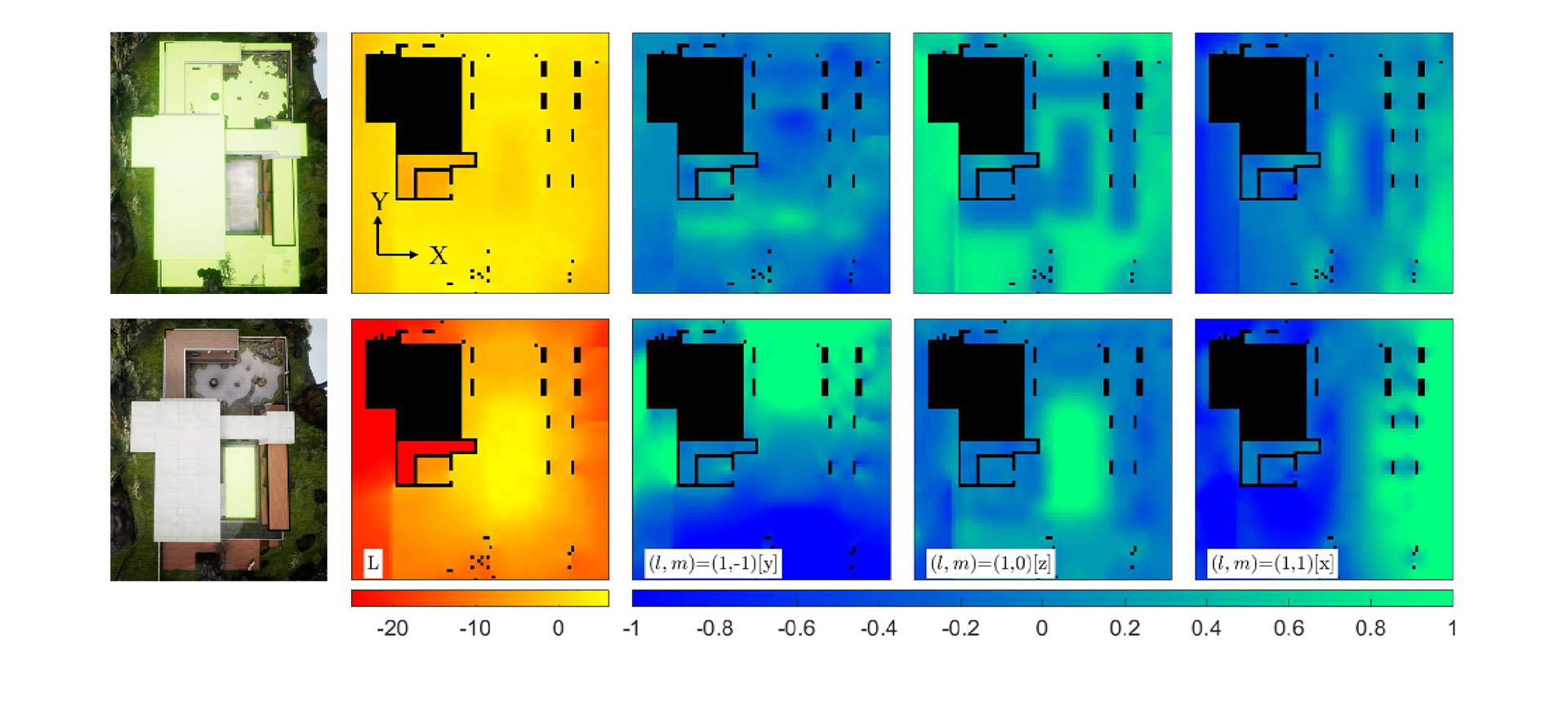
Ambient sounds arise from a massive superposition of chaotic events distributed over a large area or volume, such as waves breaking on a beach or rain hitting the ground. The directionality and loudness of these sounds as they propagate in complex 3D scenes vary with listener location, providing cues that distinguish indoors from outdoors and reveal portals and occluders. We show that ambient sources can be approximated using an ideal notion of spatio-temporal incoherence and develop a lightweight technique to capture their global propagation effects. Our approach precomputes a single FDTD simulation using a sustained source signal whose phase is randomized over frequency and source extent. It then extracts a spherical harmonic encoding of the resulting steady-state distribution of power over direction and position in the scene using an efficient flux density formulation. The resulting parameter fields are smooth and compressible, requiring only a few MB of memory per extended source. We also present a fast binaural rendering technique that exploits phase incoherence to reduce filtering cost.
References:
1. V Ralph Algazi, Richard O Duda, Dennis M Thompson, and Carlos Avendano. 2001. The CIPIC HRTF database. In Applications of Signal Processing to Audio and Acoustics, 2001 IEEE Workshop on the. IEEE, 99–102.Google Scholar
2. Chunxiao Cao, Zhong Ren, Carl Schissler, Dinesh Manocha, and Kun Zhou. 2016. Interactive sound propagation with bidirectional path tracing. ACM Transactions on Graphics (TOG) 35, 6 (2016), 180. Google ScholarDigital Library
3. Jeffrey N Chadwick, Steven S An, and Doug L James. 2009. Harmonic shells: a practical nonlinear sound model for near-rigid thin shells. ACM Trans. Graph. 28, 5 (2009), 119–1. Google ScholarDigital Library
4. Robert L. Cook, Thomas Porter, and Loren Carpenter. 1984. Distributed Ray Tracing. In Proceedings of the 11th Annual Conference on Computer Graphics and Interactive Techniques (SIGGRAPH ’84). ACM, New York, NY, USA, 137–145. Google ScholarDigital Library
5. Brian Hamilton, Stefan Bilbao, Brian Hamilton, and Stefan Bilbao. 2017. FDTD Methods for 3-D Room Acoustics Simulation With High-Order Accuracy in Space and Time. IEEE/ACM Trans. Audio, Speech and Lang. Proc. 25, 11 (Nov. 2017), 2112–2124. Google ScholarDigital Library
6. Jean-Marc Hasenfratz, Marc Lapierre, Nicolas Holzschuch, and François Sillion. 2003. A survey of Real-Time Soft Shadows Algorithms. Computer Graphics Forum 22, 4 (dec 2003), 753–774.Google ScholarCross Ref
7. IS ISO3382. 2009. Acoustics-Measurement of room acoustic parameters, Part 1: Performance spaces, ed. B. Standards (2009).Google Scholar
8. Doug L James, Jernej Barbič, and Dinesh K Pai. 2006. Precomputed acoustic transfer: output-sensitive, accurate sound generation for geometrically complex vibration sources. In ACM Transactions on Graphics (TOG), Vol. 25. ACM, 987–995. Google ScholarDigital Library
9. Jan Kautz, John Snyder, and Peter-Pike J Sloan. 2002. Fast Arbitrary BRDF Shading for Low-Frequency Lighting Using Spherical Harmonics. Rendering Techniques 2, 291–296 (2002), 1. Google ScholarDigital Library
10. Konrad Kowalczyk and Maarten Van Walstijn. 2011. Room acoustics simulation using 3-D compact explicit FDTD schemes. IEEE Transactions on Audio, Speech, and Language Processing 19, 1 (2011), 34–46. Google ScholarDigital Library
11. Mikko V. Laitinen, Tapani Pihlajamäki, Cumhur Erkut, and Ville Pulkki. 2012. Parametric Time-frequency Representation of Spatial Sound in Virtual Worlds. ACM Trans. Appl. Percept. 9, 2 (June 2012). Google ScholarDigital Library
12. Dingzeyu Li, Yun Fei, and Changxi Zheng. 2015. Interactive Acoustic Transfer Approximation for Modal Sound. ACM Trans. Graph. 35, 1 (Dec. 2015). Google ScholarDigital Library
13. Josh HMcDermott, Michael Schemitsch, and Eero P Simoncelli. 2013. Summary statistics in auditory perception. Nature neuroscience 16, 4 (2013), 493.Google Scholar
14. Josh H McDermott and Eero P Simoncelli. 2011. Sound texture perception via statistics of the auditory periphery: evidence from sound synthesis. Neuron 71, 5 (2011), 926–940.Google ScholarCross Ref
15. Ravish Mehra, Nikunj Raghuvanshi, Lakulish Antani, Anish Chandak, Sean Curtis, and Dinesh Manocha. 2013. Wave-based sound propagation in large open scenes using an equivalent source formulation. ACM Transactions on Graphics (TOG) 32, 2 (2013), 19. Google ScholarDigital Library
16. Hans P Moravec. 1981. 3D graphics and the wave theory. ACM SIGGRAPH computer graphics 15, 3 (1981), 289–296. Google ScholarDigital Library
17. Alan V Oppenheim. 1999. Discrete-time signal processing. Pearson Education India. Google ScholarDigital Library
18. Nikunj Raghuvanshi and John Snyder. 2014. Parametric Wave Field Coding for Precomputed Sound Propagation. ACM Transactions on Graphics (TOG) 33, 4 (July 2014). Google ScholarDigital Library
19. Nikunj Raghuvanshi and John Snyder. 2018. Parametric Directional Coding for Precomputed Sound Propagation. ACM Transactions on Graphics (TOG) 37, 4 (Aug. 2018), 14. Google ScholarDigital Library
20. Nikunj Raghuvanshi, John Snyder, Ravish Mehra, Ming C. Lin, and Naga K. Govindaraju. 2010. Precomputed Wave Simulation for Real-Time Sound Propagation of Dynamic Sources in Complex Scenes. ACM Transactions on Graphics (proceedings of SIGGRAPH 2010) 29, 3 (July 2010). Google ScholarDigital Library
21. Yotka S Rickard, Natalia K Georgieva, and Wei-Ping Huang. 2003. Application and optimization of PML ABC for the 3-D wave equation in the time domain. IEEE Transactions on Antennas and Propagation 51, 2 (2003), 286–295.Google ScholarCross Ref
22. Tobias Ritschel, Carsten Dachsbacher, Thorsten Grosch, and Jan Kautz. 2012. The State of the Art in Interactive Global Illumination. Computer Graphics Forum 31, 1 (2012), 160–188. Google ScholarDigital Library
23. Lauri Savioja and U Peter Svensson. 2015. Overview of geometrical room acoustic modeling techniques. The Journal of the Acoustical Society of America 138, 2 (2015), 708–730.Google ScholarCross Ref
24. Carl Schissler, Ravish Mehra, and Dinesh Manocha. 2014. High-order diffraction and diffuse reflections for interactive sound propagation in large environments. ACM Transactions on Graphics (TOG) 33, 4 (2014), 39. Google ScholarDigital Library
25. Carl Schissler, Aaron Nicholls, and Ravish Mehra. 2016. Efficient HRTF-based spatial audio for area and volumetric sources. IEEE transactions on visualization and computer graphics 22, 4 (2016), 1356–1366. Google ScholarDigital Library
26. John B Schneider and Christopher L Wagner. 1999. FDTD dispersion revisited: Faster-than-light propagation. IEEE Microwave and Guided Wave Letters 9, 2 (1999), 54–56.Google ScholarCross Ref
27. Dirk Schröder. 2011. Physically Based Real-Time Auralization of Interactive Virtual Environments. Logos Verlag. http://www.worldcat.org/isbn/3832530312Google Scholar
28. Peter-Pike Sloan. 2013. Efficient spherical harmonic evaluation. Journal of Computer Graphics Techniques 2, 2 (2013), 84–90.Google Scholar
29. Peter-Pike Sloan, Jesse Hall, John Hart, and John Snyder. 2003. Clustered principal components for precomputed radiance transfer. In ACM Transactions on Graphics (TOG), Vol. 22. ACM, 382–391. Google ScholarDigital Library
30. Peter-Pike Sloan, Jan Kautz, and John Snyder. 2002. Precomputed Radiance Transfer for Real-time Rendering in Dynamic, Low-frequency Lighting Environments. ACM Trans. Graph. 21, 3 (July 2002), 527–536. Google ScholarDigital Library
31. Julius Orion Smith. 2008. Introduction to digital filters: with audio applications. Vol. 2. Julius Smith.Google Scholar
32. Allen Taflove and Susan C Hagness. 2005. Computational electrodynamics: the finite-difference time-domain method. Artech house.Google Scholar
33. Vesa Valimaki, Julian D Parker, Lauri Savioja, Julius O Smith, and Jonathan S Abel. 2012. Fifty years of artificial reverberation. IEEE Transactions on Audio, Speech, and Language Processing 20, 5 (2012), 1421–1448. Google ScholarDigital Library