
“A model of local adaptation” by Vangorp, Myszkowski, Graf and Mantiuk
Conference:
Type(s):
Title:
- A model of local adaptation
Session/Category Title:
- Color and Sketching
Presenter(s)/Author(s):
Abstract:
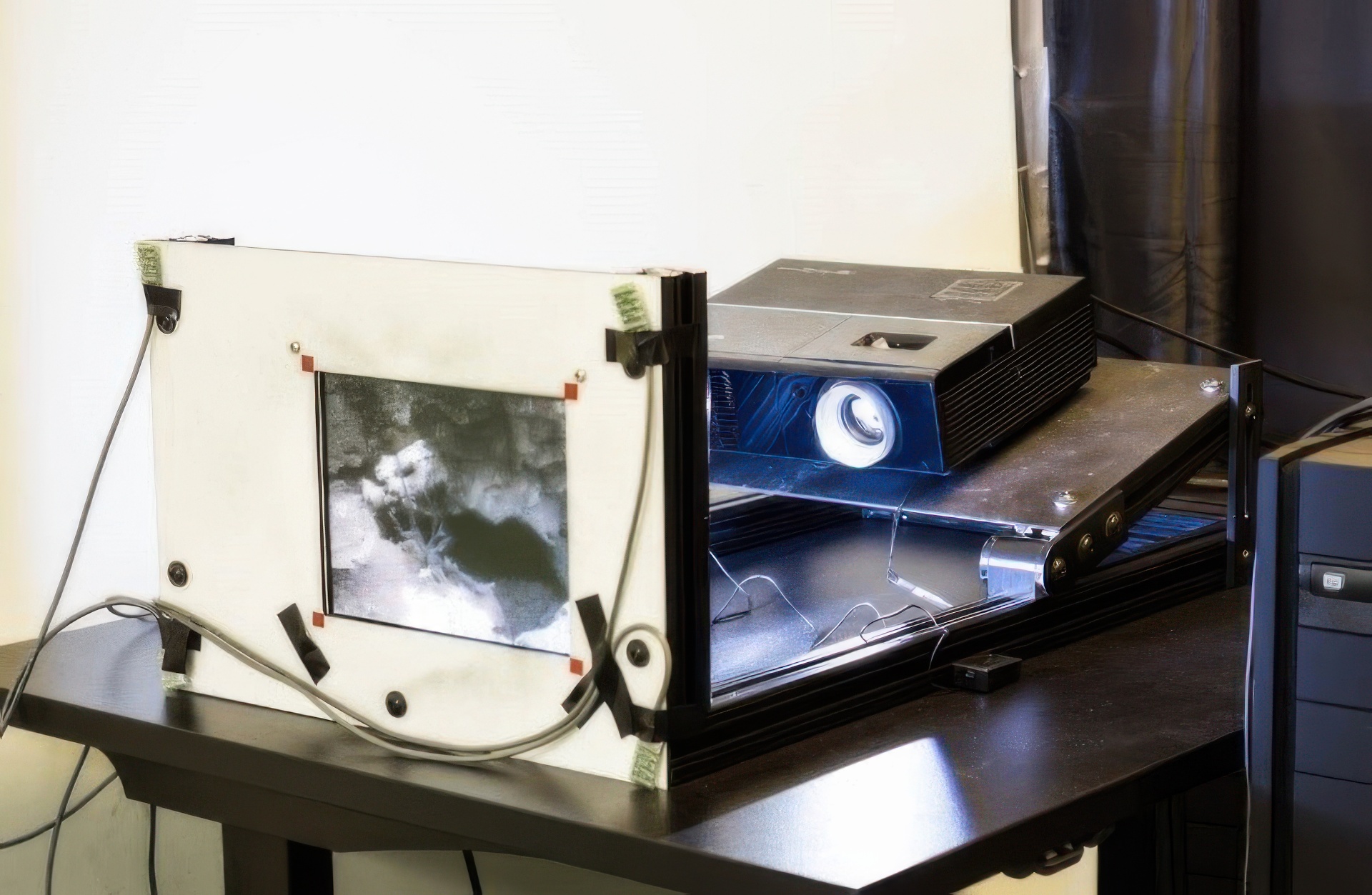
The visual system constantly adapts to different luminance levels when viewing natural scenes. The state of visual adaptation is the key parameter in many visual models. While the time-course of such adaptation is well understood, there is little known about the spatial pooling that drives the adaptation signal. In this work we propose a new empirical model of local adaptation, that predicts how the adaptation signal is integrated in the retina. The model is based on psychophysical measurements on a high dynamic range (HDR) display. We employ a novel approach to model discovery, in which the experimental stimuli are optimized to find the most predictive model. The model can be used to predict the steady state of adaptation, but also conservative estimates of the visibility (detection) thresholds in complex images. We demonstrate the utility of the model in several applications, such as perceptual error bounds for physically based rendering, determining the backlight resolution for HDR displays, measuring the maximum visible dynamic range in natural scenes, simulation of afterimages, and gaze-dependent tone mapping.
References:
1. Adams, W., Elder, J., Graf, E., Muryy, A., and Lugtigheid, A. 2015. Perception of 3D structure and natural scene statistics: The Southampton-York Natural Scenes (SYNS) dataset. Vision Sciences Society 2015 Poster.
2. Ahmad, K. M., Klog, K., Herr, S., Sterling, P., and Schein, S. 2003. Cell density ratios in a foveal patch in macaque retina. Visual Neuroscience 20, 2 (June), 189–209.
3. Allred, S. R., Radonjić, A., Gilchrist, A. L., and Brainard, D. H. 2012. Lightness perception in high dynamic range images: Local and remote luminance effects. Journal of Vision 12, 2, 7.
4. Barlow, H. 1972. Dark and light adaptation: Psychophysics. In Visual Psychophysics, D. Jameson and L. Hurvich, Eds., vol. 7 / 4 of Handbook of Sensory Physiology. Springer Berlin Heidelberg, 1–28.
5. Bolin, M. R., and Meyer, G. W. 1998. A perceptually based adaptive sampling algorithm. In Proc. of SIGGRAPH ’98, ACM Press, New York, New York, USA, ACM, 299–309.
6. Chiu, K., Herf, M., Shirley, P., Swamy, S., Wang, C., and Zimmerman, K. 1993. Spatially nonuniform scaling functions for high contrast images. In Proceedings of Graphics Interface ’93, 245–253.
7. Craik, K. J. W. 1938. The effect of adaptation on differential brightness discrimination. The Journal of Physiology 92, 4, 406–421.
8. Deeley, R. J., Drasdo, N., and Charman, W. N. 1991. A simple parametric model of the human ocular modulation transfer function. Ophthalmic and Physiological Optics 11, 1 (Jan.), 91–93.
9. Dunn, F. A., and Rieke, F. 2008. Single-photon absorptions evoke synaptic depression in the retina to extend the operational range of rod vision. Neuron 57, 6, 894–904.
10. Dunn, F. A., Lankheet, M. J., and Rieke, F. 2007. Light adaptation in cone vision involves switching between receptor and post-receptor sites. Nature 449, 7162 (Oct.), 603–6.
11. Durand, F., and Dorsey, J. 2000. Interactive tone mapping. Eurographics Workshop on Rendering.
12. Fairchild, M. D. 1998. Color Appearance Models. Addison-Wesley. ISBN 0-201-63464-3.
13. Fairchild, M. D. 2008. The HDR Photographic Survey. MDF Publications. http://rit-mcsl.org/fairchild/HDR.html.
14. Ferwerda, J. A., Pattanaik, S., Shirley, P., and Greenberg, D. P. 1996. A model of visual adaptation for realistic image synthesis. In Proceedings of SIGGRAPH 96, Annual Conference Series, ACM, 249–258.
15. Ferwerda, J. A., Shirley, P., Pattanaik, S. N., and Greenberg, D. P. 1997. A model of visual masking for computer graphics. In Proc. of SIGGRAPH ’97, ACM Press, New York, New York, USA, ACM, 143–152.
16. Finkelstein, M. A., Harrison, M., and Hood, D. C. 1990. Sites of sensitivity control within a long-wavelength cone pathway. Vision Research 30, 8 (Jan.), 1145–1158.
17. Geisler, W. S. 1978. Adaptation, afterimages and cone saturation. Vision Research 18, 3, 279–289.
18. Greenlee, M. W., and Heitger, F. 1988. The functional role of contrast adaptation. Vision Research 28, 7, 791–797.
19. Gutierrez, D., Anson, O., Munoz, A., and Seron, F. 2005. Perception-based rendering: eyes wide bleached. In Proc. Eurographics (Short Papers), 49–52.
20. Hess, R. F., Sharpe, L. T., and Nordby, K. 1990. Night Vision: Basic, Clinical and Applied Aspects. Cambridge University Press.
21. Hood, D. C., Finkelstein, M. A., and Buckingham, E. 1979. Psychophysical tests of models of the response function. Vision Research 19, 401–406.
22. Hunt, R. W. G. 1995. The Reproduction of Colour in Photography, Printing and Television: 5th Edition. Fountain Press.
23. Ijspeert, J. K., van den Berg, T. J., and Spekreijse, H. 1993. An improved mathematical description of the foveal visual point spread function with parameters for age, pupil size and pigmentation. Vision Research 33, 1 (Jan.), 15–20.
24. Irawan, P., Ferwerda, J. A., and Marschner, S. R. 2005. Perceptually based tone mapping of high dynamic range image streams. In Eurographics Symposium on Rendering (2005), K. Bala and P. Dutré, Eds., Eurographics.
25. Jacobs, D. E., Gallo, O., Cooper, E. A., Pulli, K., and Levoy, M. 2015. Simulating the visual experience of very bright and very dark scenes. ACM Trans. Graph. 34, 3 (May), 25:1–25:15.
26. Jakob, W., 2014. Mitsuba 0.5.0 Physically Based Renderer. http://www.mitsubarenderer.org/.
27. Jobson, D. J., Rahman, Z., and Woodell, G. A. 1997. A multi-scale retinex for bridging the gap between color images and the human observation of scenes. IEEE Transactions on Image Processing: Special Issue on Color Processing 6, 7, 965–976.
28. Kim, M. H., Weyrich, T., and Kautz, J. 2009. Modeling human color perception under extended luminance levels. ACM Transactions on Graphics (Proc. SIGGRAPH 2009) 28, 3, 27:1–9.
29. Kuang, J., Johnson, G. M., and Fairchild, M. D. 2007. iCAM06: A refined image appearance model for HDR image rendering. Journal of Visual Communication and Image Representation 18, 406–414.
30. Larson, G. W., Rushmeier, H., and Piatko, C. 1997. A visibility matching tone reproduction operator for high dynamic range scenes. IEEE Transactions on Visualization and Computer Graphics 3, 4, 291–306.
31. Ledda, P., Santos, L. P., and Chalmers, A. 2004. A local model of eye adaptation for high dynamic range images. In Proceedings of AFRIGRAPH ’04, AFRIGRAPH, 151–160.
32. Mantiuk, R., and Markowski, M. 2013. Gaze-dependent tone mapping. Proc. of ICIAR 7950, 426–433.
33. Mantiuk, R., Kim, K. J., Rempel, A. G., and Heidrich, W. 2011. HDR-VDP-2: A calibrated visual metric for visibility and quality predictions in all luminance conditions. ACM Transactions on Graphics 30, 4 (July), 40:1–40:13.
34. McCann, J. J., and Rizzi, A. 2007. Camera and visual veiling glare in HDR images. Journal of the Society for Information Display 15, 9, 721.
35. McKee, S. P., and Westheimer, G. 1970. Specificity of cone mechanisms in lateral interaction. The Journal of Physiology 206, 1, 117–128.
36. Moon, P., and Spencer, D. E. 1945. The visual effect of nonuniform surrounds. Journal of the Optical Society of America 35, 3, 233–248.
37. Naka, K. I., and Rushton, W. A. H. 1966. S-potentials from luminosity units in the retina of fish (Cyprinidae). Journal of Physiology 185, 587–599.
38. Pajak, D., Cadik, M., Aydin, T. O., Myszkowski, K., and Seidel, H.-P. 2010. Visual maladaptation in contrast domain. In Human Vision and Electronic Imaging XV, B. E. Rogowitz and T. N. Pappas, Eds., vol. 7527, Proc. SPIE, 752710–12.
39. Pattanaik, S. N., Tumblin, J. E., Yee, H., and Greenberg, D. P. 2000. Time-dependent visual adaptation for fast realistic image display. In Proc. of SIGGRAPH 2000, ACM, 47–54.
40. Radonjić, A., Allred, S. R., Gilchrist, A. L., and Brainard, D. H. 2011. The dynamic range of human lightness perception. Current Biology 21, 22, 1931–1936.
41. Ramasubramanian, M., Pattanaik, S. N., and Greenberg, D. P. 1999. A perceptually based physical error metric for realistic image synthesis. In SIGGRAPH 99 Conference Proceedings, A. Rockwood, Ed., Annual Conference Series, ACM, 73–82.
42. Reinhard, E., and Devlin, K. 2005. Dynamic range reduction inspired by photoreceptor physiology. IEEE Transactions on Visualization and Computer Graphics 11, 1, 13–24.
43. Reinhard, E., Stark, M., Shirley, P., and Ferwerda, J. 2002. Photographic tone reproduction for digital images. ACM Transactions on Graphics (Proc. SIGGRAPH) 21, 3, 267–276.
44. Ritschel, T., and Eisemann, E. 2012. A Computational Model of Afterimages. Computer Graphics Forum 31, 2pt3 (May), 529–534.
45. Schlick, C. 1995. Quantization techniques for visualization of high dynamic range pictures. In Photorealistic Rendering Techniques, Eurographics, 7–20.
46. Seetzen, H., Heidrich, W., Stuerzlinger, W., Ward, G., Whitehead, L., Trentacoste, M., Ghosh, A., and Vorozcovs, A. 2004. High dynamic range display systems. ACM Transactions on Graphics 23, 3, 760–768.
47. Shapley, R., and Enroth-Cugell, C. 1984. Chapter 9 Visual adaptation and retinal gain controls. Progress in Retinal Research 3 (Jan.), 263–346.
48. Stiles, W. S., and Crawford, B. H. 1933. The luminous efficiency of rays entering the eye pupil at different points. Proceedings of the Royal Society of London B: Biological Sciences 112, 778, 428–450.
49. Tumblin, J., Hodgins, J. K., and Guenter, B. K. 1999. Two methods for display of high contrast images. ACM Transactions on Graphics 18, 1, 56–94.
50. Valeton, J. M. 1983. Photoreceptor light adaptation models: An evaluation. Vision Research 23, 12, 1549–1554.
51. van Hateren, H. 2005. A cellular and molecular model of response kinetics and adaptation in primate cones and horizontal cells. Journal of Vision 5, 4, 331–347.
52. van Hateren, J. H. 2006. Encoding of high dynamic range video with a model of human cones. ACM Transactions on Graphics 25, 4, 1380–1399.
53. Vidal, Franck, P., Villard, P.-F., and Lutton, E. 2012. Tuning of patient specific deformable models using an adaptive evolutionary optimization strategy. IEEE Transactions on Biomedical Engineering 59, 10, 2942–2949.
54. Vos, J. J., and van den Berg, T. J. 1999. CIE 135/1-6 Disability Glare. Tech. rep., CIE.
55. Ward, G. 1994. A contrast-based scalefactor for luminance display. Graphics Gems IV, 415–421.
56. Watson, A. B., and Pelli, D. G. 1983. QUEST: a Bayesian adaptive psychometric method. Perception & Psychophysics 33, 2, 113–120.
57. Westheimer, G. 1967. Spatial interaction in human cone vision. Journal of Physiology 190, 139–154.
58. Wilson, H. R. 1997. A neural model of foveal light adaptation and afterimage formation. Visual Neuroscience 14, 03 (June), 403–423.



