“A Micrograin BSDF Model for the Rendering of Porous Layers” by Lucas, Ribardière, Pacanowski and Barla
Conference:
Type(s):
Title:
- A Micrograin BSDF Model for the Rendering of Porous Layers
Session/Category Title:
- Materials
Presenter(s)/Author(s):
Abstract:
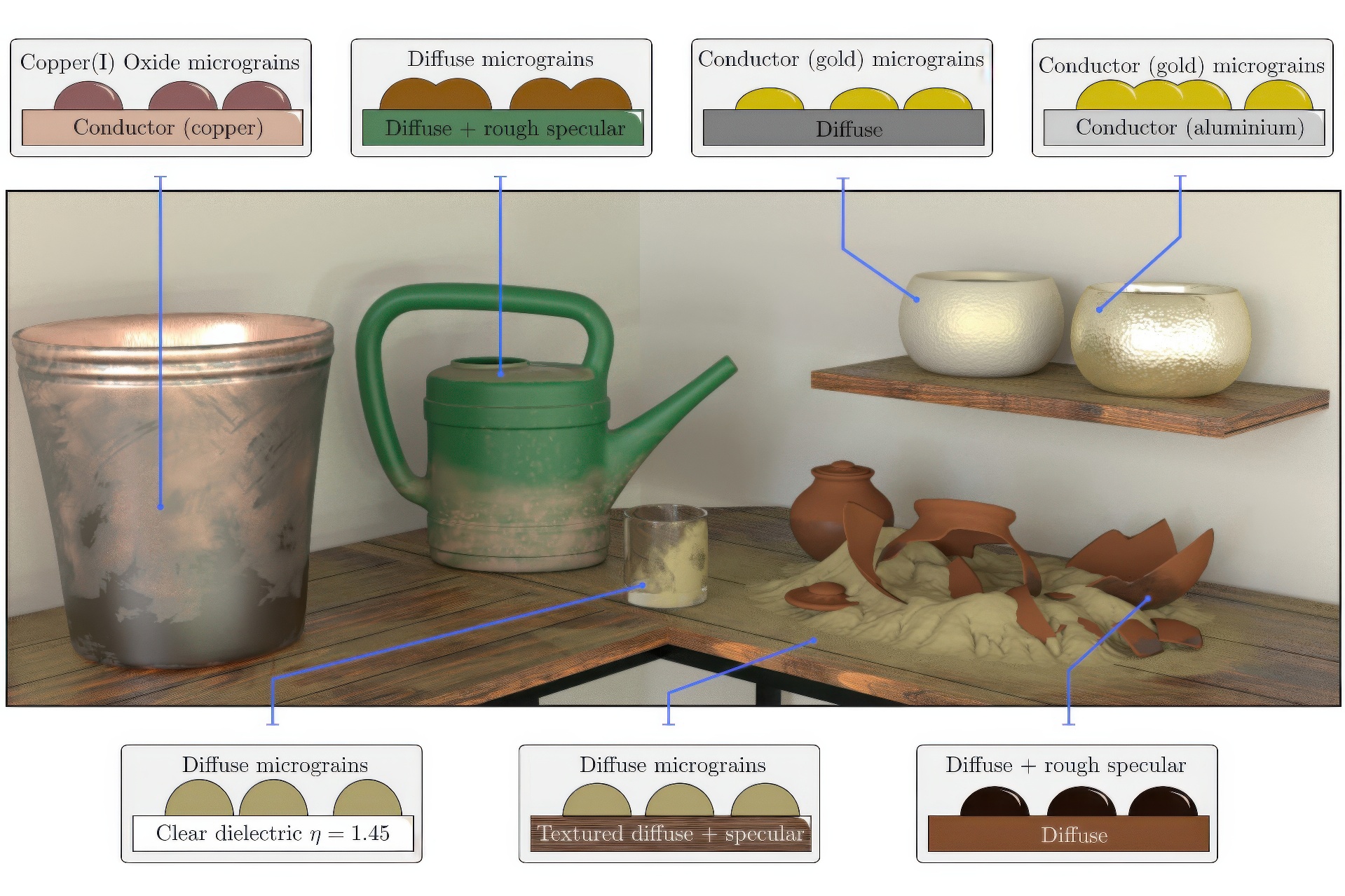
We introduce a new BSDF model for the rendering of porous layers, as found on surfaces covered by dust, rust, dirt, or sprayed paint. Our approach is based on a distribution of elliptical opaque micrograins, extending the Trowbridge-Reitz (GGX) distribution [Trowbridge1975,Walter2007] to handle pores (i.e., spaces between micrograins). We use distance field statistics to derive the corresponding Normal Distribution Function (NDF) and Geometric Attenuation Factor (GAF), as well as a view- and light-dependent filling factor to blend between the porous and base layers. All the derived terms show excellent agreement when compared against numerical simulations. Our approach has several advantages compared to previous work [Merillou2000,Wang2022,dEon2023]. First, it decouples structural and reflectance parameters, leading to an analytical single-scattering formula regardless of the choice of micrograin reflectance. Second, we show that the classical texture maps (albedo, roughness, etc) used for spatially-varying material parameters are easily retargeted to work with our model. Finally, the BRDF parameters of our model behave linearly, granting direct multi-scale rendering using classical mip mapping.
References:
[1]
M. Ashikhmin, S. Premoze, and P. Shirley. 2000. A microfacet-based BRDF generator. In Proceedings of the 27th Annual Conference on Computer Graphics and Interactive Techniques, SIGGRAPH 2000, New Orleans, LA, USA, July 23-28, 2000. ACM, 65–74.
[2]
A. Atanasov, V. Koylazov, R. Dimov, and A. Wilkie. 2022. Microsurface Transformations. Computer Graphics Forum 41, 4 (2022), 105–116. https://doi.org/10.1111/cgf.14590 arXiv:https://onlinelibrary.wiley.com/doi/pdf/10.1111/cgf.14590
[3]
P. Barla, R. Pacanowski, and P. Vangorp. 2018. A Composite BRDF Model for Hazy Gloss. Computer Graphics Forum 37, 4 (2018), 55–66. https://doi.org/10.1111/cgf.13475 arXiv:https://onlinelibrary.wiley.com/doi/pdf/10.1111/cgf.13475
[4]
Benedikt Bitterli and Eugene d’Eon. 2022. A Position-Free Path Integral for Homogeneous Slabs and Multiple Scattering on Smith Microfacets. Computer Graphics Forum 41, 4 (2022), 93–104. https://doi.org/10.1111/cgf.14589 arXiv:https://onlinelibrary.wiley.com/doi/pdf/10.1111/cgf.14589
[5]
R. L. Cook and K. E. Torrance. 1982. A Reflectance Model for Computer Graphics. In ACM SIGGRAPH proceedings.
[6]
Herbert A David and Haikady N Nagaraja. 2004. Order statistics. John Wiley & Sons.
[7]
Eugene d’Eon. 2021. An analytic BRDF for materials with spherical Lambertian scatterers. Computer Graphics Forum 40, 4 (2021), 153–161. https://doi.org/10.1111/cgf.14348 arXiv:https://onlinelibrary.wiley.com/doi/pdf/10.1111/cgf.14348
[8]
Eugene d’Eon, Benedikt Bitterli, Andrea Weidlich, and Tizian Zeltner. 2023. Microfacet theory for non-uniform heightfields. In SIGGRAPH 2023 Conference Papers (Los Angeles, CA, USA). Association for Computing Machinery, New York, NY, USA, 10 pages. https://doi.org/10.1145/3588432.3591486
[9]
Jonathan Dupuy, Eric Heitz, and Eugene d’Eon. 2016. Additional Progress towards the Unification of Microfacet and Microflake Theories. In Proceedings of the Eurographics Symposium on Rendering: Experimental Ideas & Implementations (Dublin, Ireland) (EGSR ’16). Eurographics Association, Goslar, DEU, 55–63.
[10]
Alejandro Conty Estevez and Christopher Kulla. 2017. Production Friendly Microfacet Sheen BRDF. ACM SIGGRAPH 2017 (2017).
[11]
Bruce Hapke. 2012. Theory of Reflectance and Emittance Spectroscopy (2 ed.). Cambridge University Press. https://doi.org/10.1017/CBO9781139025683
[12]
E. Heitz. 2014. Understanding the Masking-Shadowing Function in Microfacet-Based BRDFs. Journal of Computer Graphics Techniques 3, 2 (June 2014).
[13]
Eric Heitz. 2018. Sampling the GGX Distribution of Visible Normals. Journal of Computer Graphics Techniques (JCGT) 7, 4 (30 November 2018), 1–13. http://jcgt.org/published/0007/04/01/
[14]
Eric Heitz and Jonathan Dupuy. 2015. Implementing a Simple Anisotropic Rough Diffuse Material with Stochastic Evaluation. Technical Report.
[15]
Eric Heitz, Johannes Hanika, Eugene d’Eon, and Carsten Dachsbacher. 2016. Multiple-Scattering Microfacet BSDFs with the Smith Model. ACM Trans. Graph. 35, 4, Article 58 (jul 2016), 14 pages. https://doi.org/10.1145/2897824.2925943
[16]
Wenzel Jakob, Sébastien Speierer, Nicolas Roussel, Merlin Nimier-David, Delio Vicini, Tizian Zeltner, Baptiste Nicolet, Miguel Crespo, Vincent Leroy, and Ziyi Zhang. 2022. Mitsuba 3 renderer. https://mitsuba-renderer.org.
[17]
Joo Ho Lee, Adrian Jarabo, Daniel S. Jeon, Diego Gutierrez, and Min H. Kim. 2018. Practical Multiple Scattering for Rough Surfaces. ACM Trans. Graph. 37, 6, Article 275 (dec 2018), 12 pages. https://doi.org/10.1145/3272127.3275016
[18]
S. Merillou, J.-M. Dischler, and D. Ghazanfarpour. 2000. A BRDF postprocess to integrate porosity on rendered surfaces. IEEE Transactions on Visualization and Computer Graphics 6, 4 (2000), 306–318. https://doi.org/10.1109/2945.895876
[19]
Thomas Müller, Marios Papas, Markus Gross, Wojciech Jarosz, and Jan Novák. 2016. Efficient Rendering of Heterogeneous Polydisperse Granular Media. ACM Transactions on Graphics (Proceedings of SIGGRAPH Asia) 35, 6 (Dec. 2016), 168:1–168:14. https://doi.org/10/f9cm65
[20]
M. Oren and S. K. Nayar. 1994. Generalization of Lambert’s Reflectance Model. In ACM SIGGRAPH proceedings.
[21]
B. Smith. 1967. Geometrical shadowing of a random rough surface. IEEE Transactions on Antennas and Propagation 15, 5 (September 1967), 668–671.
[22]
K. E. Torrance and E. M. Sparrow. 1967. Theory for Off-Specular Reflection From Roughened Surfaces*. J. Opt. Soc. Am. 57, 9 (Sep 1967), 1105–1114. https://doi.org/10.1364/JOSA.57.001105
[23]
T. S. Trowbridge and K. P. Reitz. 1975. Average irregularity representation of a rough surface for ray reflection. J. Opt. Soc. Am. 65, 5 (May 1975), 531–536. https://doi.org/10.1364/JOSA.65.000531
[24]
B. Walter, S. R. Marschner, H. Li, and K. E. Torrance. 2007. Microfacet Models for Refraction Through Rough Surfaces. In Computer Graphics Forum, EGSR proceedings.
[25]
Beibei Wang, Wenhua Jin, Miloš Hašan, and Ling-Qi Yan. 2022. SpongeCake: A Layered Microflake Surface Appearance Model. ACM Trans. Graph. 42, 1, Article 8 (sep 2022), 16 pages. https://doi.org/10.1145/3546940
[26]
Feng Xie and Pat Hanrahan. 2018. Multiple Scattering from Distributions of Specular V-Grooves. ACM Trans. Graph. 37, 6, Article 276 (dec 2018), 14 pages. https://doi.org/10.1145/3272127.3275078
[27]
Tizian Zeltner, Brent Burley, and Matt Jen-Yuan Chiang. 2022. Practical Multiple-Scattering Sheen Using Linearly Transformed Cosines. In ACM SIGGRAPH 2022 Talks (Vancouver, BC, Canada) (SIGGRAPH ’22). Association for Computing Machinery, New York, NY, USA, Article 7, 2 pages. https://doi.org/10.1145/3532836.3536240