
“A material point method for nonlinearly magnetized materials” by Sun, Ni, Zhu, Wang and Chen
Conference:
Type(s):
Title:
- A material point method for nonlinearly magnetized materials
Session/Category Title:
- Physically-based Simulation and Motion Control
Presenter(s)/Author(s):
Abstract:
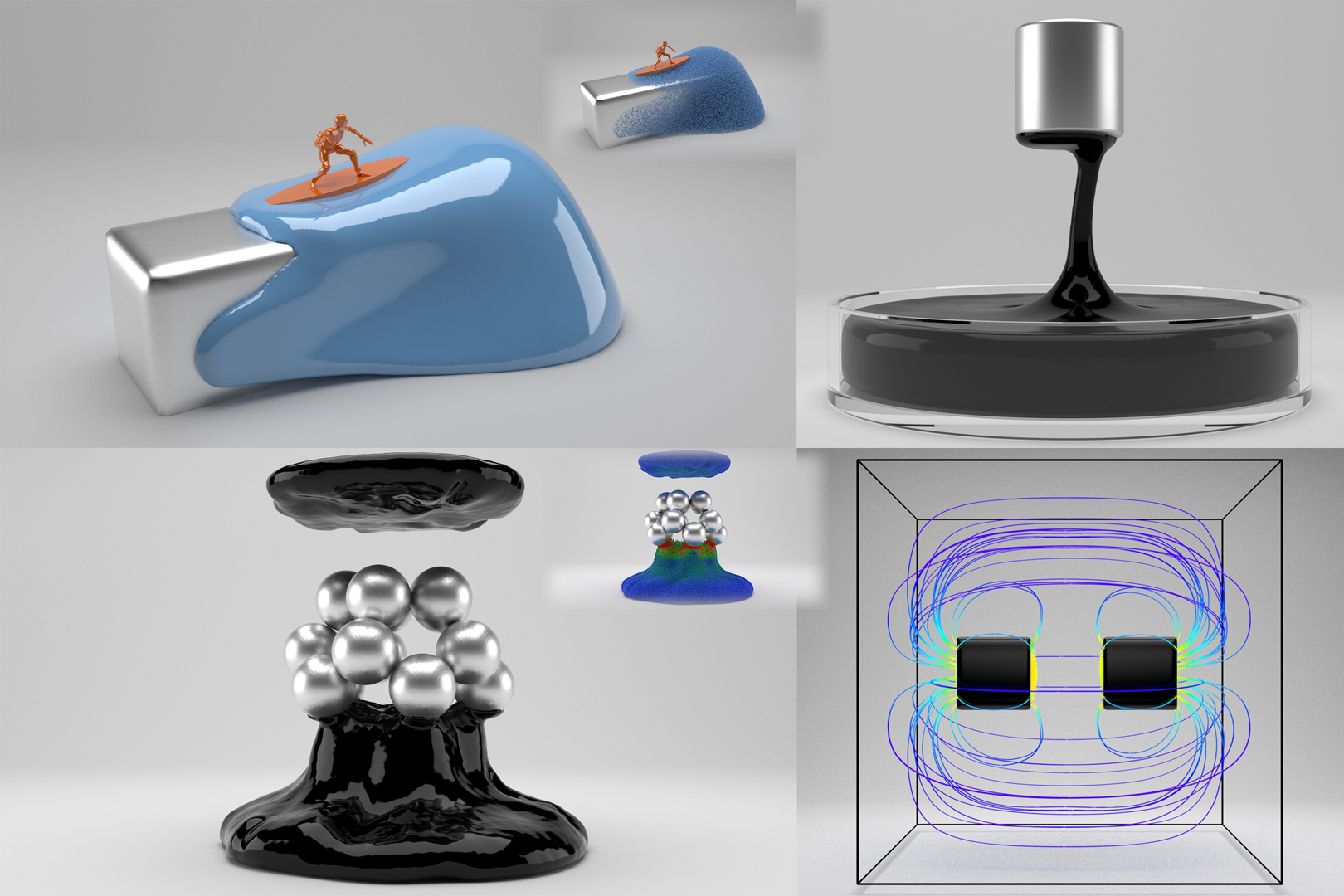
We propose a novel numerical scheme to simulate interactions between a magnetic field and nonlinearly magnetized objects immersed in it. Under our nonlinear magnetization framework, the strength of magnetic forces is effectively saturated to produce stable simulations without requiring any parameter tuning. The mathematical model of our approach is based upon Langevin’s nonlinear theory of paramagnetism, which bridges microscopic structures and macroscopic equations after a statistical derivation. We devise a hybrid Eulerian-Lagrangian numerical approach to simulating this strongly nonlinear process by leveraging the discrete material points to transfer both material properties and the number density of magnetic micro-particles in the simulation domain. The magnetic equations can then be built and solved efficiently on a background Cartesian grid, followed by a finite difference method to incorporate magnetic forces. The multi-scale coupling can be processed naturally by employing the established particle-grid interpolation schemes in a conventional MLS-MPM framework. We demonstrate the efficacy of our approach with a host of simulation examples governed by magnetic-mechanical coupling effects, ranging from magnetic deformable bodies to magnetic viscous fluids with nonlinear elastic constitutive laws.
References:
1. Rick Beatson and Leslie Greengard. 1997. A short course on fast multipole methods. Oxford University Press, Oxfordshire, England, UK, 1–37.
2. J. U. Brackbill and H. M. Ruppel. 1986. FLIP: A Method for Adaptively Zoned, Particle-in-Cell Calculations of Fluid Flows in Two Dimensions. J. Comput. Phys. 65, 2 (Aug. 1986), 314–343.
3. J. M. D. Coey. 2010. Magnetism and Magnetic Materials. Cambridge University Press, Cambridgeshire, England, UK.
4. Gilles Daviet and Florence Bertails-Descoubes. 2016. A Semi-Implicit Material Point Method for the Continuum Simulation of Granular Materials. ACM Trans. Graph. 35, 4, Article 102 (July 2016), 13 pages.
5. Albert Einstein and Jakob Laub. 1908. Über die im elektromagnetischen Felde auf ruhende Körper ausgeübten ponderomotorischen Kräfte. Annalen der Physik 331, 8 (1908), 541–550.
6. Richard P. Feynman, Robert B. Leighton, and Matthew Sands. 2011. The Feynman Lectures on Physics (the new millennium ed.). Vol. 2. Basic Books, New York, NY, USA.
7. Chuyuan Fu, Qi Guo, Theodore Gast, Chenfanfu Jiang, and Joseph Teran. 2017. A Polynomial Particle-in-Cell Method. ACM Trans. Graph. 36, 6, Article 222 (Nov. 2017), 12 pages.
8. Ming Gao, Andre Pradhana, Xuchen Han, Qi Guo, Grant Kot, Eftychios Sifakis, and Chenfanfu Jiang. 2018. Animating Fluid Sediment Mixture in Particle-Laden Flows. ACM Trans. Graph. 37, 4, Article 149 (July 2018), 11 pages.
9. Ali Ghaffari, Seyed Hassan Hashemabadi, and Mansour Bazmi. 2015. CFD simulation of equilibrium shape and coalescence of ferrofluid droplets subjected to uniform magnetic field. Colloids and Surfaces A: Physicochemical and Engineering Aspects 481 (2015), 186–198.
10. Francis H. Harlow and J. Eddie Welch. 1965. Numerical calculation of time-dependent viscous incompressible flow of fluid with free surface. The Physics of Fluids 8, 12 (1965), 2182–2189.
11. Yuanming Hu, Yu Fang, Ziheng Ge, Ziyin Qu, Yixin Zhu, Andre Pradhana, and Chenfanfu Jiang. 2018. A Moving Least Squares Material Point Method with Displacement Discontinuity and Two-Way Rigid Body Coupling. ACM Trans. Graph. 37, 4, Article 150 (July 2018), 14 pages.
12. Libo Huang, Torsten Hädrich, and Dominik L. Michels. 2019. On the Accurate Large-scale Simulation of Ferrofluids. ACM Trans. Graph. 38, 4, Article 93 (July 2019), 15 pages.
13. Libo Huang and Dominik L. Michels. 2020. Surface-Only Ferrofluids. ACM Trans. Graph. 39, 6, Article 174 (Nov. 2020), 17 pages.
14. David A. B. Hyde, Steven W. Gagniere, Alan Marquez-Razon, and Joseph Teran. 2020. An Implicit Updated Lagrangian Formulation for Liquids with Large Surface Energy. ACM Trans. Graph. 39, 6, Article 183 (Nov. 2020), 13 pages.
15. Tomokazu Ishikawa, Yonghao Yue, Kei Iwasaki, Yoshinori Dobashi, and Tomoyuki Nishita. 2013. Visual Simulation of Magnetic Fluid Using a Procedural Approach for Spikes Shape. In Computer Vision, Imaging and Computer Graphics. Theory and Application. Springer Berlin Heidelberg, Berlin, Heidelberg, 112–126.
16. Chenfanfu Jiang, Theodore Gast, and Joseph Teran. 2017. Anisotropic Elastoplasticity for Cloth, Knit and Hair Frictional Contact. ACM Trans. Graph. 36, 4, Article 152 (July 2017), 14 pages.
17. Chenfanfu Jiang, Craig Schroeder, Andrew Selle, Joseph Teran, and Alexey Stomakhin. 2015. The Affine Particle-in-Cell Method. ACM Trans. Graph. 34, 4, Article 51 (July 2015), 10 pages.
18. Chenfanfu Jiang, Craig Schroeder, Joseph Teran, Alexey Stomakhin, and Andrew Selle. 2016. The Material Point Method for Simulating Continuum Materials. In ACM SIGGRAPH 2016 Courses (Anaheim, California) (SIGGRAPH ’16). Association for Computing Machinery, New York, NY, USA, Article 24, 52 pages.
19. Seung-wook Kim and JungHyun Han. 2020. Simulation of Arbitrarily-shaped Magnetic Objects. Computer Graphics Forum 39, 7 (2020), 119–130.
20. Seung-Wook Kim, Sun Young Park, and Junghyun Han. 2018. Magnetization Dynamics for Magnetic Object Interactions. ACM Trans. Graph. 37, 4, Article 121 (July 2018), 13 pages.
21. Gergely Klár, Theodore Gast, Andre Pradhana, Chuyuan Fu, Craig Schroeder, Chenfanfu Jiang, and Joseph Teran. 2016. Drucker-Prager Elastoplasticity for Sand Animation. ACM Trans. Graph. 35, 4, Article 103 (July 2016), 12 pages.
22. Jing Liu, Yit Fatt Yap, and Nam-Trung Nguyen. 2011. Numerical study of the formation process of ferrofluid droplets. Physics of Fluids 23, 7 (2011), 072008.
23. Xingyu Ni, Bo Zhu, Bin Wang, and Baoquan Chen. 2020. A Level-Set Method for Magnetic Substance Simulation. ACM Trans. Graph. 39, 4, Article 29 (July 2020), 15 pages.
24. Curtis M. Oldenburg, Sharon E. Borglin, and George J. Moridis. 2000. Numerical simulation of ferrofluid flow for subsurface environmental engineering applications. Transport in Porous Media 38, 3 (2000), 319–344.
25. Daniel Ram, Theodore Gast, Chenfanfu Jiang, Craig Schroeder, Alexey Stomakhin, Joseph Teran, and Pirouz Kavehpour. 2015. A Material Point Method for Viscoelastic Fluids, Foams and Sponges. In Proceedings of the 14th ACM SIGGRAPH / Eurographics Symposium on Computer Animation (Los Angeles, California) (SCA ’15). Association for Computing Machinery, New York, NY, USA, 157–163.
26. Avi Robinson-Mosher, Tamar Shinar, Jon Gretarsson, Jonathan Su, and Ronald Fedkiw. 2008. Two-Way Coupling of Fluids to Rigid and Deformable Solids and Shells. ACM Trans. Graph. 27, 3 (Aug. 2008), 1–9.
27. Ronald E. Rosensweig. 1985. Ferrohydrodynamics. Cambridge University Press, Cambridgeshire, England, UK.
28. Rajsekhar Setaluri, Mridul Aanjaneya, Sean Bauer, and Eftychios Sifakis. 2014. SPGrid: A Sparse Paged Grid Structure Applied to Adaptive Smoke Simulation. ACM Trans. Graph. 33, 6, Article 205 (Nov. 2014), 12 pages.
29. Dongxiao Shi, Qincheng Bi, and Rongqi Zhou. 2014. Numerical simulation of a falling ferrofluid droplet in a uniform magnetic field by the VOSET method. Numerical Heat Transfer, Part A: Applications 66, 2 (2014), 144–164.
30. Eftychios Sifakis and Jernej Barbic. 2012. FEM Simulation of 3D Deformable Solids: A Practitioner’s Guide to Theory, Discretization and Model Reduction. In ACM SIGGRAPH 2012 Courses (Los Angeles, California) (SIGGRAPH ’12). Association for Computing Machinery, New York, NY, USA, Article 20, 50 pages.
31. Michael Steffen, Robert M. Kirby, and Martin Berzins. 2008. Analysis and reduction of quadrature errors in the material point method (MPM). Internat. J. Numer. Methods Engrg. 76, 6 (2008), 922–948.
32. Alexey Stomakhin, Craig Schroeder, Lawrence Chai, Joseph Teran, and Andrew Selle. 2013. A Material Point Method for Snow Simulation. ACM Trans. Graph. 32, 4, Article 102 (July 2013), 10 pages.
33. Alexey Stomakhin, Craig Schroeder, Chenfanfu Jiang, Lawrence Chai, Joseph Teran, and Andrew Selle. 2014. Augmented MPM for Phase-Change and Varied Materials. ACM Trans. Graph. 33, 4, Article 138 (July 2014), 11 pages.
34. Deborah Sulsky, Shi-Jian Zhou, and Howard L. Schreyer. 1995. Application of a particle-in-cell method to solid mechanics. Computer Physics Communications 87, 1-2 (May 1995), 236–252.
35. Andre Pradhana Tampubolon, Theodore Gast, Gergely Klár, Chuyuan Fu, Joseph Teran, Chenfanfu Jiang, and Ken Museth. 2017. Multi-Species Simulation of Porous Sand and Water Mixtures. ACM Trans. Graph. 36, 4, Article 105 (July 2017), 11 pages.
36. Bernhard Thomaszewski, Andreas Gumann, Simon Pabst, and Wolfgang Straßer. 2008. Magnets in Motion. ACM Trans. Graph. 27, 5, Article 162 (Dec. 2008), 9 pages.
37. Joel Wretborn, Rickard Armiento, and Ken Museth. 2017. Animation of Crack Propagation by Means of an Extended Multi-Body Solver for the Material Point Method. Comput. Graph. 69, C (Dec. 2017), 131–139.
38. Yonghao Yue, Breannan Smith, Christopher Batty, Changxi Zheng, and Eitan Grinspun. 2015. Continuum Foam: A Material Point Method for Shear-Dependent Flows. ACM Trans. Graph. 34, 5, Article 160 (Nov. 2015), 20 pages.
39. Gui-Ping Zhu, Nam-Trung Nguyen, R. V. Ramanujan, and Xiao-Yang Huang. 2011. Nonlinear Deformation of a Ferrofluid Droplet in a Uniform Magnetic Field. Langmuir 27, 24 (2011), 14834–14841.
40. Yongning Zhu and Robert Bridson. 2005. Animating Sand as a Fluid. ACM Trans. Graph. 24, 3 (July 2005), 965–972.



