“A framework for the experimental comparison of solar and skydome illumination” by Kider, Knowlton, Newlin, Li and Greenberg
Conference:
Type(s):
Title:
- A framework for the experimental comparison of solar and skydome illumination
Session/Category Title:
- Light In, Light Out
Presenter(s)/Author(s):
Abstract:
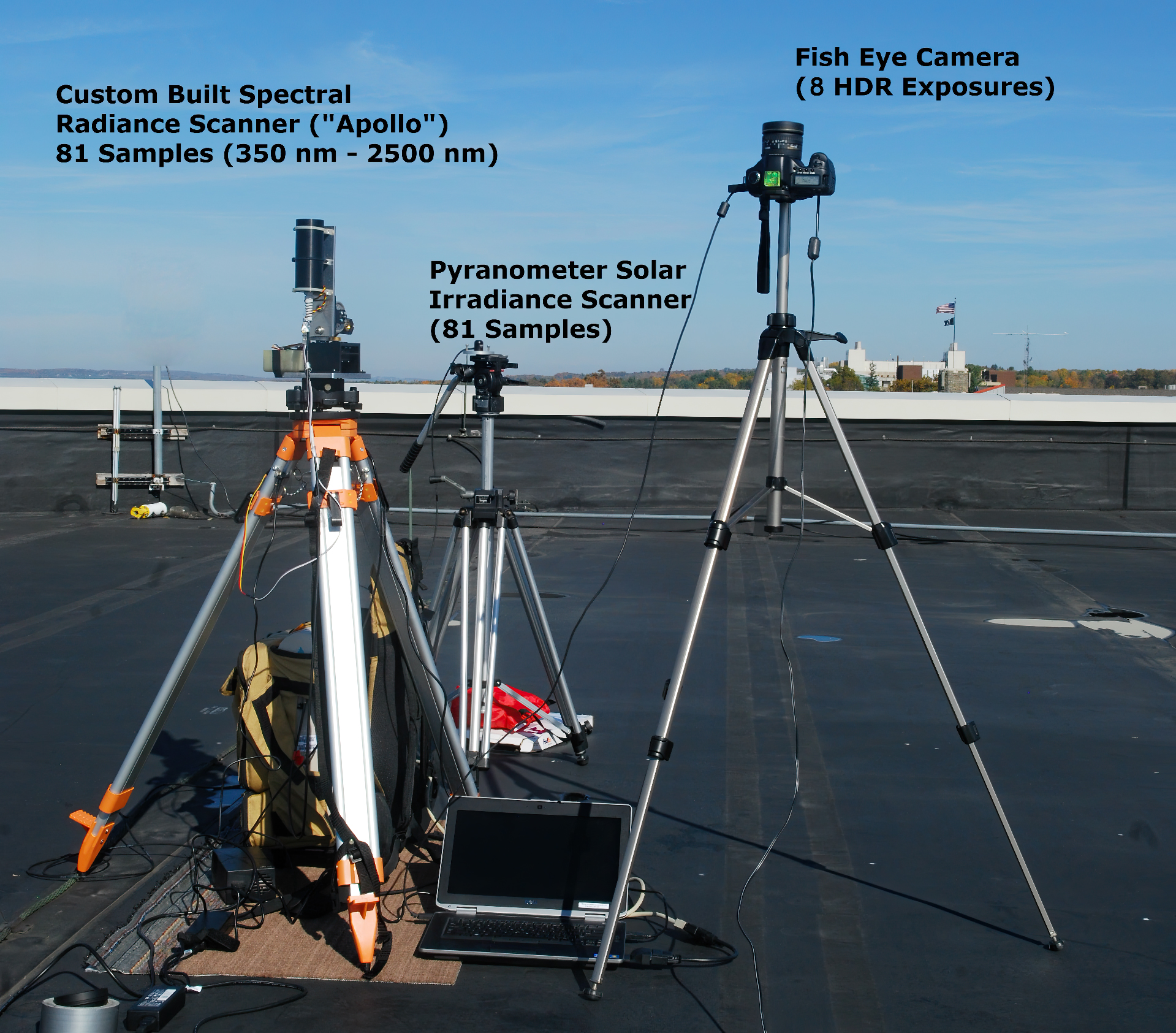
The illumination and appearance of the solar/skydome is critical for many applications in computer graphics, computer vision, and daylighting studies. Unfortunately, physically accurate measurements of this rapidly changing illumination source are difficult to achieve, but necessary for the development of accurate physically-based sky illumination models and comparison studies of existing simulation models.To obtain baseline data of this time-dependent anisotropic light source, we design a novel acquisition setup to simultaneously measure the comprehensive illumination properties. Our hardware design simultaneously acquires its spectral, spatial, and temporal information of the skydome. To achieve this goal, we use a custom built spectral radiance measurement scanner to measure the directional spectral radiance, a pyranometer to measure the irradiance of the entire hemisphere, and a camera to capture high-dynamic range imagery of the sky. The combination of these computer-controlled measurement devices provides a fast way to acquire accurate physical measurements of the solar/skydome. We use the results of our measurements to evaluate many of the strengths and weaknesses of several sun-sky simulation models. We also provide a measurement dataset of sky illumination data for various clear sky conditions and an interactive visualization tool for model comparison analysis available at http://www.graphics.cornell.edu/resources/clearsky/.
References:
1. Abbot, C., Aldrich, L., and Fund, S. I. H. 1916. The pyranometer–an instrument for measuring sky radiation. No. v. 66, nos. 1–18 in Smithsonian miscellaneous collections. Smithsonian institution.
2. Acharya, P., Anderson, G., Berk, A., Bernstein, L., Chetwynd, J., Hoke, M., and Lewis, P., 2003. Band model method for modeling atmospheric propagation at arbitrarily fine spectral resolution, May 22. US Patent App. 09/838,801.
3. Bruneton, E., and Neyret, F. 2008. Precomputed atmospheric scattering. Comput. Graph. Forum 27, 4 (June), 1079–1086. Special Issue: Proceedings of the 19th Eurographics Symposium on Rendering 2008.
4. CIE. 1994. Guide to Recommended Practice of Daylight Measurement. CIE technical report. CIE.
5. Darula, S., Kittler, R., and Road, D. 2002. Cie general sky standard defining luminance distributions. Moon, 11–13.
6. de Bary, E., and Eschelbach, G. 1974. The ratio of primary scattering to total scattering of sky radiance. Tellus 26, 6, 682–690.Cross Ref
7. Debevec, P. 1998. Rendering synthetic objects into real scenes: Bridging traditional and image-based graphics with global illumination and high dynamic range photography. In Proceedings of the 25th Annual Conference on Computer Graphics and Interactive Techniques, ACM, New York, NY, USA, SIGGRAPH ’98, 189–198.
8. Diez-Mediavilla, M., de Miguel, A., and Bilbao, J. 2005. Measurement and comparison of diffuse solar irradiance models on inclined surfaces in valladolid (spain). Energy Conversion and Management 46, 1314, 2075–2092.
9. Elek, O., and Kmoch, P. 2010. Real-time spectral scattering in large-scale natural participating media. In SCCG ’10: Proceedings of the 26th Spring Conference on Computer Graphics, ACM, New York, NY, USA, H. Hauser and R. Klein, Eds., 77–84.
10. Grynberg, A. 1989. Validation of radiance. Tech. Rep. LBID-1575, July.
11. Gueymard, C. 1995. SMARTS, A Simple Model of the Atmospheric Radiative Transfer of Sun- shine: Algorithms and Performance Assessment. Florida Solar Energy Center Technical Reports FSEC-PF-270-95.
12. Haber, J., Magnor, M., and Seidel, H.-P. 2005. Physically-based simulation of twilight phenomena. ACM Trans. Graph. 24, 4 (Oct.), 1353–1373.
13. Hess, M., Koepke, P., and Schult, I. 1998. Optical Properties of Aerosols and Clouds: The Software Package OPAC. Bulletin of The American Meteorological Society 79, 831–844.Cross Ref
14. Hoffman, N., and Preetham, A. J. 2003. Rendering outdoor light scattering in real time. 337–352.
15. Hosek, L., and Wilkie, A. 2012. An analytic model for full spectral sky-dome radiance. ACM Trans. Graph. 31, 4 (July), 95:1–95:9.
16. Hosek, L., and Wilkie, A. 2013. Adding a solar-radiance function to the hosek-wilkie skylight model. IEEE Computer Graphics and Applications 33, 3, 44–52.
17. Inanici, M., and Galvin, J. 2004. Evaluation of high dynamic range photography as a luminance mapping technique.
18. Ineichen, P., Molineaux, B., and Perez, R. 1994. Sky luminance data validation: Comparison of seven models with four data banks. Solar Energy 52, 4, 337–346.Cross Ref
19. ISO, and CIE. 2004. Spatial Distribution of Daylight – CIE Standard General Sky. ISO 15469:2004 (E)/CIE S 011/E:2003. ISO/CIE.
20. Jakob, W., 2010. Mitsuba renderer. http://www.mitsuba-renderer.org.
21. Karayel, M., Navvab, M., Ne’eman, E., and Selkowitz, S. 1984. Zenith luminance and sky luminance distributions for daylighting calculations. Energy and Buildings 6, 3, 283–291.Cross Ref
22. Kneizys, F. X., Shettle, E. P., and Gallery, W. O. 1981. Atmospheric transmittance and radiance – The LOWTRAN 5 code. In Atmospheric transmission, vol. 277 of Society of Photo-Optical Instrumentation Engineers (SPIE), 116–124.
23. Littlefair, P. J. 1994. A comparison of sky luminance models with measured data from garston, united kingdom. Solar Energy 53, 4, 315–322.Cross Ref
24. Loutzenhiser, P., Manz, H., Felsmann, C., Strachan, P., Frank, T., and Maxwell, G. 2007. Empirical validation of models to compute solar irradiance on inclined surfaces for building energy simulation. Solar Energy 81, 2, 254–267.Cross Ref
25. Mayer, B., and Kylling, A. 2005. Technical note: The libradtran software package for radiative transfer calculations – description and examples of use. Atmospheric Chemistry and Physics 5, 7, 1855–1877.Cross Ref
26. Myers, D. R. 2013. Solar Radiation: Practical Modeling for Renewable Energy Applications (Energy and the Environment). Energy and the Environment. CRC Press.
27. Nishita, T., Sirai, T., Tadamura, K., and Nakamae, E. 1993. Display of the earth taking into account atmospheric scattering. In Proceedings of the 20th Annual Conference on Computer Graphics and Interactive Techniques, ACM, New York, NY, USA, SIGGRAPH ’93, 175–182.
28. Nishita, T., Dobashi, Y., Kaneda, K., and Yamashita, H. 1996. Display method of the sky color taking into account multiple scattering. In Proceedings of Pacific Graphics 1996, Pacific Graphics ’96, 117–132.
29. Noorian, A. M., Moradi, I., and Kamali, G. A. 2008. Evaluation of 12 models to estimate hourly diffuse irradiation on inclined surfaces. Renewable Energy 33, 6, 1406–1412.Cross Ref
30. Ochoa, C. E., Aries, M. B. C., and Hensen, J. L. M. 2011. State of the art in lighting simulation for building science: a literature review. Journal of Building Performance Simulation 5, 4 (May), 209–233.
31. Perez, R., Seals, R., and Michalsky, J. 1993. All-weather model for sky luminance distributionpreliminary configuration and validation. Solar Energy 50, 3, 235–245.Cross Ref
32. Preetham, A. J., Shirley, P., and Smits, B. 1999. A practical analytic model for daylight. In Proceedings of the 26th annual conference on Computer graphics and interactive techniques, ACM Press/Addison-Wesley Publishing Co., New York, NY, USA, SIGGRAPH ’99, 91–100.
33. Pust, N. J., and Shaw, J. A., 2007. All-sky polarization imaging.
34. Reinhard, E., Stark, M., Shirley, P., and Ferwerda, J. 2002. Photographic tone reproduction for digital images. In Proceedings of the 29th annual conference on Computer graphics and interactive techniques, ACM, New York, NY, USA, SIGGRAPH ’02, 267–276.
35. Ricchiazzi, P., Yang, S., Gautier, C., and Sowle, D. 1998. SBDART: A Research and Teaching Software Tool for Plane-Parallel Radiative Transfer in the Earth’s Atmosphere. Bulletin of the American Meteorological Society 79 (Oct.), 2101–2114.Cross Ref
36. Shirley, P., and Chiu, K. 1997. A low distortion map between disk and square. J. Graph. Tools 2, 3 (Dec.), 45–52.
37. Sloup, J. 2002. A survey of the modelling and rendering of the earth’s atmosphere. In Proceedings of the 18th spring conference on Computer graphics, ACM, New York, NY, USA, SCCG ’02, 141–150.
38. Soler, A., and Gopinathan, K. 2000. A study of zenith luminance on madrid cloudless skies. Solar Energy 69, 5, 403–411.Cross Ref
39. Stumpfel, J., Jones, A., Wenger, A., Tchou, C., Hawkins, T., and Debevec, P. 2004. Direct hdr capture of the sun and sky. In AFRIGRAPH, 145–149.
40. Stumpfel, J. 2004. Hdr lighting capture of the sky and sun. Master’s thesis, California Institute of Technology.
41. Tominaga, S., and Fukuda, T., 2007. Omnidirectional scene illuminant estimation using a multispectral imaging system.
42. Ward, G. J. 1994. The radiance lighting simulation and rendering system. In Proceedings of the 21st annual conference on Computer graphics and interactive techniques, ACM, New York, NY, USA, SIGGRAPH ’94, 459–472.
43. Wilkie, A., Ulbricht, C., Tobler, R. F., Zotti, G., and Purgathofer, W. 2004. An analytical model for skylight polarisation. In Proceedings of the Fifteenth Eurographics Conference on Rendering Techniques, Eurographics Association, Aire-la-Ville, Switzerland, Switzerland, EGSR’04, 387–397.
44. Zotti, G., Wilkie, A., and Purgathofer, W. 2007. A critical review of the preetham skylight model. In WSCG ‘ 2007 Short Communications Proceedings I, University of West Bohemia, V. Skala, Ed., 23–30.