“A Biologically Inspired Hair Aging Model” by Balbão and Walter
Conference:
Type(s):
Title:
- A Biologically Inspired Hair Aging Model
Session/Category Title:
- Cloth and Hair Simulation
Presenter(s)/Author(s):
Abstract:
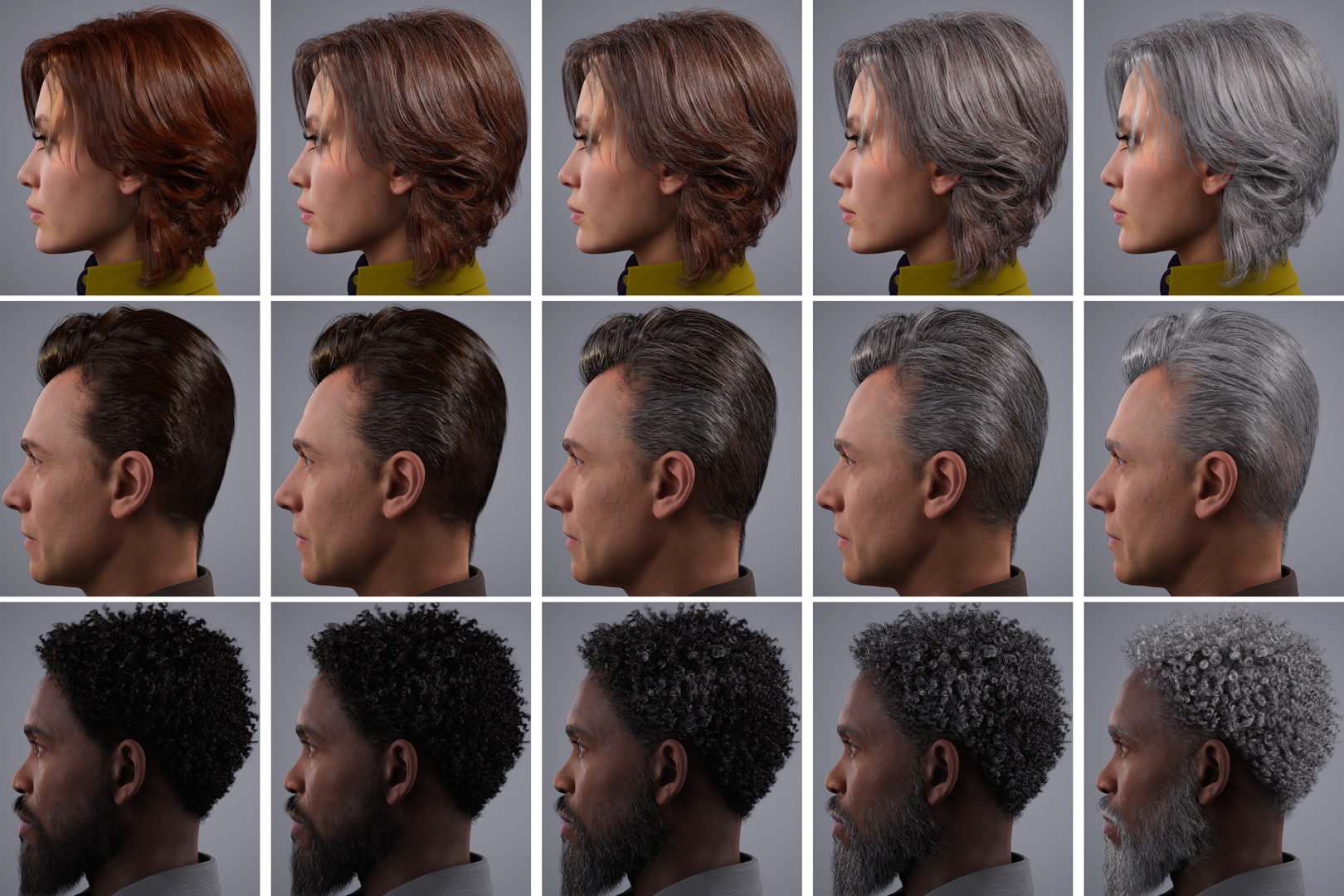
Hair rendering has been a focal point of attention in computer graphics for the last couple of decades. However, there have been few contributions to the modeling and rendering of the natural hair aging phenomenon. We present a new technique that simulates the process of hair graying and hair thinning on digital models due to aging. Given a 3D human head model with hair, we first compute a segmentation of the head using K-means since hair aging occurs at different rates in distinct head parts. Hair graying is simulated according to recent biological knowledge on aging factors for hairs, and hair thinning decreases hair diameters linearly with time. Our system is biologically inspired, supports facial hair, both genders and many ethnicities, and is compatible with different lengths of hair strands. Our real-time results resemble real-life hair aging, accomplished by simulating the stochastic nature of the process and the gradual decrease of melanin.
References:
1. Ersoy Acer et al. 2020. Clinical and epidemiological characteristics and associated factors of hair graying: a population-based, cross-sectional study in Turkey. Anais Brasileiros De Dermatologia 95, 4 (2020), 439–446.
2. Yuval Alaluf, Or Patashnik, and Daniel Cohen-Or. 2021. Only a matter of style: Age transformation using a style-based regression model. ACM Transactions on Graphics 40, 4 (2021), 1–12.
3. Yongtang Bao and Yue Qi. 2018. A survey of image-based techniques for hair modeling. IEEE Access 6 (2018), 18670–18684.
4. R. S. Barros and M. Walter. 2017. Synthesis of Human Skin Pigmentation Disorders. Computer Graphics Forum 36, 1 (2017), 330–344.
5. Blender Foundation. 2021. Unity 2021. https://www.blender.org
6. Wei Cao et al. 2021. Unraveling the Structure and Function of Melanin through Synthesis. Journal of the American Chemical Society 143, 7 (2021), 2622–2637.
7. Menglei Chai, Tianjia Shao, Hongzhi Wu, Yanlin Weng, and Kun Zhou. 2016. AutoHair: Fully Automatic Hair Modeling from a Single Image. ACM Transactions on Graphics 35, 4 (2016).
8. M J Chiang, B Bitterli, C Tappan, and B Burley. 2016. A Practical and Controllable Hair and Fur Model for Production Path Tracing. Computer Graphics Forum 35, 2 (2016), 275–283.
9. Eugene d’Eon, Guillaume Francois, Martin Hill, Joe Letteri, and Jean-Marie Aubry. 2011. An Energy-Conserving Hair Reflectance Model. Computer Graphics Forum 30, 4 (2011), 1181–1187.
10. Epic Games. 2021. MetaHuman Creator. https://metahuman.unrealengine.com/
11. Epic Games. 2022. Unreal Engine 5. https://www.unrealengine.com
12. Angel Fernandez-Flores, Marcela Saeb-Lima, and David S. Cassarino. 2019. Histopathology of aging of the hair follicle. Journal of Cutaneous Pathology 46, 7 (2019), 508–519.
13. Y. Gitlina et al. 2020. Practical Measurement and Reconstruction of Spectral Skin Reflectance. Computer Graphics Forum 39, 4 (2020), 75–89.
14. Marcel Grimmer, Raghavendra Ramachandra, and Christoph Busch. 2021. Deep face age progression: A survey. IEEE Access 9 (2021), 83376–83393.
15. Liwen Hu, Chongyang Ma, Linjie Luo, Li-Yi Wei, and Hao Li. 2014. Capturing Braided Hairstyles. ACM Transactions on Graphics 33, 6 (2014), 225:1–225:9.
16. J A Iglesias-Guitian, C Aliaga, A Jarabo, and D Gutierrez. 2015. A biophysically-based model of the optical properties of skin aging. In Computer Graphics Forum, Vol. 34. 45–55.
17. Erik Sven Vasconcelos Jansson, Matthäus G. Chajdas, Jason Lacroix, and Ingemar Ragnemalm. 2019. Real-Time Hybrid Hair Rendering. In Eurographics Symposium on Rendering – DL-only and Industry Track, Tamy Boubekeur and Pradeep Sen (Eds.). The Eurographics Association.
18. Seong Jin Jo et al. 2012. Hair graying pattern depends on gender, onset age and smoking habits. Acta dermato-venereologica 92, 2 (2012), 160–161.
19. Hyeong-Seok Ko, Kwang-Jin Choi, Min Gyu Choi, Seyoon Tak, Byoungwon Choe, and Oh-Young Song. 2003. Research Problems for Creating Digital Actors. In Eurographics (State of the Art Reports).
20. Marc A. LeBeau, Madeline A. Montgomery, and Jason D. Brewer. 2011. The role of variations in growth rate and sample collection on interpreting results of segmental analyses of hair. Forensic Science International 210, 1 (2011), 110–116.
21. M Lee, D Hyde, M Bao, and R Fedkiw. 2018. A skinned tetrahedral mesh for hair animation and hair-water interaction. IEEE TVCG 25, 3 (2018), 1449–1459.
22. Pengbo Li and Paul G Kry. 2014. Multi-layer skin simulation with adaptive constraints. In Proceedings of the Seventh International Conference on Motion in Games. 171–176.
23. Stephen Lombardi, Tomas Simon, Gabriel Schwartz, Michael Zollhoefer, Yaser Sheikh, and Jason Saragih. 2021. Mixture of Volumetric Primitives for Efficient Neural Rendering. ACM Transactions on Graphics 40, 4 (2021).
24. Nadia Magnenat-Thalmann. 2004. Photorealistic hair modeling, animation, and rendering. In ACM SIGGRAPH 2004 Course Notes.
25. Elaine N. Marieb. 2019. Essentials of Human Anatomy & Physiology, Global Edition. Pearson.
26. Stephen R Marschner et al. 2003. Light scattering from human hair fibers. ACM Transactions on Graphics 22, 3 (2003), 780–791.
27. Koki Nagano et al. 2015. Skin microstructure deformation with displacement map convolution. ACM Transactions on Graphics 34, 4 (2015), 109–1.
28. Kyle Olszewski, Duygu Ceylan, Jun Xing, Jose Echevarria, Zhili Chen, Weikai Chen, and Hao Li. 2020. Intuitive, Interactive Beard and Hair Synthesis With Generative Models. In Proceedings of the IEEE/CVF Conference on Computer Vision and Pattern Recognition (CVPR).
29. James DB O’Sullivan, Carina Nicu, Martin Picard, Jérémy Chéret, Barbara Bedogni, Desmond J Tobin, and Ralf Paus. 2021. The biology of human hair greying. Biological Reviews 96, 1 (2021), 107–128.
30. S. Panhard et al. 2012. Greying of the human hair: a worldwide survey, revisiting the ’50’ rule of thumb. British Journal of Dermatology 167, 4 (2012), 865–873.
31. Lena Petrovic, Mark Henne, and John Anderson. 2005. Volumetric methods for simulation and rendering of hair. Pixar Animation Studios 2, 4 (2005).
32. Ewelina Pośpiech et al. 2020. Exploring the possibility of predicting human head hair greying from DNA using whole-exome and targeted NGS data. BMC genomics 21, 1 (2020), 1–18.
33. M. Richena, M. Silveira, C.A. Rezende, and I. Joekes. 2014. Yellowing and bleaching of grey hair caused by photo and thermal degradation. Journal of Photochemistry and Photobiology B: Biology 138 (2014), 172–181.
34. Ayelet M Rosenberg et al. 2021. Quantitative mapping of human hair greying and reversal in relation to life stress. eLife 10 (June 2021), e67437.
35. G Ryder and AM Day. 2005. Survey of Techniques for Rendering Real-Time Virtual Humans. Computer Graphics Forum 24, 2 (2005), 203–215.
36. Shunsuke Saito, Liwen Hu, Chongyang Ma, Hikaru Ibayashi, Linjie Luo, and Hao Li. 2018. 3D hair synthesis using volumetric variational autoencoders. ACM Transactions on Graphics 37, 6 (2018), 1–12.
37. D. J. Tobin. 2008. Human hair pigmentation – biological aspects. International Journal of Cosmetic Science 30, 4 (2008), 233–257.
38. Diego V. Volkmann and Marcelo Walter. 2020. A Practical Male Hair Aging Model. In Eurographics 2020 – Short Papers, Alexander Wilkie and Francesco Banterle (Eds.).
39. Lingyu Wei, Liwen Hu, Vladimir Kim, Ersin Yumer, and Hao Li. 2018. Real-time hair rendering using sequential adversarial networks. In Proceedings of the European Conference on Computer Vision (ECCV). 99–116.
40. Kui Wu and Cem Yuksel. 2016. Real-time hair mesh simulation. In Proceedings of the 20th ACM SIGGRAPH Symposium on Interactive 3D Graphics and Games. 59–64.
41. Jun Xing, Koki Nagano, Weikai Chen, Haotian Xu, Li-yi Wei, Yajie Zhao, Jingwan Lu, Byungmoon Kim, and Hao Li. 2019. HairBrush for Immersive Data-Driven Hair Modeling. In Proceedings of the 32nd Annual ACM Symposium on User Interface Software and Technology (UIST ’19). 263–279.
42. Xiaoxiong Xing et al. 2012. Real-Time Rendering of Animated Hair under Dynamic, Low-Frequency Environmental Lighting. In Proc. 11th SIGGRAPH VRCAI. 43–46.
43. Lingchen Yang, Zefeng Shi, Youyi Zheng, and Kun Zhou. 2019a. Dynamic hair modeling from monocular videos using deep neural networks. ACM Transactions on Graphics 38, 6 (2019), 1–12.
44. Lingchen Yang, Zefeng Shi, Youyi Zheng, and Kun Zhou. 2019b. Dynamic Hair Modeling from Monocular Videos Using Deep Neural Networks. ACM Trans. Graph. 38, 6, Article 235 (nov 2019), 12 pages.
45. Xuan Yu et al. 2012. A Framework for Rendering Complex Scattering Effects on Hair. In Proceedings of the ACM SIGGRAPH I3D. 111–118.
46. Cem Yuksel and John Keyser. 2008. Deep Opacity Maps. Computer Graphics Forum 27, 2 (2008), 675–680.
47. Cem Yuksel and Sarah Tariq. 2010. Advanced Techniques in Real-Time Hair Rendering and Simulation. In ACM SIGGRAPH 2010 Courses (SIGGRAPH ’10).
48. Yi Zhou et al. 2018. Hairnet: Single-view hair reconstruction using convolutional neural networks. In Proceedings of ECCCV. 235–251.
49. Arno Zinke, Cem Yuksel, Andreas Weber, and John Keyser. 2008. Dual Scattering Approximation for Fast Multiple Scattering in Hair. ACM Transactions on Graphics 27, 3 (2008), 1–10.